Isabella Rinaldi had spent five years searching for the son who vanished outside her gate, until grief hardened into elegance, control, and a life that looked intact from far away. Then, on a rainy Roman sidewalk, one frightened boy collided with her white suit — and the small crescent on his wrist turned a moment of cruelty into the beginning of her ruin, her repentance, and her son’s return.
Five years had passed since Isabella Rinaldi lost her son.
In the beginning, people called her brave.
They said it softly at fundraisers, at memorial dinners, in private hospital waiting rooms where her hands shook too much to hold a cup. They said it when she stood in front of cameras asking for information about Lorenzo, when she financed search teams, hired investigators, printed posters, paid for private security reviews, and chased every rumor the way drowning people chase air.
But courage, when it has nowhere to go, does not stay courage forever.
Sometimes it calcifies.
By the fifth year, Isabella had become something colder than grief and more polished than peace. In Milan’s most elegant circles, she was still beautiful, still impeccably dressed, still respected. She chaired meetings. Signed contracts. Sat on charity boards. She moved through rooms with the control of a woman who had learned that if she kept every edge of her life sharp enough, no one would notice the hollow at the center.
People called her disciplined now.
They never called her warm.
Lorenzo had disappeared at four years old outside the gates of their family home. No ransom. No witnesses. No useful clue. The police found nothing solid enough to hold. The city moved on. Isabella never did.
She spent millions trying to reverse the silence.
Nothing came back.
Until the afternoon in Rome when she shoved a child into a puddle.
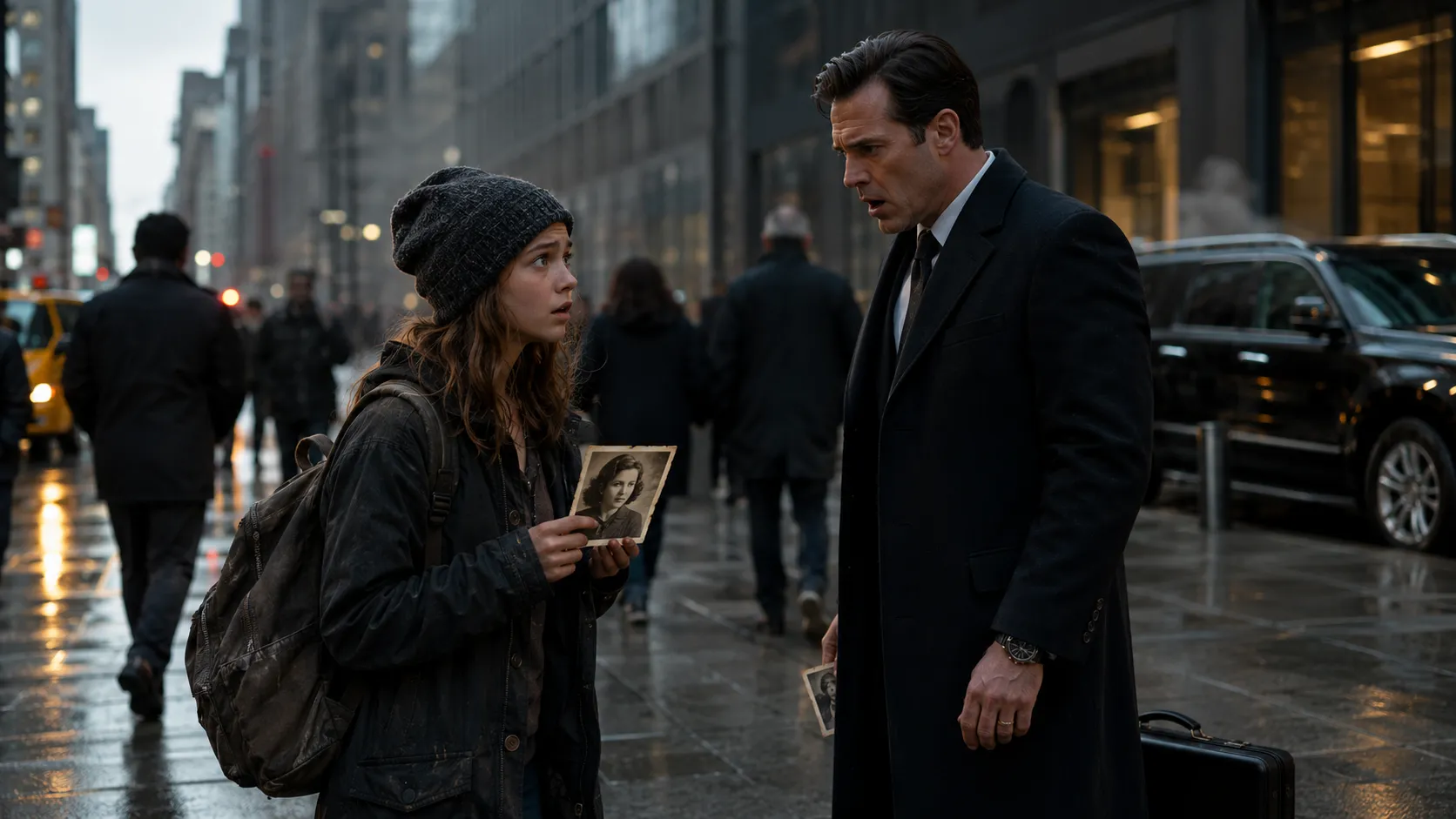
It was raining lightly when her Rolls-Royce stopped in front of Il Cristallo, an exclusive restaurant where executives, celebrities, and men with expensive watches came to reassure one another that success had taste. Isabella stepped out in a white suit so perfect it seemed almost hostile to weather. The pavement gleamed darkly. Umbrellas flashed past. Phones glowed in hands already too busy to notice suffering unless it interrupted them.
That was when the boy came running.
He couldn’t have been older than nine. He was thin, soaked through, and clutching a greasy paper bag full of what looked like leftovers. His clothes were too large in some places, too small in others, the unmistakable uniform of children who grow wherever the world happens to leave them.
He slipped.
Crashing straight into her.
Dirty water splashed across the front of her white skirt.
A murmur moved through the sidewalk.
Two women turned.
Someone lifted a phone.
Isabella looked down and, in that one terrible second, something vicious broke loose inside her.
“Watch where you’re going,” she snapped.
The boy stepped back at once.
“I’m sorry, ma’am,” he stammered. “I just wanted the food. I didn’t mean—”
“That suit is worth more than your life,” she said sharply, not caring who heard.
People definitely heard that.
More phones came out.
More faces turned.
The boy looked stunned, but not indignant. That almost made it worse. Children like him had already learned too well how to take blame before it fully landed.
Then Isabella shoved him.
Not hard enough to injure him badly.
Hard enough to send him backward into a puddle and let the whole street understand exactly what kind of woman she had become.
He landed in the water with the paper bag bursting open beside him.
For a beat, no one moved.
Then Isabella saw it.
On the boy’s left wrist, half-hidden beneath mud and rain, was a crescent-shaped birthmark.
Small.
Dark.
Perfectly placed.
Exactly like Lorenzo’s.
The street tipped.
For one suspended second, the noise of Rome, the cameras, the restaurant, the traffic — everything disappeared behind the hard, sick thunder of memory.
Lorenzo in summer pajamas.
Lorenzo reaching for juice with both hands.
Lorenzo asleep with one wrist bent under his cheek and that little crescent against the pillow.
The same mark she used to kiss and call his moon.
The boy looked up at her.
He wasn’t crying.
He wasn’t angry.
He just looked quietly broken.
“I’m sorry, ma’am,” he whispered again. “I only eat what people leave behind.”
Then he got up and walked away into the rain.
Isabella remained where she was, her hands trembling so visibly that even the driver saw it when he rushed around the car to ask if she was all right.
She wasn’t.
That night, she did not sleep.
She lay awake replaying the collision in endless loops: the wet hair, the frightened voice, the way the child had apologized to her as if her cruelty were merely another inconvenience to work around. But more than anything, she saw the birthmark.
And under it, something else.
Recognition.
Not certainty.
Not reason.
Something older and more dangerous.
By dawn she could not bear uncertainty another minute. She called the only man she trusted fully, her longtime associate Davide Conti.
“Find the boy from yesterday,” she said. “The one in the videos.”
Davide asked no questions.
Two days later, he came back with a folder so thin it frightened her.
The boy called himself Elia.
No birth certificate.
No school records.
No pediatric file.
No registered guardian.
In the San Lorenzo district, street vendors and shelter volunteers said he was often seen with an older homeless man named Vittorio, who seemed to watch over him like a grandfather without paperwork.
That evening Isabella did something she had not done in years: she went somewhere without a driver, a publicist, or a plan.
She tied back her hair, wore an ordinary coat, left her jewelry at home, and crossed Rome as dusk settled into wet gray. She found the place through Davide’s directions — a strip of crumbling wall, cardboard shelter, blankets layered against concrete.
Elia was asleep there, curled tightly as if his body had learned to occupy as little room as possible. Beside him sat an elderly man with a gray beard and a face hollowed by the long arithmetic of hardship. He looked up when Isabella approached but did not flinch.
“You’re looking for the boy?” he asked.
She nodded, unable to produce language yet.
He looked down at Elia with quiet pride.
“He’s a good child,” he said. “Doesn’t complain. Shares food when he has any. Says his mother will come back someday.”
The sentence struck her so hard she had to steady herself.
Then the old man lifted the blanket edge just enough for her to see the cord around the boy’s neck.
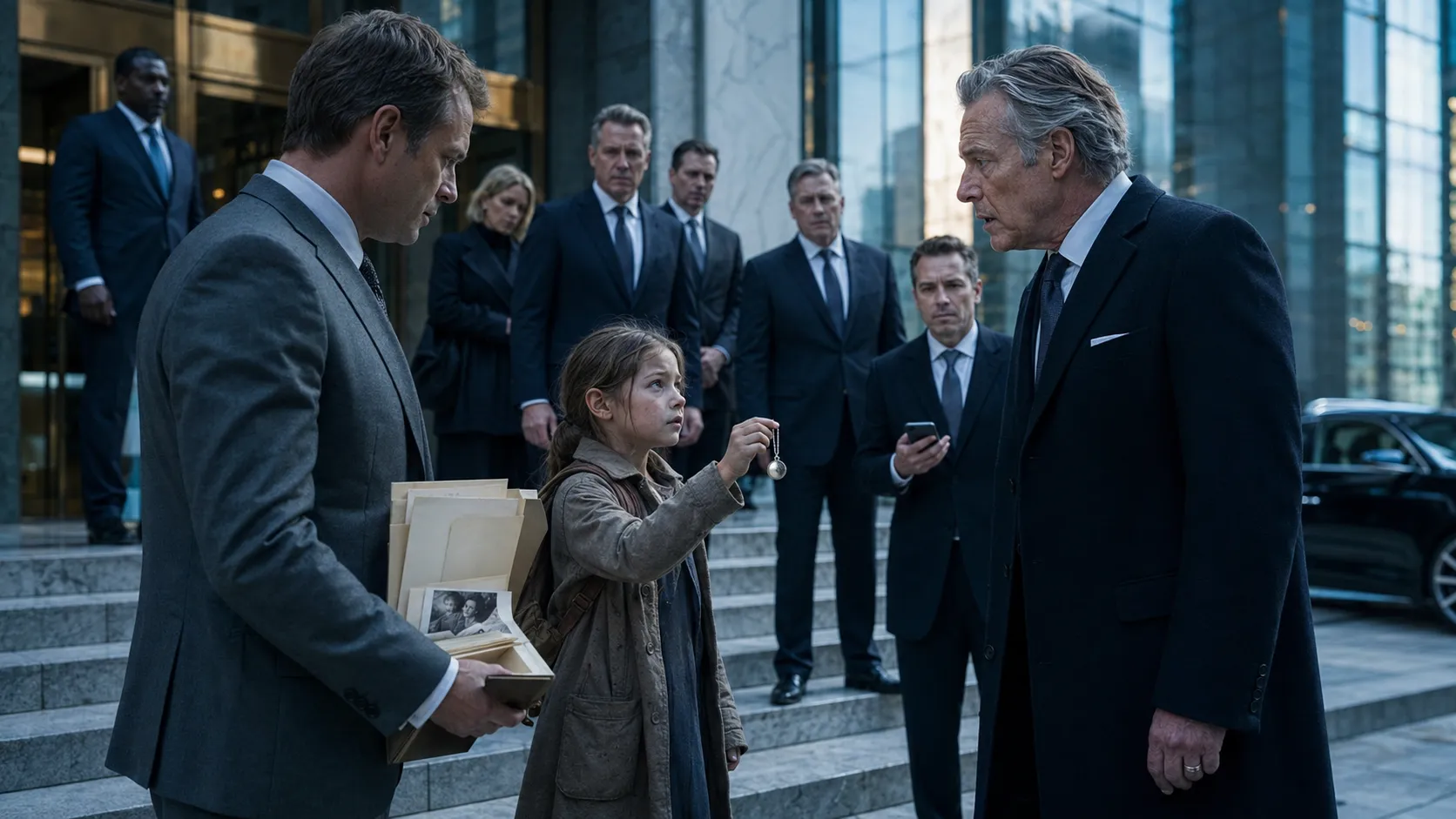
A silver pendant hung against his chest.
Worn smooth.
Old.
Engraved with one word:
Lorenzo
For a moment Isabella could not breathe.
She went home shaking.
After that, she returned again and again — never close enough to frighten him, never bold enough yet to claim anything she might still lose. She left food. Blankets. Medicine. Fresh socks. Bottled water. She watched from a distance as Elia smiled a little more on some evenings, and as Vittorio quietly accepted the invisible mercy with the dignity of a man who knew dependence too well to romanticize it.
Then she did what she could not avoid any longer.
She took strands of hair from a sweater left to dry on a fence line and submitted them for testing.
The wait was unbearable.
When the results arrived three days later, her fingers shook so badly she tore the envelope opening it.
99.9% match.
Elia was Lorenzo.
Her knees gave out.
The paper fell to the floor.
Her breath broke open into the deepest crying she had done in years.
She had found her son.
And the first thing she had done when she saw him was humiliate him in public.
That was the part she could not escape.
Not the kidnapping.
Not even the years.
The shove.
The words.
The look in his eyes when she treated him like something dirty instead of something lost.
Still, she had him now. Or rather, she knew where he was. And once certainty enters grief, it begins issuing commands.
She arranged, through one of the charitable shelters she funded, for a private transitional placement to be prepared — quiet, staffed, no photographers, trauma-informed. She told herself she would move carefully. Gently. Slowly. She would tell him the truth in safety, with therapists nearby, with warmth and privacy and every protection money could buy.
The next morning, she went to the center.
Chaos met her at the door.
“He ran,” a staff worker said, pale and breathless. “He heard he was being moved and got scared. He left before dawn.”
That was the moment Isabella understood that money could still lose to fear.
She didn’t call her driver.
She didn’t call security.
She ran.
She ran through alleys and side streets and underpasses in shoes not made for running, calling both names into the rain.
“Elia!”
“Lorenzo!”
“Please!”
Hours passed.
At last, beneath a bridge, she saw him.
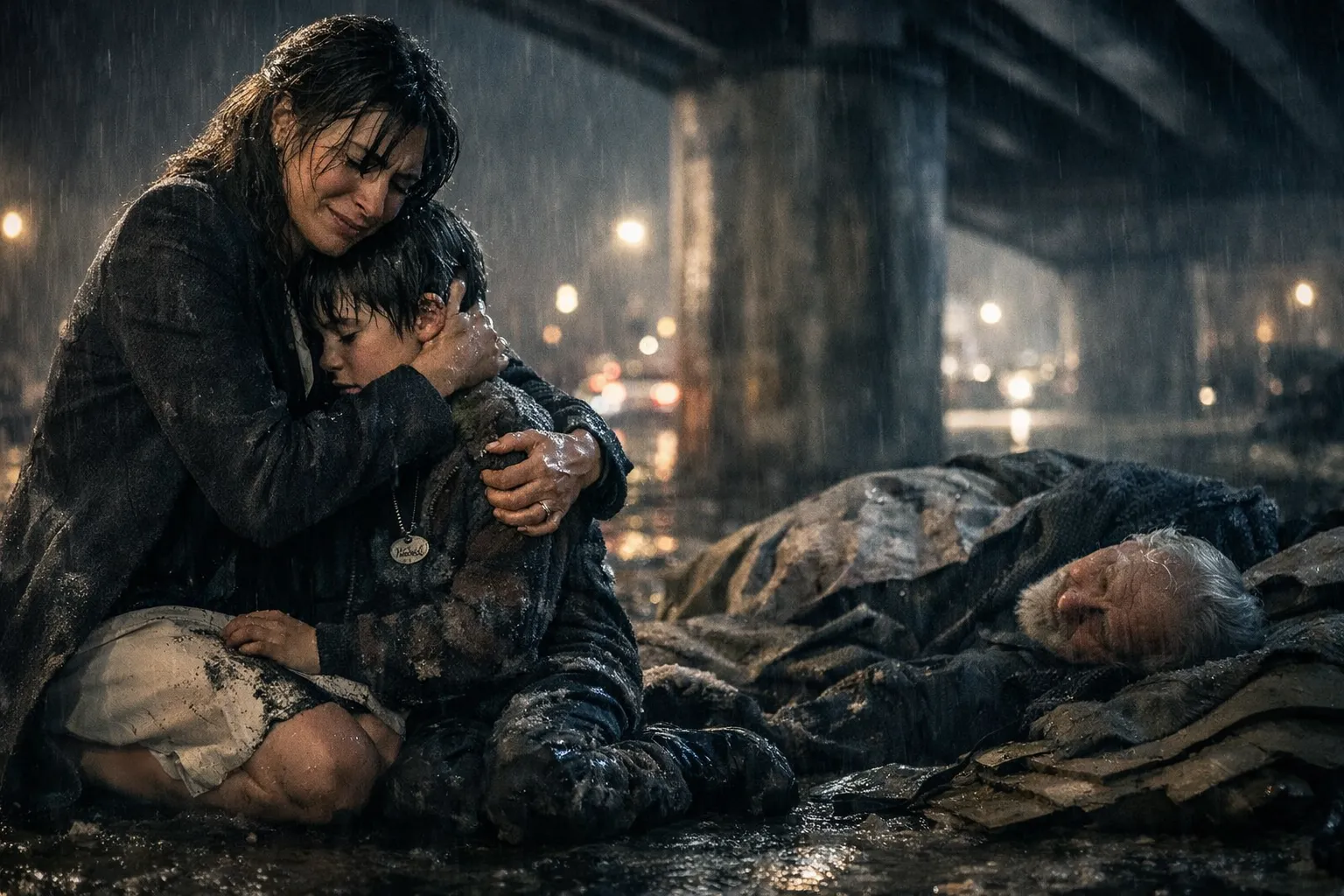
Elia sat with his knees pulled to his chest beside a heap of damp blankets. His eyes were swollen red. Rain streaked his face. Beside him, under one of the blankets, Vittorio lay motionless.
The moment Isabella saw the stillness in that old man’s body, she knew.
Elia heard her and looked up.
“He died last night,” he whispered. “He always told me my mom would come back. But she never did.”
The sentence was so naked, so free of drama, that it tore through her more cleanly than any scream could have.
She fell to her knees in the mud.
Rain soaked her hair, her coat, her face. Nothing in her resembled the woman who had stepped from the Rolls-Royce two days earlier.
“I’m here,” she said, voice breaking apart. “Lorenzo… I’m here. I’m your mother. I never stopped looking for you.”
The boy stared at her.
His mouth trembled.
Then he said the one thing she deserved to hear.
“But… you hurt me.”
There was no accusation in it.
That made it worse.
Only truth.
Isabella cried harder.
“I know,” she whispered. “And I can’t erase it. I can’t make that moment disappear. I can only tell you the truth now, and spend the rest of my life trying to make it right, if you let me.”
For a long time, only the rain spoke.
Then Elia slowly lifted one shaking hand and touched her cheek.
“You came back,” he whispered.
She gathered him into her arms, holding him with the desperation of a woman who knew exactly how long absence can last.
The months after were not easy.
They were not cinematic.
They were not tidy.
Lorenzo did not become her son again in a single embrace.
He was wary of locked doors.
He hid food.
He woke at night.
He flinched at raised voices in other rooms.
He called her “ma’am” at first, then “signora,” as if putting formality between them might protect him from disappointment.
Isabella did not demand tenderness from him.
She earned proximity the hard way.
She sat beside his silences.
Waited through his refusals.
Learned what food he would take without fear.
Kept promises small enough to be believable.
When he asked once, “Are rich people always angry when things get dirty?” she went into the bathroom and wept without letting him hear.
She made sure Vittorio was buried with dignity and his name properly marked. She paid every cost without making a spectacle of it. On the stone she had only one line carved:
He kept a child alive until love found its way back.
That was the truth of him.
Once the police reopened Lorenzo’s disappearance, the rest came slowly, then all at once. The kidnapping had not been random. A chain of quiet corruption, trafficking intermediaries, and bought silences reached from private clinic staff to a driver who had once worked near the Rinaldi estate. Money had been used to erase tracks — not hers, but the money of men who profit from invisible children.
This time, Isabella did not outsource the fight and call that strength.
She stayed in it herself.
And when the first child-rescue network meeting ended with no one willing to commit real funding, Isabella stood up and created the foundation before she sat back down.
Not in her own name.
In his.
The Lorenzo Rinaldi Foundation for Missing Children.
She did not build it as an apology.
Apologies are private.
This was duty.
Years later, on rainy days, mother and son still returned beneath that bridge.
Not because pain deserves worship.
Not because trauma becomes noble when repeated.
But because some places divide a life so completely that forgetting them becomes another kind of lie.
One afternoon, long after the newspapers had moved on and the cameras had chosen newer tragedies, Lorenzo stood beside her there and looked at the swollen river below.
“Do you still think about the day we met again?” he asked.
Isabella did not pretend not to understand which moment he meant.
“The shove?” she asked quietly.
He nodded.
She looked down at her hands.
“Yes,” she said. “Every time it rains.”
He was silent for a while.
Then he slipped his hand into hers — no longer the hand of a child trying not to be left, but the hand of someone who had learned the cost of both absence and return.
“Mama,” he said, and though he had said it before, it still caught in her chest every time, “that wasn’t the day we met again.”
She turned toward him.
“That was the day you stopped being asleep.”
She closed her eyes then, because there was no defense against that kind of mercy.
The rain kept falling.
And beneath it, for the first time in years, Isabella understood that compassion does not always arrive cleanly. Sometimes it comes after failure, after shame, after the worst version of yourself has already done damage.
What matters, in the end, is whether you stay long enough to become worthy of the love that survived you anyway.