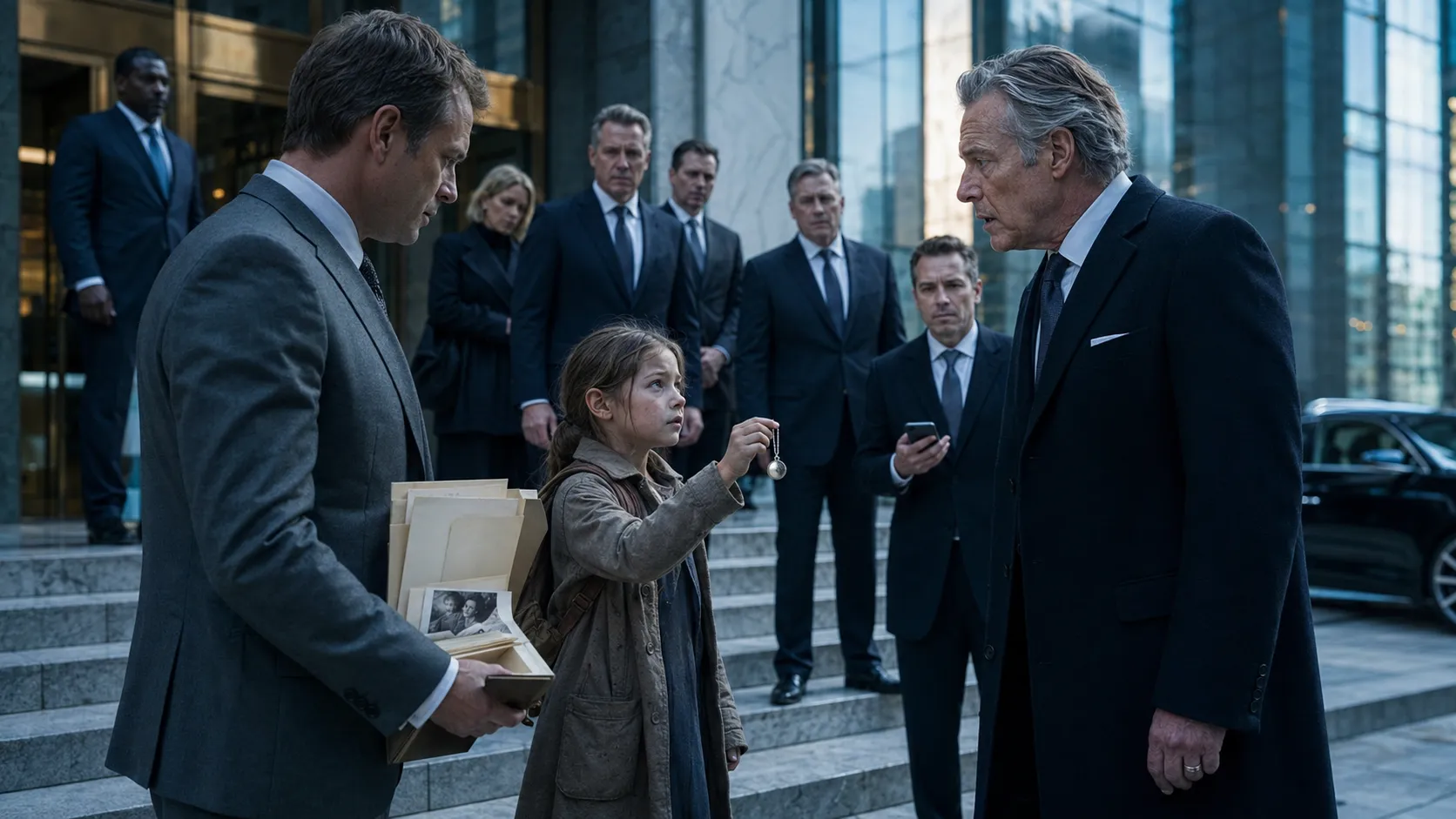
Ethan Cole had carried the photograph for seven years because of one dying woman’s final words. But when a homeless teenage girl found it on a New York sidewalk and recognized her mother’s face, the truth neither of them expected finally came back to life.
New York did not stop for grief.
It never had.
Cars hissed over wet pavement. Yellow taxis cut through traffic like angry streaks of light. Men in suits checked watches. Women in heels stepped around puddles without looking down. Delivery riders shouted through crosswalks. Strangers brushed shoulders, muttered apologies they did not mean, and kept moving.
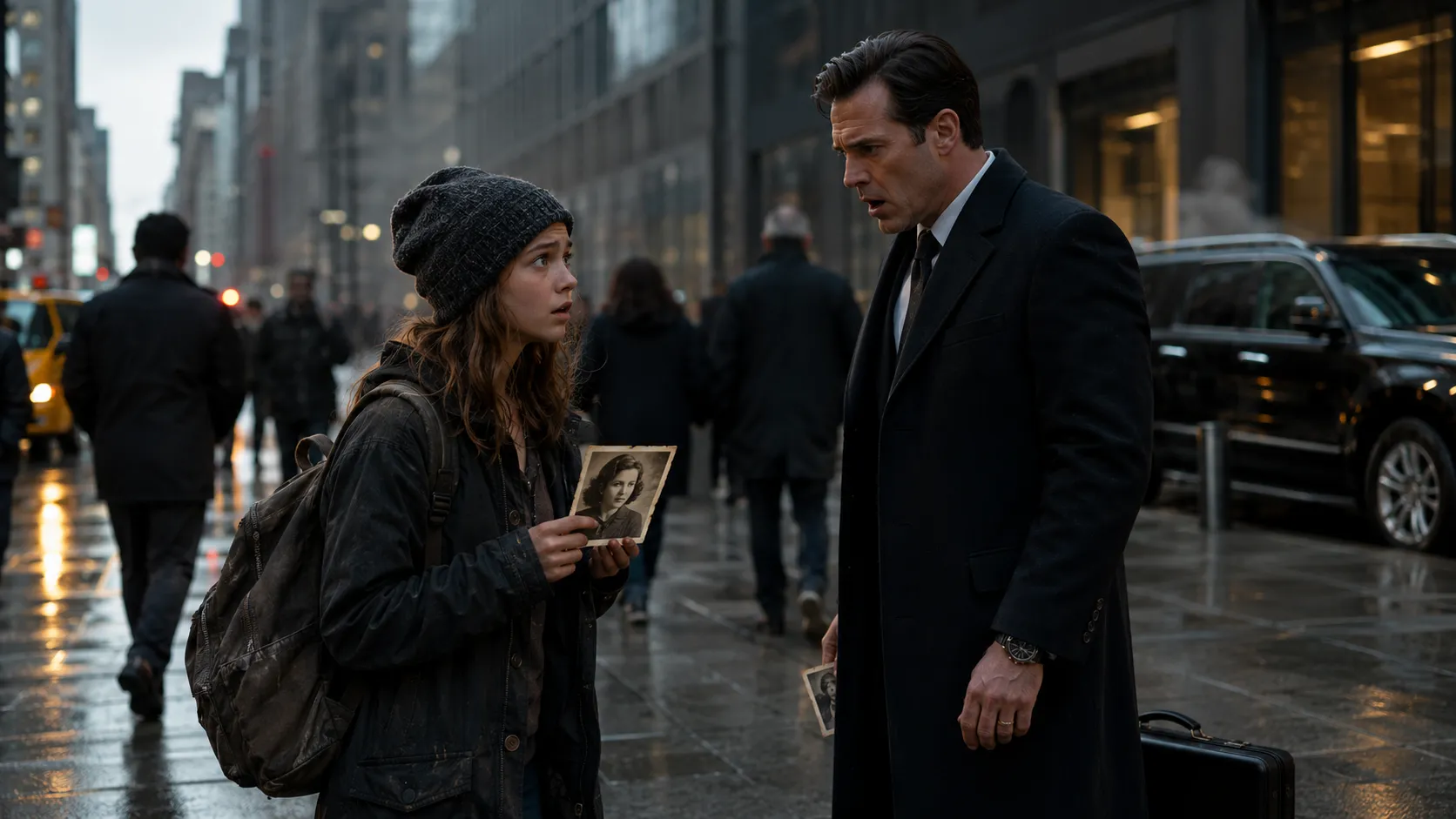
On West 42nd Street, beneath the cold glass face of an office tower, Ethan Cole walked like a man who had taught the world to move around him.
He was thirty-nine years old, dressed in a tailored charcoal suit, black overcoat, and polished shoes that had never known the kind of sidewalk where people slept. His hair was dark, carefully combed. His face was clean, controlled, unreadable.
People recognized him sometimes.
Not always by name.
But by category.
Money.
Power.
Someone important enough to avoid blocking.
Ethan Cole was a senior partner at a private legal firm that handled corporate crises, missing heirs, insurance settlements, and old cases wealthy families wanted closed quietly. Newspapers had called him “the man billionaires call when the past becomes expensive.”
It was a sentence he hated.
Not because it was false.
Because it was too accurate.
That afternoon, Ethan was walking to a meeting he did not want to attend. A developer had died, leaving behind three families, five shell companies, and a fortune no one could agree on. Ethan had the documents in his briefcase, the strategy in his head, and a headache behind his eyes.
His phone buzzed again.
He ignored it.
Instead, his hand slipped into the back pocket of his coat, searching for his phone without thinking.
His fingers brushed something else.
A photograph.
He did not pull it out.
He did not need to look at it.
He knew every crease.
Every softened edge.
Every faded tone.
The woman in the photo had been with him longer than some friends, longer than most lovers, longer than nearly every promise he had managed to keep.
Her name was Amelia Rivers.
Or that was the name he had found later.
For seven years, her photo had lived in his wallet, then in his coat pocket, then back in his wallet, then in the drawer of his desk when he tried to stop carrying it, then back in his pocket the next morning because guilt has a way of making its own home.
Ethan did not notice when the photo slipped free.
It slid from the edge of his pocket, caught a small current of wind between passing bodies, fluttered once, and drifted downward.
The city kept moving.
The photo landed beside a girl sitting near the base of the office tower.
She was sixteen, though hunger and weather had blurred the softness from her face. Her hair was dark, tangled beneath a knit hat. Her jeans were ripped at one knee. Her jacket was too thin. Beside her sat a frayed backpack and a paper cup with three coins in it.
Her name was Lily Rivers.
Most people did not know that.
To them, she was another homeless girl on a busy street.
Something to step around.
Something to pretend not to see.
Lily noticed the photo because she noticed everything on the ground.
Coins.
Receipts.
Lost cards.
Food still wrapped.
Things people dropped because their lives were full enough to let small losses remain small.
At first, she thought it was just another discarded picture. Maybe someone’s girlfriend. Maybe a family member. Maybe one of those old photos people put in wallets and forget until the wallet becomes trash.
Then she picked it up.
And the world stopped.
The woman in the photograph had soft brown eyes, dark hair tucked behind one ear, and a smile that looked tired but warm, the kind of smile that belonged to someone who had learned to be gentle without being weak.
Lily’s fingers tightened.
Her breath vanished.
“No,” she whispered.
The city moved around her.
She did not move with it.
She knew that face.
Not from dreams.
Not from imagination.
From memory.
A kitchen with yellow curtains.
A hand brushing hair from her forehead.
A voice singing while making soup.
A woman kneeling in front of her, buttoning her coat, saying, “If we get separated, you stay where people can see you, okay? Don’t hide from the helpers.”
Lily stood so quickly that her backpack tipped over.
“Hey!” she shouted.
Ethan kept walking.
“Hey! Stop!”
Her voice cracked through the traffic noise, raw enough that several people turned.
Ethan stopped.
He did not usually respond to strangers shouting behind him. In his world, people called his assistant, sent emails, scheduled meetings, waited behind glass doors.
But something in that voice was not begging.
It was demanding.
He turned.
The girl was standing ten feet behind him, holding the photograph in both hands like evidence.
For one second, annoyance crossed Ethan’s face.
Then he saw the photo.
His expression changed.
He walked back slowly.
“Yes?” he asked, his voice controlled.
Lily stepped toward him.
Her hands were shaking.
“Where did you get this?”
Ethan looked at her.
Then at the photograph.
His chest tightened.
“That’s mine.”
“I didn’t ask if it was yours.” Her voice trembled, but she did not lower it. “I asked where you got it.”
A few pedestrians slowed.
Ethan noticed.
He disliked public scenes.
He disliked losing control even more.
“Give me the photo,” he said quietly.
Lily pulled it closer to her chest.
“No.”
His jaw tightened.
“Miss—”
“She’s my mother.”
The sentence hit him so hard that for a moment he forgot the street.
People passed on both sides of them, but Ethan heard nothing.
Only the girl’s breathing.
Only the word mother.
He stared at Lily properly for the first time.
Dark eyes.
High cheekbones.
A small scar near her eyebrow.
A mouth set with the same stubborn curve as the woman in the photo.
His own voice sounded far away.
“What did you say?”
Lily’s eyes filled, but she refused to cry in front of him.
“She’s my mother. Amelia Rivers. Where did you get her picture?”
Ethan swallowed.
Amelia Rivers.
For seven years, he had searched for that name.
For seven years, it had led to closed records, wrong addresses, disconnected numbers, and a grief he could not explain to anyone.
Now a homeless girl on a New York sidewalk had said it like the name had been waiting in her mouth all this time.
“That isn’t possible,” he said.
Lily’s face hardened.
“Don’t lie to me.”
“I’m not lying.”
“Then answer me.”
Ethan looked at the photo again.
Amelia’s face smiled up at both of them from a day neither of them could reach.
He spoke carefully.
“I found her seven years ago.”
Lily blinked.
“Found her?”
Ethan lowered his eyes.
“There was an accident outside the city. Late at night. A highway pileup after a storm. I was driving back from Albany. I stopped before the ambulances got there.”
Lily’s grip weakened.
The photo nearly slipped from her hand.
“No.”
Ethan continued because stopping would be crueler.
“She was in one of the cars. She was alive when I reached her.”
Lily stepped back.
“No.”
“I’m sorry.”
“No.” Her voice rose. “No, you’re wrong. She left. She disappeared. They said she left me.”
Ethan’s face tightened.
“Who said that?”
“The shelter people. The police. Foster workers. Everyone.” Tears finally broke loose. “They said maybe she ran because she couldn’t take care of me. They said mothers do that sometimes.”
Ethan closed his eyes for one second.
When he opened them, the city looked harsher.
“She didn’t run,” he said.
Lily stared at him.
“How do you know?”
He reached slowly into his inside coat pocket and removed his wallet.
From behind a card he rarely used, he pulled another photograph.
Older.
More faded.
He held it out.
Lily looked down.
This photo showed Amelia sitting on a park bench with a little girl on her lap. The child was maybe eight or nine, missing one front tooth, holding a melted ice cream cone, laughing as Amelia tried to clean her fingers with a napkin.
Lily made a sound like someone had touched a wound.
“That’s me.”
Ethan nodded.
“She had this in her hand.”
Lily sank onto the low stone ledge beside the tower.
For several seconds, she did not speak.
Her eyes moved over the photo again and again, as if the image might explain the seven years that came after it.
Ethan crouched in front of her, ignoring the looks now.
“She kept saying something,” he said.
Lily looked up.
“What?”
His voice softened.
“Find my daughter.”
Lily covered her mouth.
Ethan held the second photograph carefully.
“She didn’t know where she was. She was hurt. She could barely breathe. But she kept saying it. Over and over.”
Lily shook her head, tears falling freely now.
“No. If she was looking for me, why didn’t anyone find me?”
Ethan did not answer quickly.
Because the truth was not simple.
Because the truth was shameful.
Because he had spent seven years telling himself he had done everything possible, while knowing that “everything possible” often depends on how badly someone wants to be inconvenienced.
“I tried,” he said.
The words sounded weak even to him.
Lily heard it.
Her eyes sharpened through tears.
“You tried?”
Ethan looked down.
“Yes.”
“Then why am I still here?”
The question landed cleaner than any accusation.
He stood slowly.
A black SUV had pulled closer to the curb. His driver, Mark, watched through the windshield. Ethan’s phone buzzed again in his pocket. The meeting upstairs waited. Millions of dollars waited. Men who believed their problems were urgent waited.
Ethan looked at the girl sitting on the sidewalk with her mother’s photo in her hands.
Then he turned off his phone.
“My name is Ethan Cole,” he said.
“I know your name now. I don’t care.”
That almost made him smile.
Not because it was funny.
Because Amelia had looked at him the same way when she was dying — as if his importance meant nothing unless he used it for something human.
“Lily,” he said carefully, “will you come with me somewhere warm? Just for an hour. You can keep the photo. You can sit near the door. You can leave if you want.”
Her eyes narrowed.
“I’m not stupid.”
“I didn’t say you were.”
“Men in suits don’t help girls like me unless they want something.”
Ethan nodded.
“Usually, you’re right.”
That answer surprised her.
He continued, “Today, I want to know how I failed your mother.”
Lily looked away.
The words had reached her, but trust had not.
Trust did not arrive just because truth did.
She held the photo against her chest.
“Where?”
“There’s a diner around the corner. Public. Busy. You choose the table.”
She stared at him for a long time.
Then she bent, picked up her backpack, and said, “If you lie, I’ll scream.”
“I believe you.”
They walked to the diner in silence.
Ethan kept space between them.
Lily noticed.
That helped.
Inside, the diner smelled of coffee, butter, burnt toast, and old vinyl seats. A waitress with silver hair looked up from behind the counter.
“Two?” she asked.
Lily pointed to a booth near the window and close to the door.
“That one.”
Ethan nodded.
They sat across from each other.
The waitress came over with menus.
Lily did not open hers.
Ethan said, “Order anything.”
Lily stared at him.
“I’m not a charity case.”
“No.”
“Then don’t say it like that.”
He accepted the correction.
“You’re right. I’m sorry.”
That was the second thing that surprised her.
Rich adults did not usually apologize on the first try.
She ordered coffee, scrambled eggs, toast, pancakes, and orange juice, then looked at Ethan as if daring him to comment.
He did not.
When the waitress left, Lily placed both photographs on the table.
“My mother’s name was Amelia Rivers,” she said. “She used to work at a nursing home in Queens. She liked old songs. She hated onions. She cut my hair crooked once and cried harder than I did.”
Ethan listened.
“She had a blue coat,” Lily continued. “She said it made her feel like she looked organized. She always carried peppermint candies. She said people were kinder when you gave them something sweet before asking for help.”
Ethan felt his chest ache.
“She had peppermint candies in her coat pocket,” he said.
Lily’s face twisted.
“For a long time, I thought I made her up.”
“No.”
“I mean, I remembered her. But everyone kept saying things. That she probably left. That maybe I remembered wrong. That kids make stories when bad things happen.”
Her fingers touched the edge of the photo.
“I started thinking maybe I only remembered the good parts because I needed them.”
Ethan leaned forward slightly.
“She was real. And she was looking for you.”
Lily closed her eyes.
The food arrived.
For a moment, neither touched anything.
Then Lily picked up the fork with shaking fingers and began eating fast, then slower when she realized no one was going to take the plate.
Ethan waited.
After several minutes, she asked, “How did she die?”
He looked toward the window.
Rain had started again, faint lines sliding down the glass.
“There had been a fire at a women’s shelter in Yonkers earlier that evening,” he said.
Lily stopped eating.
“The red building.”
“You remember?”
Her voice went quiet.
“I remember smoke. People yelling. Mom pushing me toward a woman in a yellow jacket. She told me to stay with the helpers. Then she went back inside.”
“For someone?”
Lily nodded slowly.
“A baby. I think. Or another child. I don’t know.”
Ethan folded his hands.
“After the fire, she must have been told you were taken to a hospital or another shelter. The records from that night were chaos. Several children were transported to different facilities. Some names were misspelled. Some people had no identification.”
Lily stared at him.
“I was taken to Saint Anne’s.”
“I know that now.”
“You know that now?”
He accepted the anger in her voice.
“Yes.”
“Why not then?”
“Because I didn’t know enough to ask the right questions. I gave the photo to the police. I called the hospitals listed in the accident report. I contacted two shelters. Then the case went cold.”
Lily’s voice turned sharp.
“And you stopped.”
He did not defend himself.
“Yes.”
Her eyes filled again.
“My mom died asking you to find me, and you stopped.”
Ethan looked down at his untouched coffee.
“Yes.”
The booth went silent.
The waitress passed once, sensed something heavy, and kept moving.
Ethan said, “I told myself I had done what I could. I told myself the police would know better. I told myself if you were alive, someone would connect the records. I told myself a lot of things that made it easier to return to my life.”
Lily wiped her face angrily.
“Must have been nice. Having one.”
He looked at her.
“It was easier before today.”
That answer did not satisfy her.
It was not meant to.
Lily pushed her plate away.
“I went through five placements.”
Ethan went still.
“Five?”
“First one was okay. The woman got sick. Second one wanted the check but not me. Third one had sons who liked locking me in closets. Fourth one said I was ‘too angry to love.’ Fifth one kicked me out when I was fifteen and said I ran.”
Her mouth hardened.
“I did run. After they put my backpack outside.”
Ethan’s hand tightened around his coffee mug.
He had heard stories like this in courtrooms.
He had argued around them.
He had written settlements for systems that used phrases like placement instability, behavioral concerns, and resource constraints.
He had never had to watch those words sit across from him in a diner, eating pancakes with dirty sleeves.
“I’m sorry,” he said.
Lily laughed once.
It had no humor.
“Everybody’s sorry when it’s too late.”
He nodded.
“Then I need to be more than sorry.”
She looked at him.
“How?”
It was not a hopeful question.
It was a challenge.
A test.
Ethan took out his wallet, removed a business card, then stopped.
A card felt obscene.
He put it away.
Instead, he took a napkin and wrote his personal phone number on it.
Not his office.
Not his assistant.
His.
He slid it across the table.
“This is my number. No receptionist. No assistant. If you call, I answer.”
Lily stared at the napkin.
“I don’t have a phone.”
“Then we get you one.”
Her eyes flashed.
“There it is.”
“What?”
“Money.”
Ethan leaned back.
“You need food, a safe place to sleep, medical care, identification, a phone, and someone who understands the foster records. Money will help with some of that. It won’t fix what happened.”
Lily studied him carefully.
For the first time, he sounded less like a man performing rescue and more like a man trying to name the mess honestly.
“My mother had family,” she said.
“I know.”
Her eyes widened.
“You know?”
“Only one name. Nora Rivers. Amelia’s older sister. Your aunt.”
Lily stared at him.
“I have an aunt?”
Ethan nodded.
“I found the name years ago, but the address was old. Mail came back. The phone number was disconnected. I should have kept looking.”
Lily’s face changed.
An aunt.
A word she had never been allowed to keep.
“Is she alive?”
“I don’t know.”
Her jaw tightened.
“Then find out.”
Ethan nodded.
“I will.”
“No.” She leaned forward. “Not like before.”
He held her gaze.
“Not like before.”
That afternoon, Ethan canceled the meeting, returned to his office with Lily, and did something he had not done in years.
He used every door his privilege could open for someone who had no power to open one herself.
Not quietly.
Not as charity.
As obligation.
He called a private investigator he trusted, then fired him ten minutes later when the man referred to Lily as “the subject.” He called a former family court judge. He called a social worker who owed him nothing and would not be impressed by his name. He called a doctor who worked with homeless youth. He called a legal aid director who told him, bluntly, that if he wanted to help, he could start by listening instead of managing.
Lily sat in his office during all of this, wrapped in a blanket his assistant found in a closet, eating soup from a paper bowl and watching him with suspicion.
His office was high above Manhattan. Glass walls, dark shelves, expensive chairs, a view of the city she had slept inside without ever seeing from above.
She hated it.
She also liked the warmth.
Both were true.
At 6:14 p.m., Ethan found Nora Rivers.
She was alive.
Sixty-two years old.
Living in a small house outside Philadelphia.
She had spent seven years believing her sister and niece were both dead.
When Ethan called, she hung up on him twice.
On the third call, he said, “I have Lily.”
There was silence.
Then a sound from the other end of the line.
Not words.
A breath breaking.
“What did you say?”
Ethan looked through the glass wall at Lily, who was pretending not to listen.
“Your niece is alive.”
Nora Rivers arrived in New York just after midnight.
She came in an old green sedan with a cracked bumper, wearing a winter coat over pajamas and slippers she had forgotten to change. She pushed past the security desk before Ethan could meet her downstairs.
When the elevator opened, Lily stood in the hallway.
For a moment, the older woman simply stared.
Then her hand rose to her mouth.
“You look like her,” Nora whispered.
Lily did not move.
She had imagined family before.
A hundred times.
A thousand.
In foster beds, subway stations, shelter rooms, stairwells, hospital waiting areas. She had imagined someone appearing and saying they had been searching. She had imagined running into arms. She had imagined anger too.
Now the woman stood there, real and shaking, and Lily felt nothing at first.
Then too much.
Nora took one step forward and stopped.
She did not grab.
She did not assume.
She only said, “I am your Aunt Nora. I looked for you, baby. I swear on my sister’s grave, I looked.”
Lily’s face crumpled.
“Why didn’t you find me?”
Nora began crying.
“Because they told me you died in the shelter fire. They showed me the wrong report. They told me there was no surviving child matching your name.”
Lily looked at Ethan.
He lowered his eyes.
Nora continued, voice breaking, “I buried an empty box because there was nothing else to bury. I put your name beside your mother’s because I thought both my girls were gone.”
Lily made a small sound.
Then she crossed the hallway and fell into Nora’s arms.
The older woman held her like someone gripping the edge of the world.
“My baby,” Nora sobbed. “My God, my baby.”
Lily cried the way children cry only when some part of them finally believes an adult might stay.
Ethan stood twenty feet away and watched.
He did not move closer.
This was not his moment.
It was his failure being corrected by someone else’s love.
The next weeks were not simple.
Stories like this should be simple, Lily thought.
Lost girl finds family.
Rich man helps.
Dead mother vindicated.
Home restored.
But real life was paperwork.
Court petitions.
Emergency housing.
Medical exams.
Nightmares.
Anger.
Panic attacks.
Lily waking at 3:00 a.m. in Nora’s guest room, convinced she had dreamed everything and would open her eyes under a bridge again.
Nora crying in the laundry room because every shirt Lily owned fit into one plastic bag.
Ethan sitting with attorneys, reconstructing seven years of bureaucratic failure from files that used passive language to hide active neglect.
The records were worse than he expected.
Lily had not vanished from the system.
She had been misspelled.
Lillian Rivers became Lily River.
Then Lily R.
Then Unknown minor female, approx. 9.
Her connection to Amelia was broken by bad intake forms after the shelter fire. Amelia’s accident two hours later was filed in a different county. Nora’s inquiry was closed after a mistaken death notice. No one reopened it because no one had to.
There was no single villain.
That made the damage harder to punish.
A dozen people had done their jobs carelessly.
A few had done them cruelly.
Most had done them tiredly, underfunded, overworked, and protected by the fact that poor children rarely had lawyers waiting at the other end of mistakes.
Ethan became one of those lawyers.
Not because Lily asked him to.
Because Amelia had.
Find my daughter.
Seven years late, he finally began to understand that finding someone did not end when their body appeared.
Sometimes you had to find their name.
Their records.
Their family.
Their stolen years.
Their right to be more than a file.
Lily moved in with Nora permanently after the court approved kinship guardianship.
The first night in Philadelphia, she slept on top of the blankets with her backpack under her head. Nora found her like that and quietly put another blanket over her without moving the bag.
The second week, Lily began leaving the backpack beside the bed.
The third month, she hung Amelia’s photograph above the dresser.
Beside it, she placed the photo Ethan had kept — Amelia holding little Lily on the park bench.
For a long time, Lily hated that Ethan had carried those photos while she slept outside.
Then she hated that she was grateful he had carried them at all.
Both feelings lived together.
She told her therapist that.
The therapist said, “Contradiction is not dishonesty. It is often where healing begins.”
Lily hated therapist sentences.
Then wrote that one down.
Ethan visited every Sunday.
At first, Nora did not trust him.
She told him so while standing in her kitchen with a wooden spoon in one hand.
“You are not family,” she said.
“I know.”
“You are not her savior.”
“I know.”
“You are not going to build a sad little foundation with my sister’s face on it unless Lily wants that someday.”
Ethan paused.
“I had considered something like that.”
Nora pointed the spoon at him.
“Of course you had. Rich guilt loves a plaque.”
He accepted that.
“No plaques.”
“Good.”
Lily, sitting at the table, almost smiled.
Almost.
Over time, Sunday visits changed.
At first, Ethan came with documents, updates, legal forms, and careful apologies. Later, he came with groceries Nora pretended not to need and Lily criticized for being “lawyer food.”
“What is lawyer food?” Ethan asked.
“Expensive things nobody actually wants to eat.”
He looked at the bag of imported crackers.
Nora looked too.
Lily said, “See?”
The next week, he brought normal bread, eggs, apples, peanut butter, and a box of cereal with a cartoon tiger on it.
Lily said, “Better.”
That was high praise.
The case became public six months later.
Not because Ethan wanted it.
Because one of the foster families sued to block release of records and claimed Lily had fabricated abuse for money.
That was when Lily decided silence was no longer protection.
She testified in family court first.
Then in a closed oversight hearing.
Then, at seventeen, in front of a state committee reviewing child welfare failures across multiple counties.
Ethan sat behind her.
Nora sat beside him.
Lily wore a blue sweater Nora bought her, though she had refused three others before accepting it. Her hair was brushed but still a little wild. Her hands shook when she unfolded her paper.
“My name is Lily Rivers,” she began. “For seven years, the system lost me while I was still inside it.”
The room went silent.
“I was not missing because I disappeared. I was missing because adults stopped connecting the pieces.”
She looked down at the paper, then up again.
“My mother died asking someone to find me. My aunt was told I was dead. I was told my mother left me. All of those things were easier for adults than admitting they did not know.”
Ethan lowered his eyes.
Lily continued.
“I am not here because I want pity. I am here because there are children right now whose names are spelled wrong in files, whose relatives are not being called, whose anger is being treated like proof they are unlovable. A child should not need a millionaire’s lost photograph to be found.”
That line reached the newspapers by evening.
Lily hated the attention.
But she did not regret saying it.
The hearing forced a review.
Old cases were reopened.
Data systems were audited.
Kinship search procedures changed.
A statewide missing-family reconciliation unit was created after pressure from advocates, attorneys, and families who had lived the same nightmare without a dramatic photograph to rescue them.
Ethan did not put his name on any of it.
Nora made sure.
Amelia’s name appeared only once, at Lily’s request, in a training guide for caseworkers.
It read:
The Amelia Rivers Standard: no child is “located” until their family search has been completed, verified, and documented across jurisdictions.
Lily approved that.
“It sounds boring enough to actually matter,” she said.
Ethan smiled.
“Your mother might have liked that.”
Lily looked at him.
“You didn’t really know her.”
The sentence was not cruel.
It was true.
Ethan nodded.
“No. I only met the last minutes of her life.”
Lily touched the photo in her pocket.
“But you listened to them.”
He swallowed.
“Too late.”
“Yeah,” she said. “But eventually.”
Eventually was not forgiveness.
But it was no longer nothing.
Years passed.
Lily finished high school one year late and refused to be embarrassed by that.
At graduation, Nora cried so loudly that Lily threatened to move seats. Ethan stood in the back, clapping with everyone else, though he stayed out of family photos until Lily rolled her eyes and said, “Get over here. You’re in the story whether I like it or not.”
He joined the picture.
Awkwardly.
Carefully.
Like a man aware that inclusion was not ownership.
Lily studied social work in college, then law.
At first, Ethan worried she was building her life around pain.
Nora told him to shut up before Lily did.
“Pain is not the same as purpose,” Nora said. “And you of all people should know the difference.”
He did.
By twenty-seven, Lily Rivers became an attorney specializing in foster youth records, family tracing, and wrongful separation cases.
Her office was small, cluttered, and intentionally warm. No glass towers. No dark wood conference rooms. No receptionist who made frightened people feel underdressed.
On one wall hung three photographs.
Amelia smiling alone.
Amelia holding Lily on the park bench.
And the photo Ethan had dropped on the sidewalk, framed with the crease still visible.
Beneath it was a handwritten note:
Sometimes truth survives in what someone accidentally keeps.
Ethan visited the office on the day it opened.
He was older now. Gray at the temples. Slower in the way men become when ambition no longer drags them by the throat.
He brought no flowers.
Nora had warned him that flowers made offices look like funerals.
Instead, he brought a box of plain pens, file folders, and a coffee maker Lily had chosen herself and told him to buy if he insisted on being useful.
She took the box.
“Good. You followed instructions.”
“I’m improving.”
“Slowly.”
“I accept that.”
They stood in the office for a moment, surrounded by empty folders waiting for names.
Ethan looked at the framed photo.
“I still remember the moment it fell,” he said.
“You didn’t notice.”
“No.”
“That’s the point.”
He looked at her.
Lily’s voice softened slightly.
“People like you drop things all the time and assume someone else will pick them up.”
Ethan nodded.
“Yes.”
“But that time,” she said, looking at the photo, “I picked it up.”
He felt the weight of the sentence.
Then she turned back to him.
“I’m taking my first case tomorrow. A boy in Newark. Twelve. His grandmother has been calling agencies for six months, and they keep saying they can’t confirm the relationship because one form has the wrong birth date.”
Ethan’s face tightened.
“Do you need help?”
“Yes.”
He straightened.
“What kind?”
Lily handed him a stack of folders.
“Copy these. Then make coffee. Bad coffee. Office coffee. Not lawyer food coffee.”
He looked at the folders.
Then at her.
For the first time in many years, Ethan Cole did exactly what he was told without trying to lead.
The boy in Newark was reunited with his grandmother three weeks later.
Not because of a miracle.
Because Lily called every office until someone answered.
Because Ethan knew which legal pressure points made agencies move.
Because Nora had taught Lily how to speak to frightened relatives without making them feel small.
Because Amelia Rivers had died asking one stranger to find one child, and that request had grown into a way of finding many.
On the tenth anniversary of the day the photo fell, Lily returned to West 42nd Street.
She did not tell Ethan she was going.
Nora knew, because Nora knew most things.
The sidewalk looked the same and completely different. The office tower still rose cold and reflective above the street. Taxis still rushed. People still hurried. The city still failed to stop for grief.
Lily stood near the place where she had once sat with a paper cup and three coins.
She wore a dark coat now.
Warm boots.
A leather bag full of files.
People moved around her, not recognizing anything.
That was alright.
Some sacred places look ordinary to everyone else.
She took Amelia’s photo from her pocket.
The one Ethan had dropped.
For years, Lily had wondered whether to hate the photograph or treasure it.
Now she understood it was not responsible for either pain or rescue.
It was only a thing.
A piece of paper.
A face.
A bridge.
Her phone buzzed.
A message from Ethan.
Nora said you might be there. I won’t come unless you ask.
Lily stared at the message.
Then typed:
You can come.
He arrived twenty minutes later, slightly out of breath because he had walked too fast from his office.
They stood side by side beneath the tower.
For a while, neither spoke.
Finally, Ethan said, “I’m sorry I stopped looking.”
Lily looked at the traffic.
“You’ve said that before.”
“I know.”
“You’ll probably say it again.”
“Yes.”
She nodded.
“Good.”
He glanced at her.
She continued, “Not because I need you to suffer forever. Because some things should stay remembered.”
Ethan swallowed.
“I agree.”
Lily held out the photograph.
He looked at it but did not take it.
“That belongs with you.”
“It does,” she said. “But you carried it when nobody else did.”
His eyes filled.
She did not soften the moment for him.
That was not her job.
But she did say, “I used to think Mom was gone because she chose to be. Now I know she was trying to come back.”
Ethan closed his eyes briefly.
“When she said ‘Find my daughter,’ I thought she was asking me to solve a mystery.”
Lily looked at him.
“What was she asking?”
“To become responsible.”
The answer satisfied her.
Not completely.
But enough.
A young girl passed them on the sidewalk, maybe fourteen, wearing a backpack with one broken strap and scanning the ground the way Lily used to.
Lily noticed immediately.
So did Ethan.
The girl paused near a trash bin, looked around, then kept walking too quickly.
Lily put the photo back in her pocket.
“Come on,” she said.
Ethan followed.
The girl had stopped outside a subway entrance, pretending to check a phone that did not turn on.
Lily approached slowly.
“Hey,” she said gently. “You okay?”
The girl stiffened.
“I’m fine.”
Lily knew that answer.
She had lived inside it.
“I’m Lily,” she said. “I work with kids who need help finding people.”
The girl looked suspicious.
“I don’t need help.”
“Maybe not.”
Ethan stood several feet back, silent.
Good.
He had learned.
Lily took out a business card and held it low, not forcing the girl to take it.
“If you ever do, this number answers.”
The girl looked at the card.
Then at Lily’s face.
After a long moment, she took it.
Lily did not ask for her story.
Not yet.
The girl disappeared down the subway stairs.
Ethan and Lily watched her go.
“Do you think she’ll call?” he asked.
“I don’t know.”
“That must be hard.”
Lily looked at him.
“Maybe is where honest work starts.”
He smiled faintly.
“Did you steal that from someone?”
“Probably.”
They walked back toward the diner they had first entered ten years earlier.
It was still there.
Different sign.
Same smell of coffee and toast.
They took the same booth.
Lily ordered pancakes.
Ethan ordered coffee.
“Not the expensive kind,” she warned.
“This diner has one kind.”
“Good.”
The waitress brought the food. Lily poured syrup over the pancakes and looked out the window.
The city still moved.
But not everything was the same.
Somewhere in Philadelphia, Nora was probably overwatering her plants and pretending she was not waiting for Lily’s call.
Somewhere in a file cabinet, Amelia Rivers’s name had become policy instead of a mistake.
Somewhere in Newark, a boy slept in his grandmother’s apartment because one wrong birth date had finally been corrected.
Somewhere, a girl with a broken backpack strap held Lily’s card in her pocket.
And on the table between Lily and Ethan sat the memory of a photograph that had fallen from a rich man’s pocket because guilt made him carry it, and landed beside a lost girl because sometimes the truth is not powerful.
Sometimes it is small.
Faded.
Bent at the edges.
Easy to miss.
Unless the right person picks it up.
Years later, when Lily trained new advocates, she always began with the same story.
Not the dramatic version.
Not the viral version people wanted.
She did not say, “A photo changed my life,” as if paper had magic.
She said:
“My mother died asking to be believed. A man failed her, then spent years learning that failure is not the end of responsibility. I survived because evidence fell where I could reach it. Our job is to make sure children do not need accidents to be found.”
Then she would place the photograph on the table.
Amelia smiling.
Warm.
Tired.
Real.
“This is my mother,” Lily would say. “Her name was Amelia Rivers. Not unknown woman. Not accident victim. Not unresolved case. Amelia Rivers.”
Then she would look at every person in the room.
“Start with the name. Always start with the name.”
And every time she said it, somewhere inside her, the child on the sidewalk stood up again.
Not hungry.
Not invisible.
Not abandoned.
Found was not a perfect word.
It did not erase the years.
It did not give back Amelia’s voice, or Lily’s childhood, or the nights she slept in places no child should know.
But it was a beginning.
And some beginnings arrive late, carrying an old photograph, asking to be made worthy of the time they lost.