Margaret Ellis thought police had already handled the scream coming from the beige house on the corner. But when she realized there was no patrol car, no sirens, and no record of any officers being sent, the widow understood she had just seen two criminals walk out in uniform.
Margaret Ellis had walked the same street every evening for three years.
Not because she needed groceries every day.
Not really.
The small grocery store at the end of Maplewood Lane gave her an excuse to leave the house before sunset, buy something simple — milk, tea, bread, oranges, sometimes a magazine she never read — and return before the porch lights came on.
Routine was important after loss.
Her husband, Thomas, had believed that.
“Grief needs a schedule,” he used to say. “Otherwise it starts making one for you.”
Margaret had laughed at him then.
After he died, she understood.
At sixty-eight, she had learned that silence could become a room you lived inside. Their house, once full of radio music, tools in the garage, Thomas calling from the kitchen, and grandchildren running across the carpet during holidays, had become careful and still.
Too still.
So every evening, unless the rain was hard, Margaret put on her brown coat, took her canvas grocery bag, locked the front door, and walked.
Maplewood Lane was the kind of suburban street people described as safe without thinking too deeply about what safe meant.
White fences.
Trimmed lawns.
Mailboxes painted to match shutters.
Porch swings.
Dogwood trees.
Sprinklers clicking over grass in summer.
Halloween pumpkins in October.
Christmas wreaths by Thanksgiving.
People waved from driveways, but rarely came inside one another’s homes anymore. Margaret knew names, faces, cars, and small habits. She knew Mrs. Delaney watered her roses too late in the evening. She knew Mr. Price pretended not to smoke behind his garage. She knew the young couple at number thirty-two argued on Thursdays, always Thursdays, and always about money.
But the beige house on the corner was different.
Number 41.
It had stood empty for almost a year after old Mr. Holcomb died. Then, six months earlier, someone bought it quietly. No moving truck came. No welcome basket was needed. No children appeared on the lawn. No dog barked behind the fence.
Sometimes Margaret saw lights inside.
Sometimes a black van parked in the driveway at strange hours.
Sometimes the curtains moved even when no one opened a window.
She told herself not to invent mysteries.
Lonely widows, she knew, could become too familiar with imagination.
That evening, the sun was low and orange, stretching long shadows across the pavement. Margaret walked slowly with a small grocery bag hanging from her wrist. Inside were two cans of soup, a loaf of wheat bread, a box of tea, and a chocolate bar she had bought because Thomas had loved that brand and she still sometimes bought things for him by accident.
The street was unusually quiet.
No lawn mower.
No children on bicycles.
No dog barking.
Just the distant hum of traffic beyond the neighborhood and the soft rustle of leaves along the curb.
Margaret had just passed the pale blue house with the birdbath when the scream tore through the evening.
“HELP!”
It was a woman’s voice.
Sharp.
Raw.
Terrified.
Margaret froze so suddenly the grocery bag swung against her knee.
For one second, her mind refused to understand what her ears had heard.
Then the scream came again.
Shorter this time.
Cut off.
Her heart began pounding.
She turned slowly toward the beige house on the corner.
Number 41.
The curtains were drawn, as always.
No porch light.
No open window.
No visible movement.
Margaret’s first instinct was to reach for her phone.
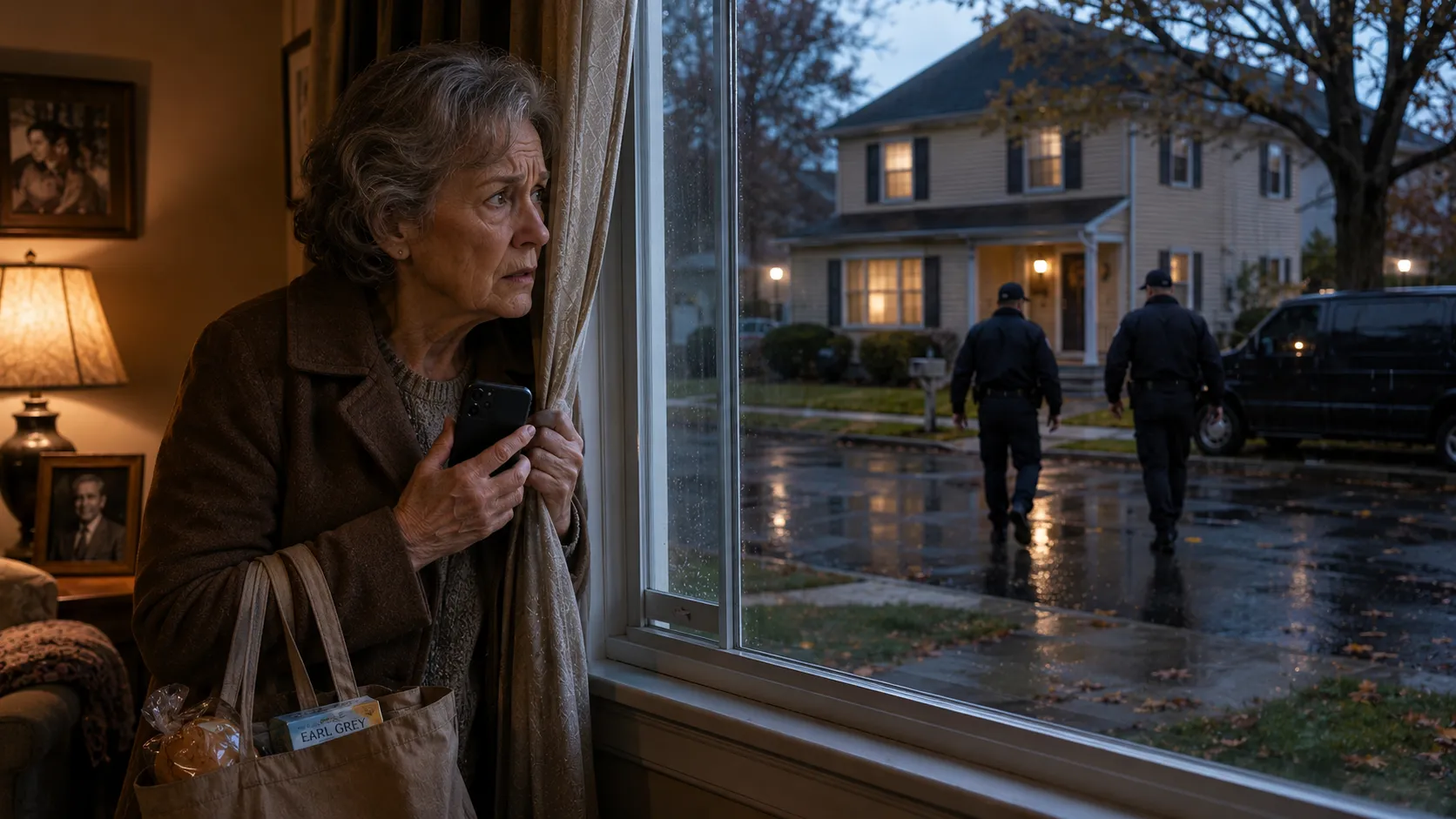
Her hand had barely entered her coat pocket when the front door of the beige house opened.
Two police officers stepped out.
At first, Margaret felt a rush of relief so strong her knees almost weakened.
Police.
Good.
Someone had called.
Someone was handling it.
But that relief lasted only a moment.
The officers did not move like men responding to an emergency.
They did not rush.
They did not call for backup.
They did not speak into radios.
They did not look over their shoulders toward whatever had happened inside.
They stepped onto the porch calmly, almost casually, as if leaving a house after a polite visit.
Both were tall, broad-shouldered men in dark uniforms.
One adjusted his cap.
The other removed a white handkerchief from his pocket and wiped his hands.
Slowly.
Carefully.
Margaret’s throat tightened.
The second officer did the same.
Two white handkerchiefs.
Two calm faces.
No panic.
No concern.
Then one of them smiled.
Not kindly.
Not reassuringly.
A small, private smile, as if he knew something awful and found it amusing that the rest of the world did not.
Margaret took one step backward.
The movement made her grocery bag crinkle.
Both officers looked at her.
Their heads turned at the same time.
Margaret’s body went cold.
The taller one stepped off the porch.
“Evening, ma’am,” he called.
His voice was smooth.
Too smooth.
Margaret tried to answer, but her mouth had gone dry.
“I… I heard someone scream.”
The officer kept walking toward her.
“Everything is under control.”
Those words should have comforted her.
They did not.
He said them with finality.
Not as information.
As instruction.
Do not ask.
Do not look.
Do not remember.
Margaret forced herself to glance toward the curb.
No police car.
No flashing lights.
No patrol vehicle in the driveway.
Only the black van parked half a block away under a maple tree.
The officer noticed her looking.
His smile widened slightly.
“Are you alright, ma’am?”
Margaret nodded too quickly.
“Yes. Yes, I’m fine.”
“You live nearby?”
A simple question.
But something in it made her fingers go numb.
“I’m just walking home.”
“Good,” he said.
The second officer stood on the porch watching her with his hands folded in front of him.
The taller one lowered his voice.
“Best to keep moving. No need for neighbors to worry.”
Margaret nodded again.
“Yes. Of course.”
She turned away.
Not too fast.
Not too slow.
Every instinct in her body screamed at her not to run.
So she walked.
Ten steps.
Fifteen.
Twenty.
Then faster.
Only when she reached the next corner did she allow herself to breathe.
But she could feel them watching.
Even with her back turned, she felt their eyes between her shoulder blades.
She did not stop until she reached her own house.
Her hands shook so badly she dropped her keys twice before getting the door open. Once inside, she shut it, locked it, slid the chain into place, and leaned against the wood.
The house was silent.
Too silent.
Margaret stood there, gasping softly, the grocery bag still hanging from her wrist.
Everything is under control.
She heard the words again.
The voice.
The smile.
The handkerchief.
The absence of a patrol car.
Her phone was in her pocket.
She pulled it out and stared at the screen.
Call the police, she thought.
Then another thought answered.
But they were the police.
Weren’t they?
Her chest tightened.
Thomas would have known what to do.
The thought came suddenly and painfully.
Thomas had been a firefighter for thirty-four years. He had walked into danger for a living and then come home to tell her, calmly, that most people froze not because they were cowards, but because their minds were trying to protect them from understanding too much too quickly.
“If something feels wrong,” he used to say, “trust the wrongness. Your body notices before your pride does.”
Margaret looked toward the window.
From her living room, if she stood at the left side of the curtain, she could see part of Maplewood Lane and, beyond the trees, the upper windows of the beige house.
The curtains were still drawn.
No flashing lights.
No ambulance.
No neighbors outside.
Nothing.
The scream seemed impossible now.
As if it had happened in another version of the street.
Margaret dialed the non-emergency police number first.
Her hands trembled while the line rang.
“Brookhaven Police Department,” a woman answered. “How may I direct your call?”
Margaret swallowed.
“I need to ask if officers were sent to Maplewood Lane. Number forty-one.”
“One moment.”
Keyboard clicks.
“What was the nature of the call?”
“I heard a scream. A woman screaming for help. Then I saw two officers leaving the house.”
Another pause.
“What time was this?”
“Maybe ten minutes ago.”
More typing.
“Ma’am, I don’t show any call dispatched to that address tonight.”
Margaret’s heart stopped.
“Are you sure?”
“Yes, ma’am. No units have been sent to Maplewood Lane this evening.”
“But I saw them.”
“Uniformed officers?”
“Yes.”
“Did you see a patrol vehicle?”
Margaret closed her eyes.
“No.”
The dispatcher’s voice changed.
Not dramatically.
Professionally.
Carefully.
“Ma’am, I’m going to transfer you to emergency dispatch. Please stay on the line.”
Margaret gripped the phone harder.
Within seconds, another voice came on.
“911, what is your emergency?”
Margaret explained again.
The scream.
The house.
The two officers.
The handkerchiefs.
The smile.
The missing patrol car.
As she spoke, her fear changed shape.
It became responsibility.
The dispatcher asked, “Are you currently safe?”
“I’m at home. My door is locked.”
“Do not return to the house. Do not approach anyone. Officers are being sent now.”
Real officers, Margaret thought.
She almost said it aloud.
“Ma’am,” the dispatcher continued, “can you see the house from your location?”
“Part of it.”
“Do you see anyone outside now?”
Margaret moved carefully to the living room window and parted the curtain only slightly.
The street looked empty.
“No.”
“Do you see the black van?”
Margaret looked.
The van was gone.
Her throat tightened.
“No. It was there before. Now it’s gone.”
“Stay inside. Officers are on the way.”
Margaret stayed at the window until the first patrol car arrived four minutes later.
This one had lights.
This one had markings.
This one stopped hard in front of number 41.
Then another came.
Then a third.
Officers moved quickly, weapons drawn. One went around the side of the house. Two approached the porch. One spoke into a radio. Another knocked once, then kicked the door open.
Margaret watched from behind her curtain with one hand over her mouth.
The street, so quiet before, erupted into blue and red light.
Neighbors came onto porches.
Someone shouted a question.
Someone else was told to go back inside.
Ten minutes passed.
Then twenty.
No ambulance came.
That frightened Margaret more than she expected.
If someone had screamed and no ambulance came, what did that mean?
At 8:11 p.m., an officer knocked on Margaret’s door.
She opened it only after checking through the peephole and seeing a marked patrol car behind him.
“Mrs. Ellis?”
“Yes.”
“I’m Officer Ruiz. We need to ask you some questions.”
“Did you find her?”
The officer hesitated.
That hesitation stayed with Margaret for the rest of her life.
“We didn’t find anyone inside.”
She stared at him.
“What?”
“The house is empty.”
“No.” Her voice sharpened. “No, I heard her. I saw them come out.”
“I understand.”
“No, you don’t. There was a scream.”
“We believe you.”
Margaret searched his face.
He did believe her.
That made it worse.
He continued, “There are signs someone was there recently. We need your statement.”
Margaret stepped aside and let him in.
A detective arrived thirty minutes later.
Detective Laura Bennett.
Mid-forties, dark coat, gray eyes, no nonsense in the way she carried herself. She introduced herself without warmth but not without kindness.
Margaret appreciated that.
Too much warmth would have felt like pity.
Detective Bennett sat across from her at the kitchen table while Officer Ruiz stood near the doorway taking notes.
“Mrs. Ellis,” Bennett said, “tell me everything from the beginning. Slowly.”
Margaret did.
The walk.
The scream.
The door.
The officers.
The handkerchiefs.
The smile.
The phrase.
Everything is under control.
Detective Bennett wrote that sentence down carefully.
When Margaret finished, the detective asked, “Could you identify the men if you saw them again?”
Margaret’s stomach tightened.
“Yes.”
“Did either have a name badge?”
Margaret closed her eyes, trying to replay the moment.
“I looked, but only quickly. The taller one… his badge said Miller, I think. Or Milner. Something like that.”
Officer Ruiz looked up.
Detective Bennett’s pen stopped.
“What?”
Ruiz said quietly, “There’s no Miller on Brookhaven PD.”
Bennett looked back at Margaret.
“And the other?”
“I didn’t see.”
“Anything unusual about the uniforms?”
Margaret thought.
Then she remembered.
“The shoulder patches looked right from a distance, but the blue was wrong.”
“The blue?”
“My husband was a firefighter. He worked with police often. Their patches had a darker blue border. These looked almost black.”
Bennett’s eyes sharpened.
“That’s helpful.”
Margaret almost laughed from nerves.
Helpful.
A woman screamed.
Men walked out smiling.
A van disappeared.
And she was helpful because she noticed a patch color.
Detective Bennett leaned forward.
“Mrs. Ellis, I need to ask this carefully. Did either man threaten you?”
“No. Not directly.”
“But you felt threatened.”
“Yes.”
“Why?”
Margaret looked down at her hands.
They were still shaking.
“Because he wanted me to understand I had seen something I wasn’t supposed to see.”
The kitchen went quiet.
Bennett nodded.
“I think you’re right.”
Margaret looked up.
“You found something in the house.”
The detective did not answer immediately.
“Some blood,” she said finally. “Not much. Enough to test. Restraint marks on a chair in the basement. Fresh tire tracks in the garage. And one room upstairs with soundproofing inside the walls.”
Margaret felt sick.
“Soundproofing?”
“Yes.”
“But I heard her scream.”
“That means a door or window was open at the right moment. Or someone wanted the scream heard.”
Margaret’s mouth went dry.
“Why would anyone want that?”
Detective Bennett closed her notebook.
“That is what worries me.”
That night, Margaret did not sleep.
She sat in Thomas’s old armchair with a blanket over her knees and all the lights on. Every noise became a warning. Every passing car slowed too much. Every shadow moved.
At 2:13 a.m., her phone rang.
Unknown number.
Margaret stared at it until it stopped.
Then a message appeared.
No words.
Only a photo.
Her own front door.
Taken from outside.
The timestamp was one minute earlier.
Margaret stopped breathing.
Then a second message came.
Everything is under control.
Her hand shook so violently she almost dropped the phone.
She called Detective Bennett.
Within six minutes, police were outside her house again.
This time they found footprints in the damp soil beneath her porch window.
Large.
Men’s boots.
Two sets.
Detective Bennett stood in Margaret’s living room, looking at the message on her phone.
“They know you called.”
Margaret’s voice trembled.
“Should I leave?”
“Yes.”
The answer came too quickly.
Margaret’s eyes filled.
“This is my home.”
“I know.”
“My husband died in that room.” She pointed down the hall without looking. “My grandchildren learned to walk on that carpet. I planted the hydrangeas outside myself.”
Bennett’s expression softened.
“Mrs. Ellis, I’m not asking you to leave forever. I’m asking you to stay alive long enough to come back.”
That settled it.
Margaret packed one bag.
Clothes.
Medication.
Thomas’s watch.
A framed photo of the two of them at Niagara Falls.
The chocolate bar from the grocery bag, because grief had made her buy it and fear had not yet let her eat it.
Detective Bennett drove her to a safe hotel herself.
Not because it was standard.
Because something about the case had already moved beyond standard.
The next morning, Margaret became the woman on the news.
Not by name.
Not at first.
Police Investigate Suspicious Activity at Quiet Brookhaven Home.
Possible Impersonation of Officers Under Review.
Neighbors Report Scream Before Vanishing Vehicle.
The beige house was taped off. Cameras filmed the crooked mailbox. Reporters stood under umbrellas and said words like “disturbing” and “unclear.”
Margaret watched from the hotel television with the sound low.
She hated seeing her street like that.
Maplewood Lane looked smaller on TV.
Less safe.
Less real.
At noon, Detective Bennett arrived with coffee and a folder.
“You don’t have to watch,” she said.
“I know.”
Margaret did not turn off the television.
Bennett sat across from her.
“We got the blood results back.”
Margaret gripped her cup.
“Is she alive?”
“We don’t know. But we have an identity.”
Margaret closed her eyes.
“Who?”
“Her name is Emily Hart.”
The name meant nothing to Margaret.
Bennett placed a photo on the table.
A young woman, maybe twenty-eight, with light brown hair, kind eyes, and a little girl sitting on her lap.
Margaret touched the edge of the photo.
“She’s a mother.”
“Yes.”
“How old is the child?”
“Six. Her name is Sophie.”
Margaret looked up sharply.
“Where is she?”
“Safe. With her grandmother. Emily disappeared two days ago after leaving work.”
Margaret stared at the photo.
The scream became a face.
That made it worse.
It also made it impossible to look away.
“What does she do?” Margaret asked.
“She’s a court clerk.”
“A court clerk?”
Bennett nodded.
“She worked in family court records.”
Margaret did not understand at first.
Then she saw Bennett’s face.
“This is bigger than one house.”
“Yes.”
Detective Bennett opened the folder.
“Emily had been helping federal investigators quietly. She found irregularities in sealed custody cases. Children moved into emergency placements that didn’t exist. Foster homes listed at addresses that turned out to be empty lots. Judges’ signatures appearing on documents after hours.”
Margaret felt the room tilt.
“Children?”
“Yes.”
“The beige house…”
“We think it was a holding location. Temporary. Quiet street. Low traffic. House purchased under a shell company.”
Margaret pressed one hand to her mouth.
“And the men in uniforms?”
“Not officers. We think they’re part of a private security group hired to move people while impersonating law enforcement.”
“Move people,” Margaret repeated.
Bennett’s jaw tightened.
“Children. Witnesses. Anyone who asks the wrong questions.”
Margaret looked again at Emily’s photo.
“She screamed because she knew someone might hear.”
Bennett nodded slowly.
“Maybe.”
Margaret’s voice broke.
“And I walked away.”
The detective leaned forward.
“You called.”
“After I went home.”
“You called.”
“I left her there.”
“Mrs. Ellis,” Bennett said firmly, “you were a sixty-eight-year-old woman standing alone in front of two armed men wearing police uniforms. If you had confronted them, you might be missing too.”
Margaret looked at the window.
“Maybe I should be.”
Bennett’s voice softened.
“No. Emily screamed because she needed a witness. You became one.”
That sentence did not comfort Margaret.
Not then.
But it stayed.
The investigation moved quickly after that.
The black van was found abandoned behind an old warehouse thirty miles away. Its interior had been scrubbed, but not well enough. Forensics found traces of Emily’s blood and fibers from her sweater. They also found a child’s hair clip wedged beneath a seat.
Pink plastic.
A tiny butterfly.
Margaret saw it in a photo and had to leave the room.
By the third day, federal agents joined the case.
By the fourth, Detective Bennett brought Margaret to a secure building for formal identification.
They showed her six photos.
Then twelve.
Then twenty.
She identified the taller fake officer in less than three seconds.
His real name was Aaron Pike.
Former military police.
Dismissed from a private security contractor after excessive-force complaints.
No registered address.
No current employer.
The second man was harder.
Margaret asked to see the photos again.
Then again.
Her hands trembled.
“Take your time,” Bennett said.
Margaret looked at the faces.
Men with blank eyes.
Men with beards.
Men with shaved heads.
Men who might look ordinary in grocery stores.
Then she saw him.
Not the face exactly.
The smile.
Smaller in the photo.
No uniform.
No handkerchief.
But the same cold amusement around the mouth.
“Him,” she said.
Bennett leaned closer.
“You’re sure?”
Margaret did not look away.
“I’m sure.”
The man’s name was Victor Lyle.
A former deputy from another state.
Fired after evidence disappeared from a trafficking case.
Never charged.
Margaret stared at the photo.
“He smiled when he saw me.”
Bennett removed the folder gently.
“He won’t be smiling forever.”
The break came from Thomas’s old security camera.
Margaret had forgotten about it.
Thomas had installed it five years earlier after a package theft, then complained every week that the app was confusing. After he died, Margaret stopped checking it. But the small camera above her porch still worked, storing short clips whenever motion passed the front of the house.
Detective Bennett asked whether Margaret had any cameras.
Margaret said no.
Then remembered Thomas standing on a ladder, muttering about Wi-Fi.
The old account was still active.
The password was still written in Thomas’s handwriting inside a kitchen drawer.
They accessed the footage from the night of the scream.
There it was.
The black van driving slowly past Margaret’s house at 7:03 p.m.
Then again at 7:47.
Then, at 2:12 a.m., two men walking up her driveway.
Pike and Lyle.
One held a phone.
The other stood near the porch window while the photo of her front door was taken.
Then Lyle turned toward the camera.
He saw it.
For one full second, his face filled the frame.
No mask.
No hat.
No smile now.
Just irritation.
He reached up and ripped the camera from the wall.
But it was too late.
The image had uploaded.
Thomas had given them a face.
Margaret cried when Bennett told her.
Not because she was afraid.
Because for the first time since his funeral, she felt Thomas had reached into the present and done exactly what he used to do.
Notice danger.
Leave evidence.
Help somebody get home.
“He always said that camera was worth the money,” Margaret whispered.
Bennett smiled faintly.
“He was right.”
The photo from the porch camera led to a warrant.
The warrant led to a storage unit.
The storage unit led to files.
Not digital files.
Paper.
Old-fashioned, organized, color-coded paper files that made Bennett angrier than any messy criminal chaos could have.
Children’s names.
Case numbers.
Family court orders.
False emergency placements.
Transportation logs.
Payments.
Names of judges, clerks, attorneys, private contractors, and donors.
At the bottom of one box was Emily Hart’s handwritten note:
If I disappear, ask why Judge Kessler signed six removals while hospitalized.
Judge Kessler had died three months earlier.
Those signatures were impossible.
That was the first loose thread.
Emily had pulled it.
Then someone took her.
Margaret did not know all of this immediately. Bennett told her only what she could. But even the little she heard made sleep impossible.
Children had been stolen through paperwork.
Not dragged screaming from playgrounds.
Not lured into vans by strangers.
Stolen by forms, signatures, emergency orders, and adults saying:
Everything is under control.
That phrase no longer belonged only to the fake officer.
It belonged to the whole machine.
On the sixth day, Margaret asked to see Emily’s mother.
Detective Bennett hesitated.
“Mrs. Ellis, that may not be wise.”
“I need to tell her I heard her daughter.”
“You don’t owe her that.”
“Yes,” Margaret said. “I do.”
Emily’s mother was named Nora Hart.
She lived in a small brick house two towns over with Emily’s six-year-old daughter, Sophie.
When Margaret arrived with Detective Bennett, Nora opened the door already crying.
She was around Margaret’s age, maybe younger, but fear had aged her quickly. Sophie stood behind her holding a stuffed rabbit by one ear.
Margaret had planned what to say.
Every sentence disappeared.
Nora looked at her and knew.
“You’re the woman from Maplewood Lane.”
Margaret nodded.
“I heard her.”
Nora covered her mouth.
Sophie looked between the adults.
Margaret knelt slowly so she was closer to the child’s height.
“Your mother is very brave,” she said.
Sophie’s lower lip trembled.
“Is she coming home?”
The question tore through the room.
Margaret looked at Nora.
Nora closed her eyes.
Detective Bennett stepped in gently.
“We are doing everything we can to find her.”
Sophie looked at Margaret again.
“Did you see her?”
Margaret shook her head.
“No, sweetheart. I only heard her voice.”
“What did she say?”
Margaret swallowed.
“She asked for help.”
Sophie nodded seriously, as if that made perfect sense.
“Mommy helps people,” she said. “Maybe she needed someone to help her too.”
Margaret had to look away.
Nora invited her inside.
They sat at the kitchen table while Sophie colored nearby.
Nora told Margaret about Emily.
How she had always hated unfairness.
How she fed stray cats as a child.
How she became a court clerk because she believed records mattered.
“She used to say paperwork is where powerful people hide,” Nora said. “I told her she was too young to sound that tired.”
Margaret held her tea with both hands.
“I walked away from the house.”
Nora looked at her.
Then reached across the table and touched her hand.
“You came back with help.”
Margaret began to cry.
“I was afraid.”
“So was she,” Nora said. “But she screamed.”
That was the beginning of their friendship.
Built not from happiness, but from shared waiting.
On the eighth day, police found the farmhouse.
It sat on twelve acres outside Millstone County, hidden beyond a tree line and reached by a private road. Officially, it belonged to a retired attorney who claimed he had not visited in years. Unofficially, payment records connected it to the same shell company that purchased number 41.
Federal agents moved before dawn.
Detective Bennett was there.
So was Officer Ruiz.
Pike and Lyle were there too.
This time, they were not in police uniforms.
They were armed.
The raid lasted eleven minutes.
To those inside, it felt like years.
Three suspects were arrested.
One was shot after firing at agents.
Pike tried to run through the rear field and was tackled near a drainage ditch.
Lyle barricaded himself in the basement with a hostage.
Not Emily.
A twelve-year-old boy named Caleb who had been missing from the foster system for six months.
Bennett negotiated for seven minutes.
Then Caleb crawled out through a small basement window while Lyle was distracted by flashlights at the stairwell.
Agents stormed the room.
Lyle was arrested alive.
In the basement, they found five children.
Scared.
Hungry.
Alive.
And one adult woman locked in a storage room behind a false panel.
Emily Hart.
She was dehydrated, bruised, weak, and barely conscious.
But alive.
When Detective Bennett reached her, Emily grabbed her sleeve with trembling fingers.
“My daughter,” she whispered.
“She’s safe,” Bennett said. “Sophie is safe.”
Emily closed her eyes and began to cry.
Then she whispered something else.
“The woman…”
Bennett leaned closer.
“What woman?”
“The neighbor. The one on the street.”
“Margaret?”
Emily’s eyes opened slightly.
“She heard me?”
“Yes.”
A faint, broken smile touched Emily’s mouth.
“I knew someone would.”
Margaret was at Nora’s house when the call came.
She had spent the morning helping Sophie make pancakes shaped like stars because Sophie insisted her mother liked stars better than circles.
Nora answered the phone.
Margaret knew before a word was spoken.
Nora’s face collapsed.
Not with grief.
With something too large and sudden to be anything but hope.
“They found her,” Nora whispered.
Sophie dropped the spoon.
“Mommy?”
Nora sank to the kitchen floor and pulled the child into her arms.
“She’s alive.”
Margaret gripped the counter.
For a moment, she could not move.
Then she sat down hard in the nearest chair and covered her face.
Thomas, she thought.
Thomas, they found her.
At the hospital, Margaret did not go into Emily’s room immediately.
She stood in the hallway while Nora and Sophie went first.
Through the partially open door, Margaret heard Sophie cry, “Mommy!”
Then Emily sobbed.
Then nothing that could be translated into words.
Detective Bennett stood beside Margaret.
“You did this,” the detective said quietly.
Margaret shook her head.
“No.”
“Yes.”
“No,” Margaret said again. “Emily screamed. You investigated. Officers raided. Her mother waited. Her daughter hoped. Thomas’s camera worked.” Her voice trembled. “I was only one part.”
Bennett looked at her.
“Sometimes one part is the part that keeps the whole thing from disappearing.”
Margaret did not answer.
Inside the room, Sophie began talking quickly through tears, telling her mother about pancakes, the stuffed rabbit, the police lady, Grandma crying, and the old woman who heard her.
Emily’s voice, weak but alive, answered:
“I want to meet her.”
Margaret froze.
Bennett nodded toward the door.
“Go.”
Margaret stepped into the room.
Emily Hart looked smaller than in the photo. Pale, bruised, tubes taped to her arm, hair tangled against the pillow. But her eyes were clear.
Sophie sat curled beside her on the bed.
Nora stood near the window, one hand over her mouth.
Margaret stopped just inside.
“I’m sorry,” she said immediately.
Emily’s brow tightened.
“For what?”
“I heard you. And I left.”
Emily looked at her for a long moment.
Then she reached out one weak hand.
Margaret crossed the room and took it.
“You came back,” Emily whispered.
Margaret began crying.
Emily’s fingers tightened slightly.
“I screamed because I heard your grocery bag.”
Margaret stared.
“What?”
“The plastic,” Emily said softly. “Through the window. I heard it outside. I knew someone was there.”
The grocery bag.
That small, ordinary sound.
The soup cans.
The bread.
The chocolate bar bought for a dead husband.
Margaret pressed Emily’s hand to her forehead.
“I was so scared.”
Emily’s eyes filled.
“Me too.”
They stayed like that for a long time.
Two women connected by a scream, a street, and the terrible few minutes when courage had to become action after fear had already won once.
The case became national news.
Not immediately in full.
At first, the headlines were about fake police officers.
Then the hidden farmhouse.
Then missing children found alive.
Then the family court records.
Then the judges.
Then the private placement companies.
Then the donor network that profited from moving vulnerable children into “emergency care” no one inspected.
The public wanted a simple story.
Bad men in fake uniforms.
A brave old woman.
A dramatic rescue.
But the truth was more difficult and more American than that.
The fake officers mattered.
The farmhouse mattered.
But the children had not become vulnerable in one night.
They had been handed over by systems that were supposed to protect them.
Forms signed.
Warnings ignored.
Clerks pressured.
Mothers dismissed.
Grandparents told to wait.
Caseworkers overworked into mistakes and sometimes bribed into silence.
Everything is under control.
The phrase appeared in Emily’s testimony later.
She said it slowly into the microphone during a state hearing while Margaret, Nora, Sophie, Detective Bennett, and several rescued children’s families sat behind her.
“That sentence is how they moved children,” Emily said. “They said it to parents. To teachers. To caseworkers. To neighbors. To police. To anyone who asked why a child was being removed, transferred, isolated, or hidden.”
She paused.
“They counted on people being embarrassed to question authority.”
Margaret lowered her eyes.
Emily continued.
“I am alive because a woman heard me scream and eventually questioned what she was told.”
Eventually.
The word pierced Margaret.
Not because it was cruel.
Because it was accurate.
After Emily testified, Margaret was asked to speak.
She had refused three times.
Then Sophie asked if she would.
That made refusal difficult.
Margaret stood slowly, one hand resting on the table. Cameras pointed at her. Officials watched from raised seats. Reporters typed.
She had never felt more ordinary.
“My name is Margaret Ellis,” she said. “I am sixty-eight years old. I am a widow. I am not a hero.”
The room became very still.
“I heard a woman scream from a house on my street. I saw two men in police uniforms leave the house. They told me everything was under control.”
She looked at the officials.
“And I almost believed them because they wore uniforms.”
Someone shifted in a chair.
Margaret continued.
“I want to say something to every person who has ever felt something was wrong but was afraid of looking foolish, afraid of being rude, afraid of questioning someone important. Ask anyway.”
Her voice shook, but grew stronger.
“Call anyway. Write down the license plate. Look twice. Tell someone. Then tell someone else. The worst that happens is you are mistaken. The worst that happens when you stay silent is much harder to live with.”
She paused.
“I know because for ten minutes, I stayed silent. I will carry those ten minutes for the rest of my life.”
Emily reached back from the table in front and took her hand.
Margaret finished through tears.
“But I also learned this: courage does not always arrive before fear. Sometimes it comes after, ashamed and shaking, but still in time to open a door.”
The clip of her testimony spread widely.
People called her brave.
She still disliked that.
But she stopped correcting everyone.
Not because she agreed.
Because Detective Bennett told her, “Sometimes people need a human shape for the lesson.”
Margaret became, reluctantly, a lesson.
The trials took years.
Pike accepted a plea and testified against others.
Lyle refused, then changed his mind when prosecutors added charges connected to two older missing-person cases.
A judge resigned.
A placement agency collapsed.
Two attorneys were disbarred.
A former family court administrator went to prison.
Several children were reunited with relatives who had been told they were unreachable or unfit without proper hearings.
Not all endings were clean.
Some children had no safe family to return to.
Some were too traumatized to trust reunions.
Some cases remained tangled in bureaucracy.
Emily recovered physically, but nightmares stayed. Sophie slept on a mattress beside her mother’s bed for almost a year. Nora aged ten years in six months and then slowly became herself again.
Margaret returned home after three weeks in the hotel.
The first night back, she stood inside her front door and listened.
The house was quiet.
But different now.
Not empty.
Alert.
Thomas’s old security camera had been replaced with a better one. Detective Bennett had helped arrange extra patrols for a while. Neighbors brought casseroles, tea, flowers, and apologies for not noticing enough.
Margaret accepted the food.
She did not accept the idea that safety had returned simply because the street looked peaceful again.
Number 41 remained empty for months.
Then the city took ownership after the shell company was seized.
Some wanted it torn down.
Margaret understood that.
She wanted it gone too at first.
Then Emily asked if they could turn it into something else.
“Not a museum,” Emily said. “Not a memorial people visit once and forget. Something useful.”
Two years after the scream, the beige house reopened.
The crooked mailbox was replaced.
The curtains were removed.
The basement was rebuilt.
The soundproof room became a counseling office with soft chairs and windows cut into the wall so light could enter.
The sign outside read:
THE MAPLEWOOD CHILD ADVOCACY HOUSE
A place where children, parents, grandparents, teachers, and neighbors could report concerns, ask questions, and receive help navigating family court, foster placement, emergency removals, and suspected abuse.
No question too small.
No concern dismissed.
No authority unquestioned.
Emily Hart became its records director after leaving court employment. Detective Bennett joined the advisory board after retirement. Nora volunteered twice a week. Sophie, older now, helped paint stars on the ceiling of the children’s room.
Margaret resisted having anything named after her.
So they named the front room after Thomas.
THE THOMAS ELLIS WITNESS ROOM.
When Margaret saw the plaque, she cried so hard Emily had to sit beside her for twenty minutes.
“He would have hated the attention,” Margaret said.
Emily smiled.
“Then he should not have installed such a useful camera.”
Margaret laughed through tears.
The first child helped by Maplewood House was a boy named Aaron, nine years old, whose grandmother suspected he had been moved between placements without a proper hearing. She arrived clutching a folder and apologizing before she even sat down.
“I know I’m probably overreacting,” she said.
Emily looked at Margaret.
Margaret stepped forward.
“No,” she said gently. “Start from the beginning.”
That became the sentence of the house.
Start from the beginning.
Not calm down.
Not wait.
Not everything is under control.
Start from the beginning.
Years later, Maplewood Lane looked peaceful again.
Children rode bicycles.
Dogs barked.
Porch lights glowed.
Mrs. Delaney still watered her roses too late.
Mr. Price still smoked behind his garage.
The young couple at number thirty-two had divorced, then remarried, then finally learned not to argue on the porch.
Margaret still walked to the grocery store most evenings.
But she walked differently now.
Not afraid exactly.
Attentive.
She noticed vans.
Curtains.
Children walking too fast.
Women looking over shoulders.
Uniforms with patches slightly wrong.
She carried her phone fully charged.
She knew the direct number for Detective Bennett, even after retirement.
And every so often, Sophie joined her.
At twelve, Sophie was tall for her age and serious in a way that made Margaret ache. She liked chocolate bars, star-shaped pancakes, and asking questions adults underestimated.
One evening, as they walked past the former beige house, now warm with lights from Maplewood House, Sophie asked, “Were you scared that night?”
Margaret looked at the building.
“Yes.”
“But you still called.”
“Not right away.”
Sophie thought about that.
“Mom says right away would have been better, but later was better than never.”
Margaret smiled sadly.
“Your mother is a wise woman.”
“She says she learned from screaming.”
Margaret stopped walking.
Sophie looked up at her.
“Do you still hear it?” the girl asked.
Margaret did not pretend not to understand.
Sometimes, yes.
In dreams.
In quiet rooms.
In the second before sleep.
A woman’s voice from a house that looked empty.
Help.
Margaret looked at Maplewood House.
Through the front window, Emily was helping an elderly man fill out a form. Nora was arranging donated coats. A little boy sat at a table drawing with blue crayons.
“No,” Margaret said softly. “Not the same way.”
“What do you hear now?”
Margaret listened.
Children’s voices.
A copier.
Someone laughing.
A door opening.
A woman saying, “Start from the beginning.”
She took Sophie’s hand.
“I hear what happened after.”
Sophie smiled.
They continued down the sidewalk, past the house that once swallowed screams and now answered questions.
At the corner, Margaret looked back once.
For a long time, she had wondered what happened inside.
That question had haunted her.
Now she knew.
Terrible things had happened inside.
Cruelty.
Fear.
Captivity.
Silence dressed as authority.
But something else had happened inside too, later.
Records were corrected.
Children were found.
Grandmothers were believed.
Mothers were heard.
A dead husband’s camera became evidence.
A widow’s fear became testimony.
A scream became a door.
And every evening when the lights came on in the old beige house, Margaret remembered the sentence that once chilled her blood.
Everything is under control.
Then she looked at the people inside Maplewood House — messy, human, tired, brave, imperfect people asking questions no one was allowed to bury anymore — and she understood the better truth.
Nothing was ever truly under control.
But some things were finally being watched.
Some voices were finally being heard.
And some doors, once opened, would never again be allowed to close quietly.