Ryan drove to the wedding convinced he was about to confirm an old, comforting lie: that leaving Lily had been the ambitious choice, the winning choice, the correct choice. But when he saw the groom — an old friend he had once quietly judged as lesser — and watched the woman he had broken walk toward a love that asked her to become nothing smaller than herself, he realized too late that success had not made him superior. It had only made him hollow.
At forty-seven, I had everything I used to think a man needed in order to call himself successful.
A senior title at a respected firm.
A BMW in the garage.
Tailored suits.
A high-rise apartment in San Francisco with windows wide enough to make the bay look like something I owned.
What I did not have was peace.
From a distance, my life still looked impressive in all the ways people are trained to admire. It photographed well. It sounded expensive when summarized over dinner. It had the right job titles, the right neighborhoods, the right brand of exhaustion.
But more and more often, I felt like a man standing inside a carefully built display case — visible, polished, and profoundly airless.
Fifteen years earlier, Lily Parker had been my wife.
We met at UCLA, back when life still felt open enough to mistake ambition for destiny and kindness for something that would always be waiting when you got around to appreciating it. I was studying economics, already hungry for more than I had. Lily worked evenings at the library and somehow remembered everyone’s name — professors, janitors, shy freshmen who looked like they were trying not to get lost. She had that rare kind of warmth that made people feel noticed without ever making a performance out of it.
At twenty-two, I thought that quality made her sweet.
At twenty-four, I married her.
At twenty-nine, I was ashamed of how much I needed it.
For a little while, our life was small and happy.
We rented a narrow apartment near campus after graduation. Lily took a job as a hotel receptionist because her mother’s health had started to fail and she needed hours she could count on. I joined an international firm and began doing what ambitious young men do when they are still convinced that climbing will solve every quieter ache inside them.
That was when the rot began.
The higher I rose, the more I started measuring people in the ugliest possible way: by title, polish, income, and usefulness to the image I was trying to build. Lily still packed my lunch some mornings in folded paper bags. She still wore simple dresses. She still stopped for strangers who dropped things, got lost, or looked one hard hour away from tears.
Instead of admiring her, I began to feel embarrassed by how ordinary she seemed next to the world I wanted to enter.
Then Amanda Blake arrived.
Amanda was beautiful in the deliberate, expensive way certain people are beautiful. Sharp. Effortless. The daughter of one of the company directors. With her, every dinner table became the right table. Every introduction seemed to open another door. Standing beside Amanda made me feel like the version of myself I had always been trying to advertise.
Standing beside Lily began to feel, in the worst and most cowardly part of my mind, like standing too close to the life I wanted to outgrow.
I told myself I deserved more.
What I meant was that I wanted to be admired more.
I left Lily using the kind of language men like me mistake for honesty because it sounds composed enough to let us avoid the truth. I talked about different futures. About growth. About not wanting resentment to set in. About being mature enough to admit we wanted different things.
Lily did not scream.
She did not plead.
She did not say the things that might have made me look as cruel as I was.
She just stood in the hallway outside the attorney’s office, her hands clasped in front of her, and cried quietly enough to preserve my dignity while I dismantled hers.
I remarried within a year.
Amanda and I built the kind of life people admire from flattering angles: dinner parties, polished vacations, donor galas, executive promotions that looked better in print than they ever felt in the body. From the outside, I had done exactly what successful men are taught to do. I had traded softness for status and called it growth.
From the inside, my life began to feel increasingly uninhabitable.
Amanda was not cruel in an obvious way. That would have been easier to confront. Easier to hate. Easier, perhaps, to leave.
She was simply a woman who never let me forget that her family’s name had opened doors my talent alone might not have unlocked. When she was displeased — and she often was — she had a way of reminding me that my beginnings were smaller than hers and that, in some quiet invisible ledger, I was always still paying for the privilege of standing where I stood.
“If it weren’t for my father,” she once said over dinner without even looking up from her wineglass, “you’d still be trying to impress middle management.”
She was not entirely wrong.
That may have been the most humiliating part.
Years passed. Titles improved. My soul did not.
Then one evening, at a corporate retirement party full of stale laughter and expensive watches, an old college acquaintance leaned toward me and asked, “Do you remember Lily Parker?”
I felt something tighten in my chest before I answered.
“Of course.”
“She’s getting married next month,” he said. “Up near Sacramento. To a construction supervisor, I think. Nice guy, from what I hear.”
A construction man.
I remember laughing too quickly, too sharply, making some remark about people never really outgrowing their limitations. Even then, some part of me recognized the pettiness of the reaction. But underneath it was something smaller and uglier than I wanted to admit.
I wanted to see her.
Not because I still loved her.
Not because I wanted closure.
Because I wanted proof that I had been right.
I wanted to arrive in the full costume of my success, look at her life, and feel vindicated. I wanted to stand at the edge of whatever modest second act she had chosen and think: yes, this is exactly where she was always going to end up. I chose correctly. I did not lose anything that mattered.
So I went.
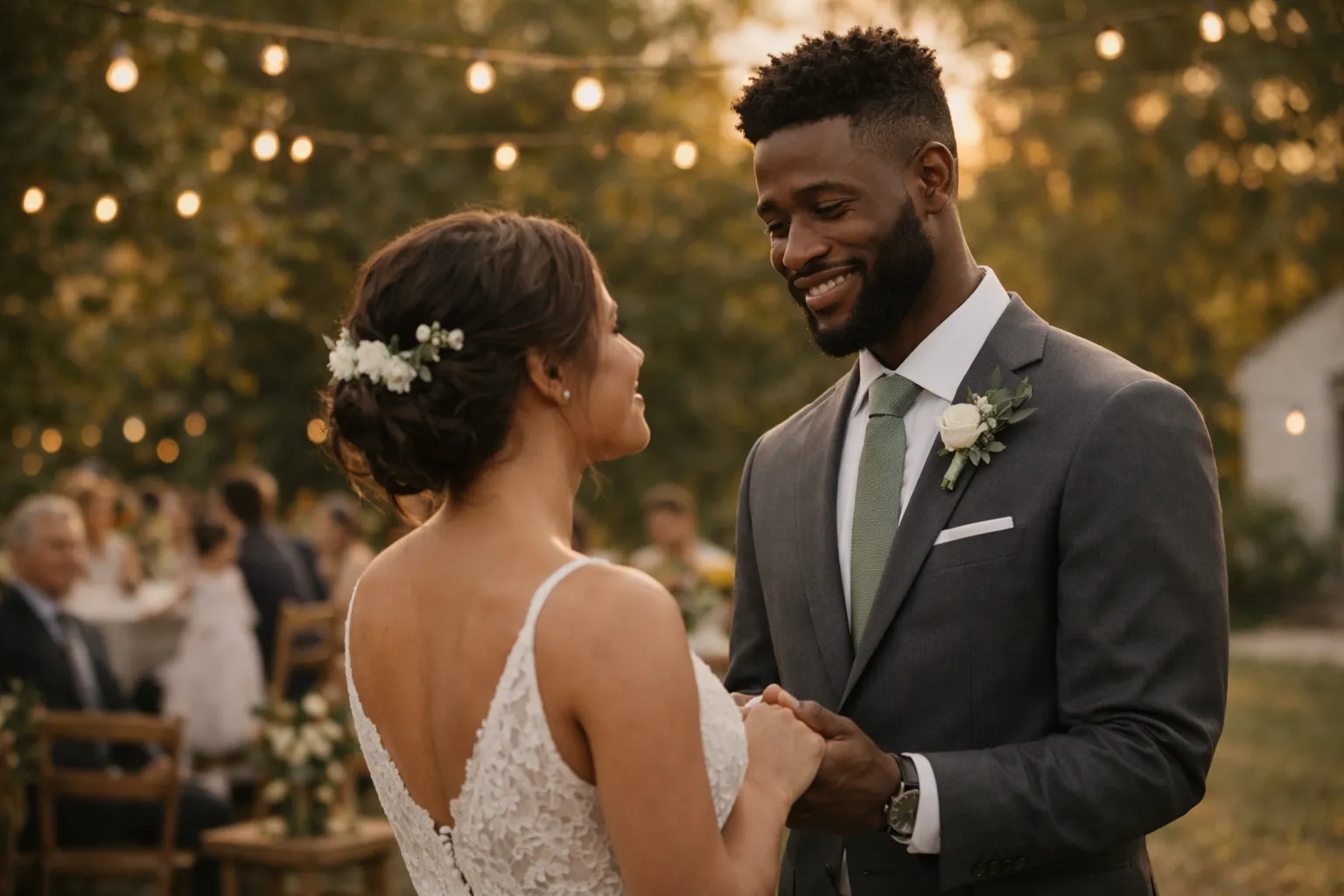
The wedding was held in a small town on the outskirts of Sacramento, in a garden behind a modest white church.
Nothing about it was extravagant. Wooden chairs. Mason jars filled with wildflowers. Yellow ribbons tied by hand. Folding tables beneath strings of little lights that would start to glow when the evening softened. Children ran through the grass. Older women adjusted platters of food. Someone laughed from the catering tent. The air smelled like cut greenery, roasted chicken, and a kind of honest effort no one had hired a planner to fake.
It was simple.
It was beautiful.
I stepped out of my car in an expensive jacket and immediately felt overdressed, though not yet ashamed.
Then I saw the groom.
At first I did not understand what I was looking at. I saw the dark suit, the broad shoulders, the slight unevenness in the stance. Then he turned.
Mark Dawson.
My old friend.
My best friend, once.
Mark had lost his left leg in a car accident during our final year at UCLA. He learned to walk with a prosthetic and a level of grit I had admired at the time without ever fully understanding. He was the kind of man who showed up. The kind who drove me to the airport at three in the morning when my father had chest pains. The kind who cooked in our cramped apartment because Lily and I were both too tired. The kind who stood beside us when Lily and I got married the first time.
I had not spoken to him in years.
In the lazy, ambitious corner of my mind, I had filed him away under a word men like me use too easily: limited.
And yet there he stood — calm, steady, respected — waiting for Lily.
I could not move.
A soft murmur passed through the guests. Heads turned. Then Lily appeared.
She wore a simple ivory dress. No glitter. No excessive train. Her hair was pinned back loosely, with tiny white flowers tucked into it as if someone had placed them there with love instead of strategy. She was not trying to look impressive.
She looked happy.
Not the bright, theatrical happiness people wear when they want to be envied.
Not the tight smile people fix on for photographs.
Real happiness.
The kind that rests in the face and softens it.
When her eyes found Mark, something in her whole body changed — not excitement exactly, but recognition. Relief. Belonging.
I had not seen anyone look at me that way in years.
Maybe ever.
I stayed at the edge of the garden while the ceremony began. I should have left. Instead, I remained there, trapped inside the punishment of clarity, forced to watch what I had once thrown away.
The officiant kept the words short.
Then Mark took Lily’s hands and made his vows.
He did not promise grand things.
He did not perform devotion.
He simply said, in a voice that carried because it was sincere, “I cannot promise you an easy life. But I can promise you that you will never have to carry a hard one alone.”
Several guests wiped their eyes.
Mine burned.
Then Lily spoke.
“With you,” she said, “I have never had to become smaller to be loved.”
That sentence struck me with the clean force of a verdict.
Because that was exactly what I had once done to her.
I had taken a good woman and made her feel as though she needed polishing in order to be worthy of standing beside me. I had mistaken gentleness for a lack of value. I had treated her ordinariness as a flaw instead of the rarest kind of richness.
Now here she was, speaking to a man I had once judged beneath me — a man who had lost a leg and yet somehow become more whole than I had ever learned how to be.
As the ceremony ended and people rose, embraced, laughed, and drifted toward the tables, I overheard two older guests behind me speaking softly.
“Mark built that little house for her himself,” one said. “Board by board.”
The other nodded.
“And when Lily’s mother was sick, he drove her to every appointment before heading to the site. Never complained once.”
I stared straight ahead and felt something in me collapse.
This was the man I had dismissed.
A man who worked with his hands.
A man who had suffered publicly and rebuilt himself quietly.
A man who had done the ordinary, unglamorous labor of loving well.
After the ceremony, I meant to leave before anyone saw me.
But Lily saw me.
For a second, surprise crossed her face. Then something gentler.
Not bitterness.
Not triumph.
Not satisfaction.
Just composure.
She came toward me with Mark beside her.
“Ryan,” she said.
I had imagined this meeting on the drive up. In every version, I had the advantage. I was composed, detached, superior. I knew what to say. I knew how to wear success like armor.
Standing in front of them, I felt like a badly dressed lie.
“Lily,” I said. “Congratulations.”
Mark extended his hand first.
“Good to see you, Ryan.”
I stared half a second too long before taking it.
His grip was firm. Unshowy. Honest.
“You too,” I managed.
Lily looked at me in the old direct way she always had. Not hostile. Not curious. Just clear.
“I hope you’re well,” she said.
There was no cruelty in it.
That was what undid me.
If she had wanted to wound me, I might have defended myself. If she had wanted me to feel small, I could have resisted. But she did not need revenge. She had built a life too real to waste energy punishing a man who no longer belonged in it.
I left before the meal.
I drove back to San Francisco with the radio off and both hands fixed to the wheel as if I were holding myself together by force. When I got home, the apartment was dark. Amanda was away at some fundraiser I had forgotten to attend. The city shone through the glass in all its cold, expensive perfection. My jacket slipped from my hand and landed on the floor.
And for the first time in many years, I cried.
Not because Lily had married a working man.
Not because she had moved on.
Not because I suddenly wished she still belonged to me.
I cried because I had finally seen, clearly and without excuse, the measure of my own failure.
The man I once dismissed had become the kind of husband I should have been.
The woman I once underestimated had chosen wisely the second time.
And I, with all my polish and money and carefully curated evidence of success, had become the poorest person in that garden.
I did not write Lily afterward.
Some apologies arrive too late and serve only the conscience of the one offering them.
But I did begin, slowly, to change the part of the story still in my hands.
I stopped using money as a mirror.
I stopped mocking ordinary lives.
I stopped mistaking access for worth.
I learned, late, that listening is harder than impressing, and that respect is rarer than status.
When I think of Lily and Mark now, I do not feel jealousy.
I feel instruction.
They taught me something without ever intending to teach me at all: a man’s worth is not measured by the salary he brings home, the car he parks outside, or the titles arranged neatly after his name. It is measured by whether the people who love him feel smaller in his presence — or safer.
Money can buy comfort.
It can buy access.
It can buy the illusion of importance.
But it cannot buy the look Lily had in her eyes when she took Mark’s hand.
And by the time I understood that, the lesson had already cost me the only woman who had once loved me for free.