For two years, Michael Harrison had spent fortunes trying to make his son walk again, only to watch hope drain from the boy’s face one cautious day at a time. Then a thin child with sunburned skin, worn clothes, and a dented metal basin climbed over the estate fence and said the impossible with the calm certainty of someone who had already suffered enough to stop fearing rich men: “I’m going to wash his feet. And he’s going to walk.”
For two years, twelve-year-old Ethan Harrison had not stood on his own feet.
The fall from the old oak tree behind the Harrison estate had shattered more than part of his spine. It had altered the rhythm of the entire house. Before that afternoon, the place had been noisy in the ordinary ways families are noisy — doors slamming, a dog scratching at the kitchen door, piano notes struck badly and too often, a boy racing down hallways faster than he was allowed.
After the accident, the house became careful.
Too careful.
Voices lowered.
Footsteps softened.
Doors closed more gently.
Even laughter, when it happened, sounded as though it had first asked permission.
Specialists came from Boston, Zurich, London. Screens glowed with scans. Men and women in expensive coats used polished, expensive caution to explain the same grim truth in different language: the injury was severe, the damage extensive, the prognosis uncertain, the odds poor.
Michael Harrison listened to them all.
At fifty-three, he had built his life on the belief that pressure, speed, intelligence, and money could solve almost anything if applied hard enough. He knew how to rescue failing deals, salvage public disasters, rebuild reputations, and make problems smaller by throwing resources at them.
But grief would not negotiate.
He bought the equipment.
He flew in the surgeons.
He financed the therapies.
He signed every check before anyone could finish asking.
None of it brought the light back to his son’s face.
One late September afternoon, Michael stood in his study overlooking the rear lawn when he saw something so strange that for a second he thought fatigue had tricked him.
A boy was climbing over the back fence.
He could not have been older than eleven. He was thin, sun-browned, and dressed in a shirt that had been washed so many times it no longer remembered its original color. In one hand he carried a dented metal basin.
He jumped down onto the grass, steadied himself, and began walking calmly across the lawn as if large estates, private security, and the invisible lines between worlds had nothing to do with him.
Michael was already moving by the time the boy reached the terrace.
Ethan sat there in his wheelchair under a blanket, staring out at the garden with the flat stillness of someone who no longer expected the world to offer him anything.
“Hey!” Michael shouted. “What do you think you’re doing?”
The boy looked up at him without fear.
“I came for him,” he said, nodding toward Ethan.
Michael’s jaw tightened.
“You are on private property.”
The boy set the basin down beside the wheelchair.
“I’m going to wash his feet,” he said, with complete seriousness. “And then he’s going to walk.”
Michael almost called security on the spot.
But before he could speak, Ethan lifted one hand.
“Dad,” he said quietly, “please. Let him talk.”
It was the first time in weeks that Ethan had sounded curious about anything at all.
That alone stopped Michael.
The boy straightened.
“My name is Lucas Bennett,” he said. “My grandma used to say that sometimes the feet forget the ground before the heart does. She said when that happens, you start with the feet.”
Michael stared at him.
“That makes no sense.”
Lucas shrugged.
“Maybe not to you.”
Something at the corner of Ethan’s mouth moved.
Not quite a smile.
But close enough to hurt.
Lucas lifted the basin slightly.
“Can I try?”
Michael should have said no.
He should have sent the child away, called the guards, and shut the gate more tightly against whatever this was — desperation, superstition, intrusion, madness.
Instead, against every reasonable instinct in him, he said, “Five minutes.”
Lucas filled the basin at the outdoor tap, added a pinch of salt from a folded paper packet in his pocket, and knelt in front of Ethan’s chair. His movements were small, careful, practiced. He eased Ethan’s feet out of their supports and lowered them into the warm water as if they were not ruined limbs but tired ones.
Then he began to rub them.
Not theatrically.
Not like a mystic in a story.
Like a child who had watched someone do this with love and remembered exactly how.
He pressed the arches.
The heels.
Each toe.
The base of the ankle.
Under his breath, he hummed a tune old enough to belong to another house, another kitchen, another woman who had known how to care for pain without talking too much about it.
After a while he said, “Close your eyes.”
Ethan obeyed.
“What do you miss?” Lucas asked.
Ethan frowned.
“What?”
“In your feet,” Lucas said. “What do you miss?”
Ethan was silent a long time.
Then, with his eyes still closed, he said, “Grass.”
Lucas nodded.
“What else?”
“The edge of the pool in summer,” Ethan whispered. “And hot pavement.”
Lucas kept working.
When he was done, he dried Ethan’s feet with the edge of his own shirt and stood.
“That’s enough for today,” he said.
Michael folded his arms.
“And that was supposed to accomplish what, exactly?”
Before Lucas could answer, Ethan drew in a sharp breath.
“There’s… something.”
Michael turned so fast he nearly knocked the basin over.
“What do you mean?”
Ethan’s eyes were wide now.
“Pins and needles,” he whispered. “Like when your leg falls asleep. Just for a second.”
Michael went still.
He knew what such a sensation could mean.
And what it might not mean.
He knew better than to confuse hope with proof.
But it was the first time in months his son had reported feeling anything below the knee.
Lucas picked up the basin.
“I’ll come tomorrow at four,” he said.
“You will do no such thing,” Michael snapped.
But Ethan looked up at him, more awake than Michael had seen him since the accident.
“Dad.”
Just that.
One word.
One plea.
One small, unbearable sign that his son wanted something again.
Michael exhaled.
“Tomorrow,” he said stiffly. “At four.”
Lucas nodded as if this were the most natural arrangement in the world, then climbed back over the fence the way he had come.
He returned the next day.
And the next.
Every afternoon at four o’clock, Lucas appeared with the basin.
He washed Ethan’s feet.
Massaged his calves.
Moved his toes gently by hand.
Asked him strange, simple questions about memory and sensation.
What does wet grass feel like?
What does cold tile feel like in winter?
What does gravel do under bare feet?
What do you miss most?
Sometimes Ethan talked.
Sometimes Lucas did.
Sometimes they sat mostly in silence while the water cooled.
What changed first was not Ethan’s body.
It was the house.
Ethan started asking what time it was.
He started waking before noon.
He began doing the therapy exercises he had been refusing for months.
When the physical therapist came and found Ethan actually trying — really trying — she stopped midway through her notes.
“What changed?” she asked.
Michael looked toward the terrace, where Lucas was rinsing out the basin.
“I’m still trying to understand that myself.”
Within three weeks, Ethan moved two toes on his left foot.
It was almost nothing.
The kind of progress that would not impress strangers or make headlines.
But men like Michael, who had spent too much money chasing miracles, eventually learned the value of small things.
The therapist adjusted the plan.
A spinal specialist reviewed the change and called it modest but meaningful.
“The boy didn’t perform magic,” the doctor said carefully. “But he restored engagement. Hope changes compliance. Compliance changes outcomes.”
Michael heard the words.
Still, he kept thinking of Lucas.
The child never arrived by car.
Never asked for money.
Never stayed for dinner, no matter how often he was offered.
If Ethan insisted on sharing food, Lucas took it, but even then he often tucked half into his pocket “for later.”
One rainy Thursday, Lucas’s hands shook so badly he nearly dropped the basin.
“You’re freezing,” Ethan said.
“I’m fine.”
“You’re not,” Michael said. “Sit down.”
Lucas stood still for a second, as if deciding whether he could afford disobedience.
Then his knees gave way.
He collapsed before anyone reached him.
At the hospital, the doctor’s face hardened as soon as the bloodwork came back.
“Severe anemia,” she said. “Malnutrition. Exhaustion. This child has been pushing his body far past what it can safely do.”
Michael stared through the glass at Lucas sleeping in the hospital bed, an IV in his arm, his face suddenly so young that it was painful to see.
“How long?” he asked.
The doctor looked at him.
“Long enough that someone should have noticed.”
The words struck him like a slap.
That night Michael found Lucas’s mother.
Rosa Bennett lived in a weather-beaten rental cottage less than three miles from the estate, hidden behind a row of storage yards and a car wash. She worked double shifts cleaning offices and had spent months trying to keep the place standing after her own mother died that spring.
Lucas’s grandmother, Michael learned, had raised him through most afternoons and evenings. She was the one who had used warm salt water and rubbing to soothe tired feet after long workdays. She had taught the boy that healing often begins with touch, patience, and reminding the body it still belongs to the earth.
Rosa stood in the doorway looking exhausted and ashamed.
“I told him not to trouble rich people,” she said quietly. “But he said the boy in the chair looked lonelier than hungry.”
Michael had no answer for that.
He looked past her into the dim little house — the patched roof, the medicine bottles by the sink, the thin mattress on the floor, the evidence of careful survival everywhere — and for the first time in many years, his wealth did not make him feel powerful.
It made him feel indicted.
He paid for Lucas’s treatment.
Not dramatically.
Not publicly.
Not as a story about generosity.
Because there was no decent excuse not to.
He arranged repairs on the cottage.
He hired Rosa into a full-time logistics position at one of his care properties.
He set up a trust for Lucas’s schooling.
When Lucas woke and learned what Michael had done, he looked embarrassed.
“I didn’t come for money,” he said.
Michael pulled a chair close to the bed.
“I know.”
Lucas frowned.
“Then why are you helping us?”
Michael was quiet a long time.
Then he said, “Because I’m starting to understand what it cost you to help my son.”
Lucas looked away.
“It wasn’t my strength,” he said softly. “I just kept coming.”
Michael nodded.
That was exactly what had undone him.
Not genius.
Not power.
Not miracle.
Just the humiliating, beautiful fact that a hungry child had given his son the one thing money had failed to buy: patient human devotion.
When Lucas was strong enough to leave the hospital, Ethan asked for him that same afternoon.
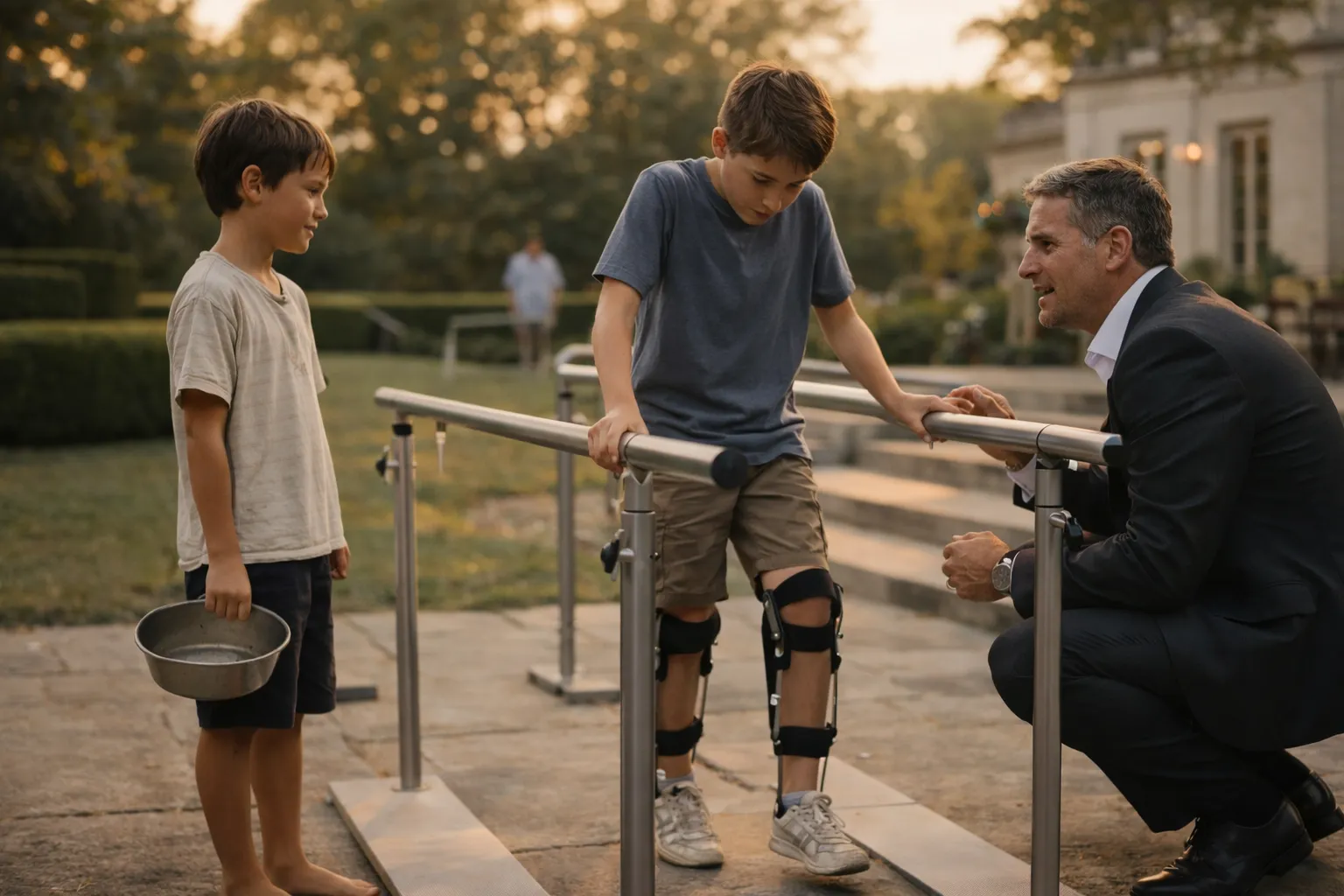
By then Ethan was working between parallel bars. His legs still shook. Braces held what muscles could not yet hold. But now he fought.
Lucas came into the rehab room carrying the basin again.
Michael almost laughed when he saw it.
“You still brought that thing?”
Lucas looked down at it.
“My grandma used to say you don’t stop a good habit just because rich people own better equipment.”
For the first time in two years, Michael laughed in front of his son without forcing it.
That evening, at Lucas’s request, they wheeled Ethan onto the terrace under a pale rising moon. The air was cool. The lawn smelled of cut grass and damp earth.
Lucas set the basin down and looked at Michael.
“You do it tonight.”
Michael blinked.
“Do what?”
“Wash his feet.”
Michael hesitated.
Lucas held his gaze.
“You can’t hire everything out forever.”
So Michael knelt.
The stone pressed cold through his trousers. He lifted his son’s feet — thinner than they used to be, scarred by two years of stillness — and lowered them into the warm water.
His hands trembled.
Not because the feet were heavy.
Because the moment was.
When he dried Ethan’s feet, Ethan looked at him differently than he had in months.
Not as a broken son staring at a father who could not fix him.
But as a boy watching his father finally enter the grief instead of managing it from a distance.
Then the therapist locked Ethan’s braces, took one side, and Michael took the other.
Ethan pushed upward.
His face tightened.
His arms shook.
His mouth opened in a silent cry of effort.
For one terrible second Michael thought he would fall.
Then Ethan stood.
Not straight.
Not steady.
Not beautifully.
But upright.
Michael made a sound that was half laugh, half sob.
Ethan took one step.
Then another.
Dragging, uneven, incomplete steps — but steps.
When he reached Lucas, he stopped, breathing hard. His eyes were wet.
“My pain belongs to me now,” Ethan said softly. “You don’t have to carry it anymore.”
Lucas smiled, tired and bright all at once.
“I never carried it,” he said. “I just reminded you it was still yours to fight.”
Michael turned away then, just for a second, because he could no longer see clearly.
Recovery did not happen in a single night.
That was another lesson.
There was no instant miracle.
There were months of rehab, setbacks, plateaus, anger, tiny victories, more anger, and then victories so small they would have looked like nothing to anyone who had not lived through the months before them.
Ethan first walked with braces.
Then crutches.
Then a cane.
Later, on good days, he crossed short distances on his own.
But the night he first stood became the line between before and after.
Michael changed too.
One of his planned luxury developments was quietly canceled. In its place, he funded a rehabilitation and community care center on the edge of the city — one wing for pediatric mobility therapy, another for families who had nowhere stable to stay while their children recovered.
He named it the Bennett Center.
Lucas protested.
Michael ignored him.
Years later, Lucas entered medical school on a scholarship Michael made sure would never run out. He wanted to study rehabilitation medicine and community health — to bring together the old wisdom his grandmother had lived by and the kind of care poor families usually received only after damage had become harder to undo.
Ethan, taller now and walking with only the slightest unevenness on long days, volunteered at the center every summer. He liked telling younger children the truth no one had told him in the beginning:
that progress is not what comes back all at once.
It is what returns one stubborn inch at a time.
One evening, long after the worst was over, Michael stood outside the Bennett Center and watched the two boys — no longer boys, not really — crossing the courtyard side by side.
He thought of the afternoon Lucas had climbed over the estate fence carrying that dented metal basin.
At the time, Michael believed the child had come to heal his son.
He understood better now.
Lucas had crossed that fence to heal everything wealth had hidden from him:
his son’s despair,
his own helplessness,
the blindness that had let suffering live only a few miles away and still seem invisible.
The basin had never held a miracle.
It had held warm water, salt, patience, and the kind of love that costs something.
And in the end, Michael learned what no specialist had been able to teach him:
sometimes healing begins not when the body changes,
but when one human being refuses to let another disappear.