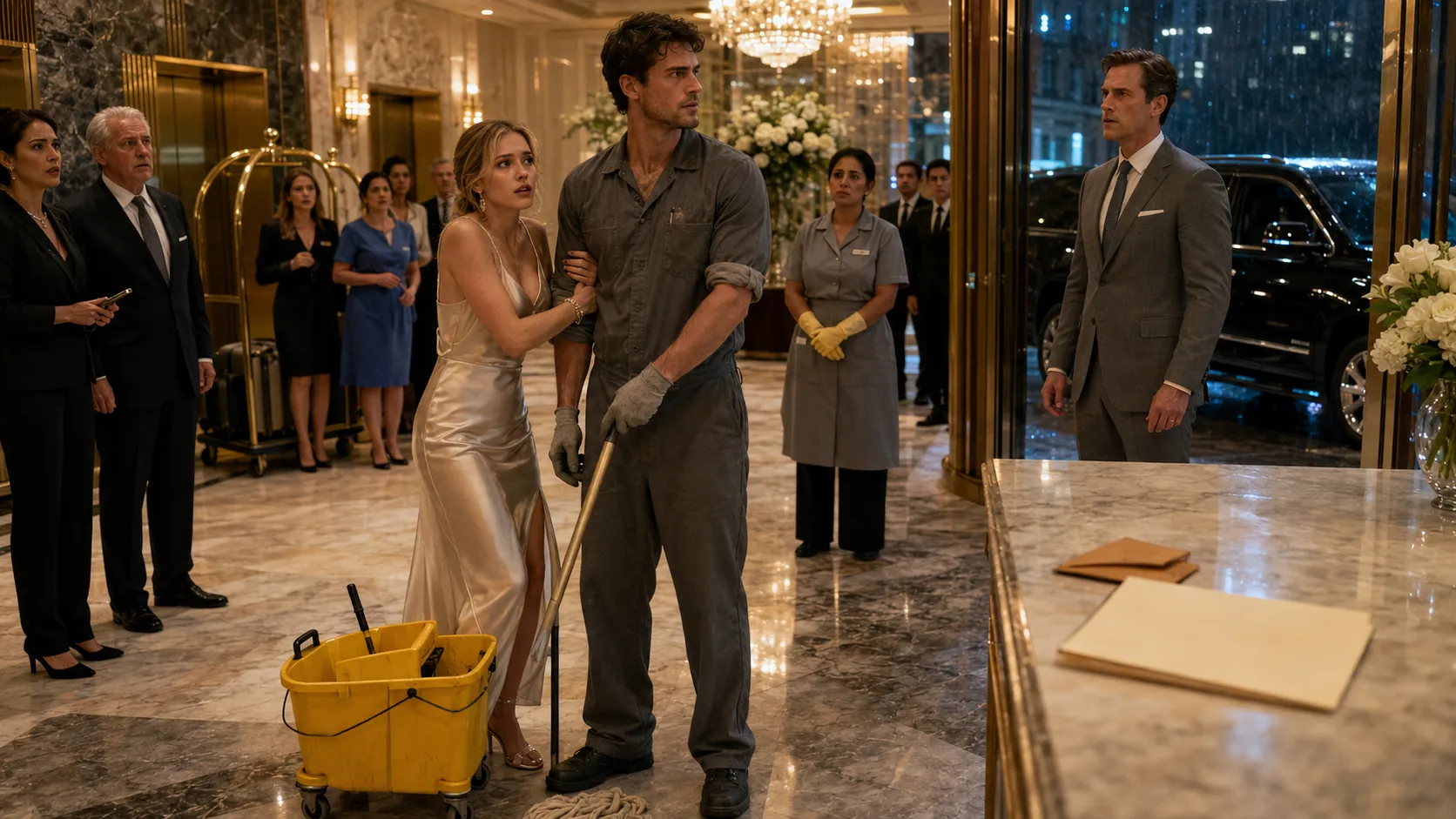
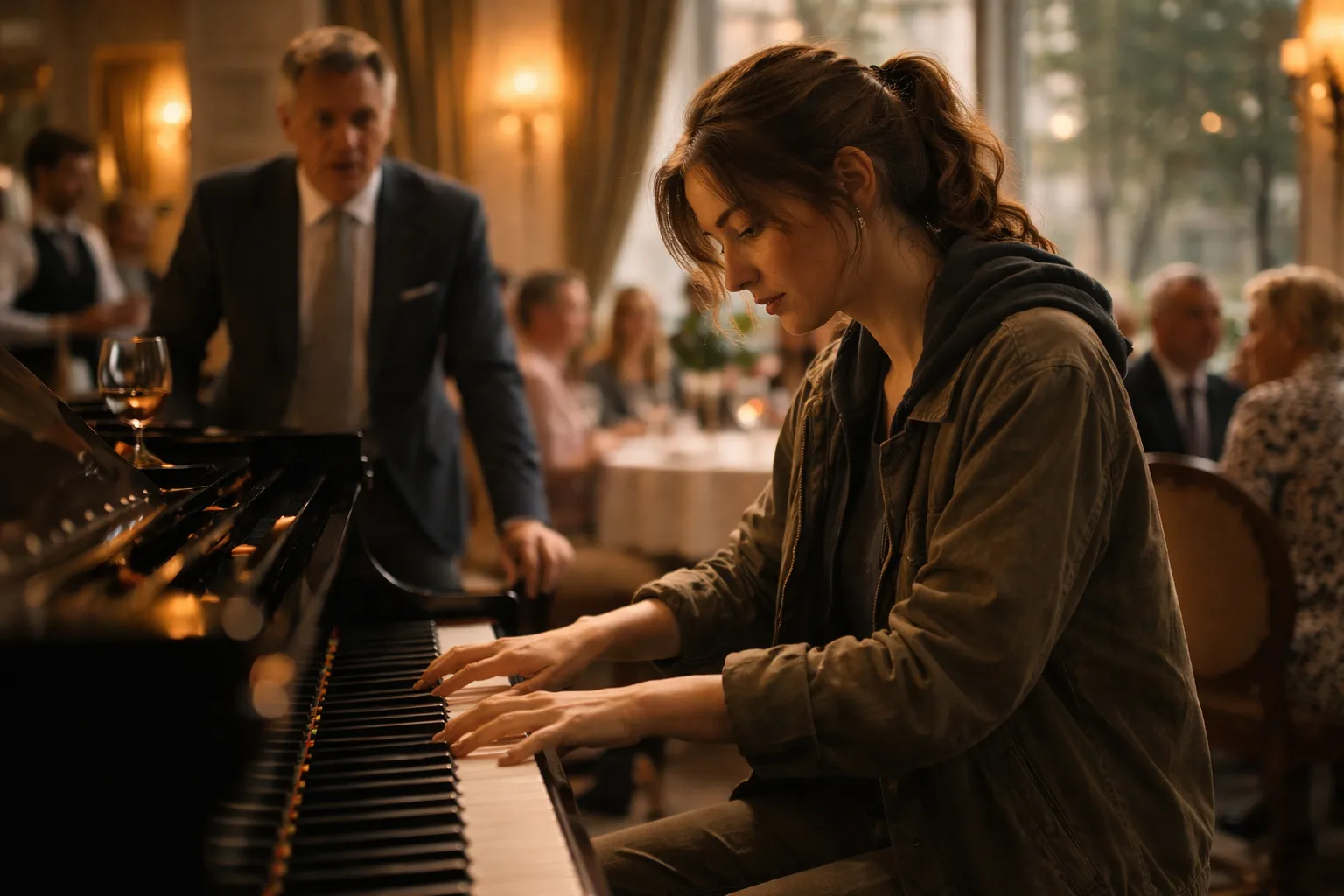
Sophia Carter walked into the Meridian Grand looking for dishwashing work, not dignity, applause, or rescue. But when a billionaire decided to turn her hunger into public entertainment, he accidentally put a lost prodigy back in front of a piano — and the whole room was forced to witness what real worth sounds like.
Eight months had passed since Sophia Carter had last slept in a real bed.
Eight months since the accident had taken not only her parents, but the life that made sense around them. At nineteen, she had learned something quickly and cruelly: hunger strips a person in layers. First comfort. Then certainty. Then pride. Then, if no one interrupts it, the quiet belief that you still deserve to be looked at as fully human.
That Tuesday morning in New York arrived with the kind of damp cold that slips through worn fabric and settles into the bones. Sophia pulled her jacket tighter around herself. It had once been a bright, cheerful blue; now it was the dull gray of weathered pavement. Her sneakers were soft at the soles and split near the toes. She had not eaten since the afternoon before.
Usually she would have gone toward the shelter kitchen by noon.
That day, something inside her — pride, maybe, or simple desperation sharpened into recklessness — pushed her somewhere else.
She stopped in front of the Meridian Grand Hotel.
Through the towering glass windows, she could see everything that did not belong to her anymore. Marble floors polished to a mirror. Waiters in crisp black vests moving like choreography. Guests who never had to glance at price tags. In one corner of the restaurant, lit by warm gold lamps, stood a black Steinway grand piano.
The sight of it sent a cramp through her fingers.
Not from the cold.
From memory.
Her hands — rough now from cleaning floors, carrying crates, and taking whatever temporary work she could get — still remembered the weight of scales, the distance between octaves, the discipline of repetition. They remembered the life she had once been building before hospitals, debt, funeral clothes, and eviction notices erased the shape of everything.
Inside, Jonathan Whitmore held a glass of red wine that cost more than Sophia usually spent on food in three months.
At fifty-five, Jonathan was the sort of man people admired for the wrong reasons. He believed in winning, in standards, in polished shoes and hard opinions. He wore tailored suits like armor and used his deep, measured voice the way other men used fists. More than anything, he believed poverty revealed character — not circumstance.
“No one wants to earn their bread anymore,” he was saying to a business partner as Sophia stepped through the revolving door. “They all want sympathy before effort.”
The maître d’ looked up and saw her at once.
He did not bother with professional ambiguity.
“I’m sorry, we’re full,” he said before she had spoken a word.
“I’m not looking for a table,” Sophia answered quietly. Her voice was hoarse from cold and disuse. “I wanted to ask if you need help in the kitchen. Washing dishes. Cleaning. Anything. I’m a hard worker.”
The man’s expression changed from annoyance to open distaste.
“Miss, this isn’t the place for that. Try the fast-food place on the corner. Please leave before I call security.”
A few diners had already turned.
Sophia felt heat rise to her face — that familiar poison made of shame and anger and the exhaustion of having to stand upright while strangers decide what you are worth.
She was about to turn away when a voice cut cleanly through the room.
“Wait.”
Jonathan Whitmore had risen from his table.
He approached with the easy confidence of a man who expected space to open for him wherever he went. The maître d’ straightened immediately. Several guests pretended not to stare. Jonathan looked Sophia up and down as if examining an item brought to him for evaluation.
“So,” he said, “you want to work.”
Sophia met his eyes.
“I’ll do whatever is necessary, sir.”
“Whatever is necessary,” Jonathan repeated, smiling with only his mouth. “Everyone says that until they’re asked to prove it.”
The room grew quieter.
He enjoyed that. Sophia could see it at once. This was not generosity awakening in a rich man. This was performance. He wanted an audience. He wanted to confirm something he already believed about people like her.
He turned and pointed toward the piano.
“Entertainment matters in a place like this,” he said. “That instrument has been collecting dust because nobody plays anything decent anymore. If you can sit down there and play something — anything worth listening to — I’ll buy you a full meal. You’ll earn it.”
A few people chuckled.
Jonathan let the moment breathe, then added loudly enough for the room to hear,
“Unless, of course, you can’t. In that case, let’s not pretend this is about work. The door is still available.”
Humiliation hung in the air like smoke.
Some guests smiled into their glasses. Others looked embarrassed but not enough to intervene. A woman near the window had already lifted her phone, sensing spectacle.
Sophia glanced down at her hands.
Her nails were uneven.
The skin along her knuckles was dry and cracked.
These were not the hands people expected to see on a Steinway.
Then she thought of her father.
Not the accident.
Not the hospital.
Not the silence afterward.
Her father on an ordinary afternoon years earlier, standing beside the piano while she struggled through a difficult passage, smiling and saying, Music is your voice when words fail. So when the world tries to shrink you, don’t speak smaller. Play bigger.
She lifted her chin.
“I’ll play,” she said.
Jonathan laughed softly and returned to his table with a dismissive wave, already tasting his victory.
“Go on, then,” he said. “Maybe start with something simple.”
Sophia walked toward the piano.
Every step felt heavier than the last. She could feel the eyes on her — wealthy strangers judging the dirt on her shoes, the frayed hem of her sleeves, the audacity of her body in a room not built for it.
But the closer she came to the instrument, the less the room mattered.
She sat down.
The bench gave a faint creak. In the black gloss of the Steinway, she caught her reflection: a thin homeless girl with hollow cheeks and tired eyes. For one terrible second she thought Jonathan had been right. That all the years between then and now had broken the bridge back.
Then she placed her hands above the keys.
And everything became still.
Jonathan was already leaning back, preparing his next cruel remark. He expected fumbling. Hesitation. A simple tune played badly enough to justify the lesson he had decided to teach.
Sophia chose Chopin.
Not because it was safe.
Because it wasn’t.
She chose the piece that felt most like her life had felt inside her body these last eight months — furious, relentless, wounded, defiant.
She chose the “Winter Wind.”
The opening notes were soft enough to be mistaken for uncertainty.
Jonathan raised one eyebrow, confused.
Then her right hand exploded across the keyboard.
The sound struck the restaurant like weather.
Not pleasant background music.
Not a trick.
Not a lucky memory.
Power.
The room froze.
Jonathan’s fork stopped halfway to his mouth.
A waiter halted with a tray lifted in one hand.
The woman filming lowered her phone, then raised it again — not to mock, but because she had just realized she was witnessing something extraordinary.
Sophia did not play for the room.
She played through it.
She played for every freezing dawn she had walked through half-starved.
For every night she had talked to her parents in silence because there was nowhere else to put the grief.
For the humiliation of being measured by her coat before her voice.
For the fury of talent surviving in a body the world had already dismissed.
The piano roared under her fingers.
Her left hand drove the piece forward with thunderous force. Her right hand flashed like broken weather. The sound built and climbed and tore through the smug stillness of the Meridian Grand until the entire dining room felt too small to contain it.
A silver-haired man at a corner table stood up so abruptly that his chair scraped the floor.
“My God,” he whispered. “That’s Chopin.”
Not just played well.
Played truly.
That is rarer.
It was not perfection in the fragile, careful sense. It was something stronger: command. Interpretation. Pain disciplined into beauty. The kind of playing that tells anyone who understands music that the performer has not merely studied the piece, but survived enough to mean it.
Jonathan began to sweat.
This was not the outcome he had invited.
This was not a humiliation he controlled.
One by one, people in the room stopped pretending they were detached. A woman near the bar began to cry without seeming aware of it. The restaurant manager stepped out from his office and stood rooted near the host stand. Even the kitchen staff edged toward the door, drawn by the impossible force of what was happening in the dining room.
Sophia’s body moved with the music now. Not dramatically, not for show — simply with total commitment. She was no longer a girl being tested for a meal. She was a pianist inside the storm she had chosen.
Jonathan finally tried to interrupt.
“That’s enough,” he called out too loudly. “You’ve proved your point. She’s earned her meal.”
No one listened.
A man from the back of the room turned in his chair and snapped, “Be quiet and let her finish.”
The room belonged to Sophia now.
And Jonathan knew it.
She drove the piece toward its climax with a force that seemed impossible for someone who had walked into the hotel thin with hunger. Every scale was sharp with memory. Every chord landed like something pulled up from the bottom of her life and made undeniable.
Then came the last great rush.
One final sweeping ascent.
One terrible, beautiful collision of power and control.
One closing chord struck with everything she had left.
Silence followed.
Not awkward silence.
Shock.
Three long seconds passed in which no one in the room seemed to remember how applause begins.
Then the restaurant erupted.
People stood.
Not politely.
Not because wealth trained them to reward spectacle.
Because they could not remain seated after what they had just heard.
The applause came like weather after weather. A full, thunderous standing ovation that shook cutlery, glasses, and every assumption Jonathan Whitmore had carried so comfortably into that afternoon.
Sophia turned on the bench, stunned.
She saw the room on its feet.
Saw tears on strangers’ faces.
Saw Jonathan sitting down at last, pale and stripped of the certainty that had protected him a quarter hour earlier.
Then the silver-haired man approached her.
He was elegant, but not in the soft, decorative way of the room. His face had the intensity of someone who had spent a life listening harder than other people.
“Miss,” he said, and his voice was trembling slightly, “I’m Dr. Bennett. New York Conservatory.”
Sophia stared.
He leaned closer.
“Did you study with Elena Vázquez?”
At the name, something flickered painfully through her.
“Yes,” she said. “Before the accident.”
Dr. Bennett exhaled as though a thought he had been afraid to trust had just become real.
“I knew it,” he said. “That phrasing in the left hand — that attack — she taught discipline exactly that way.” He looked at her more fully. “You have not lost what they think you’ve lost.”
Jonathan stood then, trying instinctively to reenter the story as something other than its villain.
“Well,” he said too loudly, “I’m glad I could provide the opportunity—”
A journalist near the bar turned toward him with open disgust.
“You didn’t provide an opportunity,” she said. “You tried to humiliate a hungry girl in public. All you did was show the room how small you are.”
Several people heard.
Several more agreed.
Jonathan stopped talking.
The video was everywhere before sunset.
Not because the internet loves classical music.
Because it loves reversal.
And because once in a while reversal deserves to go viral.
By evening, clips of “the homeless girl at the piano” were ricocheting across platforms. By midnight, people had given her a name the media could use before they learned her real one:
The Meridian Pianist.
But for Sophia, the night did not become magical.
It became practical.
Dr. Bennett did not offer platitudes. He offered contact numbers, a hot meal, and a direct question:
“Do you have anywhere safe to sleep tonight?”
She shook her head.
He nodded once, already deciding.
By morning, she had a room in a women’s residence arranged through a conservatory donor, a proper coat, and an appointment to play for a small committee three days later — not because of pity, but because professionals who knew what they had heard wanted to verify the truth with their own ears.
Andrew Collins, director of the Philharmonic, did not burst dramatically through a restaurant door that night.
He saw the video the next morning, called Dr. Bennett by noon, and asked for one thing:
“If she’s real, bring her in.”
She was.
Six months later, Sophia Carter walked onto the stage at Lincoln Center in a black concert gown that fit her like a life returned rather than a fantasy borrowed.
The hall was sold out.
In the front row sat Dr. Bennett, hands folded, trying not to look emotional and failing. Beside him sat Andrew Collins, who had stopped calling her “that girl from the video” after the second rehearsal and started calling her by name.
Critics were already trying to write the story for the public: lost prodigy, miracle comeback, genius from the street.
They were all too simple.
Sophia knew better than anyone that talent had not saved her.
Talent had merely survived her.
Now she sat at the piano and looked out over the sea of waiting faces.
This time she was not playing to prove she deserved food.
Not playing to silence a cruel man.
Not playing to earn one night’s mercy.
She was playing because the voice she thought she had buried with her old life had come back.
And because once it returned, she owed it honesty.
When the hall went completely silent, she let herself think of that cold morning outside the Meridian Grand.
Of the revolving door.
Of the smell of coffee and polished wood.
Of Jonathan Whitmore’s smile when he thought he had found something easy to crush.
Then she smiled.
Just once.
And placed her hands on the keys.
By the time the first note sounded, she no longer needed revenge.
She had something far better.
Her voice back.