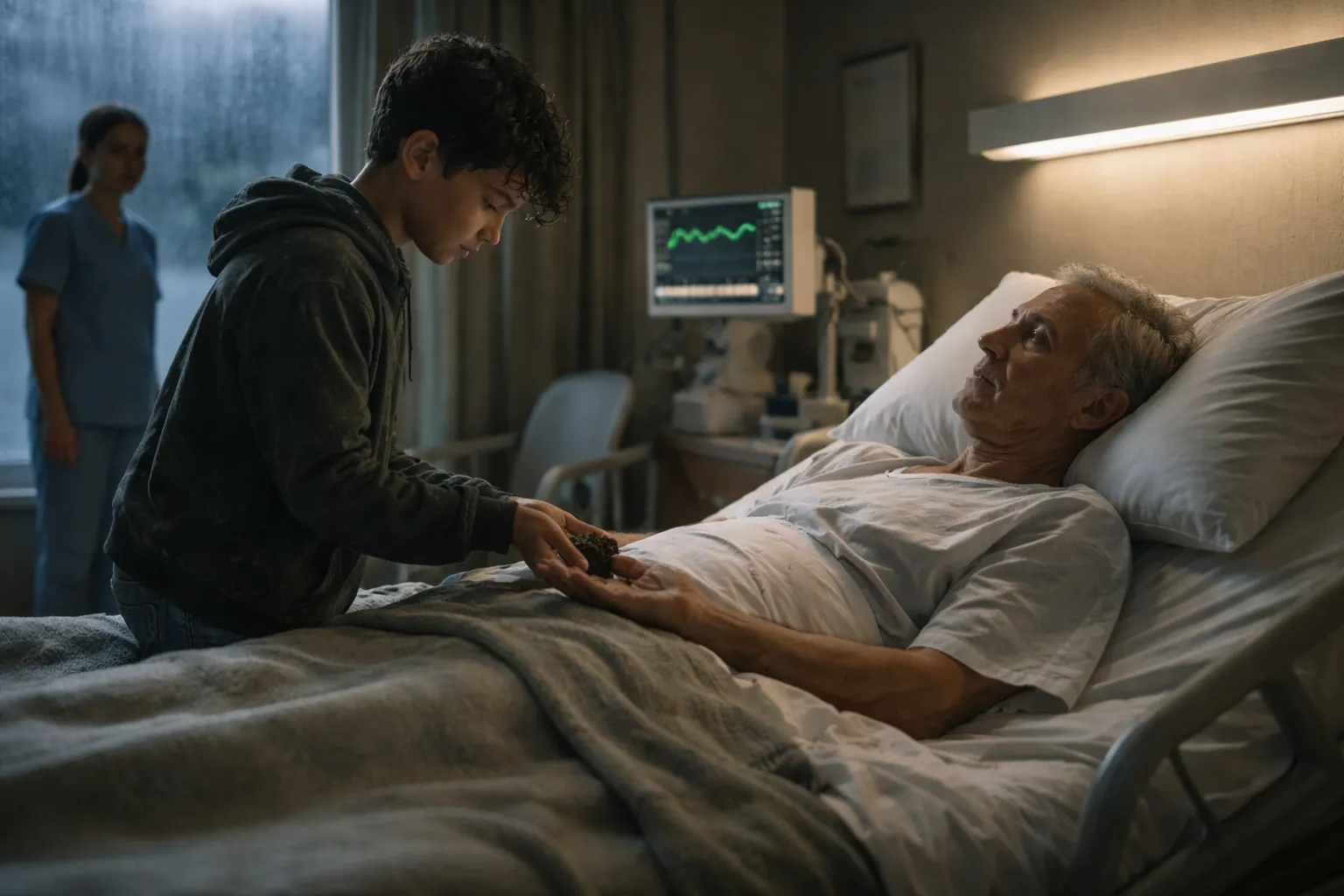
Leonard Whitmore had outspent grief, outlived hope, and outlasted every specialist money could summon, yet he remained silent in a private hospital room while the world slowly learned to call that silence permanent. Then, on a storm-dark afternoon, an eleven-year-old boy slipped into Room 701, pressed wet earth into Leonard’s hand, and reached the one place medicine had not been able to find.
For ten years, the man in Room 701 had not spoken a word.
Machines breathed for the room around him. Monitors drew patient green lines across black screens. Doctors entered with careful voices, nurses adjusted blankets with the practiced tenderness of people who had learned to preserve dignity even when hope had become complicated, and still the man in the bed remained suspended somewhere between life and absence.
His name still carried weight beyond the hospital walls.
Leonard Whitmore.
Founder.
Billionaire.
Industrial giant.
The sort of man whose signature had once moved markets and whose calendar had once frightened grown men more than weather, illness, or God.
Now he lay in a high-windowed room at the top of a private neurological wing, pale and motionless beneath clean sheets, as silent as a winter field.
No one had declared him dead.
No one had even declared him fully gone.
Medicine had colder, more cautious phrases for men like Leonard now: prolonged disorder of consciousness, minimal responsiveness, uncertain prognosis.
The language was honest.
After ten years, honesty had begun to sound dangerously close to surrender.
That morning, a team of specialists gathered outside his room to discuss what came next.
Not an end.
Nothing so dramatic.
Nothing mercifully final.
Just a change.
No more experimental stimulation programs.
No more visiting elite consultants flown in at absurd expense.
No more pretending that wealth could force time backward if it only spent enough.
Leonard would be moved out of the acute wing and into long-term supportive care.
The decision was medically reasonable.
It still felt like grief.
Outside, a storm rolled over the city just after lunch, turning the sky the color of old pewter. Rain slapped hard against the hospital windows. Gutters overflowed. Water ran black along the curbs.
That was the afternoon Malik wandered into Room 701.
Malik was eleven, narrow-shouldered, quick-eyed, and old in the ways poverty makes children old. His mother, Rosa, worked evening shifts cleaning offices and hospital corridors. After school he sat in waiting rooms, finished homework in lobbies, and learned exactly which nurses smiled back and which security guards pretended not to notice him as long as he stayed quiet.
He knew the hospital better than most visitors.
He knew where the vending machines ate dollars.
Which hallways stayed warm.
Which corners smelled like bleach and loneliness.
Which doors were forbidden.
Room 701 was one of them.
Still, he had passed it many times.
He had seen the man inside with the still face and expensive silence around him. To Malik, it had never looked like sleep.
It looked like being left behind.
That day he came in soaked. One sneaker had split at the side, and the hem of his pants was dark with rainwater and mud from the strip of earth behind the staff parking lot where he often cut through to escape the wind. Security had been pulled toward the loading entrance because a delivery truck had gotten stuck in the storm. The corridor outside Leonard’s room stood empty.
The door was half open.
Malik stopped on the threshold.
Then stepped inside.
Leonard Whitmore looked the way he always did: pale, still, clean in the sterile way long illness makes people look. The room smelled faintly of antiseptic, filtered air, and flowers replaced too often to have any real scent. Rain drummed against the windows as if the weather itself wanted in.
Malik moved closer to the bed.
For a moment he just stood there, looking.
Then he spoke in the quiet, respectful way children sometimes speak to the very old or very sick.
“My grandma was like this for a while,” he said softly. “Not this long. But people talked over her like she was furniture.”
There was no response.
Malik pulled a chair closer and sat down.
“They thought she couldn’t hear. But I used to tell her stuff anyway. About the weather. About the bus. About spelling tests. About kids at school. One day she squeezed my finger. Not hard. Just enough.”
He looked at Leonard’s hands resting on the blanket.
Big hands.
Heavy hands.
Hands that had once built empires and signed contracts and pointed men into motion.
Now still.
Thunder rolled outside.
Malik leaned in.
“I think being stuck and hearing everyone give up on you must be the loneliest thing in the world.”
He reached into his pocket and pulled out a crumpled napkin. Inside was a small clump of damp earth from the garden strip behind the lot, dark with rain and smelling sharp and alive.
He looked down at it, then back at Leonard.
“Don’t be mad,” he murmured. “My grandma used to say the ground remembers us. Even when people forget.”
Very gently, Malik placed the wet earth into Leonard’s open palm and folded the old man’s fingers over it.
When the hand would not keep its shape, Malik rubbed a little of the rain-dark soil between Leonard’s fingers and across the heel of his hand, as though trying to remind the skin of something older than hospitals, older than money, older than machines.
That was when the nurse stepped in.
She froze.
“What are you doing?”
Malik jumped so hard the chair nearly tipped.
“I’m sorry. I wasn’t hurting him—”
The nurse hurried forward, calling for help. Another nurse came. Then a resident. Voices filled the room. Someone reached for gloves. Someone else guided Malik back toward the door, his wet sleeve still clutched in one small fist.
The earth slid from Leonard’s hand onto the sheet.
And then the monitor changed.
Not wildly.
Not enough for drama.
Not like in stories people tell later because they need miracles to come in louder shapes.
Just enough.
A shift.
A rise.
A distinct variation that made everyone stop.
The resident frowned.
“Wait.”
Leonard’s fingers flexed.
Once.
Then again.
Tiny movements.
But deliberate.
A neurologist was called from the floor below.
Then another.
Scans were repeated.
Pupil responses sharpened.
Familiar voices produced measurable changes.
It was not recovery.
Not yet.
Not even close.
But it was response.
Real response.
The room that had spent years preserving a body suddenly had reason to look for a mind again.
Malik had already started apologizing.
“I know I wasn’t supposed to be in here. I just thought—”
But no one was listening to him the same way anymore.
Three days later, Leonard Whitmore opened his eyes.
Not dramatically.
Not all at once.
Just a slow, uncertain lifting, like a man rising through deep water toward a light he no longer trusted.
The first hours were confusion.
Then exhaustion.
Then endless measurements, adjustments, whispers, consultations, scans.
Nothing about his awakening was easy.
That was what made it believable.
He could not speak properly at first. He had to relearn time, swallowing, sound, strength, and trust. He slept often. He drifted. He startled. He wept once with no visible reason and then slept for six hours afterward.
But he was there.
When he could finally manage short sentences, one of the doctors asked the question everyone had been carrying.
“Do you remember anything?”
Leonard lay quiet for a long time.
His voice, when it came, sounded rusted.
“Rain,” he said.
The doctor leaned closer.
“What about it?”
Leonard swallowed.
“The smell.” He closed his eyes briefly, searching. “Wet earth. My father’s hands after work. The farm.”
No one in the room moved.
After another moment he added, in a voice almost too faint to hear:
“And a boy talking to me like I was still a person.”
The hospital administration did not love the story.
There had been a breach.
A restricted room.
A child where no child should have been.
Protocol broken in multiple places.
Leonard could not have cared less.
Once he learned the boy’s name, he asked for Malik.
It took two days to bring him back because Rosa, his mother, was certain they were in trouble. She arrived holding Malik’s wrist too tightly, apologizing before anyone had accused her of anything.
“I’m so sorry,” she kept saying. “He’s a good boy. He shouldn’t have been in there. I told him not to wander.”
Leonard was sitting upright when they entered, thinner than the newspapers remembered, but unmistakably alive.
Malik stopped in the doorway.
“You’re awake,” he whispered.
Leonard smiled as much as he could.
“So they tell me.”
Rosa started apologizing again, but Leonard lifted one hand.
“No,” he said gently. “Please don’t.”
Then he looked at Malik.
“Come here.”
The boy approached slowly.
Leonard reached for his hand — small, rough-skinned, still marked faintly with dirt that no amount of scrubbing ever fully leaves from a child who touches real things.
“Everyone else treated me like a condition,” Leonard said. “You treated me like I was still inside.”
Malik lowered his eyes, embarrassed by praise.
“I just talked to you.”
Leonard’s smile deepened.
“Yes,” he said. “Exactly.”
Later, when the doctors explained what they thought had happened, their language remained careful.
The smell of rain and soil may have triggered deep autobiographical memory.
Familiar sensory cues linked to childhood sometimes reached where structured stimulation did not.
Malik’s voice may have carried emotional salience in ways repeated clinical routines no longer could.
Timing mattered too. Leonard had shown faint, inconsistent signs in prior months.
No one could say the boy caused the awakening.
No one could deny he reached him.
That mattered more.
Leonard did not turn the event into legend.
He turned it into responsibility.
He paid every debt Rosa had accumulated trying to keep life from collapsing completely.
He bought them a small brick row house near Malik’s school — not huge, not flashy, just safe.
He funded Malik’s education through a trust no one could raid for anything but the boy’s future.
And when Leonard finally returned, months later, to a boardroom he no longer loved the way he once had, the first major initiative he announced was not a merger or an acquisition.
It was the Whitmore Memory & Recovery Center, attached to the very hospital where he had spent a decade suspended between presence and absence.
Not for wealthy men.
For families who could not afford long neurological care.
Speech therapy.
Rehabilitation.
Sensory recovery treatment.
Years of uncertain hope.
When reporters asked what had changed his mind, Leonard gave the quote they liked best.
“An eleven-year-old boy walked into my room with mud on his hands and more faith than a building full of experts.”
The newspapers loved that sentence because it sounded like a miracle.
But in quieter rooms, Leonard said something else.
“He didn’t wake me with magic,” he told people. “He woke the part of me that still recognized home.”
Years passed.
Malik grew taller.
Better fed.
Less wary.
He stopped hoarding crackers in his backpack.
Stopped flinching every time an adult called his name.
Started reading books about the brain.
Then volunteered at the recovery center after school.
Then said, one day without drama, that he wanted to become the kind of doctor who touched a hand before reading a chart.
Leonard, who now walked with a cane and spoke more slowly than before, found he no longer resented moving through the world at a human pace.
One spring evening, he and Malik stood together in the center courtyard of the recovery center while rain darkened the paving stones.
Between them was a long stone planter full of turned earth and lavender.
Malik looked down at the soil and smiled faintly.
“My grandma used to say the ground remembers us.”
Leonard rested both hands on the head of his cane.
“She was right.”
Malik glanced up.
“You really believe that?”
Leonard turned toward him.
“I believe some things wait a very long time to be reached,” he said. “And I believe people wake up in more ways than one.”
The rain fell harder.
Neither of them moved.
For a moment, the scent rising from the wet earth wrapped the courtyard in something older than hospitals, older than money, older even than loss.
And Leonard Whitmore — once too powerful to imagine helplessness, once too lost to imagine being found — closed his eyes and breathed it in like a second life.