Mia thought she was spending a few dollars to spare an old man public embarrassment. She had no idea that the trembling stranger counting coins at the register was the father of the woman who controlled the lease, the reputation, and the future of everyone in that room — or that one small act of dignity was about to expose exactly who belonged in that café, and who never should have been trusted with it.
By twelve-thirty, the lunch café on Maple Street was loud enough to make kindness feel inconvenient.
Orders were shouted from the kitchen.
Plates clattered into gray plastic tubs.
The espresso machine hissed without rest.
Office workers glanced at their watches as if every minute of their break had a measurable value and every delay was a personal insult.
It was the kind of place where people came because the food was fast, the soup was decent, and no one expected to be seen too closely.
Mia had been on her feet since six that morning.
She was twenty-four, picked up double shifts whenever she could, and knew too much already about the different faces of hunger. Some people wore hunger with apology. Others wore it with anger. The trick, she had learned, was figuring out which kind stood in front of you before shame turned into a scene.
That was why she noticed the old man before most people really saw him.
He stood at the counter in a clean but worn coat — the kind of coat a person keeps for years because it still works if nobody studies the elbows too closely. His hair was silver and thin, his back a little bent, and his hands trembled just enough to make counting difficult.
He emptied a small handful of coins onto the counter and began sorting them carefully.
“How much is the soup again?” he asked.
“Twelve forty with rice,” the cashier answered, not cruelly, just distracted.
The old man counted once.
Then again.
He pushed two quarters together, separated a few nickels, then stopped.
“I can do just the soup,” he said quietly. “If that helps.”
The people behind him shifted impatiently.
One prep worker muttered, not nearly low enough, “He comes in with coins now?”
The cashier looked toward the kitchen pass.
“Soup alone is nine.”
The old man glanced down at his coins and gave a tiny nod, as if he had expected exactly that answer all along.
“Then just the soup.”
Before the cashier could ring it in, Mia stepped forward.
“No,” she said gently. “Give him the rice too.”
The cashier looked at her.
“He’s short.”
“I know.”
The old man lifted his face, embarrassed already.
“That’s all right, miss. I don’t need—”
“You do,” Mia said, and smiled the way people do when they want to spare someone the weight of gratitude. “I’ve got it.”
The cashier hesitated.
From the end of the counter, the manager, Martin Doyle, glanced over.
Mia knew that look.
It meant trouble later.
Still, she took a few bills from her apron and laid them beside the register.
“Put the rest on mine.”
The old man stared at the money as if it had appeared by mistake.
“That’s too much.”
“It’s lunch,” Mia said. “Not a favor.”
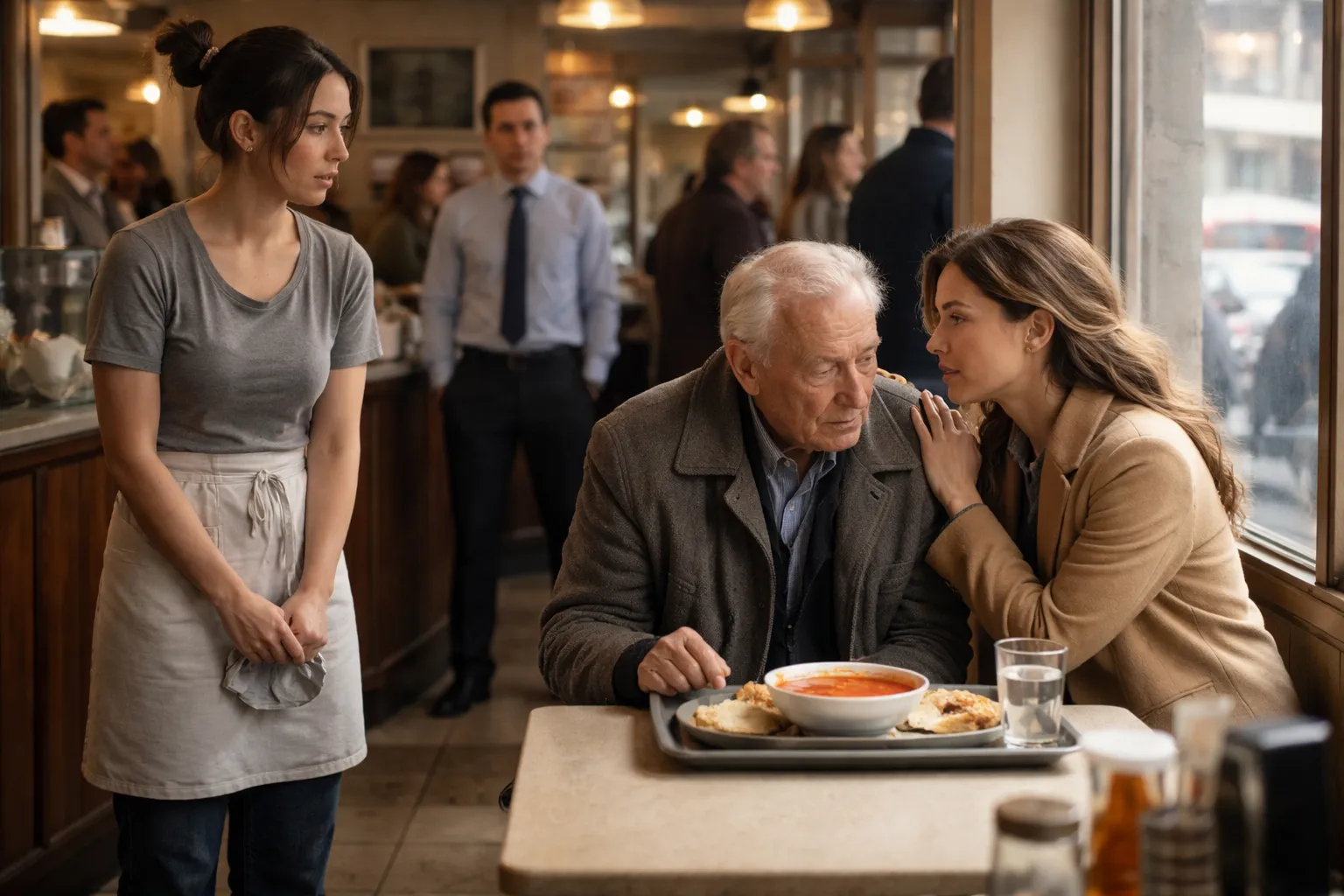
A few minutes later she carried the tray herself to the corner table by the window: tomato soup, rice, half a piece of bread, and a glass of water.
“I didn’t order the rice,” he said softly.
“I know.”
She set the tray down.
“It’s better hot,” she added. “Eat before the soup gets cold.”
He looked up at her for a long moment. Not in the way some men looked at young waitresses. More as if he were trying to understand how, in a room full of people, one stranger had remembered he existed.
“Thank you,” he said at last.
“You’re welcome.”
He picked up the spoon with both hands, steadying it before lifting it. That tiny movement told Mia more than any speech could have. Whatever life this man had once lived, pride had survived it.
Martin came out from behind the counter just as she turned away.
“What was that?” he asked.
“Lunch.”
“This is a business, Mia.”
“I paid.”
He lowered his voice, though not enough.
“That’s not the point. People see that and start expecting handouts.”
At the corner table, the old man had heard him. Mia saw it in the slight tightening of his shoulders.
She kept her tone even.
“He was short three dollars.”
“He was short dignity too, from the look of it,” Martin muttered.
Mia turned fully toward him.
“That wasn’t necessary.”
He sniffed, straightened his tie, and said, “Next time, let the register handle it.”
There was no point arguing in the middle of lunch rush, so she went back to the table instead.
The old man was eating carefully, slowly, as if the soup deserved respect.
For a moment she stood there, then asked, “Would you like more water?”
He shook his head.
“No, thank you.”
She started to walk away, but he spoke again.
“My daughter gets upset when I skip lunch.”
Mia glanced back.
“She worries.”
“She sounds like a good daughter.”
The old man smiled faintly.
“She is. Busy. Too busy, probably. I had an appointment nearby and thought I could manage on my own.”
He touched the empty place where a phone might have been.
“I forgot to charge it. She won’t like that.”
There was embarrassment in the way he said it, but not confusion. He knew exactly where he was, exactly who he was, and exactly what it meant to need help.
“You’re not a burden,” Mia said quietly.
He let out a breath that might once have been a laugh.
“At my age, people don’t say that as often as they should.”
“No,” Mia said. “But it can still be true.”
For the first time, he smiled properly.
It changed his whole face.
Then the café door opened hard enough to make the little bell ring twice.
A woman in a camel coat stepped inside, followed by a driver and a young assistant with a folder tucked under one arm. She wasn’t dressed for spectacle, but people moved anyway. Wealth has its own posture, and hers was the kind that needed no introduction.
She scanned the room once.
Then saw the old man.
“Dad.”
Her voice cracked on that single word.
She crossed the room quickly and dropped to one knee beside his chair.
“There you are,” she said, one hand already on his shoulder. “We’ve been looking for you for forty minutes.”
He blinked up at her, sheepish now.
“I had lunch.”
“I can see that.”
Her eyes moved to the tray, then to Mia, then back to him.
“Did you pay?”
“I tried,” he said softly. “The young lady helped me.”
The woman rose slowly and turned toward Mia.
“You paid for his meal?”
Mia nodded, already wishing the ground would open and swallow the whole moment.
“He was just a little short. It wasn’t anything.”
Before the woman could answer, Martin stepped in with the polished smile he saved for people he thought might matter.
“We always try to take care of our guests,” he said smoothly.
The old man looked down at his soup.
Then, without malice, simply said, “He told me not to come in if I couldn’t afford it.”
Silence rolled across the café.
The woman looked at Martin.
All the warmth disappeared from her face.
“What’s your name?”
He stiffened.
“Martin Doyle.”
She gave a slight nod, as if confirming something.
“I’m Claire Laurent.”
Mia saw the recognition strike him a second too late.
The Laurent name was on the building lease.
On the hospitality group invoices.
On the framed photographs upstairs in the office hallway.
It belonged to the family that owned not only the café space but half the block and the offices above it.
Claire looked at Martin with a calm so controlled it felt harsher than yelling.
“I was already due upstairs for a lease review at one o’clock,” she said. “Now I think I understand why my operations team has received three complaints about this location in two months.”
Martin opened his mouth, then closed it again.
“This is being blown out of proportion.”
Claire turned slightly toward the room, toward the customers who had gone completely quiet.
“An old man tries to buy soup. A member of your staff helps him. And your contribution is to humiliate both of them in public.” She turned back to him. “No, Mr. Doyle. If anything, this has finally been put in the right proportion.”
She held out her hand to her assistant, who gave her the folder.
Claire removed one document and laid it flat on the counter.
“You are relieved of duty effective immediately, pending formal review.”
Martin stared at the paper.
“You can’t fire me.”
“No,” Claire said evenly. “The operating company will decide your final employment status. But I can remove you from this site, and I am doing that now. My operations director is upstairs and will be down in five minutes.”
She paused.
“And if you’d like to test how serious I am, we can discuss your treatment of customers during the lease hearing this afternoon.”
He looked at the paper.
Then at Claire.
Then at the driver standing silently by the door.
His face changed in the way faces do when people who have always hidden safely inside their own cruelty finally realize the wall has opened.
Claire turned back to Mia.
“What’s your full name?”
“Mia Alvarez.”
“How long have you worked here, Mia?”
“Three months.”
“That’s long enough.”
Mia frowned.
“For what?”
Claire glanced at her father.
“For me to know exactly who saw a human being and who saw a nuisance.”
She thought for a moment, then continued.
“You’re not becoming manager today. That would be unfair to you and careless from me. But if you want it, I’m offering you paid training as acting floor supervisor starting tomorrow. We’ll do it properly.”
Mia just stared.
“I… I don’t know what to say.”
“Say yes only if you mean it.”
Across the café, one customer murmured, “Good.”
Another nodded.
The old man had risen from his chair now. He stepped carefully toward the counter, reached into his coat, and unfolded a twenty-dollar bill.
“For the soup,” he said, placing it in front of Mia.
She pushed it back immediately.
“You don’t have to.”
He smiled.
“My wife used to say kindness should never be left carrying the whole cost alone.”
His eyes softened.
“You reminded me of her.”
Something caught hard and painful in Mia’s chest.
“She sounds lovely.”
“She was,” he said. “The kind of woman who always noticed who had less on their plate.”
Claire slipped her arm beneath his elbow.
“Come on, Dad. Let’s get you home before you decide to adopt the whole lunch crowd.”
That earned the faintest laugh in the room.
Before leaving, Claire looked once more at Mia.
“I’ll be here tomorrow morning at nine,” she said. “We’ll go over staffing, payroll, and what you’ll need if you decide to take the position.”
Mia nodded slowly.
“Okay.”
Claire smiled then, this time with real warmth.
“The hardest part of hospitality isn’t food cost or scheduling,” she said. “It’s remembering why people walk through the door in the first place.”
She glanced at her father.
“Usually because they’re hungry. Sometimes because they’re lonely. Often both.”
Then she left with him.
The bell rang once more.
Then settled.
For a few seconds, no one moved.
Martin stood behind the counter with the paper in his hand, looking like he had aged five years since noon.
Then one of the customers in the back raised a hand and asked, almost apologetically, “So… are we still open for lunch?”
A few people laughed.
The tension broke.
Mia picked up her order pad and looked toward the kitchen.
“Yes,” she said. “We are.”
Her voice came out steadier than she felt.
She turned to the line, took the next order, and for the first time since she had started working there, the café no longer felt like a place where food was sold and people tolerated one another.
It felt like a place that might still become what it was supposed to be.
Three months later, the sign outside had been repainted.
The menu was a little simpler.
The soup was better.
Staff meals were eaten at a table, not standing over sinks.
No one was mocked for counting coins.
No one was hurried through dignity.
And every Tuesday at noon, Mr. Laurent came in wearing the same careful coat, carrying exact change in a worn leather coin pouch even though his daughter had tried repeatedly to make him stop.
Mia always brought the soup herself.
He always paid.
And once, when she set the bowl in front of him, he looked up at her and said, with quiet satisfaction,
“This place finally feels like it knows what it’s feeding.”
Mia understood exactly what he meant.
It wasn’t just hunger.
It was the part of people that needed not to be treated like an inconvenience for wanting warmth.
And that, she had learned, was worth far more than the price of soup.