For two years, I believed my daughters died in a tragic accident and that my guilt was the price of surviving them. Then a child in a cemetery pointed at their gravestone and said they were in his class — and in one sentence, the entire story of their last night began to collapse.
If someone had told me two years ago that I would become the kind of woman who speaks to strangers in cemeteries, I would have smiled politely and changed the subject.
Now I know exactly how many steps it takes from the iron gate to my daughters’ grave.
That morning I was counting them again under my breath, the way I always did when I needed my body to keep moving even if my heart wanted to stay behind.
Thirty-four.
Thirty-five.
Thirty-six.
The wind moved hard through the rows of stone, tugging at my coat and bending the heads of the lilies in my hands. White for Ava. Pink for Mia. I stopped at the same florist every time, because grief turns ordinary errands into rituals and then punishes you if you break them.
I had almost reached the grave when a little boy’s voice sounded behind me.
“Mom… those girls are in my class.”
I stopped so suddenly the stems slipped against my fingers.
For a second I did not turn around. Grief makes the mind unreliable. It makes you hear echoes and call them warnings. It teaches you that memory can sound exactly like a real voice if your loneliness is deep enough.
But this had been real.
I turned slowly.
A boy stood a few feet away, holding his mother’s hand and pointing straight at the stone.
At my girls.
He couldn’t have been more than six or seven. His cheeks were pink from the cold. He stared at the photo on the gravestone with the absolute confidence children have when they believe they are saying something obvious.
His mother gently lowered his arm.
“Eli, honey, don’t point.”
Then she looked at me and, I think, understood she had just stepped into someone else’s wound.
“I’m sorry,” she said softly. “He says things before he thinks.”
My throat had gone dry.
“It’s all right,” I said. “Could I just… ask what he meant?”
She hesitated, then crouched to her son’s level.
“Eli, why did you say that?”
He looked from her to me and back again, genuinely confused that anyone needed this explained.
“Because Demi brought them,” he said. “They’re on our wall at school. She said those are her sisters.”
The cemetery seemed to tilt.
I looked at him, then at his mother, then back at the gravestone where Ava and Mia smiled out from a summer afternoon that no longer belonged to me.
“Demi?” I repeated.
He nodded. “She sits by the windows.”
His mother gave me a small, apologetic smile.
“The class did a project last week,” she said. “People who live in your heart. Some kids brought grandparents, some pets, some siblings. One little girl brought a photo of two girls and said they were her sisters in heaven.” She paused. “I’m sure there’s an explanation.”
There was.
Or at least there should have been.
Because I knew the name Demi.
Everyone connected to that night knew the name Demi.
Demi was Macy’s daughter.
And Macy had been the babysitter the night my girls died.
Ava and Mia were five years old when the world ended.
I still remember the hour before it happened with a clarity that has outlived entire years.
They were already in their pajamas, even though it was still early, because I had promised they could stay up ten extra minutes if they got ready before Macy arrived. Ava was balancing on a cushion in the middle of the living room. Mia was trying to copy her and failing with theatrical outrage.
“Watch me!” Mia yelled. “I’m better!”
“No, you’re not,” Ava shot back, then laughed before the words even landed.
I stood in the doorway with one earring in my hand, trying to fasten it while pretending not to smile.
“Careful,” I said. “If one of you cracks your head open, your father will blame me.”
“Will not,” Stuart called from upstairs.
He was dressing for the foundation gala. I remember noticing, absurdly, that his tie looked too dark for spring.
When I told the girls Macy would be there any minute, they both came running.
“Do we have to stay with her?” Mia asked.
“It’s only for a few hours, sweetheart.”
Ava leaned against my leg.
“Can’t you stay home?”
If I let myself, that question could still kill me.
For a long time, it did.
That was the guilt I carried like a stone under my ribs: they had asked, and I had gone anyway.
The official story was simple.
Macy needed to pick up her daughter Demi because of an emergency at her mother’s house. She called. I told her to do what she needed and take the girls with her because the detour would be brief. On the way back, in the rain, a truck ran a red light.
Macy and Demi survived.
Ava and Mia did not.
That was the story.
And for two years I believed I had helped write it.
If I had stayed home, they would have stayed home.
If I had said no, they would not have been in that car.
If I had listened to that small tug of unease mothers are always told to dismiss, maybe I would not be standing in cemeteries with flowers.
Whenever I got too close to questioning the story, Stuart shut it down the same way.
“It was an accident, Taylor.”
Or:
“Nothing will change what happened.”
Or, when my grief became inconveniently curious:
“Don’t keep reopening the wound.”
But wounds do not care whether they are inconvenient.
They wait.
That afternoon, after leaving the cemetery, I sat in my kitchen for almost an hour without taking off my coat.
Demi brought a photo of her sisters.
I turned the sentence over and over, trying to make it smaller than it felt.
Maybe the teacher misunderstood.
Maybe the boy did.
Maybe Demi had once seen a picture of my girls and used “sisters” the way children sometimes use words too generously.
But there was one thing I could not reason away:
Eli had recognized them instantly.
That meant the photo at school was real.
And recent enough to matter.
I called the school before I could talk myself out of it.
The receptionist transferred me to a teacher named Ms. Edwards, whose voice had the careful kindness of someone who already sensed pain on the other end of the line. When I explained, she was quiet for a beat.
Then she said, “Would you like to come in and see the picture?”
“Yes,” I answered. “I think I need to.”
The classroom smelled like crayons, glue sticks, and industrial cleaner.
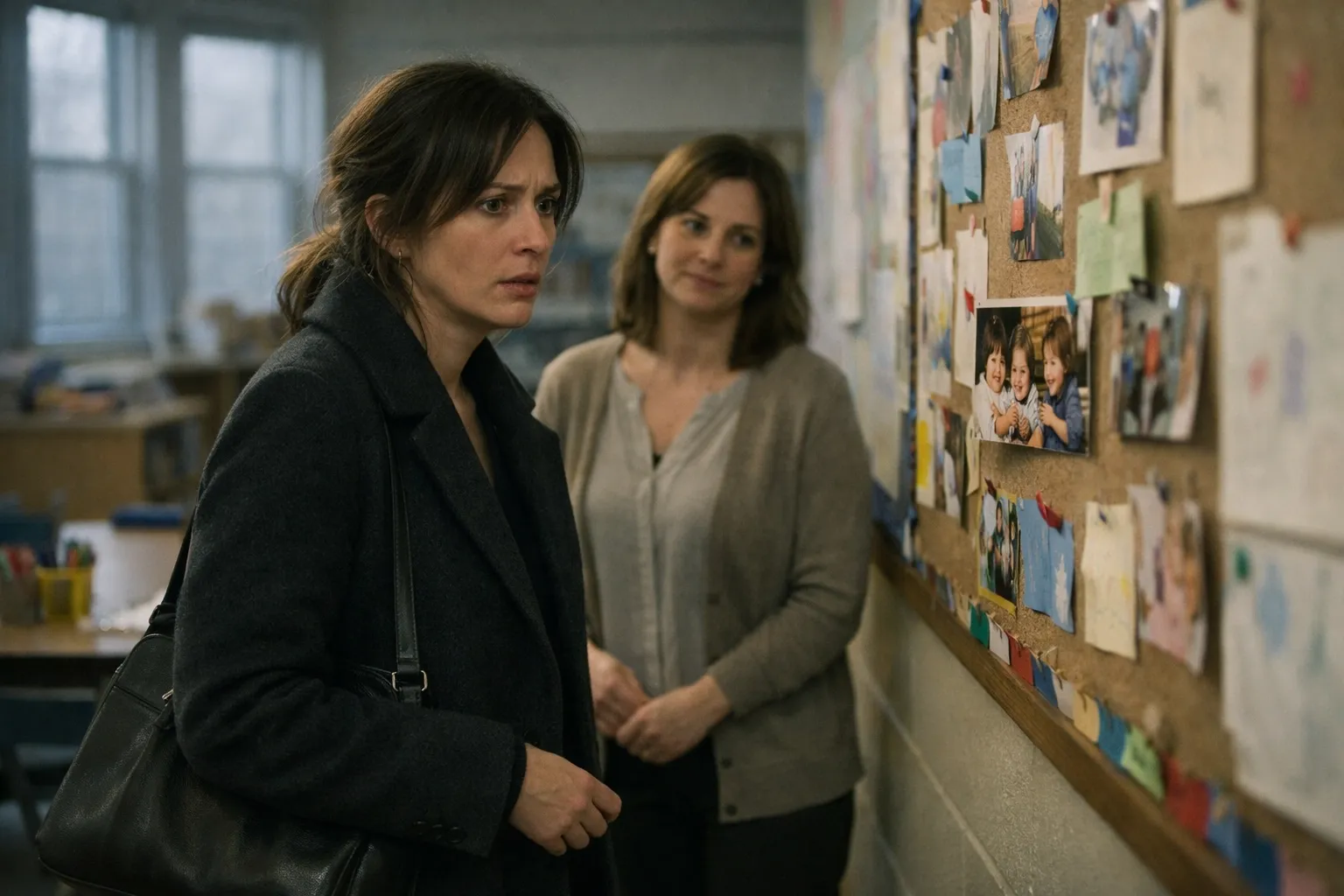
Ms. Edwards led me to a bulletin board by the windows.
OUR HEARTS HOLD MANY PEOPLE, it said in bright paper letters.
Children had pinned up photos of grandparents, cousins, dogs, even a goldfish.
And there, slightly crooked in one corner, was the picture that emptied all the air from my lungs.
Ava and Mia stood on either side of a smaller girl.
Demi.
My twins were in their pajamas. Pink cotton, soft cuffs. Ava had ice cream on her chin. Mia was laughing at something outside the frame.
I knew those pajamas.
I had zipped Ava’s myself that night.
I stepped closer until the board blurred.
“Where did this come from?”
Ms. Edwards lowered her voice.
“Demi said her mother gave it to her,” she said. “She told the class those were her sisters and that they all had ice cream together one night. I’m very sorry if this is upsetting.”
One night.
Ice cream.
Not an emergency.
Not a quick detour to a sick relative.
Not an unavoidable tragedy with no decision attached to it.
I closed my eyes.
When I opened them again, I asked, “Did Demi say when?”
Ms. Edwards shook her head. “Only that it was the last picture of them together.”
I thanked her and walked out before my legs could give way in front of a room full of finger paint and tiny chairs.
Macy opened the door on the third knock.
She had aged in two years. Not dramatically. Not poetically. Just unmistakably. The strain sat around her mouth and beneath her eyes in the same way it had begun to sit in my own face.
When she saw me, the color left her all at once.
“Taylor.”
“I need to come in.”
She stepped back without speaking.
Her house was small and warm and cluttered with the ordinary evidence of a child’s life. A backpack by the sofa. A half-finished puzzle on the table. A pink sweater hanging over a chair.
Demi’s life was everywhere.
Mine had stopped in a hospital corridor.
I stayed standing. Macy didn’t offer a chair. I took the school photo from my bag and placed it on the table between us.
“Was this taken the night they died?”
She looked at it and closed her eyes.
When she answered, her voice was barely there.
“Yes.”
I had thought I was ready for that answer.
I wasn’t.
I gripped the back of a chair until my knuckles hurt.
“I was told there was an emergency with Demi.”
“There wasn’t.”
The room went so quiet I could hear the refrigerator hum.
“What happened?”
Macy pressed both hands over her mouth, then lowered them again. She looked like someone who had told herself the truth in private so many times she no longer knew how to carry it aloud.
“The girls were upset you were going out,” she whispered. “They kept asking for one more story, one more song, one more anything. Demi was already with my mother, and I… I thought if I picked her up and took all three girls for ice cream first, it would calm them down. Fifteen minutes. Twenty, maybe. I told myself it wasn’t really breaking the rules because I’d still be with them.”
I stared at her.
“You lied to the police.”
She nodded once — a tiny, miserable motion.
“At first because I panicked,” she said. “Then because Stuart told me to.”
That struck somewhere entirely different.
I felt myself go cold.
“What?”
Macy’s eyes filled.
“I told him after the funeral,” she whispered. “I told him everything. That there was no emergency. That I took them out because they were crying and I wanted an easy way to make them happy. He said…” Her face crumpled. “He said if the truth came out, you would never recover, I would lose Demi, his family would destroy me, and none of it would bring the girls back.”
I could not speak.
I could only stand there and understand, all at once, how two things could be true at the same time:
She had loved my daughters.
And she had failed them.
“Did he ever intend to tell me?”
Macy shook her head.
“He said you were already blaming yourself. That changing the details would only make everything worse.”
No.
I understood then what he had really protected.
Not me.
Himself.
His comfort.
His reputation.
The version of the story in which tragedy had no choice attached to it and therefore no face that could be blamed.
I heard myself ask, very calmly, “How many times did he watch me carry that guilt and say nothing?”
Macy broke then.
“I’m sorry,” she sobbed. “I was a coward. I let him decide because I was terrified.”
And that, more than anything, was why I left without screaming.
Because there was no punishment I could invent for her worse than the one she had already become to herself.
Stuart ignored my calls that evening.
Then he sent a text.
Not over the phone. We’ll talk tomorrow.
Tomorrow.
As if I had not already buried my daughters and then buried the truth with them for two years.
His mother was hosting a fundraiser the next afternoon at the museum annex downtown. I knew he would be there because Stuart never missed an event with photographers.
So I went.
The room was all polished wood, white linen, and inherited confidence. People lowered their voices in expensive clothes and lifted champagne flutes with the unconscious grace of people who had never had to earn the right to belong in a room.
Stuart stood near the center, speaking to one of his mother’s donors, when he saw me.
His face changed immediately.
“Taylor,” he said under his breath when I reached him. “Not here.”
I had heard that phrase enough for one lifetime.
“No,” I said. “Here.”
A few heads turned.
His mother took one look at my face and set down her glass.
“Is something wrong?”
“Yes,” I said. “Something has been wrong for two years.”
Stuart moved closer, trying to lower the temperature of the moment with his body.
“Let’s go somewhere private.”
I stepped back before he could touch me.
“No.”
Enough people had gone quiet by then that I did not have to raise my voice.
“I went to the cemetery yesterday,” I said. “A little boy told me my daughters were in his class.”
A ripple moved through the people nearest us.
Stuart’s jaw tightened.
“Taylor—”
“I saw the photo today. Ava and Mia in their pajamas. With Demi. Eating ice cream.”
His mother looked sharply at him.
“What is she talking about?”
I kept my eyes on Stuart.
“There was no emergency that night, was there?”
He looked around the room, calculating faster than fear should have let him.
“Not like this,” he said.
“Then how?” I asked. “Because I asked you for two years. I asked in hospital corridors, at the funeral home, in our kitchen, in the dark. And every time you told me not to reopen the wound while you stood there knowing I had built my grief around a lie.”
A woman across the room set down her fork.
Stuart lowered his voice even further, which only made mine steadier.
“It was still an accident.”
I felt something inside me settle.
That was the sentence.
Not I’m sorry.
Not I was wrong.
Not I should have told you.
Just the same coward’s refuge in different clothes.
“It was an accident,” I said. “And then it became a lie. You let me carry guilt that was not mine alone because the truth would have been inconvenient for you.”
“That’s not fair.”
I almost laughed.
“Fair?”
His mother had gone pale.
“Stuart,” she said, and now there was no softness left in her voice. “Is this true?”
He looked at her, then at me, then away.
And in that silence everyone heard the answer.
No one gasped.
Adults rarely do.
But they shifted. They moved. They let space open around him in a way that felt almost physical.
“I was trying to protect you,” he said finally, but even he could hear how small it sounded.
“No,” I answered. “You were trying to protect yourself from being the man who knew and said nothing.”
For the first time since the hospital, I felt my chest loosen.
Not because the pain was smaller.
Because it had finally found the right address.
I looked at his mother once, then back at him.
“I buried our daughters,” I said. “And then I buried your lie for two years without knowing it had your name on it.”
I did not wait for him to answer.
There are moments when staying only feeds the spectacle.
I had not gone there for spectacle.
I had gone there for the truth to stand in daylight.
So I turned and walked out.
Behind me, no one called my name.
A week later I went back to the cemetery with tulips.
Yellow this time. Ava had loved bright flowers because she said they looked like they knew a joke. Mia used to smell every bouquet as if she were judging a contest.
The wind was softer than before.
I knelt in the damp grass and laid the flowers beneath their names.
“Hi, babies,” I whispered. “I know. I’m late.”
My fingers traced the carved letters.
For a long time I said nothing.
Then, because I had finally earned the right, I told them the truth.
“I trusted the wrong people,” I said. “And I let myself believe that if I had chosen one night differently, I could have protected you from everything. Maybe that’s what mothers do. Maybe we bargain with ghosts because the alternative is admitting the world can be cruel and stupid and ordinary all at once.”
I swallowed.
“But this was never mine to carry alone.”
The stone was cold beneath my palm.
“I loved you. I love you still. That part was always true. And the rest — what they hid, what they let me believe — that belongs to them now.”
I sat there until the wind changed and the cemetery quieted around me.
Then I stood.
And for the first time in two years, when I walked away from my daughters’ grave, I did not feel as if I were abandoning them.
I felt as if I were finally leaving behind the one thing they had never asked me to keep:
the lie.