When we opened the red door at 3:07 in the morning, a little girl stood on our porch barefoot, shaking, and clutching a split teddy bear. She didn’t ask us to save her first — she told us her mother was on the kitchen floor, and that the man in the basement was not dead.
At 3:07 in the morning, someone started pounding on our front door hard enough to rattle the brass mail slot.
Not a polite knock.
Not the uncertain tap of a neighbor who feels bad about waking someone.
A desperate, pounding sound that turned our quiet hallway into something cold and alert in an instant.
For a second I thought I was still dreaming. Our street was the kind where people apologized if their dog barked after nine. Nothing happened at three in the morning except sprinklers, distant sirens, and the occasional car passing too fast on the avenue.
Then the knocking came again.
David was already sitting up beside me. In the dark, I could only make out the outline of his shoulders, but I heard the change in his breathing.
“Stay here,” he whispered.
I threw on my robe anyway and followed him down the hall.
The house felt different at that hour. Bigger. Colder. Every floorboard sounded louder than it should have. David reached the front door, looked through the side glass, and then opened it.
A little girl stood on our porch.
She could not have been older than six or seven. She was barefoot in the March cold, wearing an oversized T-shirt that slid off one shoulder. Her legs were streaked with mud. Her hair clung damply to her forehead. In one hand she clutched a small brown teddy bear so tightly that one seam had split open.
She was shaking.
Not with the ordinary shiver of a child who had simply wandered outside underdressed.
This was fear.
David dropped to one knee at once.
“Hey,” he said, his voice low and careful. “You’re okay. What’s your name?”
The girl opened her mouth, but only a dry sob came out.
I crouched beside him.
“You can come inside,” I said. “You’re safe here.”
Her eyes lifted to mine.
I will never forget those eyes.
They were wet and wide and much too old for a child’s face.
Then, in a voice so small I almost missed it, she whispered, “My mommy told me to run.”
Every part of me went cold.
“Where is your mommy?” I asked.
She pointed behind her, toward the dark end of the street.
“At home.”
“Is she there now?”
The girl nodded.
“She’s on the kitchen floor.”
David and I looked at each other.
It was less than a second, but an entire conversation passed through that one glance.
This is real.
This is bad.
Don’t frighten her.
David stepped aside and opened the door wider.
“Come in, sweetheart.”
This time she didn’t hesitate. She crossed the threshold in quick, unsteady steps, still clutching the teddy bear, and I shut the door behind her with the absurd feeling that I might somehow be shutting danger out too.
In the living room, David wrapped her in the thick wool blanket from the sofa while I got water. When I handed her the glass, she held it in both hands and drank with the concentration of someone who had already learned not to waste anything.
“What’s your name?” I asked again, more gently.
“Sofia.”
“All right, Sofia,” I said, sitting down on the coffee table across from her so I’d be lower than she was. “I’m going to ask you a few questions, okay?”
She nodded.
“Did your mommy tell you to come here?”
Another nod.
“She said the red door,” Sofia whispered. “She said if the lights were on, go to the red door.”
Our front door was painted a deep oxblood red because David loved old houses and I loved the idea of being easy to find.
I swallowed hard.
“Is your daddy home?”
Sofia’s mouth trembled.
“He left.”
“When?”
“After.”
“After what?”
She pressed the teddy bear against her face.
I was about to tell her she didn’t have to answer when she spoke again, looking not at me, but at the carpet.
“And she said… if anyone asks… tell them the man in the basement isn’t dead.”
The room went still.
David took his phone from his pocket and moved two steps away so his voice wouldn’t frighten her, but he never took his eyes off us.
“Yes,” he said to the dispatcher. “This is an emergency. A child is at our home alone. She says her mother is unconscious and there’s an injured man in a basement.”
Sofia heard the word injured and snapped her head up.
“He’s not dead,” she said urgently. “Mommy told me I have to say it right so they go fast.”
I leaned toward her.
“Who is he, sweetheart?”
She sniffed hard.
“Uncle Ben.”
That told us two things at once.
There really was a man.
And she knew him.
By the time David ended the call, I had found a pair of clean socks and was easing them onto her feet. She flinched when my hand brushed a scrape near her ankle.
“How far is your house?” I asked.
She pointed again.
“Past the tree. The gray one.”
The gray one was three houses down, on the corner.
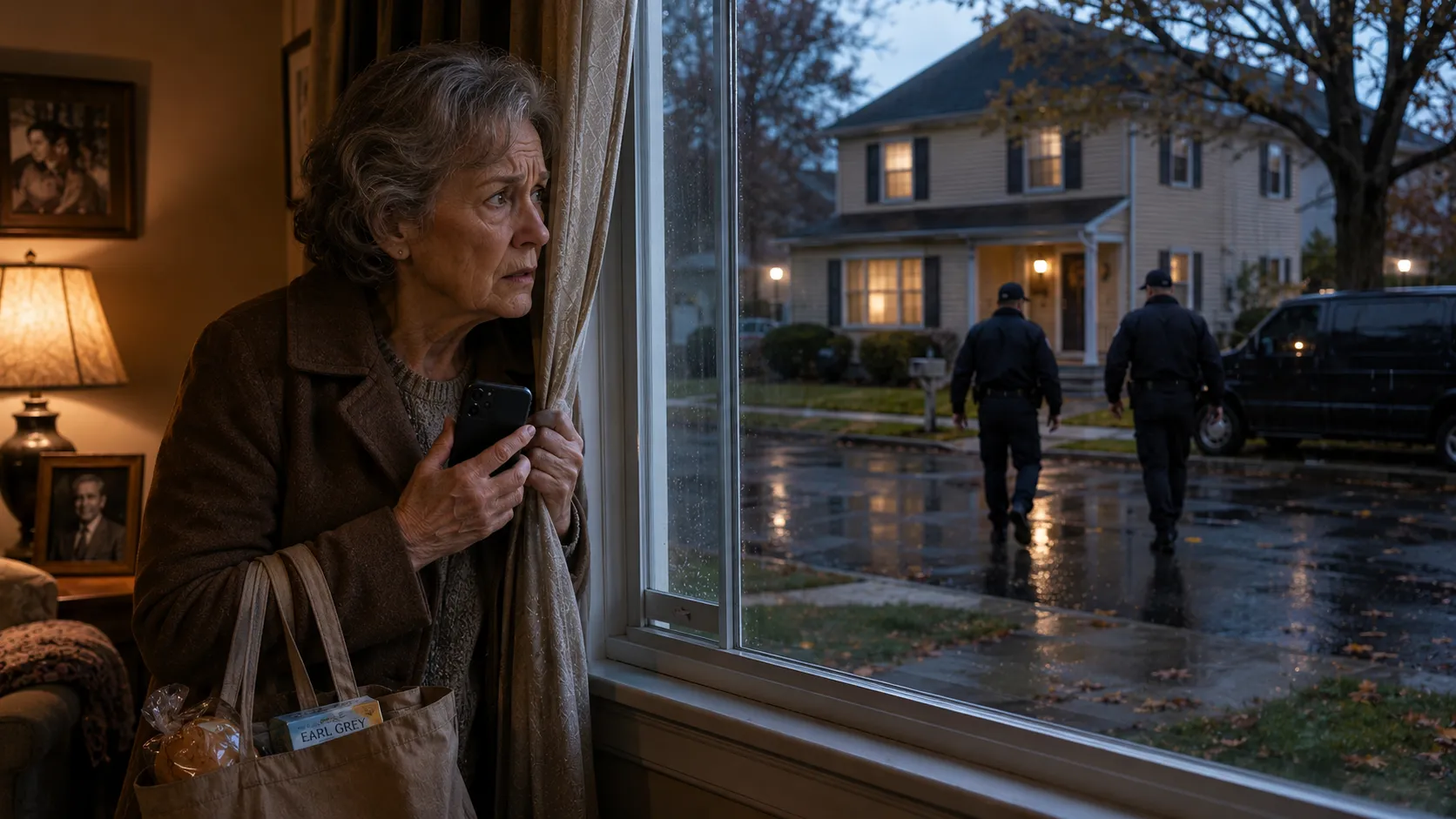
I knew the house only vaguely — the rental with peeling shutters, where a woman and child had moved in sometime last year. David and I had waved once or twice. That was all.
Soon we heard sirens.
Sofia’s whole body locked at once.
“No,” she whispered. “No loud.”
I took her hand.
“That sound means help is coming.”
But she was already crying again — not loudly, just with the exhausted, automatic tears of a child who has been brave too long for one night.
David sat cross-legged on the floor in front of her.
“Can you tell us what happened?”
Sofia stared at his wedding ring for a moment, as if it were something steady enough to think beside.
Then she answered in pieces.
“Uncle Ben came. Mommy was crying. Daddy got mad. There was a bang. Mommy said hide in the pantry. Then she came and got me and said run.”
“Did your daddy hurt your mommy?” I asked carefully.
She nodded.
“Did he hurt Uncle Ben?”
Another nod.
Before I could ask anything else, there was another knock — this one controlled, official, practiced.
Two police officers and a paramedic stood outside when David opened the door.
They moved quickly, but not recklessly, and I was grateful for that. One of the officers, a woman with tired eyes and a voice clearly made for frightened children, came straight to the couch and crouched beside Sofia.
“Hi,” she said. “I’m Officer Reyes. You did a very brave thing tonight.”
Sofia shook her head.
“I was scared.”
Officer Reyes nodded.
“Brave and scared can happen at the same time.”
That was the first thing anyone said all night that made Sofia look at a stranger with something like trust.
Within minutes the officers had the address, the essentials, and everything Sofia could tell them. Officer Reyes asked if we knew the family well.
“We don’t,” I said. “Just enough that her mother remembered the red door.”
That seemed to matter to her.
“Stay with her,” she said. “Do not leave the house. Another unit is checking the address now.”
The patrol cars sped down the block, flashing blue and red against our curtains.
The waiting afterward was one of the longest stretches of my life.
Sofia curled against David with the blanket wrapped around her and the teddy bear tucked under her chin. Every few seconds she would whisper, “They go fast?” and one of us would answer yes.
At 3:41, Officer Reyes came back.
There are expressions trained people wear when they are holding themselves together for the benefit of others. Even if you know nothing about police work, you can tell the difference between routine and something far worse.
This was far worse.
“Her mother is alive,” she said first.
I let out a breath so sharp it hurt.
“She has a head injury and signs of heavy sedation. EMS is with her now. The man in the basement is alive as well. He was bound and badly injured, but he’s breathing. You may have helped save both of them.”
Not us, I thought.
Sofia.
It was Sofia who had run barefoot through the dark and remembered the sentence exactly the way her mother told her to say it.
“Where is her father?” David asked.
Officer Reyes’s face hardened.
“Gone.”
That one word carried its own story.
Child protective services were contacted, but because Sofia was calm with us and likely to panic with strangers, we were asked whether she could remain at our house until morning.
David answered before I did.
“Of course.”
Officer Reyes nodded, grateful.
When she gently told Sofia that her mother was going to the hospital but was still alive, the child didn’t cry. She only closed her eyes and leaned all the way into David’s side with the kind of total exhaustion that frightened me more than screaming would have.
After the last siren faded, our house did not feel like the same house.
At four-thirty in the morning, Sofia slept on our couch with her shoes lined up neatly beside the coffee table, as if she had already learned that the little order you create yourself matters when everything else breaks apart.
David and I sat in the kitchen with untouched tea.
For eleven years we had lived in a quiet house.
That quiet had not come from peace. It had come from loss, appointments, failed hopes, and the slow reshaping of a marriage around an absence too painful to name for long. We had tried for children. Then stopped trying. Then stopped talking about trying. Over time, we had learned how to live in rooms where no crayons were ever left uncapped on the table and no small shoes ever turned up in the hallway.
We had called that acceptance.
At dawn, a six-year-old girl sleeping under our blanket made it look a lot like loneliness.
By seven, we knew more.
Rachel was Sofia’s mother.
Ben — the man in the basement — was Rachel’s older brother.
Mark, the father, had been controlling for years in the deadliest possible way: not loudly at first, but steadily. He controlled money, isolated Rachel, monitored her phone, insulted her, apologized, then began again. Ben had come that night to help Rachel leave.
Mark met him in the kitchen with a tire iron.
Rachel tried to call 911. He slammed her into the counter, took the phone, and when he realized Ben was still alive, dragged him to the basement and bound his wrists with extension cords. Rachel later found him breathing, barely. She got Sofia out of the pantry, told her to run to the red door, then tried to get back to Ben.
Mark struck her before she could fully open the basement door.
Then he ran.
Rachel remained in the hospital for several days. Ben survived surgery. And because there were no immediate relatives nearby who could take Sofia, forty-eight hours with us turned into five days.
Then seven.
The first morning, she apologized for using the bathroom.
The first afternoon, she asked if she should finish all the food on her plate because maybe we needed some later.
The second night, she woke screaming from a nightmare and ran not to me, but to David, who lifted her as if his body had always known what to do with a frightened child.
He sat on the floor beside her bed until dawn, repeating the same words each time she jerked awake.
“You don’t have to be brave right now. You’re safe here.”
That was the moment something changed in him.
And in me.
By the time Rachel was discharged from the hospital, our guest room had a child’s sweater over the chair, an open coloring book on the floor, and a toothbrush in the bathroom cup beside ours.
I drove Sofia to the hospital myself.
Rachel looked thinner than any human being should have looked. There were stitches disappearing into her hairline and bruises fading across one side of her face. But when Sofia saw her mother, she made a sound so raw it seemed to tear through every wall in the room.
Sofia ran into her arms.
Rachel wept into her daughter’s hair.
I stood in the doorway and understood, more clearly than I ever had before, that surviving is not the same thing as being safe.
Rachel asked me to stay behind after a nurse took Sofia down the hall to meet a therapy dog.
So I stayed.
“I told her the red door,” Rachel said, staring at her hands. “You gave her hot chocolate on Halloween when she fell on your steps. She remembered. So did I.”
I hadn’t even remembered the hot chocolate.
Rachel looked up at me.
“You saved them.”
“No,” I said. “She did.”
Rachel shook her head.
“Maybe. But she needed a door that opened.”
I cried in the hospital parking lot after that.
Not in some dramatic collapse.
Just in the quiet, painful way grown women cry when they finally understand the shape of something enormous.
Mark was arrested four days later at a motel outside Harrisburg.
The criminal case took months.
The healing took longer.
Rachel did not become whole because she escaped.
Ben did not heal because he survived.
Sofia did not stop waking up at night simply because the danger had been named.
Trauma is not a single storm.
It is weather that lingers.
But some things changed quickly.
Rachel found a small apartment on the other side of town once she was discharged. Ben recovered in a unit downstairs. Officer Reyes connected them with legal aid and a domestic violence advocate. David helped Ben install locks and reinforce the doors.
And every Wednesday after school, Sofia came to our house.
At first because Rachel had court appointments and therapy sessions.
Later because she wanted to.
She would knock once now — never pound — and come in carrying the same teddy bear, its split seam neatly sewn closed by David one rainy Sunday while pretending not to enjoy doing it.
The first time she ran laughing through our hallway, our house made a sound I had never heard from it before.
It sounded inhabited.
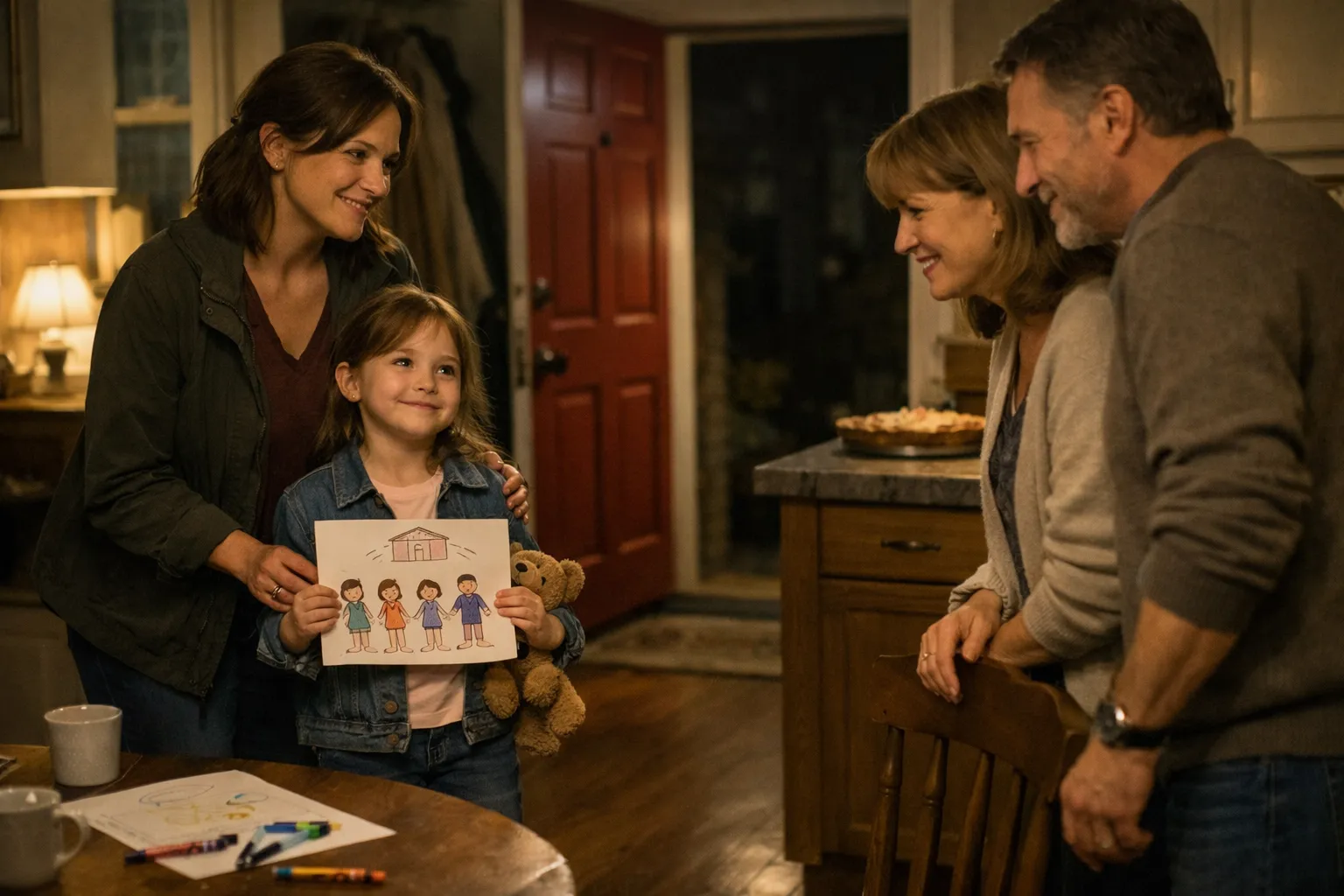
About a year later, Rachel stood in our kitchen with a pie she didn’t need to bring and asked, a little awkwardly, if David and I would agree to be Sofia’s emergency contacts at school.
Then she corrected herself.
“That’s not really what I mean,” she said, smiling through tears. “I mean… if anything ever happened… would you be her people? Would you stand for her?”
David looked at me.
I looked at him.
Then we both said yes.
At the same time.
From under the table, where she was drawing with markers, Sofia popped her head up and asked, “What people?”
Rachel smoothed her hair.
“Your forever extra people,” she said.
That answer seemed to satisfy her.
A few weeks ago, Sofia arrived for Wednesday supper carrying a school paper titled Who Keeps You Safe?
She had drawn her mother.
Uncle Ben with his cane.
David in a sweater that made him look like a lopsided rectangle.
And me with hair much blonder than reality had ever granted me.
Above the four figures she had written, in determined, slightly backward letters:
THEY OPENED THE DOOR
I keep that drawing in the kitchen now.
Because it reminds me of something I did not know before that night.
Lives can change because of violence, yes.
Because of secrets, yes.
Because one man chooses control over love.
But they can also change because someone opens the door when fear is knocking.
And sometimes, if you are very lucky, what enters your life at three in the morning is not only terror.
It is the child who teaches your home how to hold joy again.