Judge Hector Valverde had spent twenty years turning the law into a machine that crushed the weak and protected the useful. But on the morning he was about to release the city’s most untouchable defendant, a twelve-year-old girl walked barefoot into his courtroom with a dead woman’s envelope in her hands — and forced an empire of procedure, corruption, and fear to collapse in public.
The courtroom was so quiet that morning even the fluorescent lights seemed loud.
Above the benches, dark wooden beams crossed the ceiling like ribs. The old seal of the republic hung behind the bench with the heavy confidence of institutions that wanted to look eternal. Every object in the room was built to suggest permanence — the polished floor, the carved railings, the elevated chair from which one man could alter another person’s life with a few measured words.
Judge Hector Valverde had spent twenty years making sure that permanence looked like him.
The city called him the Iron Judge.
He had never chosen the name for himself, but he had worn it well enough to make people believe it had always belonged to him. He was admired for discipline, feared for precision, and useful to the kind of men who preferred justice cleaned of inconvenience. In his courtroom, emotion was treated as weakness, mercy as inefficiency, and truth as something that only mattered if it arrived on time, stamped correctly, and through the right hands.
That morning, every seat was full.
At the defense table sat Ricardo La Fuente — businessman, benefactor, public darling, and the sort of man whose face appeared so often in magazines that people forgot how much damage a polished smile could conceal. He was on trial for embezzlement, bribery, and conspiracy in the disappearance of a witness who had planned to testify against him.
The prosecution had spent months building the case.
Then Hector Valverde spent three hours taking it apart.
A financial summary was excluded because a chain-of-custody timestamp was missing.
A witness statement was dismissed because the original recording device had not been retained.
A crucial piece of electronic evidence was set aside because a filing clerk had entered the date one day late.
Every ruling was technically defensible.
That was what made them lethal.
At the prosecution table, the lead attorney stood with both hands flat on the wood, jaw tight, watching the case bleed out under rulings no appellate court would easily reverse. In the front row sat the missing witness’s mother, a thin woman in a dark dress whose fingers were twisted around a handkerchief she had not yet used. She had not cried during the hearings. She had only stared at the bench as if enough looking might force the man above her to remember that real lives existed beneath case numbers.
Hector never looked at her.
He arranged the final pages before him with exacting care. He adjusted them once, then again, until the corners were perfectly aligned. He already knew what he was going to say.
Insufficient admissible evidence.
Motion granted.
The defendant is released.
There would be outrage afterward, of course.
Editorials.
Talking heads.
Questions from reporters who still believed shame could do damage to men who had survived on shamelessness.
It did not matter.
By evening the ruling would be old news.
By morning the city would be distracted by something newer, louder, easier.
That was how power survived — not by being loved, but by outlasting attention.
Hector lifted the gavel.
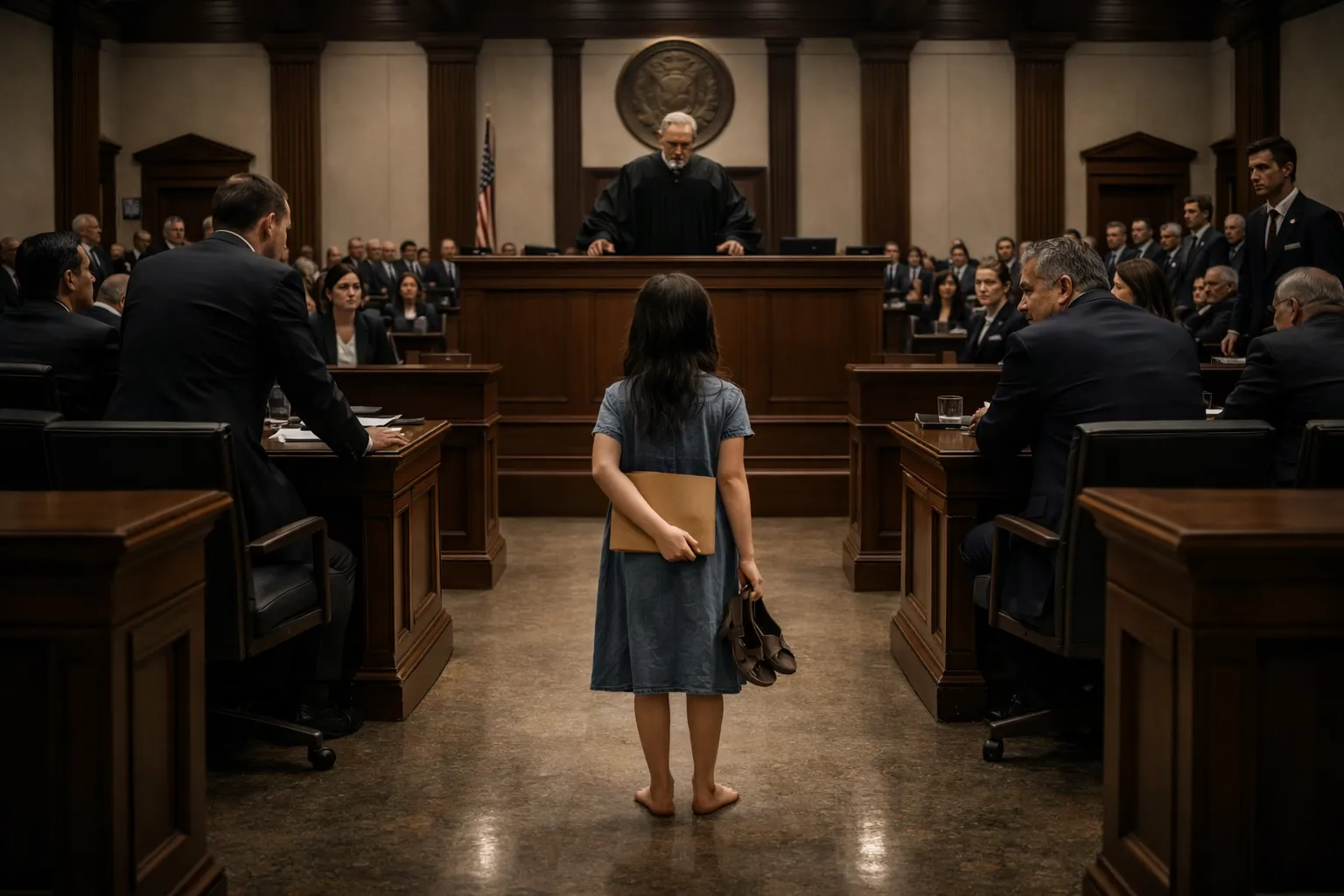
And then someone came into the courtroom barefoot.
At first, people noticed only motion in the center aisle — a slim figure, wet hair, the faint slap of bare feet against polished stone. Then row by row the room turned, and the silence changed.
She was a girl, perhaps twelve at most. Her dress was damp at the hem, as though she had come through rain. One cheap plastic sandal hung broken from two fingers; the other had clearly been lost somewhere outside. Under one arm she carried a thick brown envelope pressed tight against her body. Her face was too serious for her age.
A bailiff stepped toward her at once.
“This is a closed proceeding,” he said. “You can’t be in here.”
She kept walking until she stood almost directly beneath the bench.
Then she looked up at Hector Valverde.
His irritation was immediate.
“Remove her.”
The bailiff reached for her elbow.
She turned her head toward him, not frightened, merely steady.
“I’m not here to make a scene,” she said. “I’m here because if he strikes that gavel, another guilty man walks free.”
That sentence reached every corner of the room.
The prosecutor straightened.
Ricardo La Fuente turned fully in his chair for the first time all morning.
The press gallery leaned forward as one body.
Hector’s voice sharpened.
“What is your name?”
The girl did not lower her eyes.
“Alma Herrera.”
Nothing changed in his face.
But something small and involuntary tightened in his throat.
The name Herrera had not crossed his desk in years.
“Who allowed you into this courtroom?” he demanded.
“No one,” she said. “That’s usually how poor people get into places where they aren’t wanted. We walk.”
A murmur moved through the gallery.
Hector brought the gavel down once — not hard, just enough to remind the room who still sat above it.
“This is not a public spectacle. Bailiff—”
“Rosa Benítez is dead,” Alma said.
He stopped.
Now the silence became absolute.
The prosecutor’s head turned sharply toward the bench.
Rosa Benítez had once been Hector Valverde’s chief court clerk. She had retired quietly four years earlier. Illness, people said. Nervous collapse, said others. She had never been publicly linked to scandal.
Alma lifted the envelope.
“She mailed this to my father in prison two weeks before she died,” the girl said. “She wrote that if you ever tried to free Ricardo La Fuente, it had to be opened in court where everyone could see.”
For the first time in decades, Hector felt not anger but something colder.
Uncertainty.
“My father,” Alma continued, “is Miguel Herrera.”
There it was.
The second name.
The older wound.
Miguel Herrera had been convicted eight years earlier in a homicide case that had closed too neatly and too quickly. Hector remembered the political pressure, the police commissioner insisting the city needed closure, the weakness of the alibi, the defendant repeating over and over that he had not been there.
He remembered more than that, if he was honest.
He remembered not wanting the complication of inconvenient innocence.
The courtroom began to breathe again, but only in shallow drafts.
The prosecutor found her voice first.
“Your Honor, I request that the envelope be preserved and entered into the record—”
Hector cut her off too fast.
“This court will not accept materials from an unidentified minor—”
“Then don’t accept them,” Alma said. “Just have someone look under the false bottom of the middle drawer in your chambers.”
The words hit him like a blow.
No one else in the room could have understood them.
Not the prosecutor.
Not the defense.
Not the reporters.
But Hector did.
Ricardo La Fuente did too.
His head turned slowly toward the bench.
Inside the middle drawer of Hector’s private chambers — beneath a tray of ordinary pens and paper clips — was a hidden compartment installed years earlier by a carpenter paid in cash. In it sat a property deed in his sister-in-law’s name for a lake house no one in the family could possibly have afforded, along with a phone that had never existed under Hector’s own.
Hector rose half out of his chair.
“That is enough.”
His voice cracked.
Only slightly.
But the room heard it.
Alma did not move.
“Rosa kept copies,” she said. “Transfers. Meeting notes. The memo from the Camila Espinoza case. All of it. She said you liked to bury people under procedure because it looked cleaner than hatred.”
The prosecutor was already speaking, not to the judge but to the senior court officer by the wall.
“I want judicial security in chambers now,” she said. “And I want the record to reflect this disclosure before anything disappears.”
The defense attorney stood at once.
“This is outrageous. My client objects to—”
“Sit down,” the prosecutor snapped.
It was the first time that morning anyone had spoken with enough force to break the spell in the room.
What followed was not elegant.
Justice rarely is when it has been humiliated into motion.
A supervising judicial marshal entered from the side door, took one look at the girl, the prosecutor, the judge’s face, and the panic gathering around the defense table, and understood immediately that whatever this was, it had outgrown ordinary procedure.
Hector tried once more to reclaim authority.
“This court is in session.”
The marshal looked at him for a long second.
“Not until this is cleared.”
Then he signaled two officers toward chambers.
The press gallery erupted.
Typing.
Whispered calls.
A camera operator forgetting where he was and rising before being shoved gently back down by his producer.
Ricardo La Fuente no longer looked amused.
He looked cornered.
And in the center of all of it stood Alma Herrera, barefoot on polished stone, one broken sandal hanging from her hand, looking not triumphant but exhausted.
She had not come for drama.
She had come because somewhere along the way a dying adult had left a child the work of telling the truth in a room full of people too compromised, too frightened, or too obedient to do it themselves.
Twenty-two minutes later, the officers returned.
They said nothing at first.
They did not need to.
The marshal walked to the bench, bent toward Hector, and murmured something only he could hear. Whatever he said drained the color from Hector’s face so completely it seemed, for a moment, to erase the man people thought they knew.
Then the marshal turned to the prosecutor.
“Your office will receive chain-of-custody documentation within the hour.”
The room exploded.
Hector Valverde sat back down, but not with dignity.
With collapse.
The Iron Judge had not been struck by lightning.
No child had read his mind.
No divine hand had reached through the ceiling.
A dying woman had kept records.
A prisoner had trusted his daughter.
And a barefoot girl had done the one thing powerful men fear most:
she had said the truth aloud where everyone could hear it.
By dusk, Hector Valverde was suspended.
By the next morning, his chambers, home office, and financial records had been seized under warrant. The hidden drawer yielded the deed, the unregistered phone, and a key to a deposit box containing copies of transactions that no one could explain cleanly. Rosa Benítez’s envelope contained even more: notes, dates, duplicate memos, partial bank records, names — enough detail to turn rumor into prosecution.
Ricardo La Fuente was remanded pending further proceedings.
Within a month, Hector himself was charged.
The city reacted the way cities always do when a feared man becomes safe to condemn. Reporters called him fallen, monstrous, disgraceful. Politicians who had once eaten at his table declared themselves shocked. Colleagues hinted they had always suspected something, though most had only suspected enough to stay at a careful distance.
His wife left before the second week.
His son stopped answering calls before the first month was over.
When the trial began, Hector learned what defendants always learn too late:
procedure feels different from below.
He was convicted.
Corruption.
Bribery.
Obstruction.
Misconduct under color of office.
Twenty years.
Not because the system had suddenly become pure.
Because systems sometimes make examples of men they can no longer protect without embarrassing themselves further.
Prison did not humble him all at once.
For the first three months, humiliation did all the work. He sat on the edge of his narrow cot in protective custody and replayed the courtroom scene again and again — not because he regretted what he had done, not yet, but because he could not bear the image of being seen.
Not as feared.
Not as necessary.
Not as powerful.
Seen simply as a corrupt old man with shaking hands.
Then Alma Herrera came to visit him.
He almost refused the meeting.
Almost.
But curiosity survives in strange places, even after pride burns down.
When she entered the visitors’ room, she no longer looked like a child who had wandered into forbidden space. She looked as she had always truly been: a daughter carrying more of the world than anyone her age should have had to carry.
She sat across from him and waited.
Hector spoke first.
“Did you come to enjoy this?”
“No.”
“Then why are you here?”
She slid a folded paper across the metal table.
“There are names on that list,” she said. “People you buried because it was easier than seeing them clearly.”
He did not touch it.
“My father is one of them.”
He lowered his eyes.
“I know.”
“I’m not here for your apology.”
That sentence reached him more sharply than accusation.
“Then what do you want?”
Alma leaned back.
“You know the system better than anyone inside these walls. You know where the shortcuts were taken because you took them. You know which convictions rest on rotten beams because you helped build them.”
He stared at the paper.
“You think I can undo this?”
“No,” she said. “I think you can stop pretending you can’t do anything.”
That night he unfolded the list.
Seven names.
Julio Serrano.
Camila Espinoza.
Miguel Herrera.
Four others.
He remembered every one of them.
That was the first true punishment.
Not prison.
Memory.
Julio Serrano had been convicted on a robbery charge supported by a witness whose timeline changed twice.
Camila Espinoza had exposed procurement fraud and ended up convicted herself on evidence Hector had not wanted to examine too carefully.
Miguel Herrera — he remembered him best of all. The man who kept shouting innocence as if volume might matter in a room already arranged against him.
The next morning Hector requested paper.
Then more paper.
Then access to the prison law library.
The guards laughed, but the requests were granted. Paper is cheap. Institutions often mistake busyness for harmlessness.
At first the other inmates wanted nothing from him but distance, contempt, or a chance to spit at the name.
Then Julio Serrano’s petition was filed.
Then Camila’s sentence review.
Then a motion in Miguel Herrera’s case arguing judicial bias, prosecutorial suppression, and newly corroborated alibi evidence drawn from Rosa Benítez’s notes.
The legal work was immaculate.
Of course it was.
Hector had spent two decades learning how to twist the law.
Now he was learning, line by line, what it cost to straighten it.
He did not become likable in prison.
Redemption does not require charm.
It requires usefulness.
Honesty.
The end of self-pity.
And labor that goes on long after anyone would applaud it.
Months passed.
Julio Serrano was released first.
Then Camila Espinoza.
When Miguel Herrera’s conviction was finally overturned, Hector sat alone in the prison library with the court order in his hands and did not trust himself to move for a very long time.
He had once taken eight years from that man with the clean efficiency of a signed page.
Now, one correct filing at a time, he had handed some fragment of those years back.
Not enough.
Never enough.
But real.
Two weeks later, a correctional officer told Hector he had visitors.
Miguel entered first.
He was older, thinner, and carried one shoulder a little too high, as though prison had taught his body to remain half-defended even when doors stood open. Beside him walked Alma.
Hector stood, then sat again because he no longer knew what to do with his hands.
Miguel looked at him for a long time.
There was no hatred in that look.
That would have been easier.
There was only weight.
“You stole years from me,” Miguel said at last.
“Yes.”
“You took my daughter’s childhood with me.”
Hector lowered his head.
“Yes.”
Miguel pulled out the chair and sat down.
“But she tells me you wrote the appeal yourself. That you didn’t stop with mine.”
Hector raised his eyes slowly.
“I am trying.”
Miguel nodded once.
“That is not the same thing as making it right.”
“No,” Hector said. “It isn’t.”
Silence stretched between them.
Then Alma spoke.
“Justice isn’t what happened when you wore the robe,” she said quietly. “Justice is what you do now that you know what you were.”
Hector looked at her.
For the first time since the courtroom, he did not see the child who had destroyed him.
He saw the person who had refused to let another generation inherit the damage he had built into the law.
Miguel laid one hand flat on the table.
“I don’t forgive what you did,” he said. “Maybe I never will. But I won’t lie about this either: men are free because you chose to stop protecting yourself.”
Hector swallowed.
“That doesn’t make me a good man.”
“No,” Miguel replied. “But it may make you a useful one. Don’t confuse the two.”
When they left, Hector remained seated long after the guard told him visiting hours were over.
Then he went back to the library.
There were still names on the waiting list.
Still men writing shaky letters from other units.
Still women in other facilities whose appeals had been stamped, delayed, ignored.
Still cases resting on the same rotten beams he knew so well.
His sentence remained twenty years.
His cell remained small.
His body still tired faster than it once had.
He was not redeemed in the cheap way stories sometimes pretend men are redeemed — not by tears, not by regret alone, not by one dramatic act.
He was redeemed the hard way.
By work.
By repetition.
By doing, case after case, the labor he should have done when power had still been his and consequences had not.
Years later, when a journalist asked Alma Herrera why she had not simply let Hector Valverde rot, she answered without hesitation:
“Because punishment without repair leaves the world in the same condition — only angrier. He broke lives with the law. Let him spend what is left of his own trying to free the ones he buried.”
That was the truest judgment ever passed on Hector Valverde.
Not mercy.
Work.
And so the Iron Judge fell.
Not only in the courtroom.
Not only in prison.
But slowly — out of illusion, out of self-protection, out of the lie that power and justice had ever been the same thing.
What remained was smaller than the man he had pretended to be.
But it was, at last, human.