Mariana had already put back the cereal and chosen butter over dignity when her five-year-old son asked the question she could barely survive hearing: “Is it because Dad left?” A few feet away, a wealthy widower holding a bottle of imported wine realized that, for all his money, he was every bit as hungry as the tired woman trying to hide shame beneath a supermarket light.
The words came out of Mariana so softly that, for a moment, she thought the humming freezer cases might swallow them before her son could hear.
“Forgive Mom, sweetheart,” she whispered. “There’s no dinner this year.”
But João heard.
Children always hear the things adults most wish would dissolve into air.
He was five, small for his age, wrapped in a winter coat that had belonged to an older cousin and shoes already tightening across his growing toes. He stood beside the cart and looked up at her with the open, stunned hurt only children possess — that pure confusion before life teaches them to disguise disappointment.
“But we can still buy something, right?” he asked. “Maybe just a little one?”
He was staring at the row of turkeys in the freezer case as if they belonged to a holiday from another family’s life.
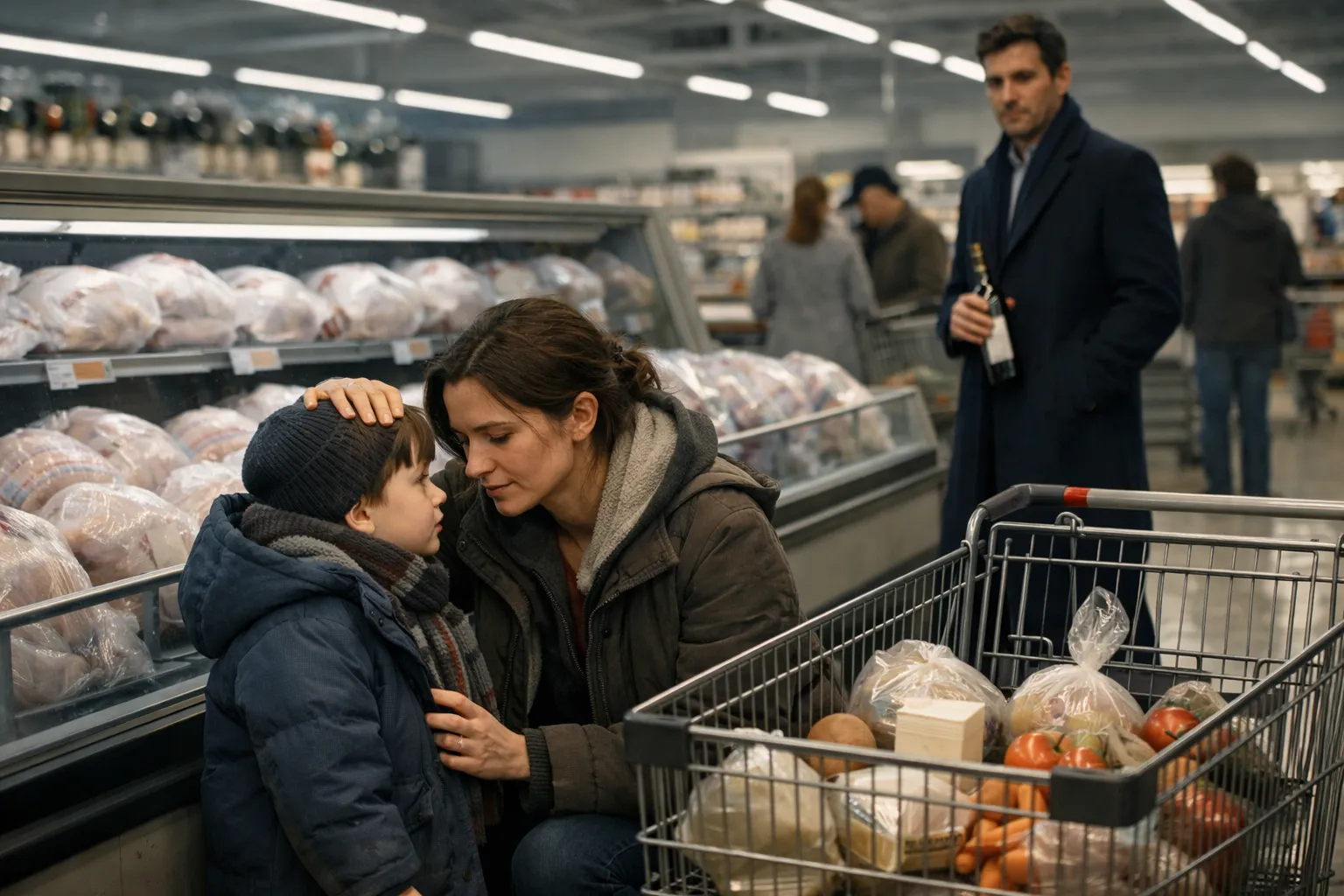
Mariana crouched down in front of him, ignoring the ache burning across her lower back from the offices she had cleaned the night before. The supermarket lights were brutal on tired people. They flattened every face and erased whatever pride anyone had brought in with them.
“We’ll make something else,” she said, smoothing his hair. “I bought flour. We can bake cookies. I’ll put orange peel in them, the way Grandma used to.”
João glanced back toward the freezers.
“Is it because Dad left?”
The question struck exactly where she had been holding herself together.
For a second she couldn’t answer. She reached instead for the shopping cart handle, because handles were easier than grief. Lists were easier than truth. Prices were easier than memory.
“It’s because everything costs too much,” she said at last. “And this year we have to be careful.”
That was true.
It just was not the whole truth.
The whole truth was that her ex-husband had disappeared a year earlier, leaving debts, silence, unpaid bills, and a little boy who now asked practical questions with the timing of a knife. The whole truth was that her work — cleaning office floors at night, helping in school kitchens when shifts opened up, scrubbing bathrooms that belonged to people who would never know her name — kept the lights on, but only just. The whole truth was that she had stood in front of the freezer case for five full minutes debating whether to put back the flour or the butter before understanding, with a humiliation so quiet it almost felt private, that she could not afford the turkey at all.
A few aisles away, in front of the imported wines, a man in a navy wool coat stopped moving.
Augusto de Lima had come into the supermarket for a bottle of wine and nothing else.
At least, that was the story he had told himself when he left his driver at home and took the car out alone. The truth was less dignified. He had not wanted to spend Christmas Eve in his enormous house, listening to his footsteps echo off expensive floors and polished surfaces that reflected light beautifully and warmth not at all. Buying wine had given the evening a purpose that sounded civilized.
Then he heard Mariana tell her son there would be no dinner.
He turned before he could talk himself out of it.
He saw the woman first: tired eyes, straight spine, careful hands, the unmistakable alertness of someone used to counting every coin before spending it. Then he saw the boy, trying not to cry because some children learn too early what kind of tears make life harder for their mothers.
And then he saw her put back a box of cereal so she could keep the butter.
Something in him shifted.
He set the bottle of wine back on the shelf.
Then he walked toward them.
“Excuse me,” he said.
Mariana looked up immediately, wary.
Women in her position become experts in the first second of meeting a stranger. They know how to measure risk before the man has finished his first sentence. Is he mocking? Drunk? Dangerous? Lonely? Amused? Looking for gratitude? Looking for weakness?
Augusto saw the calculation happen across her face.
“I’m sorry,” he said quickly. “I know this is awkward. I just… overheard what you said.”
“We’re fine,” she answered at once.
He almost smiled at the speed of the lie.
“No,” he said gently. “I don’t think you are.”
Her face tightened the way proud people’s faces do when they sense pity approaching like weather.
“We don’t take money.”
“It’s a good thing I wasn’t offering money.”
That startled her.
João, who had been studying Augusto’s coat with the grave concentration children reserve for the rich, piped up before Mariana could stop him.
“Are you rich?”
Mariana closed her eyes briefly.
“João.”
But Augusto let out a small laugh.
“Yes,” he said. “Embarrassingly.”
The boy considered this.
“You look like the mayor.”
“I’m less useful than the mayor,” Augusto replied.
That earned the smallest unwilling flicker at the corner of Mariana’s mouth.
He took it as permission to continue.
“I was planning to buy far too much food for one person,” he said. “And I’m a terrible cook. Truly terrible. I thought maybe you could help me choose dinner. Otherwise I’ll go home, burn something expensive, and eat badly over my kitchen sink.”
Mariana stared at him.
There was no slickness in his tone. No polished benevolence. No false humility. Just an odd, almost uncomfortable honesty.
“And in exchange?” she asked.
“In exchange,” he said, “maybe I don’t have to eat it alone.”
She blinked.
“You’re asking strangers to spend Christmas Eve with you?”
“Yes.”
“Why?”
For a moment he looked past her, toward the row of turkeys, and when he answered, his voice had changed.
“Because I’ve learned that being able to afford a table isn’t the same thing as knowing how to sit at one.”
That answer did something to her face.
Not enough to disarm her.
Enough to make hesitation possible.
João touched her sleeve.
“Mom,” he whispered, though not quietly enough, “he looks lonely.”
Augusto heard him anyway.
“So do you,” he said.
Silence settled between them.
Not comfortable silence.
Not polite silence.
Honest silence.
Finally Mariana looked down at the cart — flour, butter, two potatoes, carrots, discounted apples, tea — then back at her son, who was trying very hard not to look again at the freezer case.
“All right,” she said. “But no ridiculous extravagance. We buy what’s needed. Nothing more.”
“Understood.”
“And if we do this, you help cook.”
He nodded solemnly.
“I will peel whatever needs peeling.”
João grinned for the first time that evening.
So the three of them walked the aisles together.
At first it felt absurd — a millionaire in a cashmere coat pushing a squeaking supermarket cart while a tired cleaner instructed him that chestnuts were unnecessary, imported chocolate was foolish, and a small turkey could feed three people quite well if someone respected leftovers.
He obeyed her without resistance.
When he reached for expensive sweets, Mariana shook her head.
“Too much.”
When he tried to add sparkling cider, João pointed at the one with the gold foil around the neck and asked, with the seriousness of a statesman negotiating peace, “Can we have that one?”
Mariana sighed.
“One bottle.”
By the time they reached the register, the cart held a turkey, potatoes, onions, garlic, rosemary, butter, flour, sugar, apples, carrots, and the gold-capped bottle João regarded as though it were enchanted.
No one called it a miracle.
But it looked like one.
Augusto paid without glancing at the total. When he started lifting the bags, Mariana reached for them too.
“I can carry some.”
“I know you can,” he said. “That’s not the point.”
She nearly argued.
Then chose not to.
That was how Christmas Eve began.
Mariana’s apartment was on the third floor of a building whose buzzer only worked if you pressed it twice and then hit it with your thumb. The hallway smelled faintly of laundry soap, old radiator heat, and cabbage from someone else’s supper. Inside, the apartment was small, neat, warm, and obviously lived in.
Augusto noticed everything.
The repaired kitchen chair.
The children’s drawings on the refrigerator.
The line of shoes by the door.
The narrow table by the window that had clearly served as a dining table, school desk, ironing station, and bill-paying surface in the same week.
It was not stylish.
It was loved.
And somehow that made it more beautiful than half the architect-designed homes he had spent the last decade pretending to enjoy.
Mariana tied on an apron and pointed at a pile of potatoes.
“You peel.”
“Yes, chef.”
João laughed so hard at the word chef that he nearly dropped the rosemary.
That little kitchen had no room for pretense. Every movement required adjustment, waiting, brushing past one another, shifting elbows, passing bowls hand to hand. Augusto had not stood shoulder to shoulder with another person in a kitchen in years. He had not realized, until then, how much loneliness has a physical shape.
Mariana cooked with calm authority, the kind born from necessity rather than performance. She seasoned the turkey with care, not because it was special but because she refused to let a hard-won meal become a spectacle.
“You cook like this often?” Augusto asked.
“Every day,” she said.
“No, I mean… like this.”
She glanced at him.
“No. Like this, almost never.”
He peeled another potato.
“Then I’m honored.”
That time she gave him a real smile.
By the time the turkey was in the oven, the apartment smelled of garlic, butter, rosemary, and warmth. João had been given the important task of arranging napkins and performed it with nearly military seriousness.
When they finally sat down, the table was set with mismatched plates and ordinary cutlery. No one had a perfect glass. The tablecloth had a faint old stain near one corner. The chairs creaked. The turkey was slightly overbrowned on one side.
It was still the best meal Augusto had eaten in years.
For a while they ate almost silently, the way people do when gratitude and disbelief are sitting side by side.
Then João looked up and said, “This is better than TV Christmas.”
Augusto smiled.
“Why?”
“Because on TV, everybody talks too much.”
That made Mariana laugh — a tired, surprised laugh that changed her whole face.
After dinner, she packed leftovers into careful portions without comment, because women like Mariana do not wait for tomorrow’s hunger to become dramatic before preparing for it. Augusto dried plates with a dish towel that had once been white and was now the color of old snow.
When João finally disappeared into the bedroom to show his stuffed dog the toy car Augusto had slipped quietly into the groceries, Mariana leaned against the sink and asked the question she had been holding back all evening.
“Why did you really do this?”
Augusto folded the dish towel over the back of a chair.
“Do you want the polished answer or the honest one?”
“The honest one.”
He took a breath.
“My wife died four years ago,” he said. “I kept working because work is useful when grief isn’t. I got very good at efficiency and very bad at being with people who didn’t need something from me. Tonight I was buying wine so I wouldn’t have to admit I was going home to silence.”
Mariana looked down at the table.
“And hearing me tell my son there was no dinner changed that?”
“It embarrassed me,” he said. “In the best possible way.”
She was quiet for a moment.
“I was embarrassed too.”
“That’s not the same thing.”
“No?”
“No,” he said softly. “You were ashamed of not having enough. I was ashamed of having too much and still not knowing what to do with it.”
It was the kind of sentence that should have sounded rehearsed and didn’t.
João returned before she could answer, sleepy, warm, and more trusting than children in his circumstances had any right to be.
“Will you come tomorrow?” he asked Augusto.
“João,” Mariana murmured.
Augusto looked at her first.
“If your mother agrees.”
She hesitated only a second.
“There will be leftovers,” she said.
That was how he came back the next morning.
And then the day after that.
And then again.
A few days later Mariana’s cough worsened.
She had hidden it reasonably well through Christmas, but by Sunday even João noticed.
“Mom breathes like the old heater,” he said, worried.
Augusto was there when he said it.
He looked at her across the little kitchen table and, for once, did not pretend not to understand.
“You need a doctor.”
“It’s bronchitis,” she said automatically. “It always sounds worse than it is.”
“When was the last time someone listened to your lungs?”
She didn’t answer.
That was answer enough.
“There’s a clinic my company funds,” he said. “No cameras. No publicity. Just a doctor.”
“I can’t afford—”
“You won’t be billed.”
She stiffened.
“I told you, we don’t take charity.”
He nodded.
“And I’m trying very hard to respect that. So let me put it differently. I neglected the clinic for years because it didn’t fit into my reports. You going there may be the first useful thing I’ve done with it.”
That earned him half a glare and half a smile.
The doctor found what Mariana had nearly worked herself into denying: a chest infection on the edge of pneumonia.
“You kept working like this?” he asked her.
She shrugged weakly.
“Rent doesn’t pause because you cough.”
Augusto stood by the exam-room window with his hands in his pockets and said nothing.
But something in him changed again.
He did not offer rescue.
He offered support.
He had groceries sent — in plain store boxes, not luxury hampers.
He brought medicine and soup.
He took João to the park and the library so she could sleep.
He left before it became too much unless she asked him to stay.
Slowly, without anyone announcing it aloud, he stopped being a stranger who had once bought a turkey.
He became someone expected.
Spring came.
Then work — not for him, for her.
One evening, while Augusto sat at the table flipping through the glossy brochure for a new housing development his company planned to build, Mariana glanced over and frowned.
“What?” he asked.
“The kitchen.”
He smiled faintly.
“What about it?”
“It’s too narrow. The stove placement is wrong. And there’s not enough real storage. Whoever designed it has never unpacked groceries with a child underfoot, paid bills at a kitchen table, or tried to clean under a badly placed cabinet.”
He turned the brochure toward her.
“Go on.”
So she did.
She spoke about light.
About durable materials that didn’t feel punishing.
About bench space near the door.
About hooks low enough for children.
About how cheap housing didn’t have to feel humiliating.
About the difference between shelter and welcome.
He listened.
Two days later, he asked her to repeat it all in a planning meeting.
She thought he was joking.
He wasn’t.
At first it was one paid consultation.
Then another.
Then a real position advising on practical family-centered design decisions from the perspective of someone who actually knew what it meant to live tightly, honestly, and without waste.
Mariana resisted before accepting.
Not because she didn’t want the work.
Because she did.
And wanting it made her suspicious.
Augusto understood that.
“If this were pity,” he told her one evening, “it would have worn off by now. I’m asking because you notice what everyone in my office has trained themselves not to see.”
So she said yes.
Not to a fantasy.
To work.
Real work.
Real meetings.
Real opinions.
Real compensation.
A community design course he only paid for after she insisted on a structure that preserved her dignity.
The changes between them came slowly.
A book for João from a secondhand shop.
A basil plant instead of flowers, because Mariana once admitted flowers felt like a waste when herbs could be cooked.
A cardboard fort on a rainy afternoon.
Tea after João had gone to bed.
Silence that no longer felt empty.
By summer, people in the neighborhood no longer said, “Who’s the man in the expensive coat?”
They said, “Augusto’s here.”
And that frightened Mariana more than she expected.
Not because she didn’t care for him.
Because she did.
And happiness, after enough shame, can feel more dangerous than loneliness. Loneliness at least is familiar.
One evening, after walking João back from the park with a scraped knee and a triumphant story about winning an imaginary race, Augusto lingered in the doorway while Mariana folded laundry on the sofa.
“Do you know,” he said, “that I’ve been trying not to ask you something for weeks?”
She looked up.
“What?”
“I didn’t want you to think I was doing what men with money always assume they can do.”
“And what’s that?”
“Move faster than trust.”
She held a small sock in one hand and waited.
He took one step farther into the room.
“So I’m asking carefully. Would you have dinner with me next Friday? Not here. Not because João invited me. Just you and me.”
She smiled before she could stop herself.
“You took long enough.”
He looked almost boyish with relief.
“You noticed?”
“I noticed.”
“And?”
“And yes.”
A year later, on Christmas Eve, they were back in the same supermarket.
Not because life arranges itself neatly.
Because João insisted that if a miracle began somewhere, you shouldn’t act too important to return there.
He was taller now, and he pushed the cart with great seriousness. Mariana had a proper coat. Her lungs were stronger. Her work was steady. Augusto, in an ordinary winter sweater, was holding two packages of butter and trying to remember which brand she preferred.
“This one,” João announced, pointing at a turkey with the authority of a small king.
Mariana looked at the price tag and laughed softly. A year earlier she had stood in that aisle deciding whether to put back the cereal.
Now she had a cart full of food, a child who no longer asked whether dinner existed at all, and a man beside her who no longer mistook generosity for awkwardness.
At the checkout, the cashier smiled and asked whether they wanted the receipt in the bag or by hand.
Nothing more.
No humiliation.
No pity.
No performance.
And somehow that too felt like grace.
On the drive home, João spoke from the back seat.
“Mom?”
“Yes?”
“You don’t have to say sorry this year.”
Her hand tightened around the scarf in her lap.
“No,” she said quietly. “I don’t.”
Augusto reached across the console and took her hand, not as a savior, not as a benefactor, but as a man who had finally learned the difference between giving and staying.
That night there was turkey again.
Cookies with orange peel.
The gold-capped bottle João still thought was magical.
A small apartment no one was ashamed of.
And a kitchen warm enough to hold both memory and joy without breaking.
Later, after João had fallen asleep and the dishes were done, Mariana stood by the window and looked out at the Christmas lights blinking in the neighboring apartments.
“A year ago,” she said softly, “I thought one sentence in a supermarket meant the end of everything.”
Augusto came to stand beside her.
“And now?”
She looked at him.
“Now I think it was the end of one kind of life,” she said. “Just not the one I was afraid of.”
He kissed her forehead.
Outside, the city kept going.
Inside, there was food for tomorrow, flour for cookies, a sleeping child in the next room, and two people who had not found a fairy tale.
They had found something sturdier.
A life strong enough to hold dignity after shame.
And for Mariana, that was miracle enough.