Jackson Wade arrived tired, dusty, and dressed like a man no luxury hotel would notice twice. Twenty minutes later, the people who dismissed him learned they had just humiliated the new owner.
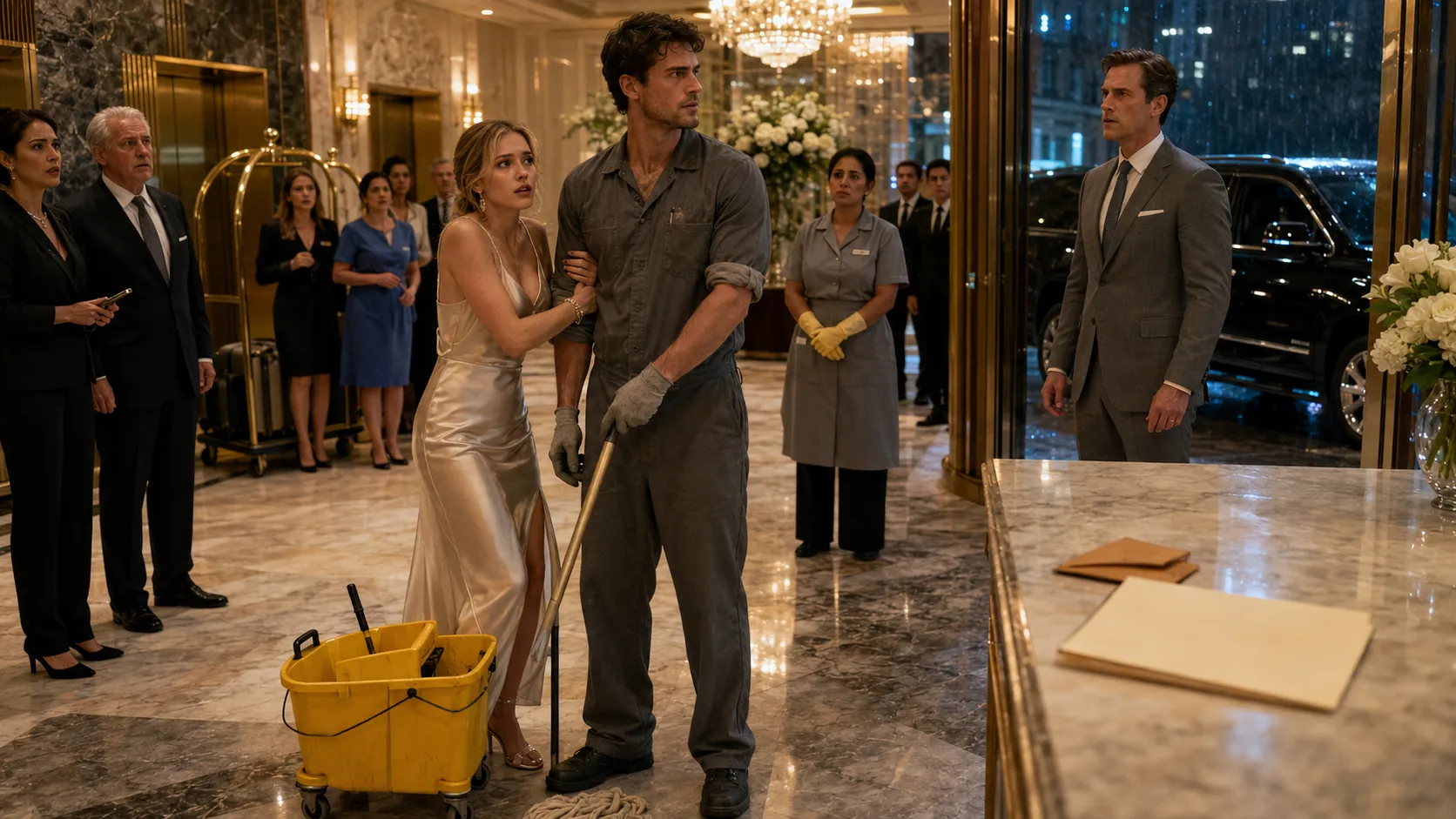
The marble lobby of the Grand Royal was built to impress. Crystal chandeliers shimmered overhead. Soft piano drifted through the air. Polished brass reflected the warm light so perfectly that every surface seemed to glow.
And yet, the moment Jackson Wade stepped through the revolving doors, the atmosphere turned cold.
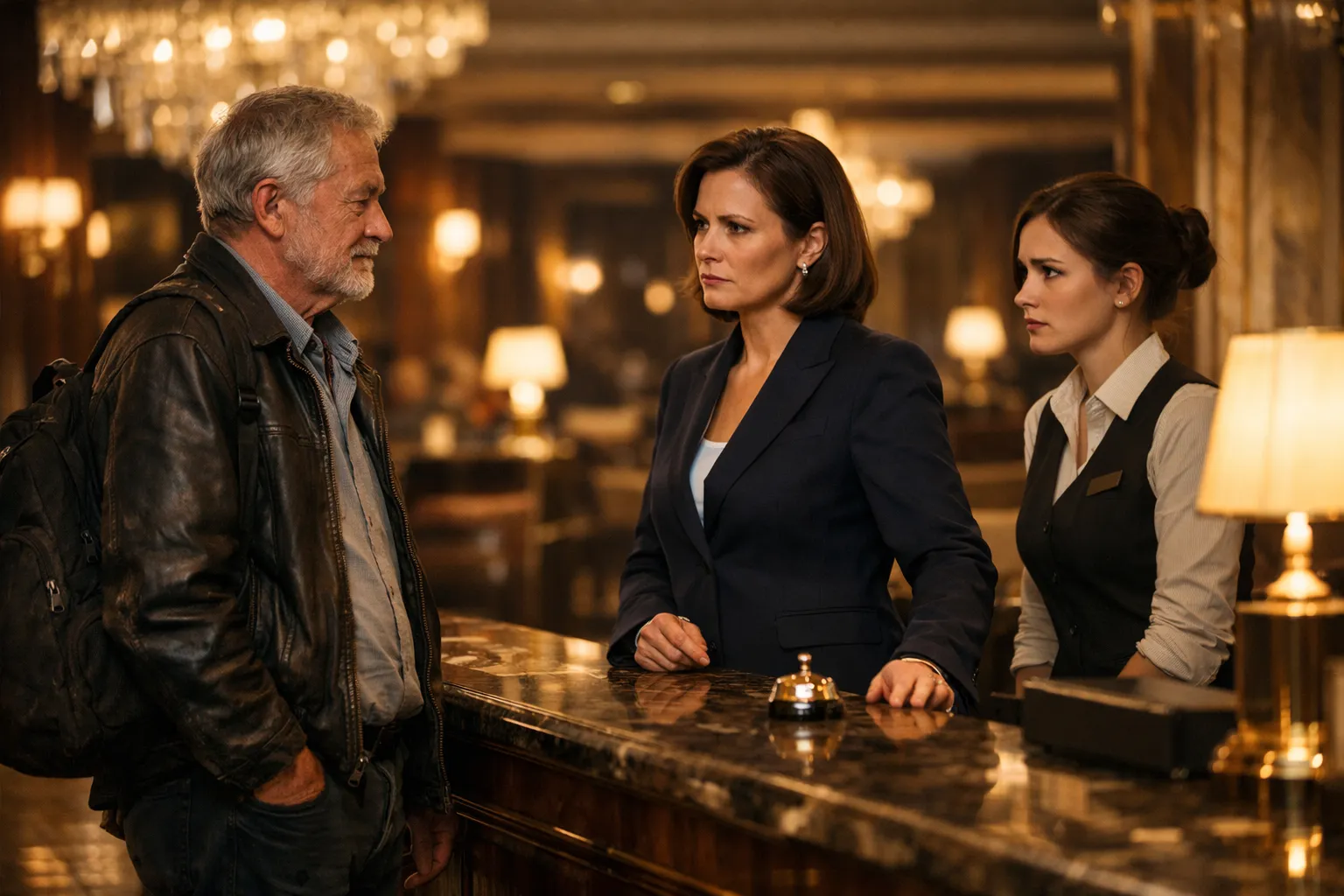
Dust clung to his worn shoes. His leather jacket had gone thin at the elbows. His shirt was neatly buttoned, but wrinkled from a sleepless overnight flight and a long drive from the airport after his luggage had been delayed. At sixty-eight, Jackson moved a little slower than he once had, but he still carried himself with a quiet steadiness that came from a lifetime of surviving harder rooms than this one.
At the front desk, a young receptionist looked up, ready to speak.
He never got the chance.
A woman in a tailored navy suit stepped forward from the office behind the desk. Her name tag read Clara Langford — General Manager. Her eyes moved over Jackson once, from his weathered jacket to his scuffed backpack, and her expression changed in an instant.
Not confusion.
Not concern.
Judgment.
Without looking away from him, Clara slid one hand beneath the desk and pressed a silent button.
Two security guards at the far end of the lobby straightened immediately.
Jackson noticed. Of course he did.
But he said nothing.
He had seen that look before — the one people wore when they thought they had measured a human being in a single glance and found him lacking. The only difference was that this time, the hotel belonged to him.
Two days earlier, Jackson had completed the quiet acquisition of the entire Grand Royal chain through a series of holding companies. No press conference. No internal announcement. No parade of executives and photographers. He had used the same method he had relied on for years whenever he bought a troubled property: arrive alone, unrecognized, and let the culture reveal itself before anyone had time to rehearse kindness.
Jackson had not built his hospitality company from a boardroom. He had built it from service hallways, laundry rooms, and loading docks. At nineteen, he had carried suitcases for wealthy men who never learned his name. At twenty-two, he had scrubbed bathroom floors in a roadside motel after the night cleaner failed to show up. At twenty-nine, he had borrowed money against his truck to buy his first failing inn. Decades later, his company operated hotels in eleven countries, but he had never forgotten the first rule of the business:
You can tell everything about a hotel by the way it treats the person it thinks does not matter.
Three days before his arrival, his assistant, Sarah, had booked the penthouse suite under a corporate account labeled Jackson Group. No title. No note. No alert to management. He wanted no favors, no smiles prepared in advance, no one performing decency because a powerful man was coming.
He wanted the truth.
Now, standing in the center of the Grand Royal lobby, he was getting it.
“This is a private property,” Clara said coolly, before he had even reached the desk. “We do not allow loitering in the lobby.”
Jackson stopped in front of her and met her gaze. His voice was calm, almost gentle.
“I have a reservation,” he said. “It should be under Jackson Group.”
The young receptionist glanced toward the keyboard.
Clara did not.
Instead, she folded her arms.
“I think you have the wrong hotel.”
A few guests seated in the lounge turned openly to watch. One man lowered his newspaper. A woman with a glass of wine leaned toward her friend and whispered something that made them both smile.
Jackson rested one hand lightly on the counter.
“I would appreciate it,” he said, “if you would check the system.”
Clara’s smile tightened.
“That won’t be necessary.”
There was a brief silence.
In that silence, the whole lobby made its choice.
No one spoke up. No one asked whether there had been a misunderstanding. No one suggested that looking at the reservation list might be the simplest solution.
The young receptionist swallowed hard but said nothing.
Jackson reached inside his jacket and removed a heavy matte-black card. He set it on the counter between them.
Clara glanced down.
Centurion.
Invitation only.
For a flicker of a second, something uncertain passed through her eyes. Then it was gone.
“Those can be faked,” she said.
It was not the insult that struck Jackson most deeply. It was the certainty behind it — the certainty of a person who had already decided what kind of man stood before her and would rather defend her judgment than verify a fact.
Jackson drew a slow breath.
“I’m going to ask you one last time,” he said. “Please check the reservation.”
Instead of answering, Clara picked up the radio clipped at her waist.
“This guest is causing a disturbance,” she said. “Please escort him outside.”
The security guards began crossing the lobby.
The young receptionist finally found his voice. “Sir,” he asked quietly, “are you certain the reservation is under Jackson Group?”
Jackson turned to him.
“Yes,” he said. “Penthouse suite. Three nights.”
Then, after a pause, he added in the same calm tone, “And I would remember this moment very carefully if I were you.”
The guards stopped beside him. One gestured politely toward the door.
Jackson did not argue. He did not raise his voice. He did not demand a manager, because the manager had already told him everything he needed to know.
He simply picked up his card, slipped it back into his jacket, and walked toward the revolving doors while half the lobby watched as if they had paid for the entertainment.
Outside, beneath the gold-lit sign of the hotel, the night air bit through the thin fabric of his shirt.
Jackson took out his phone and called Sarah.
“Board call,” he said. “Twenty minutes.”
There was no surprise in her voice. “Understood.”
“Pull guest complaint history, staff settlements, and turnover records for this property,” he added. “I want everything tied to local management. And alert regional HR to stand by.”
A short silence.
“Was it that bad?” Sarah asked.
Jackson looked back through the glass at the shining lobby.
“It was worse,” he said. “No one even checked.”
Inside, Clara accepted a few approving smiles from the lounge as though she had protected the dignity of the hotel.
But behind the desk, the young receptionist — Ryan — slowly turned back to the computer.
His fingers trembled as he typed.
Jackson Group.
He hit enter.
The reservation appeared instantly.
Penthouse Suite — Confirmed — Three Nights — Corporate VIP
Ryan stared at the screen so long that the letters began to blur.
Then he opened a browser and typed Jackson Wade.
The search results filled the screen: interviews, magazine profiles, acquisition reports, photographs from charity galas and business summits. At the top was the headline announcing that Jackson Hospitality Group had quietly acquired the Grand Royal chain.
Ryan felt his throat close.
“He owns the hotel,” he whispered.
No one answered him.
At first, perhaps, no one understood.
Then Clara turned, saw the screen, and the color drained from her face.
Twenty minutes later, the revolving doors turned again.
This time, the entire lobby noticed.
Jackson walked in exactly as he had before — same worn jacket, same tired eyes, same scuffed shoes — but now he carried something far heavier than wealth.
He carried the truth.
The room fell silent.
He went straight to the front desk and looked at Ryan.
“I believe,” he said evenly, “you found my reservation.”
Ryan swallowed. “Yes, sir. Penthouse suite. Three nights.”
Clara stepped forward, trying to recover her authority.
“Mr. Wade, I think there has been a misunderstanding—”
Jackson raised a hand.
“No,” he said. “There has been a very clear understanding.”
He placed a simple black business card on the counter.
Jackson Wade
Chief Executive Officer
Jackson Hospitality Group
No one laughed this time.
Jackson laid his phone beside the card and pressed speaker.
A composed female voice filled the lobby.
“Good evening, Mr. Wade. Regional HR and legal are on the line. We are ready when you are.”
The silence deepened.
Clara’s mouth opened, but no words came out.
Jackson turned slowly, taking in the guests, the guards, the staff members standing stiffly behind the desk.
“I did not come here for revenge,” he said. “I came here to see whether this hotel still understands the meaning of hospitality.”
He looked back at Ryan.
“Bring up the complaint records tied to local management.”
Ryan hesitated only a second this time. Then he did as he was told.
The file opened.
One complaint became five. Five became twelve. Then seventeen.
Several involved public humiliation of guests. Others referenced staff mistreatment, profiling, and private settlements that never should have been ignored. There were notes from former employees who had resigned without explanation. There were warnings buried in paperwork. There were patterns disguised as isolated incidents.
Jackson did not need to raise his voice.
“This,” he said quietly, “is not a mistake. It is a culture.”
For years, Clara had relied on silence. On people looking away. On younger employees being too afraid to contradict her. On guests being too embarrassed to complain publicly.
Now that silence began to crack.
A housekeeping supervisor stepped forward first. Then a night porter. Then one of the concierges, who admitted he had watched Clara turn away more than one guest she thought looked “wrong” for the property.
Each confession made Clara smaller.
Finally, Jackson turned to face her.
“When I was nineteen,” he said, “I carried bags through hotel lobbies for men who would not even look at me. Later, I cleaned bathrooms in places far less beautiful than this one. So let me be very clear about something, Ms. Langford.”
His voice was still calm, but now it carried to every corner of the room.
“No one in my company will ever decide a person’s worth by their shoes, their coat, their accent, or the hour they walk through the door. A luxury hotel is not defined by marble floors or chandeliers. It is defined by whether a tired stranger is treated with dignity.”
Clara tried one last time.
“I was protecting the hotel.”
Jackson held her gaze.
“No,” he said. “You were protecting your prejudice.”
Then he turned slightly toward the phone on speaker.
“Effective immediately,” he said, “remove Clara Langford from active duty pending final termination processing. Lock managerial access. Begin full review of everyone who enabled this pattern.”
A voice on the line answered at once.
“Confirmed.”
Ryan stared at the screen as Clara’s access disappeared.
No one moved.
Even the guests looked ashamed now — not all of them, perhaps, but enough.
Jackson let the silence sit for a moment longer, because some lessons needed room to land.
Then he looked at Ryan.
“You hesitated,” he said.
Ryan lowered his eyes. “Yes, sir.”
“That hesitation may have saved your job,” Jackson replied. “Because it means some part of you knew this was wrong.”
Ryan looked up, stunned.
“But hear me clearly,” Jackson continued. “The next time you know something is wrong, do not wait for permission to do the decent thing.”
Ryan nodded. “I understand.”
Jackson picked up his card and slipped it back into his jacket.
“To the rest of you,” he said, addressing the staff, “this hotel will not change because one person is leaving. It will change when every person in this building decides that respect comes before appearances. Everyone will be retrained. Every complaint process will be audited. Every guest will be treated as if their dignity matters — because it does.”
No one argued.
For the first time that evening, the lobby looked less like a showroom and more like a place where human beings actually worked.
A week later, a bronze plaque appeared beside the entrance, polished bright enough to catch the morning sun.
It read:
In this hotel, dignity checks in first.
Ryan passed it every day on his way to the desk.
And no matter who walked through the doors — tired traveler, wealthy executive, elderly widow, young family, man in work boots, woman in pearls — he greeted each one the same way.
With respect.
Because that night, everyone had learned the most expensive thing a hotel could lose was not its reputation.
It was its humanity.