For days, a silent stray followed Emma home while she fought to save her mother. Then, in the middle of a crowded street, he grabbed her bag—and forced her to reveal the pain she had been carrying alone.
No one on that street could have guessed what Emma was carrying that evening.
To the people passing by, she looked like countless other tired women at the end of a long day—coat buttoned wrong, hair slipping loose, eyes fixed somewhere far beyond the pavement. But behind her pale face was a kind of exhaustion deeper than sleeplessness. It was the exhaustion of someone who had been frightened for so long that fear had become her second skin.
For three weeks, Emma had been living between her small office job, her one-bedroom flat, and St. Catherine’s Hospital, where her mother, Margaret, had been admitted after her condition suddenly worsened.
Margaret had raised Emma alone.
She had done it with little money, aching hands, and the kind of quiet strength that no one praises enough until it is almost gone. She had worked in schools, cleaned offices in the evenings, taken in sewing on weekends, and somehow still found the energy to sit at Emma’s bedside when she was sick, cheer at every school concert, and make ordinary meals feel like love.
Now the woman who had always known how to endure was lying in a hospital bed, growing weaker by the day.
The doctors were careful with their words, but Emma heard the truth in the pauses between them. Treatment had to begin soon. Delay would make everything harder. And the cost—spoken gently, almost apologetically—landed like a sentence.
Emma did what decent people do when life turns cruel: she tried to solve it quietly.
She worked longer hours at the administrative office where she had been employed for years. She volunteered for every extra shift, every filing backlog, every mind-numbing task others avoided. At night she sat at her kitchen table with a calculator, unpaid invoices, hospital estimates, and a notebook full of figures that refused to become manageable no matter how many times she added them.
She sold the gold bracelet her grandmother had left her. She listed a dining table online. She parted with two old armchairs, a record player she loved, and the necklace her mother had given her on her twenty-first birthday. She took out a small loan with an interest rate that made her stomach turn.
Still, it was not enough.
The total she needed did not feel like a number anymore. It felt like a wall.
And all the while, she told almost no one.
Emma had never been good at asking for help. Margaret had raised her to be kind, responsible, and honest—but also proud. Not arrogant, never that. Simply the kind of proud that makes a person say, I’ll manage, even when they are already sinking.
It was during those days that the dog appeared.
The first time, Emma noticed him in the reflection of a dark shop window. He was walking several paces behind her, not too close, not timid either. He was a medium-sized stray with dusty brown fur, intelligent eyes, and the serious expression of an old soul who had seen too much of the world to be fooled by it.
She slowed down. He slowed down.
She crossed the street. He crossed after a moment.
When she reached the entrance to her building, she turned fully and looked at him. He stopped several feet away and sat down, as if to say he meant no harm.
Emma was too tired to make sense of it.
“Go on,” she murmured. “I have nothing for you.”
The dog did not move.
The next afternoon, he was there again—outside the hospital gates this time, as though he had somehow learned her route. When she came out after visiting hours, worn and hollow-eyed, he rose from where he had been lying beside a lamppost and began to follow at the same respectful distance.
He never barked.
He never whined.
He never rushed up to her for food or affection.
He simply stayed near.
By the fourth day, Emma found herself glancing for him without admitting it. By the sixth, his quiet presence had become part of the strange rhythm of her grief. She still didn’t understand it, but somewhere beneath all her fear, it comforted her. There was something steady about him. Something watchful. Almost protective.
Then came the morning that broke her.
Emma had gone to the hospital before work because one of the doctors had asked to speak with her. He was kind, middle-aged, and wore the weary expression of someone who had delivered too many difficult truths.
He explained that Margaret’s treatment could not be delayed much longer.
They had reached the edge of waiting.
Emma nodded as though she understood calmly, like a reasonable adult discussing paperwork. But when she stepped out into the corridor and the office door closed behind her, the world seemed to tilt.
She leaned against the cold white wall and pressed her fist to her mouth.
For the first time in weeks, she let herself imagine the worst.
Not the bills. Not the debt. Not the humiliation of having nothing left to sell.
Her mother’s empty chair by the window.
Her mother’s room untouched.
Her mother’s voice gone from the world.
A nurse passing by slowed, as if she might stop, but Emma quickly straightened and wiped her face. Old habits. She thanked her, lied that she was fine, and left for work with that same terrible knot in her chest.
By evening, the knot had become almost unbearable.
The city moved around her as it always did—cars passing, traffic lights changing, people talking into phones, shopping bags rustling, bus doors opening and closing. Emma walked through it all as if through water. She could hear her own thoughts repeating in a merciless loop.
It won’t be enough. You are too late. You are going to fail her.
When she reached the busy street near the pharmacy, the dog appeared beside her again.
This time, instead of falling into step behind her, he moved ahead.
Emma barely noticed at first. She was too deep inside her own panic.
Then suddenly, before she understood what he meant to do, he caught the strap of her bag gently but firmly in his teeth.
Emma gasped.
“Hey—no! Let go!”
She pulled the bag toward her. The dog held fast.
He was not snarling. He was not trying to steal it. There was no aggression in him at all. Only insistence. A stubborn, urgent refusal to move aside.
Emma tugged again, more sharply now. The dog braced himself and would not release it.
People around them began to slow.
A woman carrying groceries stopped first. Then a young man in a delivery uniform turned back. A taxi driver leaning against his car frowned and took a few steps closer. Within seconds, a loose circle had formed around them, filled not with danger but with curiosity.
Emma felt heat rush to her face.
“Please,” she whispered, though whether she was speaking to the dog, to God, or to herself, she could not have said.
The dog looked up at her.
And something in Emma finally gave way.
Not gracefully.
Not quietly.
It was as if weeks of fear tore open all at once. Her shoulders shook. Her breath broke. She tried to speak and failed. Then the tears came—sudden, uncontrollable, humiliating, unstoppable.
“I can’t do this anymore,” she said, but it came out in fragments. “I can’t… I’m trying… I’m trying so hard…”
The woman with the groceries stepped closer and laid a gentle hand on Emma’s arm.
“What happened, love?”
That was all it took.
The words poured out of Emma like water through a broken dam.
She spoke about Margaret. About the hospital. About the treatment that had to begin. About the money she did not have and the things she had already sold. About being alone. About being terrified. About not knowing how to carry one more day of it without collapsing.
No one interrupted her.
By the time she finished, the street had gone quiet.
Not awkwardly quiet.
Tenderly quiet.
The taxi driver cleared his throat first. “How much is still missing?”
Emma blinked at him, confused.
A university student, no older than twenty, had tears in her own eyes. “I can post this right now,” she said, lifting her phone. “People help when they know. Let me help.”
The woman with the groceries nodded. “My sister runs the bakery on the corner. We’ll put a collection jar out tonight.”
A retired schoolteacher who lived nearby recognized Emma from the neighborhood and said, “There’s a church group that helps families in medical crisis. I know exactly who to call.”
A pharmacist stepped out from the shop and quietly offered to speak with the hospital about medication support.
And through it all, the dog finally released the bag.
Then he simply sat beside Emma.
Calm. Still. As though his part in the matter was finished.
In the days that followed, the story spread farther than Emma could have imagined.
The student’s post was shared hundreds of times by morning. The bakery collection jar began filling with bills and coins. A local community page published Margaret’s story. The retired teacher helped organize a neighborhood fundraiser. Some people gave five dollars. Others gave fifty. One envelope arrived with no name and enough to cover several days of treatment. Strangers wrote messages that Emma read late at night with trembling hands.
My mother went through something similar. Don’t lose hope.
No daughter should face this alone.
For Margaret. For all the mothers who gave us everything.
It was not only the money that changed something in Emma.
It was the unbearable, almost shocking discovery that she was no longer invisible.
People had seen her.
Not the careful office worker who always smiled politely. Not the woman who said she was managing.
Her.
Broken, frightened, ashamed—and still worthy of help.
Margaret’s treatment began two days later.
The first week was brutal. Emma lived from one hospital call to the next. Every time her phone lit up, her heart lurched. Every visit was a battle between hope and dread. She sat by her mother’s bed, held her thin hand, and spoke softly about ordinary things—the weather, the neighbor’s roses, a film they both loved—anything to make the room feel less like a place where fate was being decided.
Then, one gray morning, the doctor entered with an expression Emma had not seen on his face before.
It was not triumph.
It was better.
Relief.
“The treatment is working,” he said. “She is stabilizing. The immediate danger has passed.”
Emma stared at him as though she no longer understood language. Then her face crumpled, and tears slid down again—but these were not the tears of helplessness that had broken open on the street.
These were lighter.
Almost unbelieving.
When Margaret was finally discharged, she looked frail, but she was smiling.
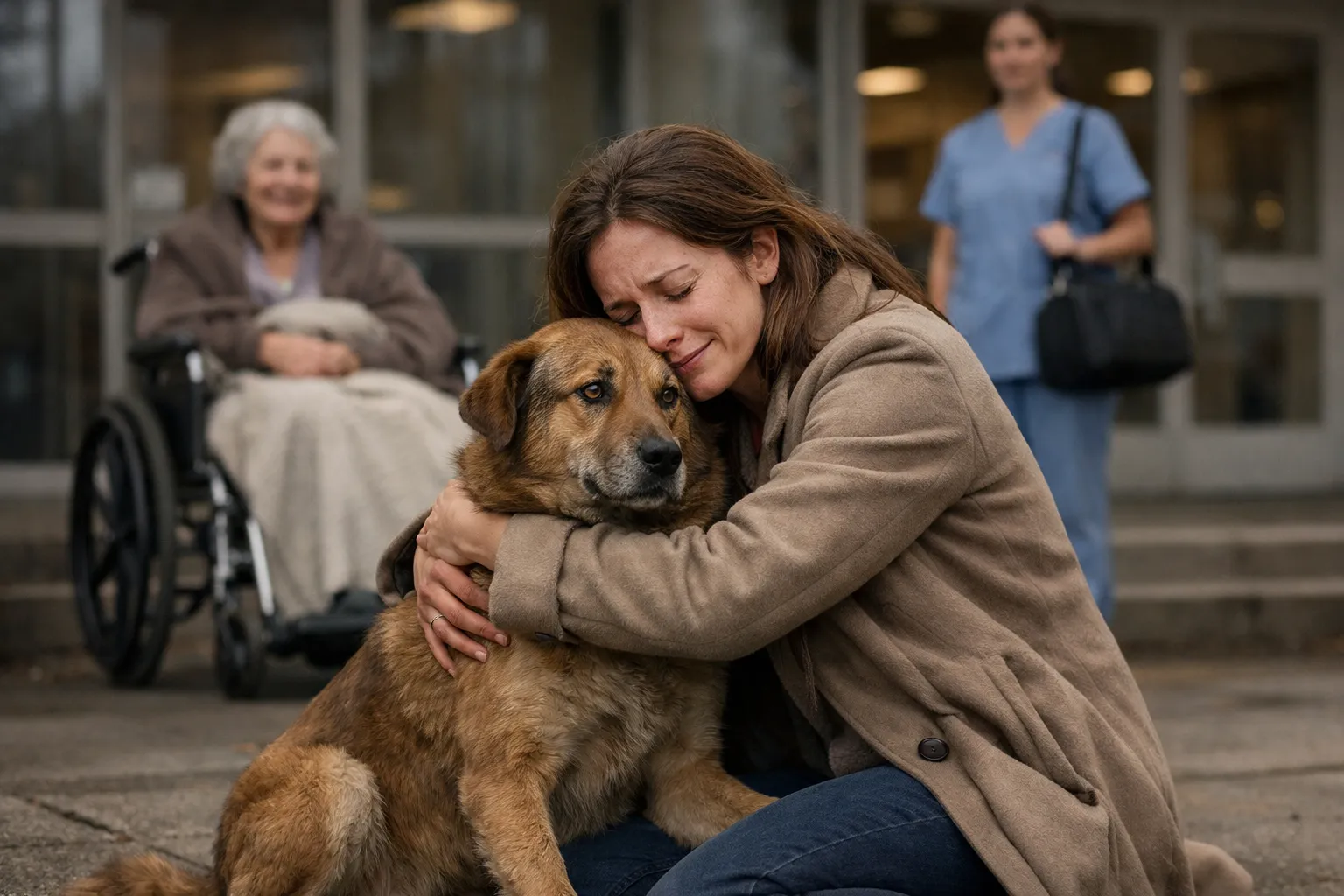
Emma carried the small overnight bag while a nurse wheeled Margaret toward the hospital entrance. The doors slid open, letting in the cool afternoon air.
And there, just beyond the steps, sitting with perfect composure as though he had been expected, was the dog.
Emma stopped walking.
For a moment she could only look at him.
Then she handed the bag to the nurse, crossed the pavement, and dropped to her knees.
She wrapped her arms around his neck and held him so tightly that passersby turned to stare.
“You,” she whispered through tears. “You’re the one who started all this.”
The dog leaned into her without resistance, tail brushing the ground once, slowly.
Margaret, still weak but alert, watched from the wheelchair with wet eyes.
“Well,” she said softly, “I suppose every family meets in its own way.”
Emma laughed for the first time in weeks.
She named him Hope.
It was the only name that felt right.
From that day forward, Hope was no longer a stray trailing at a distance. He became part of their home, sleeping by the radiator in winter and following Margaret from room to room with the solemn devotion of a creature who understood far more than he could ever say.
Margaret would stroke his head and call him their quiet miracle.
Emma never corrected her.
Because in truth, the miracle had not been magic.
It had been interruption.
A stubborn interruption in the middle of despair.
A dog refusing to let her keep walking alone with a burden that was crushing her.
Years later, Emma would still think about that evening whenever she saw someone moving through the world with that same fixed expression she had once worn—the look of a person determined not to fall apart in public.
She knew better now.
Sometimes strength is not in holding yourself together.
Sometimes it is in breaking open just enough for kindness to reach you.
And on certain evenings, when the sky turned gold and the street outside the bakery grew busy again, Emma would walk slowly with Margaret on one side and Hope on the other, feeling a quiet certainty settle in her heart.
Even in the darkest season of a life, light is often closer than it seems.
Sometimes, it arrives on four dusty paws.