The house was too quiet, and the first voice Emerson Bennett heard was his wife’s, cold and controlled, behind the shed door. What he found inside would expose months of hidden cruelty—and force him to become the father his daughter truly needed.
I used to believe that providing for my family was the same thing as protecting them.
For years, I measured love in practical things—mortgage payments made on time, a good school district, piano lessons for my daughter, fresh paint on the walls, and the kind of house people admired when they drove past. I told myself that the long business trips, the missed dinners, and the rushed phone calls from airport lounges were sacrifices a good father made.
It took one ordinary afternoon for me to understand how wrong I had been.
I came home a full day earlier than planned.
Lakewood Ridge, Colorado, was bright and still under a pale afternoon sun when my driver dropped me off at the house. I remember feeling almost cheerful as I walked up the front path. I thought I might surprise my daughter, Sofia, before dinner. She was eight years old then—small for her age, with dark serious eyes and a gentleness that made people lower their voices around her without even realizing it.
Sofia had never spoken a word in her life.
She had been born nonverbal, and from the time she was very young, she learned to communicate through facial expressions, small gestures, and a little spiral notebook she carried everywhere. That notebook was her voice. She filled it with questions, drawings, one-line observations, and, sometimes, things she was too afraid to show anyone.
When I stepped inside the house, I expected to see signs of her immediately—her shoes by the stairs, crayons on the kitchen island, maybe one of her half-finished drawings left on the table.
Instead, the house felt wrong.
Not empty. Not peaceful. Wrong.
It was too quiet.
There are different kinds of silence in a home. I knew the good kind: the kind that settles after a long day when everyone feels safe enough to be still. This silence was different. It felt tense, watchful, like a held breath.
I set my suitcase down near the staircase and listened.
That was when I heard my wife.
“Finish everything on that plate,” Lauren said sharply. “You’re not leaving until it’s gone.”
Her voice was coming from outside.
Then came another sound—small, weak, and almost too soft to catch.
A child trying not to cry.
I moved through the kitchen, across the back hallway, and out toward the yard before I had consciously decided to do it. The old garden shed stood near the hedge line, half-hidden by climbing ivy and a row of overgrown shrubs. We mostly used it for storage—tools, extra chairs, paint cans, a broken lamp I always meant to fix and never did.
As I got closer, I saw the padlock hanging open from the latch.
The door itself was shut.
I opened it.
The smell hit me first—damp wood, dust, stale air, and something sour underneath it all. The little window in the back was so dirty it barely let light through. For a second, the room was only shapes.
Then my eyes adjusted.
Sofia was sitting on the floor with her back against the wall.
There was a plate in her lap: cold green beans, a few pieces of congealed chicken, and a bowl of soup that had gone gray at the edges. Her hands were shaking so badly that the spoon rattled against the plate. Her cheeks were wet. Her eyes were swollen from crying.
Lauren stood over her, immaculate in a cream blouse and summer skirt, as though she had stepped into the shed by accident on her way to a garden party.
Her finger was pointed at the plate.
“Every bite,” she said. “You don’t get to manipulate me.”
Sofia looked up and saw me in the doorway.
I will never forget that look.
It wasn’t relief at first.
It was fear.
Fear that I might close the door and leave her there.
“Lauren.”
I barely recognized my own voice.
Lauren turned. For one brief instant, something hard and ugly flashed across her face. Then it vanished so quickly that, had I not been looking right at her, I might have missed it.
“Emerson,” she said, smoothing her expression into surprise. “You’re home early.”
I crossed the room without answering and knelt beside Sofia. She flinched before realizing it was me. That almost broke me more than anything else.
When I picked her up, I was startled by how light she felt.
Her hands were cold.
“What is this?” I asked.
Lauren let out a breath through her nose, annoyed rather than ashamed.
“She refuses to eat properly,” she said. “I’ve been trying to correct the behavior, but you’re gone so often you only ever see her when she’s being sweet.”
I looked at Sofia. She had tucked her face into my shoulder, but her whole body was still trembling.
“Correct the behavior?” I repeated.
Lauren crossed her arms. “Children need discipline. Especially difficult children.”
I turned then, slowly enough that she could see my face change.
“Do not talk about my daughter that way.”
For a moment, neither of us said anything.
Then I carried Sofia out of the shed.
As I stepped back into the sunlight, I glanced down near the wall and saw something written in the thin layer of dust on the wooden floor.
One word.
HELP.
That evening, I sat on the edge of Sofia’s bed until she fell asleep.
She would not let go of my sleeve.
At one point, she reached weakly for her notebook and pencil. Her fingers moved slowly, as if she were exhausted.
When she turned the page toward me, it said only:
Did you come back for me?
I had negotiated multimillion-dollar contracts without blinking. I had spoken in boardrooms full of men twice my age. I had held my nerve through economic crashes, lawsuits, and the death of my own father.
Nothing in my life prepared me for reading that sentence in my child’s handwriting.
“Yes,” I told her, though I knew it was not enough. “And I’m staying.”
After she finally drifted to sleep, I went into the study and turned on the security monitor.
We had installed cameras around the property after a break-in two years earlier. I had nearly forgotten they were there. Lauren, apparently, had forgotten too.
I pulled up the garden feed from that afternoon.
There she was, leading Sofia across the yard by the wrist.
Sofia resisted once—just a small backward tug, not enough to make a sound, but enough to show that she did not want to go. Lauren jerked her forward anyway, opened the shed door, pushed her inside, and shut it behind her. A moment later, she snapped the padlock into place.
Then she walked back toward the house as calmly as if she had just hung laundry in the sun.
I watched the footage three times.
Each viewing made me feel less shocked and more sick.
The next morning, the truth began arriving from directions I had failed to notice for months.
Our housekeeper, Maria, asked if she could speak to me privately before Lauren came downstairs. She stood in the kitchen twisting her apron in both hands, clearly terrified of saying too much and ashamed of having said too little.
“I tried to tell you,” she said. “Twice. But your wife answered your phone once, and the other time she told me you were too busy to be disturbed.”
Then she showed me an audio recording she had made one afternoon when she heard shouting from the upstairs hallway. Lauren’s voice was unmistakable—cold, mocking, and full of disgust. She called Sofia a burden. A nuisance. A problem that needed to be managed.
My hands started shaking as I listened.
Later that day, I went to Sofia’s school.
Her teacher and the school counselor brought out a file thicker than it should have been. Inside were notes documenting a troubling change over several months: weight loss, withdrawn behavior, fear at pickup time, unfinished lunches, and several attempts to reach me that had gone unanswered. Emails had been sent. Calls had been placed. Messages left.
I had received none of them.
Lauren handled the household calendar and often screened my calls when I traveled. Somehow, every warning had been intercepted before it ever reached me.
By the time I returned home, I understood something I had not wanted to admit even to myself:
What I found in the shed was not an isolated outburst.
It was a pattern.
That evening, I asked Lauren to sit down in the dining room.
She did so with the composed expression of someone who still believed she could control the story.
“You’ve made this bigger than it is,” she said. “Sofia is manipulative, Emerson. She knows how to use your guilt.”
I stared at her.
“My guilt?”
“Yes,” she said, leaning back in the chair. “You’re never here, so of course you overcompensate when you are. Someone has to be the adult.”
I could feel something inside me hardening—not rage, not yet, but a terrible clarity.
“The adult,” I said quietly, “does not lock an eight-year-old child in a shed.”
“She needed structure.”
“She needed safety.”
Lauren’s face changed then. The softness disappeared. So did the polished patience.
“If you keep pushing this,” she said, her voice flattening, “you will destroy this family.”
I rose from the table.
“There is no family,” I said, “where a child is afraid to come home.”
I contacted an attorney that night.
By morning, I had also contacted child protective services.
The emergency hearing took place nine days later.
Lauren came dressed in navy, conservative and serene, as if she were attending a charity luncheon. Her lawyer framed everything as a misunderstanding. Discipline mistaken for cruelty. Stress. Household tension. A difficult child in need of firmer guidance.
Then the judge asked whether Sofia wished to say anything.
My daughter was seated beside a court-appointed advocate, her notebook in her lap. She looked very small in that courtroom. Smaller than she should have.
She uncapped her pen.
The room was silent except for the scratch of the tip moving across paper.
When she was done, she turned the notebook around.
It read:
I want to live where I am not afraid.
No one spoke for several seconds.
The judge granted me temporary sole custody that day and suspended Lauren’s unsupervised access pending the outcome of the investigation.
I wish I could say that was the end of it.
It wasn’t.
Protecting a child is not a single dramatic moment. It is not only opening a locked door.
It is what comes after.
It is paperwork and therapy appointments. It is rearranging your entire life around what should have mattered all along. It is learning how badly you failed without allowing your shame to make the child comfort you for it.
I canceled contracts. I cut my travel to almost nothing. I began taking sign language classes three evenings a week because I realized, with painful honesty, that I had spent years loving my daughter without fully learning her language.
Sofia started therapy. At first, she barely looked anyone in the eye. Loud noises unsettled her. Closed doors made her tense. If I left a room without telling her where I was going, even for a minute, I would come back and find panic written all over her face.
So I stopped disappearing.
I told her where I was going.
I came back when I said I would.
Little by little, she began to trust the world again.
One Saturday morning, I took the padlock off the shed and threw it into the trash.
The following week, I hired a crew to clean the place out. We scrubbed the walls, repaired the warped floorboards, replaced the filthy window, and painted the inside a soft cream color that caught the light. We added shelves, a rug, an easel, jars of brushes, and every art supply Sofia had ever paused too long to admire in a store.
By the time we were done, the shed no longer looked like a place of punishment.
It looked like possibility.
It became her studio.
The first time she spent an afternoon there alone, painting by the window with sunlight on her hair, I stood outside for a long while and simply watched.
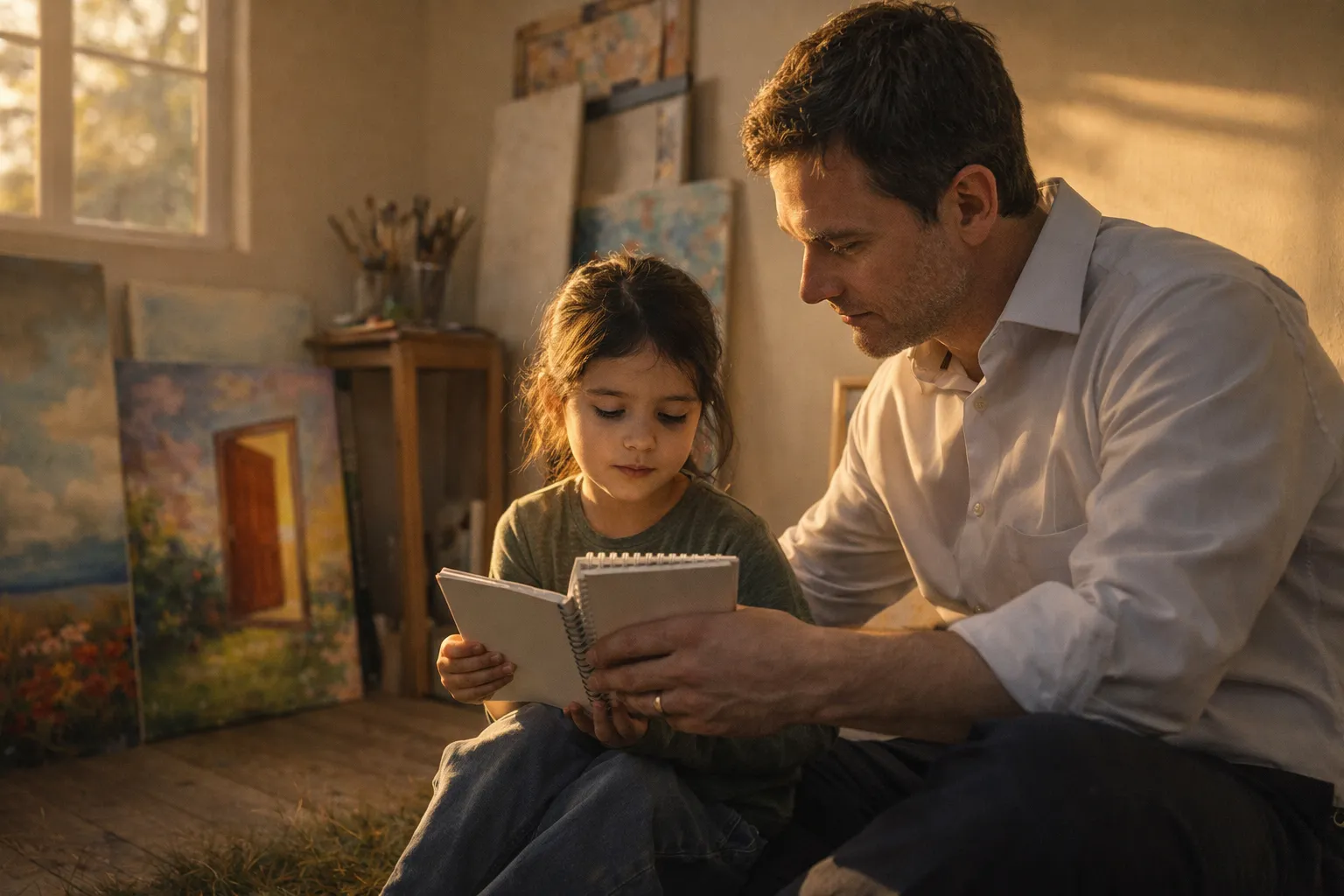
Months later, on a quiet evening in early fall, Sofia sat beside me on the studio floor with her notebook open on her knees. Her paintings lined the wall—birds, trees, hands, windows, and once, unexpectedly, a bright red door standing wide open in the middle of a field.
She wrote something carefully, then nudged the notebook toward me.
There is light here now.
I looked around the room. At the window. At the paint on her fingers. At the child who no longer flinched when footsteps approached the door.
Then I answered the best way I knew how—with the sign I had practiced again and again until it became natural.
There always will be.
Because saving a child is not only about the moment you find them.
It is about what you build afterward.
It is about becoming worthy of the trust they offer you a second time.
And I have spent every day since then trying to deserve it.