Everyone in Willow Creek had already decided what Eleanor Briggs was: too large, too plain, too much woman for any man to want. But when widowed rancher Thomas Hale watched his youngest son fall asleep in her arms, he began to wonder whether the town had mistaken gentleness for weakness.
In Willow Creek, people prided themselves on knowing one another’s business before it was spoken aloud.
It was the kind of town where laundry lines carried news faster than the post office and where a woman’s reputation could be stitched together from glances, whispers, and one careless remark repeated often enough to sound like truth.
Eleanor Briggs had lived with that truth for years.
At thirty-six, she was the seamstress who rented the narrow room above the tailor shop, the woman who worked with patient hands and spoke with more kindness than most people ever returned to her. She was known for mending wedding gowns she would never wear, children’s Sunday clothes she would never have to wash, and men’s shirts she would never be asked to iron by a husband of her own.
She had also become, in the private language of a small town, a woman others described with lowered voices and lifted eyebrows.
Too full in the hips.
Too broad in the waist.
Too plain in the face.
Too old to still be waiting.
Too much of everything, people said, for any man to choose.
After a while, Eleanor had stopped defending herself against opinions that had been decided long before she entered the room. She simply kept her head down, threaded her needles, paid her rent on time, and built a life so quiet that no one could accuse her of taking up more space than she already did with her body.
But loneliness, she had learned, does not become easier simply because you learn how to wear it gracefully.
So when Thomas Hale’s letter arrived, folded once and written in a careful, practical hand, she read it three times before she fully believed it.
I need help with my children.
Someone said you might consider it.
Room, board, and wages provided if we find we suit one another.
That was all.
No flattery.
No promises.
No unnecessary softness.
It was exactly the kind of letter a tired man would write after too many nights spent doing the work of two parents with only one grieving heart.
Everyone in Willow Creek knew Thomas Hale.
He owned one of the largest cattle ranches in the county and had the sort of reputation frontier towns admired in men — hardworking, dependable, broad-shouldered, slow to speak, impossible to intimidate. Before his wife Mary died the previous winter from a fever that came after the birth of their youngest child, Thomas had been known as a man with a quiet home, clean fences, and children who ran laughing through the fields like they had never known sorrow.
After Mary died, the laughter thinned.
The ranch kept running, because land demands labor whether a man is grieving or not. But the house, people said, had gone dim. There were five children now and only one set of hands to wash, mend, cook, comfort, discipline, and remember who was frightened of thunderstorms and who could not sleep without a lamp burning low.
Widowers, in towns like Willow Creek, rarely stayed alone for long.
The women had already begun their quiet arranging. Young widows were suggested. A cousin from two counties over was mentioned. One woman even proposed a mail-order bride as if a mother could be summoned the way a new plow part could.
Then someone — no one later admitted who — suggested Eleanor Briggs.
The suggestion had been met first with surprise.
Then with curiosity.
Then with gossip so eager it almost sounded festive.
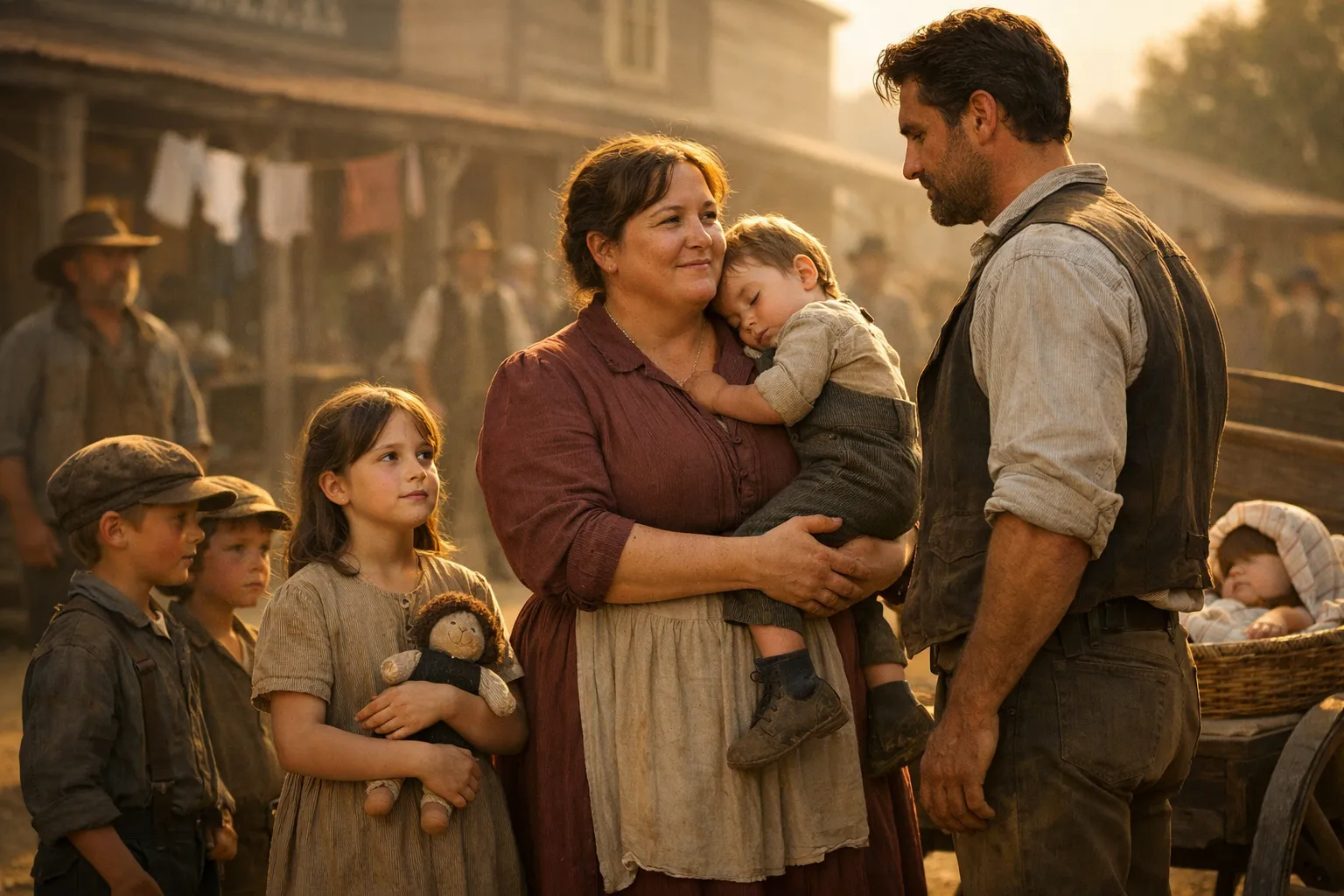
So on a warm golden afternoon, with the whole street pretending not to watch while very much watching, Eleanor stood outside the general store and faced Thomas Hale for the first time.
He was taller than she expected.
Not grand, not polished, not handsome in the way city men sometimes were, but deeply solid, like something built to endure weather rather than impress it. His shirt sleeves were rolled. His boots were dusted from the road. The lines around his eyes were the lines of a man who had spent too much of the last year staring into darkness after everyone else in the house had gone to sleep.
Four children gathered near him in a loose cluster of curiosity and caution.
Clara, the oldest girl, held a cloth doll by one arm and studied Eleanor with solemn brown eyes.
Two boys in dusty suspenders stood shoulder to shoulder, each pretending not to stare while staring very hard.
Little Samuel, drowsy and sticky-cheeked, rested on Thomas’s hip with one fist closed around the corner of a blanket.
Behind them in the wagon, the baby slept in a basket beneath a sun bonnet far too large for her tiny face.
Eleanor looked at the children and felt something ache in her chest before a single word had been spoken.
Thomas cleared his throat.
“Miss Briggs,” he said. “Thank you for coming.”
His voice was deep and restrained, the voice of a man used to asking for very little, even when he needed a great deal.
Eleanor folded her hands before her.
“Mr. Hale.”
There was a pause.
The town listened.
And because she had spent too many years being looked at as though she were a compromise life had forced upon people, Eleanor decided she would not let this man speak from pity if pity was what had brought him.
“Before you say anything more,” she said quietly, “there is something you should understand.”
Thomas’s brow drew together slightly.
“Alright.”
Eleanor took a slow breath.
Her voice did not shake. That, more than anything, came from practice.
“I am not the woman men choose.”
The words landed harder than they would have if she had said them in tears.
Several people near the store shifted uncomfortably.
A woman by the feed barrels suddenly found the sky fascinating.
Eleanor kept going.
“I know what folks say when I pass. I know what they see. They see a woman too large to be graceful, too plain to be admired, and too old to still be hoping for anything different.” She lowered her eyes for only a moment, then raised them again. “So I would rather speak honestly than let either of us waste time. I am not fit for any man.”
The street went very still.
Even the children felt it.
Then Eleanor looked past Thomas’s broad shoulders to the small faces gathered around him, and something inside her softened.
“But,” she said, her voice quieter now, “I can love your children.”
For a long moment, Thomas said nothing.
Not because he was embarrassed. Not because he pitied her. But because some truths deserve silence before they deserve an answer.
Then Clara stepped forward, clutching her doll.
“Can you braid hair?” she asked.
The question was so earnest that several people nearby nearly laughed — but didn’t.
Eleanor blinked, then nodded.
“Yes,” she said. “I can braid hair.”
Clara considered this carefully and gave a small approving nod, as if one important matter had now been settled.
One of the boys tugged at Thomas’s sleeve.
“Can she make pie?”
Eleanor looked at him and, despite herself, smiled.
“Yes,” she said. “I can make pie too.”
The other boy asked, “Can you read out loud?”
“I like reading out loud very much.”
That seemed to satisfy him.
Then Samuel, who had been studying Eleanor with the sleepy seriousness only toddlers possess, leaned away from Thomas and reached toward her without warning.
Tiny fingers opened and closed in the air.
Eleanor froze.
So did Thomas.
Samuel leaned farther, as if the decision had already been made in his mind and the adults simply needed time to catch up. Instinct took over. Eleanor stepped forward and gathered him carefully into her arms.
The little boy rested his head against her shoulder, sighed once, and settled there as naturally as if he had known her for years.
The entire street went quiet.
Thomas stared at his son. Then at Eleanor. Then at the son again, now half-asleep against the woman the town had spent years dismissing.
He rubbed the back of his neck slowly.
“Well,” he muttered, almost to himself, “that answers one question.”
Samuel yawned.
Eleanor adjusted him gently, one hand supporting his small back.
“What’s his name?” she whispered.
“Samuel,” Thomas said.
Clara tugged lightly at Eleanor’s sleeve.
“Would you show me the braid later?”
Eleanor looked down at the child and, for the first time in longer than she wanted to admit, felt something warm and dangerous move through her — hope.
“Yes, sweetheart,” she said.
Thomas was still watching her, but not the way men usually did.
Not with amusement.
Not with dismissal.
Not with the awkward courtesy reserved for women they did not know how to desire and did not want to offend.
He looked at her like a man trying to understand why peace had just entered his day wearing a burgundy dress and practical shoes.
Finally he said, “Would you like to see the ranch?”
The Hale place sat five miles outside town, where the road widened and the land began to look like it belonged more to wind and cattle than to human beings. Rolling pasture stretched toward the low blue hills. Cottonwoods lined the creek. The house itself was sturdy and handsome in the way homes often are when they were built for use first and beauty second.
But grief had left its fingerprints everywhere.
Boots were piled by the door. A chair near the table had one leg crudely braced with twine. A stack of washed clothes sat unfolded on the kitchen bench. One pan still soaked in the sink from breakfast. Dust gathered on the bookshelf in the parlor. A child’s coat hung from the stair rail where someone had likely meant to come back for it and never had the chance.
Eleanor noticed all of it.
She said none of it.
Instead, she laid Samuel carefully in his cradle, removed her gloves, rolled up her sleeves, and looked around the kitchen.
“Where do you keep the flour?” she asked.
Thomas blinked. “The flour?”
“If five children live here,” Eleanor said matter-of-factly, “someone ought to be baking.”
Clara, who had followed her inside like a shadow, almost smiled.
Thomas pointed to the cupboard.
Within an hour, the kitchen smelled of rising bread and cinnamon. One of the boys had been sent to fetch eggs. Another was wiping the table because Eleanor told him flour tastes better when it is not mixed with yesterday’s dust. Clara stood at the counter, serious as a little housekeeper, holding a bowl while Eleanor showed her how to knead gently without letting the dough turn stubborn.
The baby woke and fussed. Eleanor lifted her without hesitation, swayed once, and kept stirring with her free hand.
Thomas stood in the doorway with his arms crossed, not because he objected, but because he had not yet found another place to put the emotion rising in him.
For months the house had felt like an apology no one knew how to finish.
That afternoon it began, in the smallest ways, to feel inhabited again.
Eleanor did not try to rearrange everything at once. She did not behave as if she had arrived to rescue them, which Thomas came to understand was one of the reasons the children trusted her so quickly.
She asked before she moved things.
She listened when Clara talked about her mother’s blue ribbon box.
She mended shirts late at night after the children had gone to bed.
She found Mary Hale’s old recipe book tucked behind a flour tin and used it as if it were a form of respect.
When she braided Clara’s hair, she asked how Mary used to part it and did it the same way.
That was the moment Thomas stopped seeing Eleanor as hired help and began, though he would not yet say it aloud, to think of her as something far more dangerous to a lonely man:
A comfort.
Spring folded into summer.
The garden, neglected for months, began to bloom again under Eleanor’s hands. The boys stopped shoving one another over every small frustration. Samuel laughed more. The baby — Ruth, with her solemn eyes and cloud of soft hair — learned to sleep through the night when Eleanor sang old hymns in a low, steady voice while rocking her.
The biggest change, however, came not in the children’s behavior but in their language.
At first it was “Miss Eleanor says.”
Then it became “Eleanor says.”
Then, one afternoon in town, Thomas overheard Clara proudly telling the grocer’s wife, “At our house, Miss Eleanor makes bread on Thursdays because Samuel likes the crust warm.”
At our house.
Thomas said nothing, but he felt the words in his chest for the rest of the day.
Not everyone approved.
Willow Creek could forgive poverty faster than it could forgive a woman living contentedly without male approval. The moment people realized Eleanor was not merely helping at the ranch but becoming beloved there, the whispers changed shape.
Some said Thomas had hired her out of pity.
Others suggested a lonely man with too many children would take whatever kindness he could get.
One woman, not nearly as quietly as she imagined, remarked after church that children grow attached to anyone who feeds them regularly.
Eleanor heard it.
Thomas saw her hear it.
He saw the old, familiar habit return in her face — that small retreat into herself, that practiced pretending not to mind what had always wounded her.
Something in him hardened.
He turned toward the woman and said, in a voice calm enough to shame the whole churchyard, “My children are not attached to Eleanor because she feeds them. They are attached to her because she sees them. There are grown people in this town who could learn from that.”
The woman flushed.
Nobody answered.
Eleanor looked at him as if she had never quite believed a man might stand between her and public cruelty without embarrassment.
Thomas did not look away.
That evening, while the children chased fireflies in the yard, Clara asked Eleanor the question that finally brought all the hidden feelings into the open.
“Are you really not the woman men choose?” she asked.
Eleanor, who had been shelling peas on the porch, paused.
“Why do you ask, sweetheart?”
Clara glanced toward the barn, where Thomas stood repairing a hinge.
“Because Papa doesn’t look like he agrees.”
Heat rose softly into Eleanor’s cheeks.
She might have laughed it off if Thomas had not chosen that exact moment to turn toward the porch and meet her eyes across the fading gold of the yard.
He gave the smallest nod.
Not a flirtation.
Not a game.
Something steadier.
A recognition.
That night Eleanor lay awake in the little room off the kitchen and stared at the ceiling for a very long time. She had come to the ranch ready to offer labor, kindness, and a pair of capable hands. She had not come prepared for belonging.
And certainly not for love.
It was Samuel’s illness, late that summer, that made Thomas stop pretending to himself.
The boy developed a fever so suddenly that by midnight his skin was burning and his breath came in frightened little bursts. Thomas saddled the horse and rode for the doctor, returning near dawn with dust on his face and fear in his eyes.
He found Eleanor seated in the rocker beside Samuel’s bed, still fully dressed from the evening before, one hand on the child’s chest, the other holding a cool cloth to his brow. The room smelled faintly of peppermint and lamp oil. She had clearly not slept at all.
When Samuel whimpered, Eleanor bent low and murmured, “I’m here, love. I’m right here.”
Thomas stopped in the doorway.
Not because he meant to spy.
Because the tenderness in that room was almost too private to step into.
The doctor examined Samuel and said the fever would pass.
By noon the boy was sleeping more peacefully, one hand twisted in the fabric of Eleanor’s sleeve.
Thomas found her later at the kitchen table, exhausted, her hair loosened from its pins, her eyes shadowed with the cost of a night spent holding a frightened child together.
He stood across from her for a long while before he spoke.
“You would have done that for any child,” he said.
Eleanor looked down at her folded hands.
“Yes,” she replied.
“I know,” he said. “That’s the trouble.”
She looked up then, startled by something in his tone.
Thomas took a breath, the kind a man takes before saying something that, once said, cannot be gathered back up.
“My wife once told me that beauty is the easiest thing in the world to misjudge. She said a person’s heart will tell the truth long before their face does.” His voice lowered. “I think I understood that in theory. But I have only begun to understand it properly because of you.”
Eleanor’s throat tightened.
“Thomas…”
He crossed the kitchen slowly, as if giving her every chance to retreat if she wished.
“When you came to town that day,” he said, “you told me you were not fit for any man. I have thought about those words more times than I care to admit.” He stopped close enough to see the tears beginning to gather in her eyes. “And I think you were wrong.”
Eleanor let out a small, unsteady laugh. “You may be the first man to ever say so.”
“Then the others were fools.”
He did not say it lightly.
He said it like a man placing truth where it belonged.
Eleanor looked away for a moment, unable to bear how gently he was seeing her.
“I never wanted to be someone’s burden,” she whispered. “Or someone’s last resort.”
At that, Thomas’s expression changed — not hurt, exactly, but something deeper.
“You were never my last resort,” he said. “You were the answer I was too tired to imagine.”
A tear slipped free before Eleanor could stop it.
Thomas reached out slowly, giving her time, and brushed it away with the rough pad of his thumb.
“The children love you,” he said. “This house is steadier because of you. I am steadier because of you.” He swallowed once. “So I’ll ask plainly, Eleanor, because I don’t know how to ask any other way. Will you stay here? Not as hired help. Not as a kindness. As family.”
She stared at him.
Outside, through the open window, she could hear the boys yelling at one another over a game, Clara laughing, baby Ruth fussing in someone’s arms.
The sounds of a life she had not dared imagine becoming hers.
“I don’t want to replace Mary,” she said softly.
Thomas’s eyes gentled.
“You couldn’t,” he replied. “And I would never ask you to. The children already had one good mother. What they need now is the woman who came after grief and taught this house how to breathe again.”
That broke the last of Eleanor’s resistance.
She covered her face with one hand and laughed through her tears in the helpless way people laugh when joy arrives wearing the clothes of something they had long ago given up waiting for.
When she looked at him again, Thomas was still there.
Still patient.
Still certain.
“Yes,” she whispered.
Then, because the word felt too small for what had just been asked of her, she said it again with a trembling smile.
“Yes, Thomas. I’ll stay.”
He kissed her forehead first.
A man with children learns, if he is any kind of man at all, that tenderness should never be rushed.
By autumn, Willow Creek had a new story to tell.
Not the old one, about the seamstress no man wanted.
That story died quietly, as mean stories often do when faced with too much evidence to survive.
The new story was simpler.
That Thomas Hale had married Eleanor Briggs beneath the cottonwoods with five children standing proudly beside them.
That Clara wore her hair in the neatest braid in the county because Eleanor had done it herself that morning.
That Samuel insisted on carrying flowers and dropped half of them before reaching the porch.
That baby Ruth slept through most of the ceremony and woke only when the applause began.
That when Thomas placed the ring on Eleanor’s hand, he looked at her not as though he had settled for less than beauty, but as though he had finally recognized it in its truest form.
People still talked, of course.
Small towns always do.
But over time, even the gossips had to admit what the children made impossible to deny: the Hale house was happier, warmer, and more alive than it had been in years.
And when strangers passing through town asked who the woman was beside Thomas Hale at church suppers or harvest socials, the answer came easily now.
That is Eleanor Hale.
She is the heart of that ranch.
Years later, Clara would remember that first afternoon outside the general store more clearly than many people remember their own weddings.
She would remember Eleanor standing brave and dignified in the sunlight, saying in a steady voice, I am not the woman men choose.
And she would remember, too, what time proved afterward:
That sometimes the world is not wrong because it cannot see beauty.
Sometimes it is wrong because it has been taught to look for beauty in all the shallow places.
Thomas had not chosen Eleanor because he had run out of better options.
He had chosen her because love, when it is mature enough to recognize itself, stops asking who will impress a room.
It begins asking who will stay when the room is dark, the children are grieving, the bread is not yet baked, and hope needs hands.
In the end, Eleanor had been right about one thing.
She was not meant for every man.
She was meant for one weary cowboy, five waiting children, and a home that had been lonely long enough.
And that, it turned out, was more than enough.