Richard James could survive billion-dollar negotiations, but not dinner with his four abandoned sons. The evening he came home expecting another resigned nanny and found silence instead, he realized the stranger he had hired was not teaching the boys to behave—she was teaching them to feel safe again.
Richard James had built his life on control.
By forty-six, he could walk into a boardroom full of men twice as ruthless as he was and leave with the deal, the respect, and the final word. He had built a manufacturing empire from almost nothing, bought companies people said were beyond saving, and turned a neglected piece of old family land into a mansion so large and polished it no longer felt like a house at all. It felt like a monument to success.
And yet every evening, when he turned into the circular drive and saw the lights burning behind those tall windows, he felt something dangerously close to dread.
Inside that beautiful house lived the one reality he could not manage.
His four sons.
Finn, Liam, Logan, and Lucas were all six years old—born within minutes of each other, identical enough to confuse strangers, different enough to break a father’s heart in four separate ways.
Finn had become the strategist, sharp-eyed and cold in the way frightened children sometimes become when they decide the best defense is control. Liam carried his pain like fire; he broke first and apologized later, if at all. Logan had mastered the art of disappearing in plain sight, moving quietly through rooms as if invisibility might protect him from being left again. And Lucas, the smallest and most tender-hearted, lived with a grief too large for his body; it came out of him in piercing screams that could go on until everyone in the room felt helpless.
Three years earlier, their mother Catherine had left.
There had been no dramatic scene, no final confrontation worthy of a film. Just a note on the kitchen counter, laid neatly beside a vase of white roses that were still fresh when Richard found them.
I can’t do this.
That was all.
No explanation. No promise to return. No apology big enough to carry the weight of what she had done.
She walked away from her husband, from four toddlers, from the life everyone thought they had. And whether Richard admitted it aloud or not, part of him had walked away too. Not physically. He remained in the house, paid the bills, hired help, kept routines, bought toys, signed checks, and attended pediatric appointments. But emotionally, grief had hollowed him out. He moved through fatherhood like a man carrying furniture with a broken back—still functioning, but badly.
The boys felt it. Of course they did.
Children always do.
And because they were too young to name abandonment, they turned it into behavior.
In the last seven months, twenty-two nannies had quit.
Some lasted a week. Some didn’t survive a day. One left after Finn locked her in the pantry and slid her phone under the door. Another resigned after Liam smashed a ceramic lamp against the wall and shouted that he hoped she vanished like “the rest of them.” One highly recommended child-development specialist left in tears after Lucas screamed for four straight hours and Logan quietly cut every photograph of happy families out of the magazines in the playroom.
Richard kept every resignation letter in the same desk drawer in his study.
He privately called it the graveyard of hope.
On the morning Susanna Taylor arrived, resignation letter number twenty-two was already lying on the kitchen island, folded neatly beside a bowl of spilled cereal and a spoon crushed under someone’s shoe.
Richard didn’t even bother opening it right away.
He simply picked it up, carried it to the study, slid it into the drawer, and stared for a moment at the stack of failure inside.
When he returned to the family room, Finn was sitting on the arm of the sofa with his arms folded.
“She’s gone, isn’t she?” the boy asked.
Richard was too tired to lie. “Yes.”
Finn shrugged as if it didn’t matter, but his mouth tightened slightly. “Good.”
“Why good?”
“Because she was going to leave anyway.”
There it was.
Not anger.
Certainty.
The certainty of a child who had already decided that anyone kind enough to stay for breakfast would still be gone by dinner, so there was no point making their exit difficult for anyone but them.
Richard looked at his sons—his brilliant, damaged boys—and felt the old ache rising again, the one that money could not touch.
Later that afternoon, the butler, Mr. Whitmore, entered the study with the cautious face of a man delivering news he expected to be dismissed.
“The agency has sent another candidate, sir.”
Richard rubbed both hands over his face. “How old?”
“Thirty-nine, perhaps. She has housekeeping experience. No formal childcare certification.”
“No formal…” Richard lowered his hands. “Then why is she here?”
Whitmore hesitated. “She told the agency she felt… called.”
Richard actually laughed, though there was no humor in it. “Called? To my house? What is this, Whitmore, a religious mission?”
“I couldn’t say, sir.”
Richard looked at the clock. Then at the drawer full of resignation letters. Then back at his butler.
“Send her in. At this point I’d hire a storm if it knew how to fold laundry.”
At exactly nine the next morning, Susanna Taylor stood on the front steps.
Richard opened the door expecting someone young, nervous, and overqualified on paper. Instead he found a woman who looked neither impressed by the mansion nor intimidated by it.
She wore a spotless white blouse beneath a dark wool coat that had been carefully mended at one cuff. Her trousers were plain, her shoes sensible. Under one arm she carried an old leather bag. Tucked inside it, visible when she shifted her hand, was a worn Bible whose edges had softened from years of use.
She was a Black woman, perhaps in her late thirties, with a calm, watchful face and the sort of steady posture Richard associated not with confidence exactly, but with survival. She did not smile too quickly. She did not launch into a speech about her qualifications. She simply stood there as though she had already decided not to be rushed.
Before stepping inside, Susanna paused on the threshold.
She closed her eyes briefly and laid one hand over her chest.
Her lips moved once in silent prayer.
Richard watched, puzzled.
Then she opened her eyes and met his gaze.
“Mr. James,” she said softly, “before we talk about the job, I need to ask you something. What happened to the children’s mother?”
The question was so direct that for a second he thought he had misheard her.
He stiffened. “That’s personal.”
“It is,” she said. “And so are children.”
Something in the way she said it—without accusation, without apology—kept him from sending her away on the spot.
“She left,” he said at last. “Three years ago.”
Susanna nodded slowly, as if some private suspicion had just been confirmed.
“Then these are not badly behaved children,” she said. “They are frightened children.”
Richard gave a dry laugh. “You haven’t met them yet.”
She held his gaze. “When someone is drowning, they do not look calm. They thrash. They hit. They claw. That doesn’t mean they want to hurt the one reaching for them. It means they no longer trust what rescue feels like.”
Richard said nothing.
Because no one—no psychologist, no child specialist, no agency representative—had put it that plainly before.
Not once.
He stepped aside and let her enter.
“I’ll give you three days,” he said, slipping back into the hard edges of business because it was safer there. “If you can survive three days, the position is yours.”
Susanna took off her coat and folded it carefully over one arm.
“I don’t need three days to survive them,” she said. “I need three days to stop them surviving me.”
Then she followed Whitmore down the corridor toward the playroom.
The first meeting was ugly.
Richard heard it before he saw it—the thud of something heavy, a chair scraping, Lucas beginning to wind up into one of his screams. By the time he reached the doorway, the room looked like it always did when a new adult entered their orbit: toys overturned, books thrown open and face-down, blocks kicked under furniture, the boys standing in four different corners like a small army preparing for war.
Lucas’s mouth was open.
Anyone who had spent more than fifteen minutes with him knew what was coming next.
But before the scream fully escaped, Susanna did something no one else had done.
She knelt.
She did not clap for attention, raise her voice, or demand eye contact. She lowered herself to the floor, right into the mess, until she was at Lucas’s level. Then she began to hum.
The melody was simple. Old-fashioned. Gentle enough to seem almost foolish in that wrecked room.
Lucas froze.
The scream hovered in his throat, incomplete.
Still humming, Susanna reached for a wooden train and set it upright. Then a block. Then another. Her movements were slow, unthreatening, almost rhythmic.
“This room feels hard inside today,” she said quietly. “Sometimes when hearts feel hard, hands get rough too.”
No one answered.
Finn narrowed his eyes as if trying to detect the trick.
Liam kicked a toy truck across the carpet and waited for outrage.
None came.
Susanna looked up at him. “You’ve got a strong kick.”
Liam blinked, thrown off balance by the absence of condemnation.
Logan hovered half-hidden behind a tipped-over beanbag chair.
Susanna glanced toward him but did not call him out. “There’s enough room in here for people who don’t want to be seen yet,” she said.
And something in Logan’s face shifted. Not much. But enough.
That first day ended without disaster, which in the James household already qualified as a minor miracle.
The second day was worse.
It had to be.
Children like Richard’s did not lower their guard without first making sure the person in front of them deserved it.
That afternoon, as Richard returned from a meeting, he opened the side door near the service hall and stopped short.
Susanna was standing in the corridor completely drenched.
Water dripped from her hair, ran down her sleeves, and pooled around her shoes. A metal bucket lay tipped over beside the doorway. From the staircase landing above, four faces peeked out in astonishment.
Richard knew that trap.
The boys had done versions of it before. Flour over the door. Cold water. Glue on the chair. Once, disastrously, a bowl of paint balanced above the nursery entrance.
He closed his eyes briefly, bracing for the inevitable explosion.
Instead, Susanna laughed.
Not tightly. Not bitterly.
A real laugh.
“Well,” she said, squeezing water from one sleeve, “I suppose the weather has moved indoors.”
The boys stared.
Richard stared.
Susanna picked up the bucket, examined it, then looked toward the staircase.
“That was a good setup,” she said. “Finn planned it, didn’t he?”
Finn emerged by half an inch. “Maybe.”
“You’ve got engineering instincts,” she said. “Use them for better things tomorrow.”
Then she carried the bucket to the laundry room as though being soaked by wounded six-year-olds in a mansion corridor was not even remotely enough to frighten her off.
That night, Richard lay in bed unable to sleep.
Hope is a dangerous thing when you’ve buried too much of it already.
Yet there it was, unwelcome and bright, rising in his chest.
By the third day, the house had become unsettlingly quiet.
Richard spent the afternoon at the office unable to concentrate. Every pause in conversation made him imagine catastrophe back home. Silence in that house was never peace. Silence usually meant plotting—or disaster already completed.
By the time he turned onto the gravel drive at dusk, his palms were damp on the steering wheel.
He entered through the front door and stopped immediately.
Nothing.
No shouting. No glass breaking. No running feet. No hysterical apology from a nanny packed and ready to flee.
Just silence.
A dreadful, total silence.
He crossed the foyer quickly, then the corridor.
As he neared the dining room, a sound reached him at last.
Voices.
Low. Together.
He slowed.
Then he stepped into the archway and forgot how to breathe.
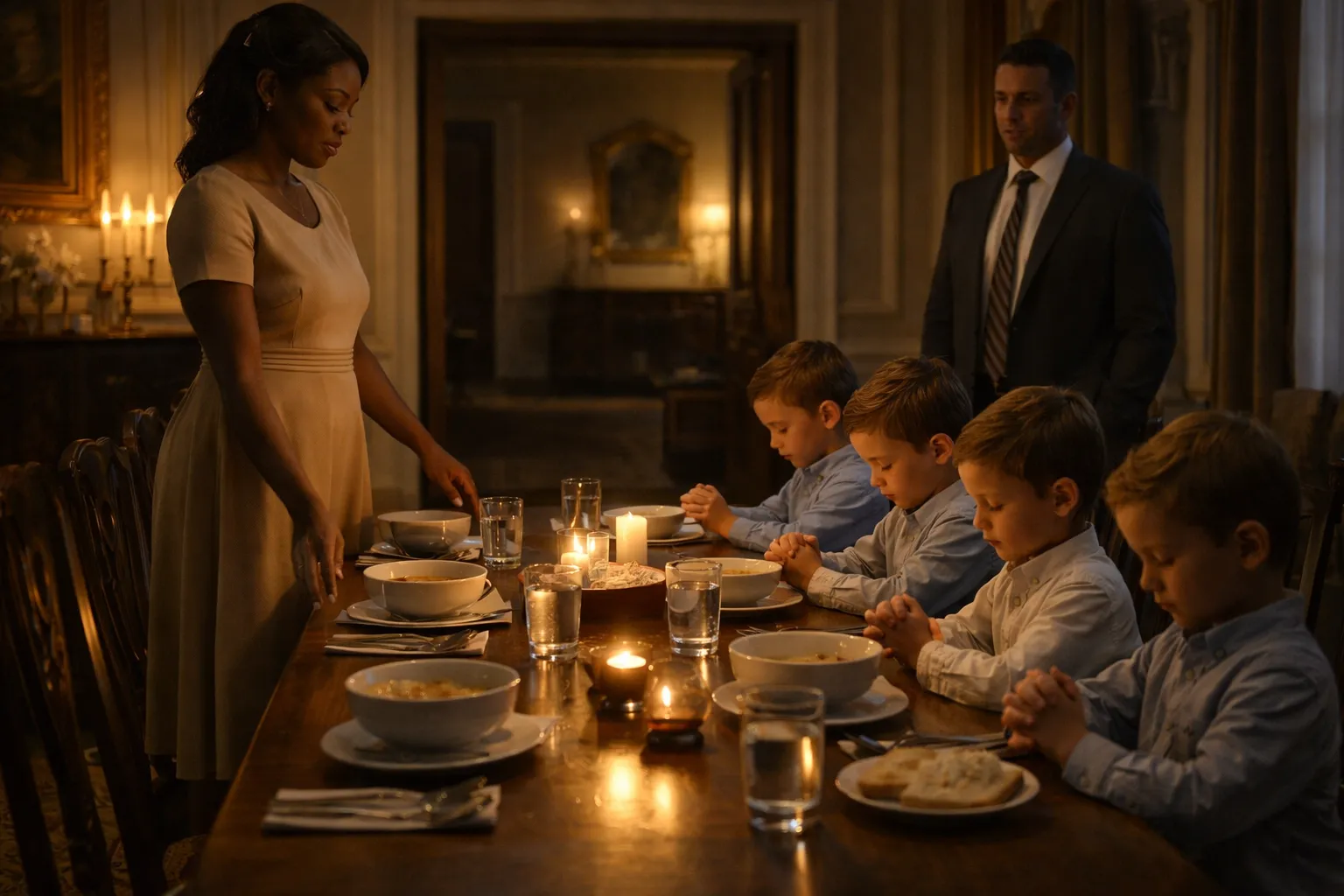
The dining table was set.
Not elaborately, but properly. Plates in place. Napkins folded. Water glasses filled. A basket of warm rolls in the center beside a bowl of soup still steaming. The overhead light cast a honey-colored glow over everything.
And seated around the table were his sons.
Not fighting.
Not climbing chairs.
Not smearing food across the tablecloth.
Sitting.
Still.
Their small hands were clasped together. Their heads were bowed. Susanna stood at the head of the table, eyes closed, her voice quiet and steady as she guided them in grace.
“Thank You for this food,” she said. “Thank You for this home. And thank You for these boys, who are learning they do not have to be afraid all the time.”
Richard’s hand closed around the doorframe.
His vision blurred.
For three years, every meal in that house had been a battlefield—screaming, throwing, bargaining, tears, one child under the table, another refusing to sit, a third trying to provoke the fourth into chaos. He had long ago stopped imagining anything else was possible.
And now here they were.
Four small boys, wounded down to the bone, sitting in peace long enough to close their eyes and trust that no one would use that vulnerability against them.
Tears slipped down Richard’s face before he could stop them.
Lucas opened one eye, saw him, and frowned in concern.
“Daddy?” he whispered. “Are you hurt?”
That nearly undid him.
Susanna opened her eyes and turned.
When she saw him standing there crying, she did not look surprised. She simply smiled—not triumphantly, not even warmly in the usual sense, but with the quiet recognition of someone who understood that a man can spend years holding himself together only to be undone by one small proof that healing has finally entered his home.
“Mr. James,” she said, “would you like to join us?”
He could not speak.
He simply nodded and took the empty chair at the end of the table.
That meal did not fix everything.
But it changed the direction of the house.
Over the following weeks, Susanna brought something into the mansion that no amount of money had ever managed to buy: rhythm. Not rigid control. Rhythm. Breakfast at the same time. Shoes in the same place. A song before cleanup. Stories before bed. Gentle correction without humiliation. Firmness without threat.
She did not try to outshout pain. She outlasted it.
And slowly, the boys changed.
Not neatly. Not all at once.
Finn began asking questions instead of issuing commands. Liam still flared up, but now he sometimes cried afterward instead of pretending the anger was all he had. Logan started sitting closer to the others during story time. Lucas’s screams grew shorter, then rarer, then gave way to tears he no longer had to hide.
At Susanna’s urging, Richard also did what he should have done years earlier: he brought in a family grief therapist and actually committed to the process. Not to outsource fatherhood, but to learn it. The sessions were messy, exhausting, and humbling. Richard discovered that love offered only through provision is a thin shelter against abandonment. The boys discovered that grief could be spoken without burning the room down.
The real test came in May.
Mother’s Day approached like a storm front.
Commercials appeared first—flowers, smiling families, handmade cards. Then school projects. Then questions whispered by other children.
Something dark and restless moved through the James house.
Finn withdrew into cold silence. Liam began slamming doors again. Logan started hiding food under his bed. Lucas’s screaming returned with a force that made the staff flinch. Even Richard, who had begun to believe the worst was behind them, felt panic rising.
“They’re getting worse,” he said one evening as Susanna folded towels in the laundry room.
She shook her head. “No. They’re remembering.”
He looked at her helplessly.
“The body remembers pain before the mind can explain it,” she said. “This holiday is a bruise.”
On the morning of Mother’s Day, the bruise split open.
Richard woke to the sharp crash of breaking glass.
By the time he reached the guest wing where Susanna’s room was, his heart was hammering. He pushed open the door and stopped cold.
The room had been destroyed.
Drawers yanked open. Clothes flung across the floor. Her suitcase overturned. A lamp smashed. The framed photograph she kept on the nightstand lying facedown in broken glass.
And at the center of it all, torn and scattered like leaves after a storm, lay the pages of her Bible.
The boys stood in the middle of the wreckage breathing hard, their faces blotched with anger and grief.
Finn’s eyes were red. Liam’s fists were clenched so tightly one knuckle had split. Logan looked sick with guilt even as he refused to step back. Lucas was crying and furious at once.
“You’re leaving!” Finn shouted the moment he saw Susanna in the doorway behind Richard. “You’re going to leave just like she did!”
Liam hit the wall with both fists. “Everyone leaves!”
“We’re bad!” Lucas cried. “That’s why!”
Richard moved instinctively, ready to stop them, to shout, to impose order over the ruin of the room and the desecration of something Susanna clearly cherished.
But she lifted one hand and stopped him.
Then, to Richard’s astonishment, she walked into the room and sat down on the floor.
Right there among the torn pages.
She looked at the boys for a long moment, and then tears filled her eyes.
Not for the Bible.
For them.
“You are right to be angry,” she said, her voice trembling. “You are right not to trust quickly. A child should not have to wonder whether love will still be there in the morning.”
The boys went very still.
No one had answered their destruction with understanding before. Only punishment. Or retreat.
Susanna reached down and picked up one torn page between her fingers.
“Your mother leaving was not because you were too loud,” she said. “Or too hard. Or too much. It was not because there was something wrong with you.”
Finn’s face crumpled.
“Then why didn’t she stay?” he whispered, and beneath the anger his voice was so small it hardly seemed like his own.
Susanna closed her eyes briefly, as though the question passed through some wound in her that had never fully healed.
“I don’t know,” she said. “Sometimes adults break in places children cannot see. And when they break, children are the ones left standing in the pieces.”
Liam started crying first, though he tried to hide it.
Then Logan.
Lucas ran to her with a sob so raw it seemed to tear up from the bottom of him.
Finn held out longest, because he always did. Then his knees gave way, and he sank to the floor beside his brothers.
Susanna opened her arms and gathered them in.
All four.
There, in the middle of the room they had destroyed, on top of the pages they had torn, the boys finally did what they had not done in three years.
They grieved.
Not in rage. Not in pranks. Not in cruelty designed to push others away before they could be left again.
Openly.
Helplessly.
Like children.
Richard stood in the doorway with his hand over his mouth and understood, with a clarity that would stay with him for the rest of his life, that money had never been the answer because money cannot kneel in the ruins and say I am still here.
Only love can do that.
Only the kind of love willing to be inconvenienced, tested, distrusted, soaked, shouted at, and still remain.
“I’m not going anywhere,” Susanna whispered into their hair, again and again. “Not today. Not tomorrow. Do you hear me? I’m still here.”
Hours later, after the storm had passed, the boys sat at the dining table with rolls of tape and careful fingers, helping Susanna piece together the torn pages of her Bible.
“I’m sorry,” Logan whispered more than once.
Susanna kissed the top of his head. “So am I.”
“For the book?” Liam asked.
“For how much hurt you’ve had to carry,” she said.
When they finished, the pages were mended as well as paper can be mended after violence. Crooked in places. Fragile. Still readable.
Susanna held the repaired Bible in both hands and smiled softly.
“It’s even dearer to me now,” she said. “It knows this family.”
Summer came.
With it came a new sound in the James house.
Laughter.
Not constant. Not perfect. But real.
Liam began using his hands to build instead of break, spending hours in the workshop with the groundskeeper making birdhouses and crooked little shelves. Logan stopped disappearing from photographs and started talking about becoming a pilot someday because he liked the idea of taking frightened people safely through the sky. Lucas followed Susanna through the house singing half-remembered fragments of the lullaby that had first quieted him. And Finn, who had once watched every adult with the cold suspicion of a tiny general, began asking Richard to help him with a model bridge he wanted to build for school.
Richard changed too.
He came home earlier.
He sat on the floor more often.
He learned how to braid calm into routine. How to apologize when he got something wrong. How to say, “I’m here,” and let it mean something more than physical presence.
Somewhere in those months, almost without his permission, he also fell in love.
Not with a savior.
Not with a fantasy.
With a woman who had walked into a wounded home carrying her own sorrow and chosen to stay long enough to make staying believable.
One night, after the boys had gone to bed, Richard found Susanna in the kitchen with a cup of tea gone cold in her hands. Rain moved softly against the windows. The house was quiet in the good way now.
He sat across from her.
“You knew from the first day,” he said. “About them.”
Susanna looked down at the table. “I knew the shape of that kind of pain.”
She was silent for a moment, then said the name he had never heard before.
“Joy.”
Richard waited.
“My daughter,” Susanna said. “She died of leukemia when she was five.”
The words altered the room.
“I’m so sorry,” he said.
She nodded once. “After she died, people kept telling me God had a plan. I wanted to hit every one of them. What I learned instead was simpler and crueler and kinder than that: grief makes some people close, and it makes other people go numb. I recognized your boys because they were grieving with no language for it.”
Richard looked at her differently after that.
Not as the woman who healed his family from some saintly distance.
But as someone who had walked through death herself and carried back from it a tenderness sharpened by fire.
By autumn, even the boys understood what was happening before Richard did.
One evening he gathered them in the den and asked, awkwardly, whether they would be upset if Susanna stayed with them “in a more permanent way.”
Finn looked at his brothers, then back at his father with an expression almost pitying.
“Dad,” he said, “she’s already ours. We were just waiting for you to notice.”
Richard laughed so hard he nearly cried.
The proposal happened the following Saturday in the garden.
Nothing about it was grand by the standards of the James estate. No orchestra. No press. No staged spectacle.
Just lanterns strung through the trees, flowers the boys had helped plant, and a long table set for supper beneath the late summer sky.
When Susanna stepped outside and saw all five of them waiting—four small boys in clean shirts and one nervous man holding a ring box with both hands—she stopped dead.
Richard knelt first.
Then, to her astonishment, the boys knelt beside him.
“Susanna Taylor,” Richard said, his voice shaking, “you came into this house when we were all drowning. You taught my sons that staying is real. You taught me that love is not management, and family is not something money can keep alive by itself.”
He opened the box.
Inside was a simple ring set with five small stones.
“One for each of the foolish, grateful men asking you this tonight,” he said, and the boys smiled through their nerves.
Then Richard drew a breath and finished what had been building in him for months.
“I cannot promise a painless life. We already know too much about pain for promises like that. But I can promise this: I will not ask you to save us. I am asking whether you will let us love you, stay with you, and build something honest with you. Will you marry me?”
For a second Susanna said nothing.
Tears filled her eyes so quickly they seemed to surprise even her.
Then Lucas, unable to bear another second of suspense, blurted, “Please say yes.”
That broke the tension at once. Even Susanna laughed through her tears.
She looked at Richard first.
Then at Finn, Liam, Logan, and Lucas.
Then back at the ring.
“When I first came here,” she said softly, “I thought I was walking into a house that needed me. I didn’t understand that I was walking into a house that would heal parts of me too.”
Her voice trembled.
“I came to help children who were afraid of being left. I did not expect to find a place where my own grief could stop wandering.”
She wiped her face, smiled, and nodded.
“Yes.”
Four boys shouted at once.
Richard closed his eyes in relief so profound it nearly dropped him to the ground before he even slid the ring onto her hand.
Later, when the garden had gone quiet and the boys were finally asleep from excitement, Richard and Susanna sat alone on the back porch beneath the yellow pool of the porch light.
Neither spoke for a while.
The house behind them held that rarest of sounds: peace without tension.
At last Susanna said, “Do you know the difference between a house and a home?”
Richard turned to her.
“A house can hide pain,” she said. “A home learns how to hold it.”
He reached for her hand.
The ring caught the porch light and flashed once.
The following spring, they married quietly in that same garden, with the boys standing beside them instead of apart from them. There were no magazine photographers, no society pages, no spectacle. Just vows spoken honestly, four children trying and failing not to cry, and a woman in a simple dress walking not into a fantasy, but into a family that had finally learned what love costs and why it is worth paying.
And when Mother’s Day came again, the house did not collapse.
The boys were subdued that morning, but not shattered.
After breakfast, Finn led the others out to the garden, where they had planted four white rose bushes near the porch steps. Liam had painted a small wooden sign. The letters were uneven, but readable:
FOR THE ONES WHO STAY.
Susanna stood with one hand over her mouth.
Richard slipped his arm around her shoulders.
No one pretended the past had not happened. No one erased Catherine from the family story, or the grief her leaving had carved into all of them. But grief no longer ruled the house. It had become part of the soil—real, painful, and somehow also capable of growing something gentler.
That evening they sat down at the same dining table where Richard had once stood in the doorway and cried at the sight of his sons bowing their heads in borrowed peace.
Now the peace was their own.
Finn passed the bread without being asked. Liam told a joke bad enough to make Logan groan. Lucas insisted on saying grace and forgot half the words, so everyone helped him finish. Susanna laughed until she had tears in her eyes. Richard watched them all—the woman who had entered the house with a worn Bible and a mended coat, the boys who no longer needed to turn pain into war, the table that had once been a battlefield and had become an altar of ordinary mercy—and he understood at last what wealth really was.
Not the mansion.
Not the company.
Not the land.
This.
A room where no one needed to test love before believing it.
A family built not by perfection, but by presence.
And late that night, as he and Susanna turned out the downstairs lights, the porch lamp remained glowing in the dark—soft, steady, unafraid.
Like a promise.
Like a witness.
Like the kind of love that sees the wreckage, sits down in the middle of it, and stays.