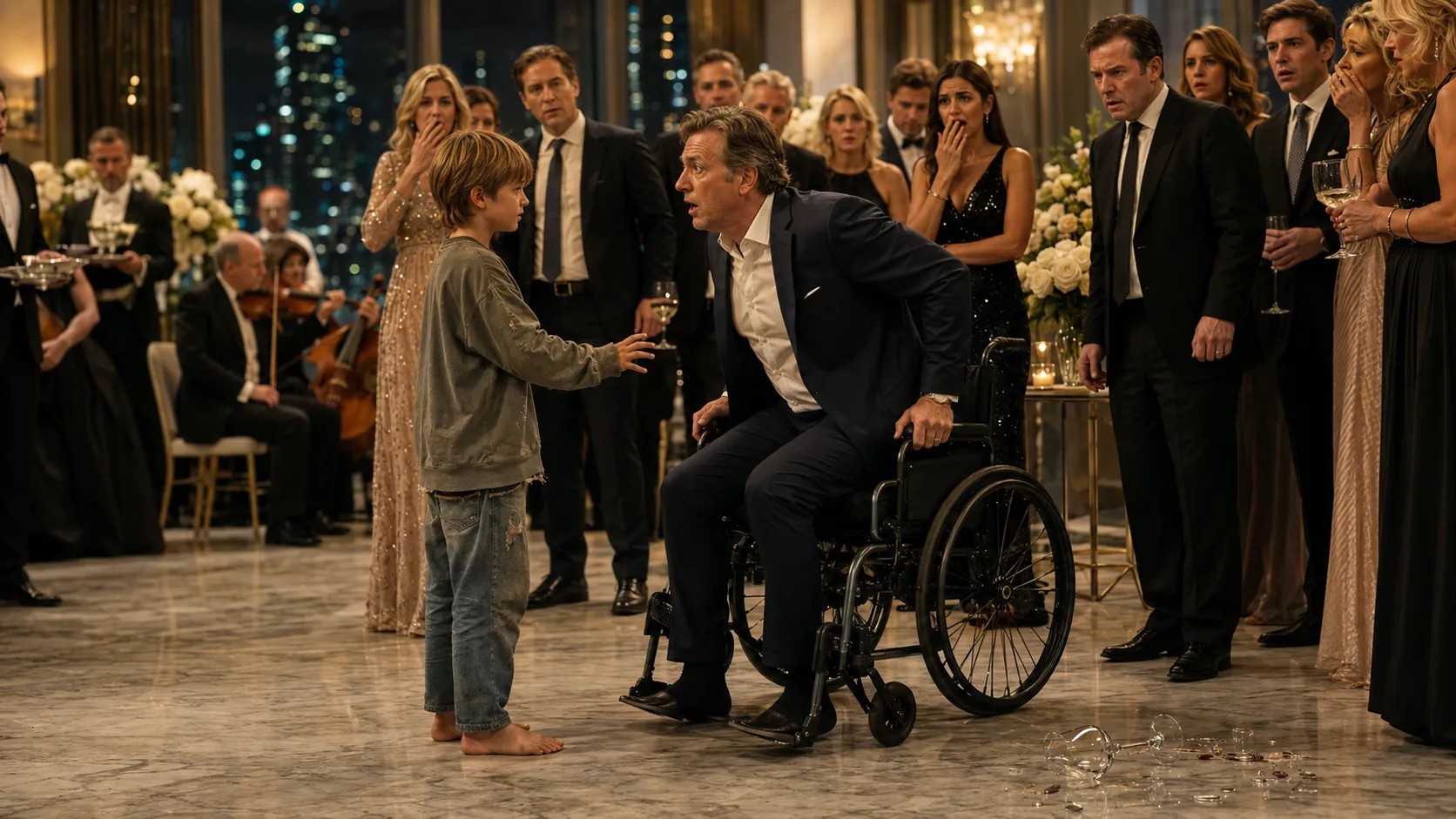
Everyone laughed when a barefoot ten-year-old boy walked into the penthouse and said he could fix the billionaire’s legs. But when Harrison Blake stood for the first time in three years, the room went silent for a reason no one was ready to hear.
The party had cost more than most families made in a year.
Crystal glasses. White roses. A string quartet near the windows. Waiters carrying silver trays through a penthouse that looked down over the city like the rest of the world was something small and distant.
It was supposed to be a celebration.
Five years of Meridian Technologies. Five years of impossible growth. Five years of Harrison Blake being called a visionary by people who had never seen what he looked like alone at midnight, when the room was quiet and his wheelchair stood beside the bed like a sentence.
Harrison was forty-nine years old and rich enough to buy almost anything.
Almost.
Three years earlier, a company trip had ended on a rain-slicked highway outside Denver. The car had rolled twice. Harrison had survived. One of his employees had not.
Since that night, Harrison had not taken a single step.
Doctors had used careful language at first. Partial spinal trauma. Long-term complications. Limited recovery expectations. With time, their voices changed from hopeful to professional.
Eventually, Harrison stopped asking.
He learned how to live from the chair. He learned how to enter rooms without letting people see the rage behind his calm face. He learned how to smile at donors, investors, and reporters who called him inspirational because they did not know what else to call him.
That evening, he sat near the center of the penthouse holding a glass of wine he did not want.
His CFO, Devin Park, stood nearby laughing too loudly at a joke from one of the board members. Devin was polished, confident, and always slightly too comfortable in rooms where other people felt small.
Harrison watched the guests without much interest.
Then the service door opened.
At first, no one noticed the boy.
He was small, maybe ten years old, with dark hair, dirty cheeks, and bare feet against the cold marble floor. His sweatshirt was too thin for winter. His jeans were worn at the knees. He looked like he had come from a world that was not supposed to exist above the ground floor.
A waiter saw him first and froze.
Then a woman near the bar stopped speaking.
Then another guest turned.
Attention moved through the room like a draft.
The string quartet played three more notes and fell apart.
The boy did not look left or right. He crossed the room with the calm focus of someone who had been afraid for so long that fear had finally become useless.
He stopped in front of Harrison Blake’s wheelchair.
The whole room watched.
The boy looked up and said, “Sir. I can fix your legs.”
For two seconds, nobody breathed.
Then Devin laughed.
It was a short, sharp laugh, meant to teach the room how to react.
“Security,” Devin said. “Please escort the child out.”
Harrison lifted one hand.
“Wait.”
Devin stopped, but irritation flashed across his face.
Harrison studied the boy.
“What’s your name?”
“Owen.”
“How old are you, Owen?”
“Ten.”
“And you believe you can fix my legs?”
“I know I can.”
Someone whispered near the bar. Another guest gave a nervous laugh.
Harrison had heard promises before. From doctors. From specialists. From men in expensive offices who spoke about experimental procedures while their assistants prepared invoices.
He had learned the difference between confidence and performance.
This boy was not performing.
That was what disturbed him.
“You understand,” Harrison said slowly, “that I haven’t stood in three years.”
“Yes, sir.”
“My injury is not simple.”
“I know.”
Devin stepped forward. “Harrison, this is absurd. He walked in from the street. He could be disturbed. He could be—”
“Quiet,” Harrison said.
The word was not loud.
It did not need to be.
The room went still again.
Harrison turned back to the boy.
“What do you need?”
“Five seconds.”
Devin stared at him. “You cannot be serious.”
Harrison did not look away from Owen.
“Clear some space.”
No one moved at first.
Then one guest stepped back. Then another. Soon a circle opened around Harrison’s wheelchair, wide enough for everyone to see and far enough for no one to feel responsible.
Owen knelt in front of him.
His small hands rested carefully against Harrison’s lower legs. Not uncertainly. Not randomly. He placed them as if he had done this before, or as if something inside him knew exactly where they belonged.
His eyes closed.
Harrison felt foolish.
Then he felt heat.
Not on his skin.
Deeper.
A strange, living warmth moved through him, down past places that had been quiet for three years. It was not pain. It was not comfort either. It was like a signal returning to a room after the lights had been out for so long everyone had forgotten there was wiring in the walls.
His right foot moved.
A woman gasped.
Harrison looked down.
His right foot had moved.
Not twitched from someone else’s pressure.
Moved.
His wine glass slipped slightly in his hand.
“What are you doing?” he whispered.
Owen opened his eyes.
“Stand up.”
The room recoiled from the words more than from the miracle.
Harrison’s fingers tightened around the armrests.
“I can’t.”
Owen looked straight at him.
“Mr. Blake,” he said gently, “stand up.”
Something in the boy’s voice cut through three years of doctors, therapy, pity, anger, and careful acceptance.
Harrison pushed against the armrests.
His shoulders rose first.
Then his hips.
His legs trembled violently beneath him, thin from years of disuse, uncertain, shaking like the legs of an old man trying to cross ice.
But they held.
Harrison Blake stood.
The wine glass fell from his hand.
It struck the marble floor and shattered.
The sound broke the silence open.
Someone cried out. Someone else covered her mouth. Devin took one step backward, his face drained of color.
Harrison stood there in the middle of his own party, breathing hard, both feet on the floor, the city lights burning behind him.
He looked down at the boy.
Owen had not smiled.
He looked relieved.
That was all.
“How?” Harrison asked. His voice was barely there. “Who are you?”
Owen stood slowly.
“My father worked for your company.”
Harrison’s expression changed.
“What was his name?”
“Daniel Reed.”
The name struck him harder than the fall of the glass.
Harrison remembered Daniel Reed.
Denver office. Systems engineer. Quiet man. Excellent work. Stayed late. Sent clear emails. Never asked for attention.
And then the accident.
Harrison had been told Daniel died before the ambulance arrived.
For three years, that name had lived in a locked room inside him.
“Owen,” Harrison said, almost too softly to hear. “I didn’t know he had a son.”
Owen nodded once.
“My mom moved us after he died.”
“I tried to reach the families,” Harrison said. “I thought everyone had been taken care of.”
“My mom stopped answering calls.”
The room absorbed that.
Not with the excitement of a miracle now, but with the heavy discomfort of people realizing there was another story beneath the one they had just witnessed.
Devin cleared his throat.
“Okay,” he said, stepping forward. “Someone needs to explain what just happened. This is not—this doesn’t happen. Harrison, do you understand what—”
“I understand perfectly,” Harrison said without looking at him.
“This child walked in off the street and—”
“Through the service door,” Owen said. “It was propped open.”
Devin stared at him.
“You’re ten.”
“Yes, sir.”
“Harrison, we need security. We need legal. We need—”
“Devin,” Harrison said. “Stop.”
The CFO closed his mouth.
Harrison took one careful step.
The room inhaled.
His knee almost buckled, but he caught himself against the arm of the wheelchair. His face tightened with pain, but beneath the pain was something stronger than pain.
Wonder.
He took another step.
Then another.
He looked at Owen.
“How long have you been able to do this?”
Owen lowered his eyes.
“Since my dad died.”
No one laughed now.
Harrison’s throat moved.
“Does your mother know you’re here?”
Owen hesitated.
“She knows I was looking for you. She didn’t know I’d find you tonight.”
“Where is she?”
“Downstairs,” Owen said. “She drives for a delivery company. She was doing a drop-off on the fourteenth floor. I saw your name on the party list at the front desk.”
Harrison stared at him.
“She’s in this building.”
Owen nodded.
“She doesn’t know I came up here. She’s going to be really upset.”
Harrison took one more step toward the elevator.
His legs shook badly, but his voice did not.
“No,” he said. “She really isn’t.”
Devin moved quickly to block him.
“Harrison, think carefully. You can barely stand. We need a doctor up here immediately. We need to document this. We need to control the narrative before—”
Harrison looked at him then.
For the first time all evening, Devin seemed to remember who had built the company he worked for.
“The narrative,” Harrison said quietly, “is that a hungry child walked barefoot into my anniversary party because this company failed his family badly enough that his mother is delivering packages in the same building where we are drinking thousand-dollar wine.”
Devin said nothing.
Harrison turned to his assistant.
“Find her.”
The assistant hurried toward the elevator.
“No,” Harrison said. “I’m going.”
The guests parted.
Nobody clapped. Nobody dared.
Harrison walked slowly, one hand brushing the wall, Owen at his side, the wheelchair behind him like a life he had not expected to leave so suddenly.
Every step looked painful.
Every step mattered.
By the elevator, Harrison stopped and looked down at the boy.
“Did your father tell you about me?”
Owen nodded.
“He said you were a good man.”
Harrison closed his eyes for a moment.
“And what do you think?”
Owen looked at the broken glass across the floor, the rich guests, the flowers, the silver trays, the room that had cost more than his mother made in months.
Then he looked back at Harrison.
“I came to find out.”
The elevator doors opened.
On the fourteenth floor, a woman in a faded delivery jacket was arguing with a security guard. She had a stack of packages in her arms and panic in her eyes.
“Owen?” she shouted the moment she saw him.
She dropped the packages.
Owen ran to her.
“I’m sorry,” he said. “Mom, I’m sorry.”
She held him so tightly that for a moment Harrison could not speak.
Then she looked up.
At Harrison.
At his shaking legs.
At the man standing where every news article said he could not stand.
Her face went pale.
“You,” she whispered.
Harrison gripped the elevator frame.
“Mrs. Reed.”
Her eyes hardened.
“Don’t call me that like you knew us.”
The words landed exactly where they were meant to.
Harrison accepted them.
“You’re right,” he said. “I didn’t.”
She looked at Owen.
“What did you do?”
“He helped me,” Harrison said.
“He’s a child.”
“Yes,” Harrison said. “And somehow he came to find me when I should have found both of you years ago.”
Her anger flickered, not disappearing, but struggling under the weight of exhaustion.
“My husband died working late for your company,” she said. “Afterward, people sent flowers. Then forms. Then nothing that could actually keep us from falling.”
Harrison lowered his head.
“I am sorry.”
She laughed once, bitterly.
“Rich men are always sorry after the damage is done.”
“Yes,” Harrison said. “But I can still do something after being sorry.”
She stared at him.
Behind them, the elevator opened again. Guests from the party stood crowded inside and in the hallway, pretending not to listen while hearing every word.
Harrison turned so they could all hear him.
“Tomorrow morning, Meridian Technologies will establish a permanent family trust for Daniel Reed’s widow and son. Full housing. Full medical coverage. Full education for Owen. Backdated survivor compensation. And an independent review of every employee family affected by the Denver accident.”
Devin, who had followed from the penthouse, looked stricken.
“Harrison—”
Harrison cut him off.
“And Devin Park is no longer CFO, effective immediately.”
The hallway went silent.
Devin’s face twisted.
“You can’t do that in a hallway.”
Harrison looked at him with a calm that had nothing to do with the miracle and everything to do with the man he had been before the chair.
“I just did.”
Owen’s mother stared at Harrison as if she did not know whether to believe him.
Harrison looked back at her.
“This does not repay your husband,” he said. “Nothing does. And I’m not buying forgiveness from you. I’m only doing what should have been done before your son had to walk barefoot into a room full of strangers to remind me what kind of man I was supposed to be.”
Her eyes filled slowly.
She looked at Owen.
Then at Harrison’s trembling legs.
“Daniel said you were decent,” she whispered. “I hated him for saying that after he died.”
“I understand.”
“No,” she said. “You don’t.”
Harrison nodded.
“You’re right.”
For the first time, nobody in the hallway tried to smooth the moment over.
Owen stepped forward and took Harrison’s hand.
It was such a small gesture that it silenced everyone more deeply than the miracle had.
“You can sit down now,” Owen said.
Harrison gave a breath that was almost a laugh and almost a sob.
“I think I should.”
Someone brought a chair from the conference room. Harrison lowered himself carefully, his body shaking from the effort.
But he was smiling.
Not the public smile.
Not the investor smile.
The real one.
The one he had not used in years.
Later, people would talk about the barefoot boy who made a billionaire stand.
They would argue about whether it was a miracle, science, faith, or something no one had a name for.
But Harrison Blake would remember something different.
He would remember a child standing in front of him with dirty feet and steady eyes.
He would remember the name of a man his company had failed to honor properly.
He would remember the widow in the delivery jacket.
And he would remember the question Owen never had to ask out loud:
What kind of man are you now?
By morning, the party photos were everywhere.
But the one that mattered never reached the papers.
It was taken quietly by Harrison’s assistant outside the building just after midnight.
A billionaire sitting in a plain lobby chair.
A tired mother holding her son.
A wheelchair folded beside the wall.
And Owen Reed, barefoot no longer, wearing Harrison Blake’s own shoes while the snow fell softly beyond the glass doors.