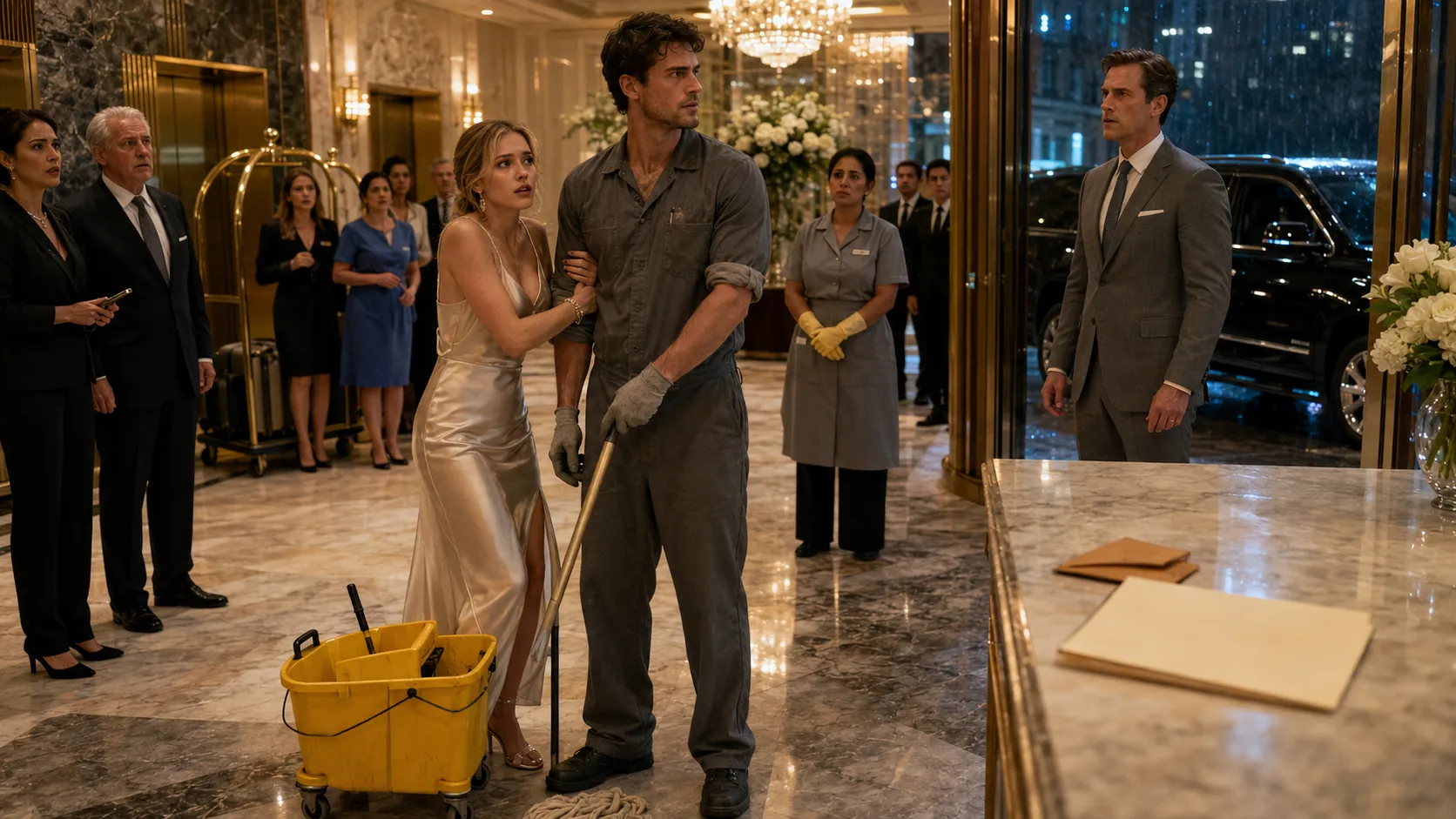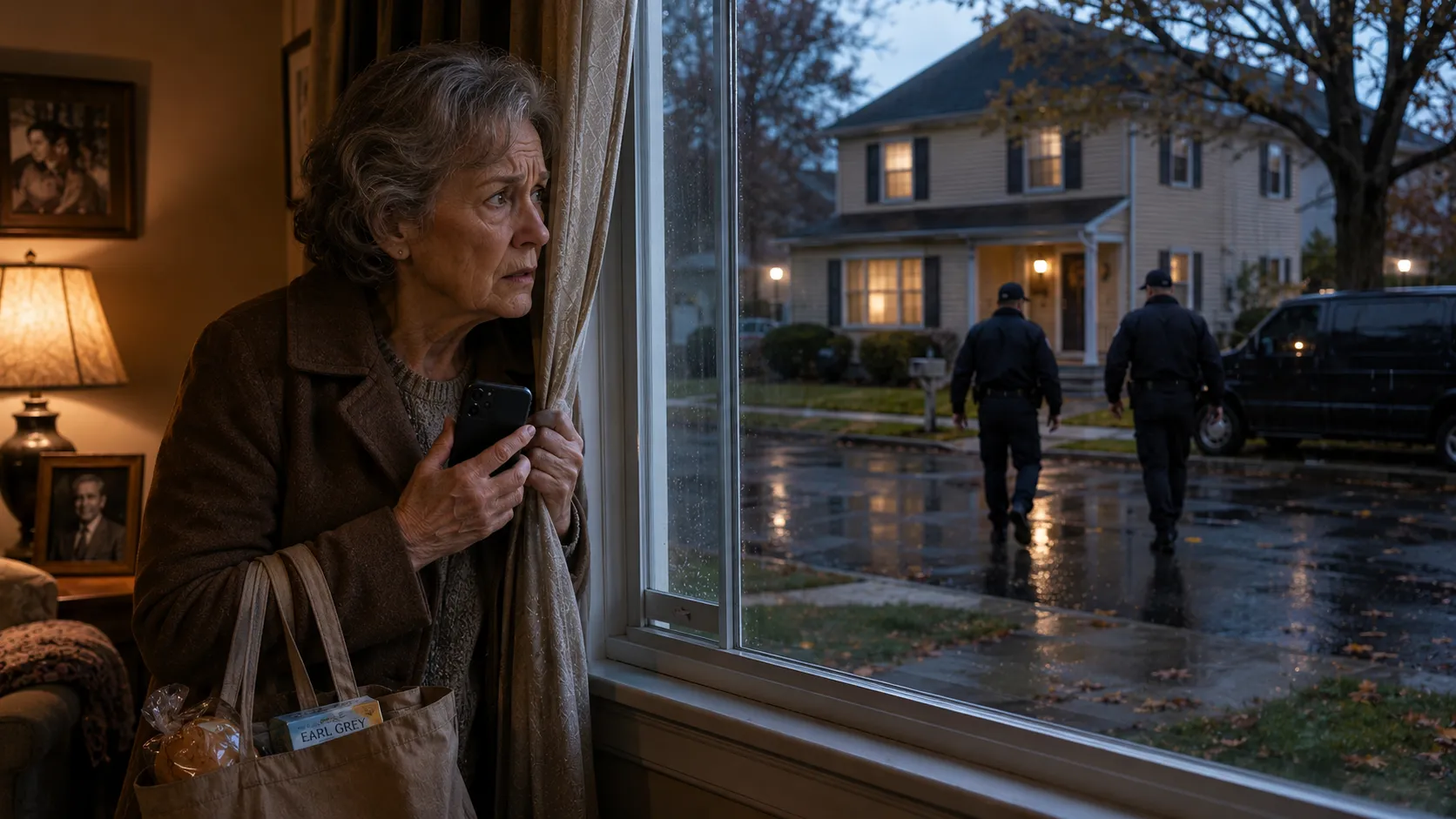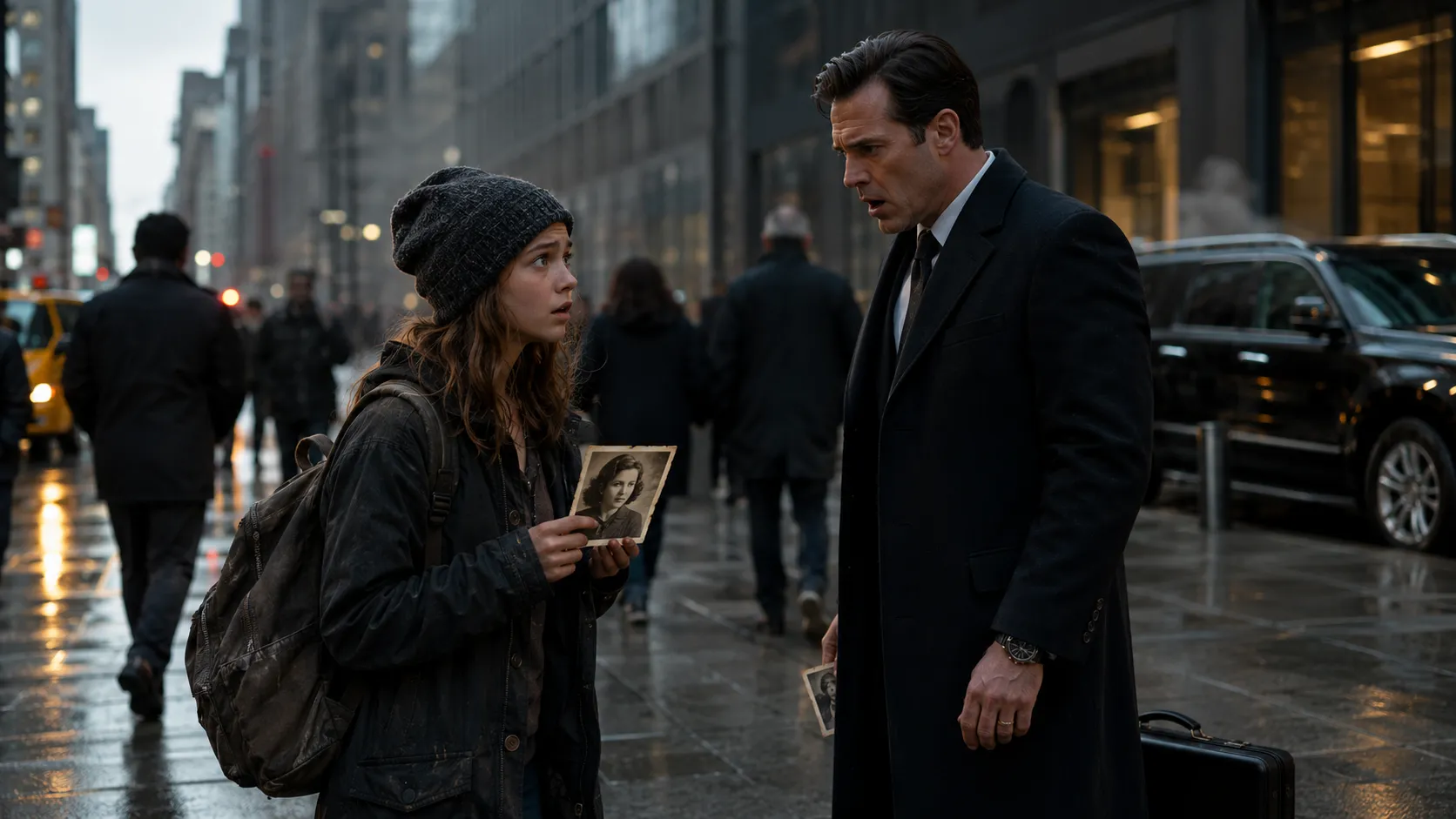

Daniel Hayes thought the past had been buried for eighteen years. Then, during a violent storm, a barefoot little girl appeared outside his penthouse holding a photograph of the woman he had once loved — and the secret that had made him rich.
The knock came at 2:03 in the morning.
Not once.
Not politely.
Three slow knocks against the front door of Daniel Hayes’s penthouse, each one landing through the storm like a hand reaching out of the past.
Daniel sat alone near the fireplace with a glass of whiskey untouched beside him and a folder of contracts open across his lap. Outside, rain hammered the windows of his forty-eighth-floor apartment, turning the lights of downtown Chicago into blurred streaks of red, white, and gold.
He should have been used to storms.
He had built half the city through them.
At fifty-one, Daniel Hayes was the kind of man magazines loved to photograph from below, so he looked even taller than he was. Billionaire real estate investor. Philanthropist. Political donor. A man who shook hands with governors, cut ribbons at children’s hospitals, and gave speeches about second chances as if the phrase had never cost anyone anything.
But alone at night, when the cameras were gone and the apartment became too quiet, Daniel was not a powerful man.
He was a haunted one.
Every storm brought the same memory.
Rain on a windshield.
A woman crying.
Headlights near the lake.
His own voice begging her not to ruin everything.
Then darkness.
Daniel closed the folder and rubbed his eyes.
The knock came again.
Slower this time.
KNOCK.
KNOCK.
KNOCK.
He looked toward the entry monitor built into the wall beside the fireplace. No visitor should have reached his door. The building had armed security, private elevators, facial recognition at the lobby, and a concierge who called before even his closest associates came upstairs.
Nobody came unannounced.
Nobody came at this hour.
Daniel stood carefully and walked toward the monitor.
The screen flickered with static.
He frowned.
“Show hallway camera,” he said.
The system glitched, then cleared.
A child stood outside his door.
A little girl.
Maybe eight years old.
Barefoot.
Soaked from the rain.
Her dark hair clung to her face. Her oversized gray hoodie dripped water onto the hallway carpet. She stood perfectly still beneath the ceiling light, both hands tucked into her sleeves, staring not at the camera but at the door itself.
Daniel felt irritation before fear.
Some employee had failed.
Some security guard would lose his job by morning.
He pressed the intercom.
“Who are you?”
The girl lifted her face.
For a moment, Daniel forgot how to breathe.
Her eyes.
He knew those eyes.
Not from business. Not from newspapers. Not from any child he had ever met.
From eighteen years earlier.
From a woman he had spent nearly two decades trying not to remember.
The girl spoke through the intercom, her voice soft enough that he had to lean closer to hear it.
“My mom said you killed her.”
Daniel stepped back.
His hand struck the marble table beside the door. The whiskey glass he had brought with him slipped from his fingers, hit the floor, and shattered.
The sound rang through the penthouse.
The girl did not move.
Daniel stared at the screen.
“What did you say?”
“My mom said you killed her.”
His throat tightened.
“This is not funny.”
“I’m not laughing.”
He should have called security immediately. He should have locked the door, turned away, made a phone call, and let professionals handle whatever sick trick was unfolding outside his apartment.
Instead, Daniel opened the door.
The hallway smelled faintly of wet carpet and electricity.
The girl stood just beyond the threshold, small and pale under the lights.
Up close, the resemblance was worse.
The same dark eyes.
The same calm, wounded expression.
The same slight tilt of the head when she studied someone.
Daniel gripped the edge of the door.
“Who sent you?”
The girl reached into her hoodie pocket and pulled out a photograph protected inside a wrinkled plastic sleeve.
She held it out.
Daniel did not take it at first.
Then he saw the image.
A younger Daniel stood beside a woman near Lake Michigan. His arm was around her shoulders. She was smiling at the camera, wind lifting her dark hair across her cheek.
Elena Carter.
The name moved through him like a blade.
Elena had been twenty-nine when she disappeared.
A journalist.
Stubborn.
Brilliant.
Too honest for a city that rewarded silence.
Once, Daniel had loved her with the kind of reckless certainty young men mistake for permanence. Then money arrived. Ambition arrived. Secrets arrived. And Elena began asking questions he could not afford to answer.
Daniel looked from the photograph to the child.
“Where did you get this?”
“My mother kept it.”
“Elena Carter had no daughter.”
The girl looked at him without blinking.
“She had me.”
“That’s impossible.”
“Because she disappeared?”
Daniel’s skin went cold.
The storm outside cracked with thunder, shaking the glass walls of the penthouse.
The girl stepped forward.
Daniel wanted to stop her.
He did not.
Water dripped from her bare feet onto the polished floor as she entered the apartment. She looked around slowly at the high ceilings, the art on the walls, the black marble kitchen, the view of the city spread beneath them like something Daniel owned.
“She said you became rich after she vanished,” the girl said.
Daniel closed the door behind her, more from instinct than thought.
“What is your name?”
“Lily.”
“Lily what?”
“Carter.”
He almost laughed.
Almost.
But nothing in the room felt absurd enough for laughter.
“You’re lying.”
Lily turned toward him.
“My mom said you would say that first.”
Daniel’s jaw tightened.
“Your mother is dead.”
“Then why are you scared of her?”
The question struck so cleanly that he had no answer ready.
Daniel walked toward the bar and poured another drink with a hand that shook just enough to spill some of it across the counter. He did not drink.
He needed something to hold.
“Listen to me carefully,” he said. “Elena Carter disappeared eighteen years ago. Police investigated. They found nothing. No body. No evidence. No crime.”
Lily’s eyes moved to the folder on his table.
“She said you were always good at making evidence disappear.”
Daniel slammed the glass down.
“Enough.”
For the first time, the girl flinched.
The movement was tiny, but it changed the room.
For one second, she looked like a real child.
Cold. Afraid. Too young to carry the weight someone had placed in her hands.
Daniel felt something old and unpleasant twist inside him.
Guilt, maybe.
Or the memory of it.
He lowered his voice.
“Where is the person who brought you here?”
“No one brought me.”
“You expect me to believe you got through private security alone?”
Lily looked toward the windows.
“I was told where to go.”
“By whom?”
“My mom.”
Daniel closed his eyes.
“Elena is dead.”
“She said you never saw her die.”
His eyes opened.
“What?”
The girl turned back slowly.
“She said you left before the lake finished deciding.”
The words were so strange, so specific, that Daniel’s breath caught.
Because that was exactly what had happened.
Eighteen years earlier, Elena had discovered the fraud before anyone else.
Not a rumor.
Not a mistake.
Proof.
Daniel had been quietly moving money through shell companies connected to city redevelopment contracts. Properties condemned too early. Families pushed out under false emergency orders. Public grants redirected into private accounts. Men in suits were getting rich while elderly tenants, immigrant shop owners, and working families lost homes they had spent their lives paying for.
Elena found the documents.
She called him in tears and told him to meet her near the lake.
He went because he believed he could still control her.
Because in those days, Daniel believed everything could be controlled.
Even love.
The argument happened in the rain.
She told him she was going to federal investigators.
He begged.
Then threatened.
Then grabbed her arm when she tried to leave.
She slipped.
Or he pushed.
For eighteen years, Daniel had moved that single second around in his mind like a piece of broken glass, cutting himself with a different version whenever guilt became too sharp.
She fell backward down the rocky slope near the water.
Her head struck stone.
The rain came harder.
Daniel remembered kneeling beside her, shouting her name, pressing his fingers to her throat and feeling something that might have been a pulse or might have been his own shaking hand.
Then headlights appeared on the road above.
He panicked.
He ran.
By morning, Elena was gone.
So was the folder she had carried.
Police found her car two days later. No body. No witnesses. No closure.
Daniel told investigators she had been unstable.
Heartbroken.
Angry.
He said she had threatened to disappear before.
People believed him because he wore a suit and spoke calmly.
And because Elena was not there to contradict him.
“You were at the lake,” Lily said.
Daniel looked at her.
“How do you know that?”
The girl reached into her pocket again.
This time, she pulled out a silver necklace.
A small pendant hung from the chain.
Daniel backed into the edge of the counter.
He had given Elena that necklace on her twenty-ninth birthday. The pendant had a tiny engraved moon on the front because she used to say the moon was the only honest thing over Chicago.
According to the police file, it had never been recovered.
“Where did you get that?” he whispered.
“My mother said you would remember it.”
Daniel reached for the necklace, but Lily closed her fist around it.
“Not yet.”
Something in her voice changed when she said that.
Older.
Colder.
Daniel stared at her.
“How old are you?”
“Eight.”
“Elena disappeared eighteen years ago.”
“Yes.”
“You understand why that makes no sense?”
Lily smiled faintly.
The smile did not belong on a child’s face.
“She said truth doesn’t age the same way lies do.”
Daniel felt the room tilt slightly.
He walked to the wall panel near the fireplace and pressed the security call button.
Nothing happened.
He pressed again.
The screen remained black.
“Security,” he snapped. “Call front desk.”
Static hissed from the speaker.
No voice answered.
Lily looked around the penthouse.
“She said you would try to call someone before you told the truth.”
Daniel turned slowly.
“What are you?”
The lights flickered.
Once.
Twice.
Then the entire penthouse went dark.
Only lightning lit the room in violent white flashes.
In each flash, Lily stood in a different place.
Near the kitchen.
Near the fireplace.
Near the window.
Then directly beside the black folder on Daniel’s table.
He stumbled backward.
“Stop.”
Lily opened the folder and looked down at the papers.
“More contracts?”
The emergency backup lights came on dimly, bathing the room in a dull red glow.
Daniel’s breathing sounded too loud.
“You don’t know what you’re talking about.”
“She knew,” Lily said.
“She didn’t understand what she found.”
“She understood enough to be afraid.”
“She was going to destroy me.”
Lily lifted her eyes.
“No. She was going to stop you.”
Daniel’s face hardened.
There it was.
The old defense.
The one he had used in boardrooms, courtrooms, interviews, and private mirrors.
“I built everything I have from nothing.”
“You built it over people.”
“I created jobs.”
“You stole homes.”
“I donated millions.”
“With money you took.”
Daniel stepped toward her.
“You are a child.”
Lily did not move.
“And you are still lying.”
The words opened something in him.
Not confession.
Not yet.
Rage came first, because rage was easier than shame.
“You have no idea what she was going to do,” he said. “She was going to ruin deals involving hundreds of people. Banks. Investors. Pension funds. Construction jobs. Entire neighborhoods depended on those projects.”
“And old women being forced out of apartments?”
Daniel froze.
Lily continued softly.
“Small shops that closed after three generations? Families told the building was unsafe when it wasn’t? Tenants signing papers they couldn’t read?”
His mouth went dry.
Elena had written those exact phrases in her final article draft.
A draft no one had ever found.
Daniel’s voice became thin.
“Who gave you that?”
Lily took another step toward him.
“My mother.”
“She’s dead!”
The girl looked suddenly sad.
“Yes.”
The storm seemed to pull back for one second, leaving only the sound of Daniel’s own breathing.
Then Lily spoke again.
“But she waited.”
Daniel pressed both hands against his head.
“No.”
“She waited at the lake.”
“No.”
“She waited while you gave speeches.”
“Stop.”
“She waited while they named buildings after you.”
“STOP.”
“She waited while her mother died without knowing where her daughter was buried.”
Daniel staggered.
Elena’s mother.
Mrs. Carter.
A small woman with gray hair and trembling hands who had stood in front of cameras begging anyone with information to come forward. Daniel had sent flowers to the funeral when she died ten years later.
He had not attended.
He told himself it would be inappropriate.
The truth was simpler.
He was afraid she would look at him and know.
Lily stood near the window now, rainwater still dripping from her hoodie though she had been inside for too long.
“What happened after she fell?” she asked.
Daniel shook his head.
“I called for help.”
“No.”
“I tried.”
“No.”
“She was breathing when I left.”
Lily’s eyes filled with tears.
The sight broke him more than the accusations.
Because now she looked less like a ghost and more like a daughter asking about a mother.
“You left her in the rain,” she said.
Daniel covered his mouth.
The room disappeared.
He was back on the lake shore.
Rain. Mud. Blood. Elena’s hand half-open on the stones. The moon pendant against her throat. The folder of documents scattered nearby.
He remembered picking up the folder.
He remembered not picking up Elena.
“Oh God,” he whispered.
Lily’s voice became almost gentle.
“Tell me.”
Daniel sank onto the edge of the sofa.
For eighteen years, he had paid lawyers, consultants, security experts, image managers, and private investigators to protect the life that began the night he abandoned her.
But no amount of money had prepared him for a barefoot child in the storm asking the one question every judge, reporter, and detective had failed to force from him.
“What did you do to my mom?”
Daniel began to cry.
Not gracefully.
Not in a way that would move a jury.
He cried like an old man whose body had finally grown tired of holding poison.
“I didn’t mean to kill her,” he said.
Lily said nothing.
“We argued. She had the files. She said she was going to the FBI. I grabbed her arm. She pulled away. I pushed her, but I didn’t think—” His voice broke. “I didn’t think she would fall.”
“What happened next?”
“She hit the rocks.”
“And?”
Daniel pressed his palms against his eyes.
“I went down to her.”
“And?”
“She was alive.”
Lily’s face changed.
The tears remained, but something colder moved behind them.
Daniel whispered, “She was still alive when I left.”
The room seemed to stop breathing.
“I took the folder,” he said. “I told myself I would call someone from the road. I told myself I would send an ambulance and leave anonymously. But I drove. And I kept driving.”
“Why?”
“Because I was a coward.”
Lily looked toward the floor.
“And because you wanted the money.”
Daniel did not deny it.
The storm outside roared again.
Then came a sound from the front door.
KNOCK.
KNOCK.
KNOCK.
Daniel jumped so violently he nearly fell from the sofa.
Lily looked toward the door.
“They’re here.”
“Who?”
“The people you should have called eighteen years ago.”
The security panel suddenly came alive.
The hallway camera showed two uniformed police officers and a man in a dark coat holding a folder under one arm.
Daniel turned toward Lily.
But she was gone.
Not hiding.
Not standing somewhere else.
Gone.
No wet footprints led from the window. No sound of running feet. No open door. Only the silver necklace remained on the table beside Elena’s photograph.
Daniel stared at the empty room.
The knocking came again.
He walked to the door like a man going to his own sentencing.
When he opened it, the taller officer looked at him carefully.
“Mr. Hayes?”
Daniel nodded.
“I’m Detective Nolan Price. This is Officer Ramirez. We need to speak with you about Elena Carter.”
The name seemed to echo through the hallway.
Daniel gripped the doorframe.
Detective Price studied him.
“May we come in?”
Daniel stepped aside.
The officers entered and immediately noticed the shattered glass, the open contracts, the necklace on the table, and Daniel’s face.
Detective Price’s eyes rested on the photograph.
“Where did you get that?”
Daniel could barely speak.
“A girl brought it.”
The detective looked toward Officer Ramirez.
“What girl?”
“She was here. She said her name was Lily. She said…” Daniel swallowed. “She said Elena was her mother.”
The officers exchanged a look.
Officer Ramirez spoke carefully.
“Mr. Hayes, building security says no one entered this floor tonight.”
Daniel turned toward her.
“That’s impossible.”
“We reviewed the lobby cameras on the way up,” Detective Price said. “No child. No visitor. No elevator activity except ours.”
Daniel looked toward the wet marks on the floor.
They were gone.
Every drop of rainwater Lily had left behind had vanished.
Only the necklace remained.
Detective Price stepped closer to it without touching.
“We found remains near Lake Michigan this morning,” he said.
Daniel stopped breathing.
“Construction crew uncovered them near the old north embankment. The medical examiner estimates they’ve been there a long time.”
Officer Ramirez opened a small evidence photo on her phone and turned the screen toward him.
A silver moon pendant lay in a muddy evidence tray.
Daniel looked from the phone to the necklace on his table.
Two identical pendants.
One with the remains.
One in his penthouse.
His legs weakened.
Detective Price noticed.
“You recognize it.”
Daniel sat down slowly.
“Elena wore one.”
Price’s voice lowered.
“Mr. Hayes, do you know how Elena Carter ended up buried near the lake?”
For one final second, Daniel considered the old habits.
Call the lawyer.
Say nothing.
Deny everything.
Let money do what money had always done.
Then lightning flashed across the window, and in the glass reflection behind Detective Price, Daniel saw Lily again.
Standing near the fireplace.
Barefoot.
Soaked.
Watching.
Daniel closed his eyes.
“Yes,” he said.
Detective Price became very still.
“Yes, what?”
Daniel opened his eyes.
“I know how she got there.”
The confession took forty-seven minutes.
By the end of it, two more detectives had arrived. Daniel’s attorney had been called and then told to wait, because Daniel did not stop speaking long enough to take legal advice. He talked about the fraud. The redevelopment scheme. The shell companies. The final argument. The push. The fall. The decision to run. The documents he had hidden. The people he had bribed. The witnesses he had intimidated. The careers he had destroyed.
At 4:11 in the morning, Daniel Hayes was placed in handcuffs in the living room where he had once hosted senators.
He did not resist.
As they led him toward the elevator, he looked down the hallway.
At the far end, beneath the flickering light, Lily stood watching.
This time, there was someone beside her.
A woman in a rain-soaked coat.
Dark hair.
Silver moon pendant at her throat.
Elena Carter.
Daniel stopped walking.
The officers tightened their grip.
Elena did not speak.
She only looked at him with an expression that held no hatred anymore.
Only distance.
The elevator doors opened.
Daniel stepped inside.
When he looked back, the hallway was empty.
By sunrise, news vans filled the street outside the building.
The headlines were everywhere before noon.
BILLIONAIRE DANIEL HAYES CONFESSES TO 18-YEAR-OLD DISAPPEARANCE CASE.
For days, the city talked about him.
The powerful man who had built towers over neighborhoods he had helped destroy.
The philanthropist whose fortune began with stolen redevelopment funds.
The boyfriend who let a woman die in the rain and then sold himself to the world as a man of vision.
But as the evidence unfolded, the story became larger than Daniel.
Investigators reopened old housing cases connected to Hayes Development. Families who had been forced out under false reports came forward. Former employees admitted documents had been altered. City officials quietly resigned. Bankers suddenly remembered meetings they had once denied.
Elena’s unfinished article was found in Daniel’s private archive.
He had kept it.
All eighteen years.
Maybe as insurance.
Maybe as a trophy.
Maybe because guilt sometimes preserves the very thing it fears most.
The article was published in full two weeks after his arrest.
Elena Carter became famous only after death, which struck many people as cruel.
But her mother’s surviving sister, Aunt Margaret, said something different when reporters asked how the family felt.
“Elena didn’t write to be famous,” she said. “She wrote so people would not be erased.”
A small funeral was held after the remains were released.
It rained that day too, but gently.
Not like the storm that took her.
Near the grave stood journalists, former tenants, old friends, city workers, and strangers who had once lived in buildings Daniel Hayes had condemned for profit.
No little girl attended.
At least, none anyone could agree on.
One woman later claimed she saw a child standing beneath a tree in a gray hoodie. Another said she saw only rain. A third insisted a little girl placed a silver moon pendant on Elena’s grave before vanishing between the headstones.
The police report included none of that.
Police reports rarely include the things that matter most.
Daniel Hayes spent the rest of his life in prison.
His lawyers tried to soften the confession, challenge the circumstances, suggest a psychological break caused by stress and alcohol. But the hidden documents supported too much. The recovered remains proved too much. The recorded confession, captured by his own penthouse security system after the cameras mysteriously returned online, said too much in his own voice.
He pleaded guilty before trial.
At sentencing, the judge asked if he wished to speak.
Daniel stood in a dark suit that no longer made him look powerful.
For a long moment, he stared at the families seated behind the prosecution table.
Then he said, “I spent eighteen years becoming rich enough to live above everyone. But there was no floor high enough to escape what I did.”
Nobody answered.
Nobody forgave him publicly.
Forgiveness was not the point.
Truth was.
Years later, the city renamed the housing justice fund after Elena Carter. Her article was taught in journalism classes. Her case became a warning whispered in boardrooms and city offices whenever someone suggested that paperwork could make cruelty look legal.
And in the lobby of a restored apartment building near the lake, there was a small plaque with words taken from Elena’s recovered notes:
A city is not measured by the height of its towers, but by the people it refuses to bury.
On stormy nights, residents sometimes said a little girl could be seen near the entrance, standing quietly by the glass doors, watching the rain.
No one knew who she was.
Some said she was imagination.
Some said she was guilt given a face.
But the oldest residents, the ones who remembered the evictions, the protests, the missing journalist, and the night Daniel Hayes finally confessed, never tried to explain her away.
They simply left the lobby light on.
Just in case someone lost was still trying to find the truth.