Victor Langston thought the quiet janitor mopping the hotel lobby was beneath him. But after the janitor saved a dying guest upstairs, the richest men in the room lowered their heads and called him by a name Victor would never forget.
The marble floor of The Grand Meridian Hotel was so polished that people could see their reflections in it.
That was why Daniel Reed noticed so much.
Shoes told stories.
The guests in the lobby wore Italian leather, glossy heels, hand-stitched loafers, and boots that cost more than some hotel workers made in a week. They crossed the lobby without looking down, trusting the world to stay clean beneath their feet.
Daniel noticed the shoes.
He noticed the scuffs people left behind.
He noticed the coffee they spilled and pretended not to see.
He noticed the way they walked around the cleaning cart as if it were an object, not something pushed by a human being.
At thirty-seven, Daniel wore a faded gray janitor uniform with his first name stitched over the chest. His sleeves were rolled up. His hands smelled faintly of lemon disinfectant. A mop bucket rattled beside him as soft piano music drifted from the lounge near the windows.
Most people did not look at his face.
That was the strange freedom of being invisible.
You learned the truth about people quickly.
That morning, the hotel was busier than usual. The Grand Meridian was hosting a private investment summit on the top floors, and powerful guests had been arriving since dawn. Bankers, real estate developers, hotel executives, politicians, consultants — men and women who smiled brightly in public and spoke sharply when staff turned their backs.
Daniel pushed the mop slowly across the lobby floor, working near the revolving doors.
A young receptionist named Clara watched him from behind the front desk.
She had worked at the hotel for only four months, but Daniel had already learned several things about her.
She was twenty-six.
She wore the same black flats every day because the hotel required formal shoes but did not pay enough for replacements.
She sent money home to her mother in Ohio.
And unlike most people in that lobby, Clara still said thank you to the people who cleaned up after her.
“Daniel,” she called softly when the front desk quieted. “Did you eat lunch?”
He smiled without looking up.
“It’s ten in the morning.”
“You skipped breakfast again.”
“I had coffee.”
“That is not breakfast.”
“It is for people with discipline.”
She rolled her eyes.
“You mean people with no common sense.”
Daniel almost laughed.
Before he could answer, three black cars pulled up outside the hotel entrance.
The doormen straightened immediately.
A small group entered through the revolving doors, wrapped in expensive coats and loud confidence. At the center walked Victor Langston, a famous real estate investor whose face appeared often in business magazines beside words like empire, vision, and disruption.
Victor did not walk into rooms.
He occupied them.
His voice carried before his body reached the front desk.
“I want the penthouse ready now,” he said to no one in particular. “And if your manager is still pretending the merger meeting starts at noon, tell him I don’t wait for hotel people.”
Clara’s polite smile tightened.
“Good morning, Mr. Langston. Your suite is being prepared. We had a slight delay because—”
Victor held up one finger without looking at her.
“No story. Fix it.”
Clara’s face flushed, but she nodded.
“Yes, sir.”
Daniel kept mopping.
He had seen Victor on television many times. He knew the type well: men who spoke about efficiency when they meant cruelty, leadership when they meant fear, and standards when they meant humiliation.
Victor turned away from the desk while typing on his phone.
He did not notice the yellow caution sign.
He did not notice the wet section of floor.
He did not notice Daniel.
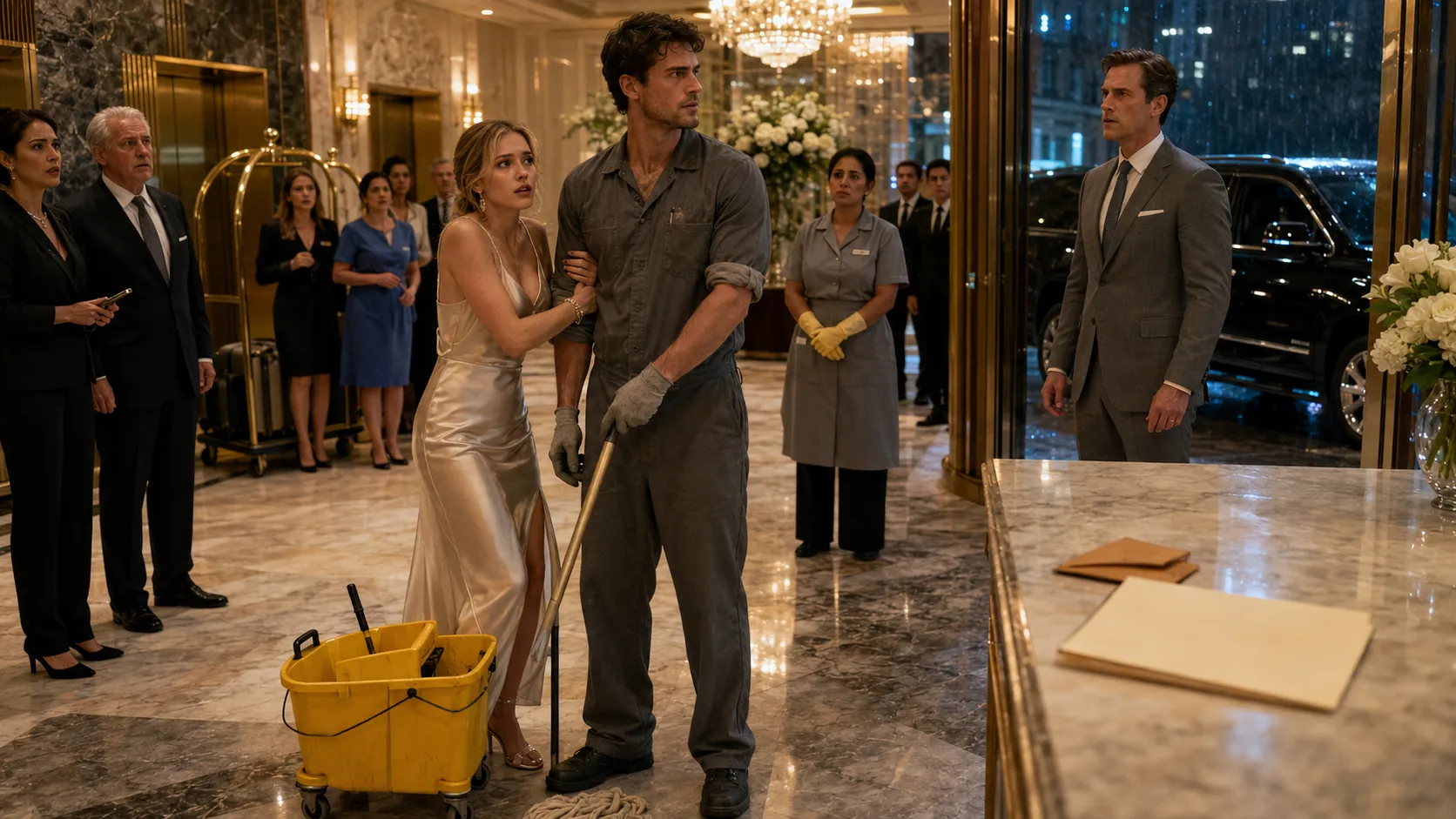
His shoulder slammed into Daniel’s arm.
The mop handle struck the bucket.
Water splashed across the marble and spotted the toe of Victor’s left shoe.
The lobby froze.
Victor looked down slowly.
A single drop of dirty water slid across the polished leather.
Then he looked at Daniel as if he had been personally attacked by poverty.
“What the hell is wrong with you?”
Daniel held the mop upright.
“My apologies, sir. The floor is wet.”
Victor’s friends turned to watch.
So did the guests in the lounge.
Clara stepped out from behind the desk, but Daniel gave her the smallest shake of his head.
Victor took one step closer.
“You people always have an excuse.”
Daniel said nothing.
The silence irritated Victor more than an argument would have.
“Do you know how much these shoes cost?”
“No, sir.”
“Of course you don’t.”
A few people laughed.
Not because it was funny.
Because Victor was important, and important people teach rooms when to laugh.
Daniel lowered his eyes briefly.
Victor smiled coldly.
“That’s right. Look down. That’s where people like you belong.”
Clara’s mouth opened.
Daniel spoke before she could.
“You’re right about one thing, sir.”
Victor raised an eyebrow.
“And what is that?”
Daniel looked at the floor.
“People reveal a lot by where they think others belong.”
For the first time, Victor really looked at him.
Not long.
Just enough to be offended that a janitor had spoken in a full sentence.
“Careful,” Victor said softly. “A man with a mop should not talk like a man with options.”
Daniel smiled faintly.
“Noted.”
Victor leaned closer.
“I could have you fired before lunch.”
“Yes,” Daniel said calmly. “You could try.”
Something in the answer unsettled the group around him.
Not the words.
The tone.
Daniel did not sound afraid.
He did not sound arrogant either.
He sounded like a man listening to a child threaten the weather.
Victor scoffed and turned away.
“Clean the floor,” he snapped. “At least be useful.”
He walked toward the elevators with his group following behind him.
Clara hurried over the moment they were gone.
“Daniel,” she whispered, “are you okay?”
“I’m fine.”
“He can’t talk to you like that.”
“He just did.”
“That’s not what I mean.”
Daniel squeezed the mop out carefully.
Clara lowered her voice.
“Why do you let people do that?”
He looked at her then.
There was kindness in his eyes, but also something older than kindness.
“Because when people believe there are no consequences, they tell you who they really are.”
Clara frowned.
“You say things like you’re writing a book.”
“Maybe I mop poetically.”
She almost smiled, but worry remained.
Before she could answer, the hotel manager appeared from the hallway with a tense expression.
Martin Keller was fifty-eight, well dressed, and always slightly damp with anxiety. He treated wealthy guests like royalty and staff like furniture that might cost money to repair.
“Daniel,” he said quickly. “Room 2107 requested assistance. Housekeeping is backed up. Go now.”
Clara looked surprised.
“Isn’t that the Bennett suite?”
Martin ignored her.
Daniel placed the mop back on the cart.
“What kind of assistance?”
“Guest request. I don’t know. Just handle it quietly. The summit starts soon, and I don’t need complaints.”
Daniel pushed the cart toward the elevators.
Behind him, he heard Martin scolding Clara for leaving the desk.
The elevator rose slowly.
Floor after floor, Daniel watched his reflection in the metal doors.
Gray uniform.
Work shoes.
Disposable face.
Two years earlier, that same reflection had looked very different.
Custom suits.
Private elevators.
People stepping aside before he asked.
Daniel Reed had once been one of the youngest tech billionaires in America.
He built a cybersecurity company from a borrowed laptop and a room above his mother’s garage. By thirty-two, his software protected banks, hospitals, airports, and government systems. Reporters called him a genius. Investors called him disciplined. Competitors called him dangerous.
His mother called him Danny.
She had worked in hotels most of her life.
Housekeeping first.
Laundry later.
Night shift when Daniel was little because it paid slightly more.
She used to come home with cracked hands, swollen feet, and stories she told lightly because she did not want her son to know how much humiliation a woman could carry in one uniform.
Daniel remembered one story more than all the others.
A guest had thrown a glass at the wall because the ice machine on his floor was broken. Daniel’s mother cleaned the glass, apologized to the man, and came home with a cut across her thumb.
“Why didn’t you tell the manager?” Daniel had asked her.
She had smiled sadly.
“Because managers listen better to wallets than to workers.”
That sentence never left him.
Even after she died.
Especially after she died.
When Daniel became rich, he told himself he would never become like the people who had treated his mother as if she were less than human.
But money changes the air around a person.
It builds walls.
It filters voices.
It lets others do cruelty in your name while bringing you only clean reports.
Two years earlier, Daniel visited one of his company offices without warning and heard senior executives laughing in a conference room. They were joking about the cleaning crew.
“People at the bottom don’t have pride,” one executive said. “That’s why they stay there.”
Another replied, “Money is proof of value. Everything else is sentiment.”
Daniel stood outside the door and felt something in him go cold.
Those were his executives.
His company.
His culture, whether he had ordered it or merely allowed it.
He resigned publicly three months later, placed his holdings under a private trust, and disappeared.
The media called it burnout.
A nervous breakdown.
A spiritual retreat.
Some said he had lost his fortune.
The truth was simpler and stranger.
Daniel wanted to understand what wealth had made invisible.
So he stopped being rich in public.
He became a dishwasher in Phoenix.
A night custodian in Cleveland.
A warehouse packer in Nevada.
A gas station clerk in Arkansas.
And eventually, under a quiet arrangement known only to a private attorney and two trusted board members, he became a janitor at The Grand Meridian Hotel — a luxury property his holding company was considering buying through a merger.
He wanted to see it from the bottom before deciding whether to own it from the top.
The elevator doors opened on the twenty-first floor.
Daniel pushed the cleaning cart down the thick carpeted hallway and stopped outside Suite 2107.
He knocked.
A woman opened the door with trembling hands.
She was in her late seventies, with silver hair pinned unevenly and a robe wrapped around her thin shoulders. Her eyes were wide with terror.
“Please,” she whispered. “My husband collapsed.”
Daniel moved immediately.
Inside the suite, an elderly man lay on the carpet beside the bed.
His skin was gray.
His lips had a faint blue tint.
Daniel dropped to his knees and checked his pulse.
Weak.
Unsteady.
“Ma’am, what’s your name?”
“Eleanor.”
“Eleanor, I need you to call emergency services from the room phone. Tell them possible cardiac arrest, twenty-first floor, Suite 2107.”
Her hands shook too badly to move.
“I can’t—”
“Yes, you can,” Daniel said firmly. “Look at me. You’re going to help save your husband.”
Something in his voice steadied her.
She grabbed the phone.
Daniel loosened the man’s collar, checked his airway, and began chest compressions.
He had taken emergency response training years earlier after an employee collapsed during a company retreat. Back then, people had praised him for attending the course instead of sending a deputy.
Now nobody praised him.
Nobody watched.
That made the moment more honest.
“One, two, three, four…”
The old man did not respond.
Eleanor sobbed into the phone.
Daniel continued.
His knees pressed into the carpet. Sweat formed beneath the janitor uniform. His arms began to burn.
Still he counted.
Still he pressed.
Still he refused to stop.
The door opened behind him.
Martin Keller rushed in with two hotel security guards.
“What happened?” the manager demanded.
Daniel did not look up.
“Get the AED from the hallway.”
Martin froze.
“The what?”
Daniel’s voice sharpened.
“Automated external defibrillator. Red box by the elevator. Now.”
A security guard ran.
Martin stared at him, stunned by the command.
Daniel kept compressions going until the AED arrived. He cut the old man’s shirt open, placed the pads, followed the machine’s prompts, and ordered everyone to stand clear.
The shock lifted the man’s body slightly.
Eleanor cried out.
Daniel resumed compressions.
Minutes passed like punishment.
Then the old man coughed.
Once.
Then again.
His eyes opened halfway.
Eleanor collapsed beside him, sobbing his name.
“Harold… Harold, stay with me.”
Daniel sat back on his heels, breathing hard.
The paramedics arrived moments later and took over. They loaded Harold onto a stretcher, started oxygen, and prepared him for transport.
As they wheeled him out, Eleanor grabbed Daniel’s hand.
“What is your name?” she asked.
“Daniel.”
“Daniel what?”
He hesitated.
“Daniel Reed.”
Her eyes widened slightly.
Not with recognition.
Not yet.
With the faint surprise of a person hearing a name that felt important before knowing why.
“You saved my husband,” she said.
Daniel shook his head.
“The paramedics saved him.”
“No,” she whispered. “You started before they came.”
Martin Keller stood near the door, pale and silent.
Daniel rose, picked up the torn shirt packaging, and began cleaning the room.
Martin looked horrified.
“What are you doing?”
“My job.”
“You just—”
“My job includes cleaning up after emergencies.”
Eleanor looked at him with tears still in her eyes.
For the first time that day, someone in the hotel looked at Daniel and truly saw him.
Not as a uniform.
As a person.
By evening, the story had spread through the staff areas.
The janitor saved a guest.
Not just any guest.
Harold Bennett.
Founder of Bennett Capital.
One of the most influential private investors in the country.
The hotel lobby buzzed with rumors. Executives came and went. Victor Langston returned from his meetings in a darker mood than before, annoyed that the hotel summit had been interrupted by an ambulance and whispers he did not control.
Daniel was back in the lobby, mopping near the fountain.
Clara approached him quietly.
“Do you realize who you saved?”
“An old man.”
“Daniel.”
“That’s who he was when he needed help.”
She studied him.
“You’re a strange person.”
“So I’ve been told.”
Before she could answer, the lobby doors opened.
The atmosphere changed instantly.
A group of men in dark suits entered with the coordinated urgency of people who did not wait in lines. Behind them came two attorneys, a woman carrying a locked document case, and the hotel owner himself, Charles Whitmore.
Martin Keller nearly sprinted from the front desk.
“Mr. Whitmore, we weren’t expecting—”
The owner walked right past him.
Toward Daniel.
The lobby grew quiet.
Victor Langston, standing near the lounge with a glass in his hand, watched with mild irritation.
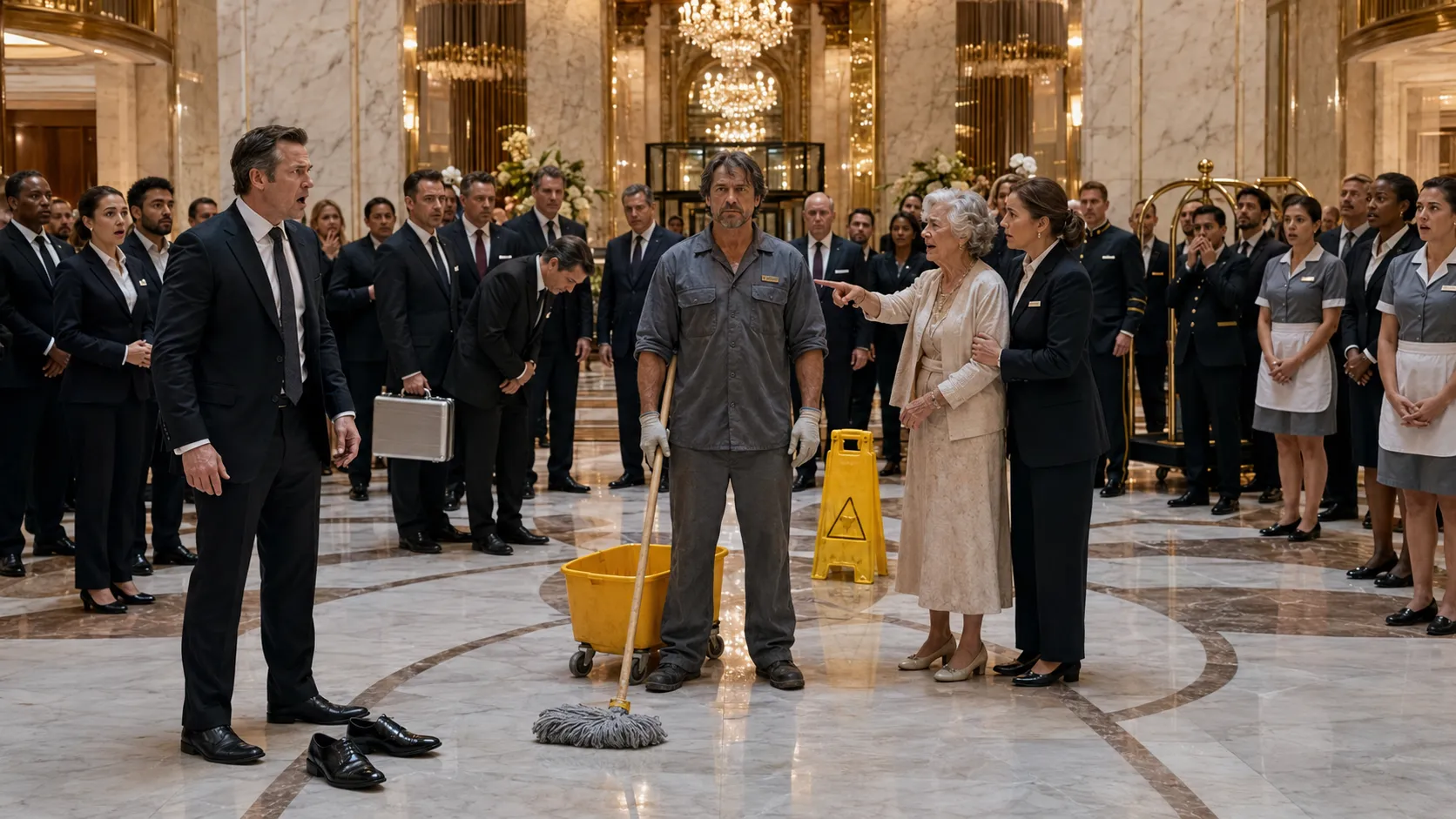
The first man in the dark suit stopped in front of Daniel and lowered his head.
“Mr. Reed.”
A sound moved through the lobby.
Not a gasp exactly.
More like confusion trying to become language.
Clara turned slowly toward Daniel.
Martin’s mouth opened.
Victor frowned.
Daniel leaned on the mop handle.
“Graham,” he said. “This is a little public.”
Graham Vale, Daniel’s chief legal officer, looked deeply uncomfortable.
“I apologize. We tried reaching you privately. Mr. Bennett regained consciousness at the hospital and insisted we contact you immediately.”
Daniel’s face changed.
“How is he?”
“Stable. Asking for his wife. And for you.”
Eleanor entered next, supported by a hospital aide and moving with the stubborn determination of a woman who had spent her life not waiting for permission.
“Where is he?” she demanded.
The group parted.
When she saw Daniel, her face softened.
“There you are.”
Daniel stepped toward her.
“You should be at the hospital.”
“I was married to Harold Bennett for fifty-four years,” she said. “Do not tell me where I should be.”
A few staff members nearly smiled.
Eleanor turned toward the lobby.
“My husband asked me to deliver a message.”
Victor Langston stepped closer.
“Mrs. Bennett, I’m sure whatever this is can wait until—”
She cut him off without looking at him.
“You must be Victor.”
His expression shifted.
“Yes.”
“Harold said you were arrogant. I see age has not improved you.”
The lobby went silent.
Victor’s smile hardened.
“I beg your pardon?”
Eleanor ignored him and looked back at Daniel.
“Harold said the merger is dead unless Daniel Reed approves it personally.”
Martin whispered, “Daniel Reed?”
Clara looked from the lawyers to Daniel’s uniform.
“The Daniel Reed?”
Victor suddenly went still.
All at once, the pieces began arranging themselves in his face.
The vanished billionaire.
The cybersecurity founder.
The silent investor rumored to be behind the trust negotiating The Grand Meridian acquisition.
The janitor he had humiliated that morning.
Victor’s glass lowered slowly.
“No,” he said under his breath.
Daniel sighed.
“It’s been a long day. Let’s not make it theatrical.”
But it was already theatrical.
Every guest in the lobby was watching.
Every staff member had stopped pretending to work.
Martin Keller looked as if the floor had disappeared beneath him.
Graham opened the document case.
“Mr. Reed, Bennett Capital will join the acquisition only if you return as controlling chair of the hospitality trust. Mr. Bennett believes this hotel needs leadership that understands what happened today.”
Daniel looked toward the workers gathered near the service hallway.
Housekeepers.
Bellmen.
Kitchen runners.
Security guards.
Maintenance staff.
People who had spent years being told to smile at insults because the guest was always right.
Daniel had seen enough.
He turned to Charles Whitmore, the current owner.
“Are payroll records ready?”
Whitmore swallowed.
“Yes.”
“Staff complaints?”
Martin Keller’s eyes widened.
“Mr. Reed, perhaps we should discuss internal matters in private—”
Daniel looked at him calmly.
“Staff humiliation happened in public. Wages were suppressed in paperwork. Medical leave requests were denied through policy. Schedules were cut without notice. Housekeepers were forced to clean rooms under unsafe time limits. Bell staff paid for uniform repairs out of pocket.”
The lobby became painfully quiet.
Daniel continued.
“I have worked here for nine weeks, Mr. Keller. I know which elevator smells like burning wires. I know which housekeeper hides her wrist brace because she’s afraid of losing shifts. I know kitchen staff share meals with employees who cannot afford the cafeteria. I know Clara has been covering front desk mistakes made by managers above her pay grade.”
Clara’s eyes filled with tears.
Daniel looked at Martin.
“And I know you laughed when a laundry worker asked for time off to take her husband to chemotherapy.”
Martin’s face drained of color.
“That was taken out of context.”
“No,” Daniel said. “It was taken on video.”
Graham handed Daniel a tablet.
Daniel did not play the recording.
He did not need to.
Martin already knew.
Victor Langston stepped forward, trying to recover control.
“Daniel, listen. We’ve both built companies. You know how emotional these environments can get. Service workers complain. That’s what they do. You can’t run an asset like this based on feelings.”
Daniel turned toward him.
There was no anger in his face.
That somehow made it worse.
“This morning, you told me people like me should stay invisible.”
Victor forced a laugh.
“I didn’t know it was you.”
Daniel nodded slowly.
“That was the problem.”
The words landed across the lobby with the weight of a judgment.
Victor lowered his eyes.
“I apologize.”
“No,” Daniel said. “You’re embarrassed. That is not the same thing.”
Victor’s jaw tightened.
Daniel looked toward the staff.
“The apology you owe is not to me.”
For a moment, Victor did not move.
He seemed to be calculating whether pride was still affordable.
Then he turned slowly toward the hotel workers.
His face was pale.
“I’m sorry,” he said stiffly.
Nobody answered.
Because some apologies arrive too late to deserve applause.
Eleanor stepped beside Daniel.
“Harold told me something in the ambulance,” she said quietly. “He said the first voice he heard after darkness was not the voice of a rich man or a poor man. It was the voice of someone who refused to let him die.”
Daniel looked down.
She placed one thin hand over his.
“Whatever you decide about this hotel, don’t forget the people who kept breathing life into it while men like Victor only came here to profit from the walls.”
Daniel closed his eyes briefly.
His mother’s voice returned.
Managers listen better to wallets than to workers.
When he opened his eyes, the decision had already been made.
“Effective immediately,” Daniel said, “the acquisition will proceed only under new management.”
Martin took a step back.
“Mr. Reed—”
“You are relieved of your position.”
Martin’s mouth opened, but no sound came out.
Daniel turned to Clara.
She looked startled.
“Me?”
“Interim guest relations director.”
“I’m a receptionist.”
“You notice people. That is the first qualification this hotel forgot.”
Her tears spilled over before she could stop them.
“I don’t know if I can—”
“You can learn operations,” Daniel said. “You cannot teach character to someone who refuses to see people.”
He looked at the gathered staff.
“Every hourly employee will receive a raise, retroactive hazard pay for the last quarter, full medical coverage review, and a direct reporting channel outside hotel management. No one will be punished for telling the truth about this place.”
A murmur rose among the workers.
Some cried quietly.
One older housekeeper covered her mouth with both hands.
A bellman who had worked there for thirty years looked away, blinking hard.
Victor’s expression darkened.
“You’re making a sentimental business decision.”
Daniel looked at him.
“No. I am correcting an expensive one.”
Graham stepped forward.
“There is also the merger vote.”
Daniel nodded.
“Langston Group is removed from consideration.”
Victor froze.
“You can’t be serious.”
“I rarely mop for entertainment, Victor.”
A few people almost laughed, then thought better of it.
Victor stepped closer, lowering his voice.
“You are going to throw away a billion-dollar opportunity because I insulted you?”
“No,” Daniel said. “Because you insulted the version of me you believed could not answer back. That tells me exactly how you would treat everyone else once you had control.”
Victor looked around the lobby.
For the first time that day, no one seemed impressed by his suit.
No one rushed to smooth over his discomfort.
No one laughed at the right time.
Power had left him standing in the open, and he looked smaller without it.
Daniel picked up his mop and placed it carefully into the bucket.
Then he removed his name tag.
The lobby watched in silence.
He turned it over in his palm.
DANIEL.
Just Daniel.
For nine weeks, that had been enough.
He handed the name tag to Clara.
“Keep this in the staff office,” he said. “Not as a trophy. As a warning.”
“A warning about what?”
Daniel looked across the marble lobby.
“That the person you overlook may be the one who sees everything.”
Three months later, The Grand Meridian Hotel reopened under new leadership.
The chandeliers were the same.
The piano still played softly in the lounge.
The marble floor still shone.
But the building felt different.
The service hallway had been renovated first, before the suites.
The staff cafeteria served proper meals now.
Housekeepers had safer room quotas.
Maintenance workers had new equipment.
The front desk had more staff per shift.
And near the employee entrance, framed beneath glass, was a simple note written in Daniel Reed’s hand:
Character is revealed by how we treat people who cannot reward us, punish us, or make us famous.
Clara became one of the best guest relations directors the hotel ever had.
Martin Keller tried to sue and quietly failed.
Victor Langston gave two interviews about “cancel culture in business” and was ignored by most people who had once feared him.
Harold Bennett recovered slowly but fully enough to return to the hotel one winter evening with Eleanor on his arm.
When Daniel saw them enter the lobby, he was not wearing a janitor uniform anymore.
He wore a simple dark suit.
No tie.
No entourage.
Harold crossed the lobby with a cane and stopped in front of him.
“I hear you cleaned this place up,” the old man said.
Daniel smiled.
“I had help.”
Harold looked toward the workers moving through the lobby with a confidence they had not carried before.
“Yes,” he said. “I can see that.”
Eleanor touched Daniel’s sleeve.
“Your mother would be proud.”
Daniel looked at her sharply.
He had never told Eleanor about his mother.
The old woman smiled faintly.
“Men who help strangers like that usually learned it from someone.”
For a moment, Daniel could not speak.
Across the lobby, Clara called to a young janitor who had just started that week. A guest had spilled coffee near the lounge and was apologizing nervously while the janitor cleaned it up.
The guest bent down to help.
It was a small thing.
Almost nothing.
But Daniel watched it as if it mattered.
Because it did.
Years earlier, his mother had come home with cut hands and quiet dignity from places exactly like this one.
For most of her life, nobody had rewritten the rules for her.
Daniel could not change that.
But he could change this place.
This lobby.
This company.
This small corner of the world where invisible people would no longer be treated as invisible.
Harold followed his gaze.
“You know,” the old man said, “wealth is a loud thing. It makes people listen whether you deserve it or not.”
Daniel nodded.
Harold smiled gently.
“But humility is quieter. Harder to notice. Harder to fake.”
Daniel looked across the polished marble floor.
A boy near the fountain dropped his toy car. The young janitor picked it up and handed it back with a smile. The boy’s mother thanked him by name.
Daniel saw the janitor’s face change when she said it.
By name.
Not “hey.”
Not “you.”
Not “clean this.”
His name.
Daniel took a slow breath.
For the first time in a long while, the hotel did not feel like a test.
It felt like an answer.
And somewhere beneath the music, the footsteps, the luggage wheels, and the soft hum of money moving through beautiful rooms, Daniel imagined his mother’s voice one last time.
Managers listen better to wallets than to workers.
He smiled faintly.
“Not anymore,” he whispered.
Then he walked across the shining floor, not above anyone, not beneath anyone, but among them.