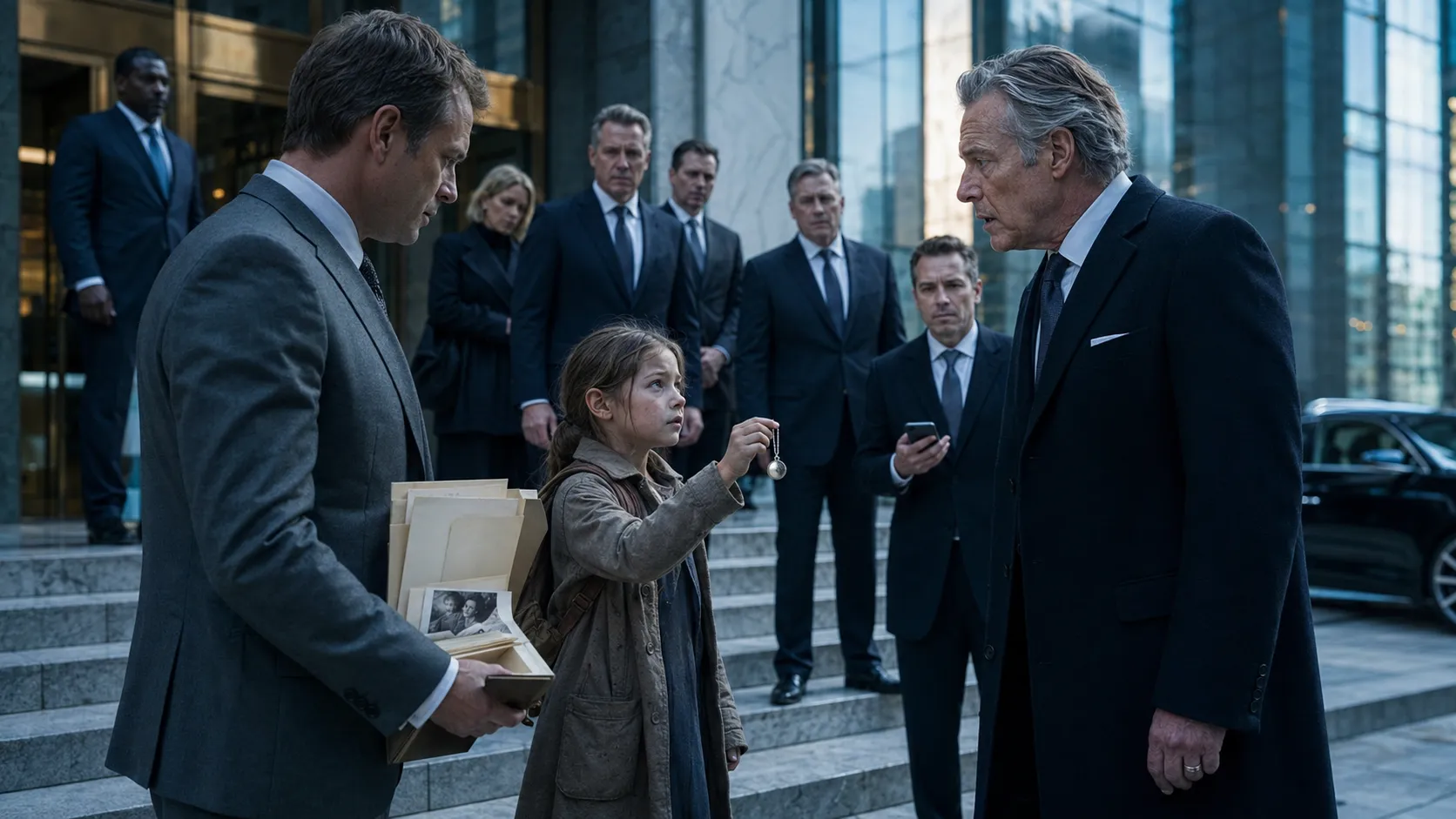
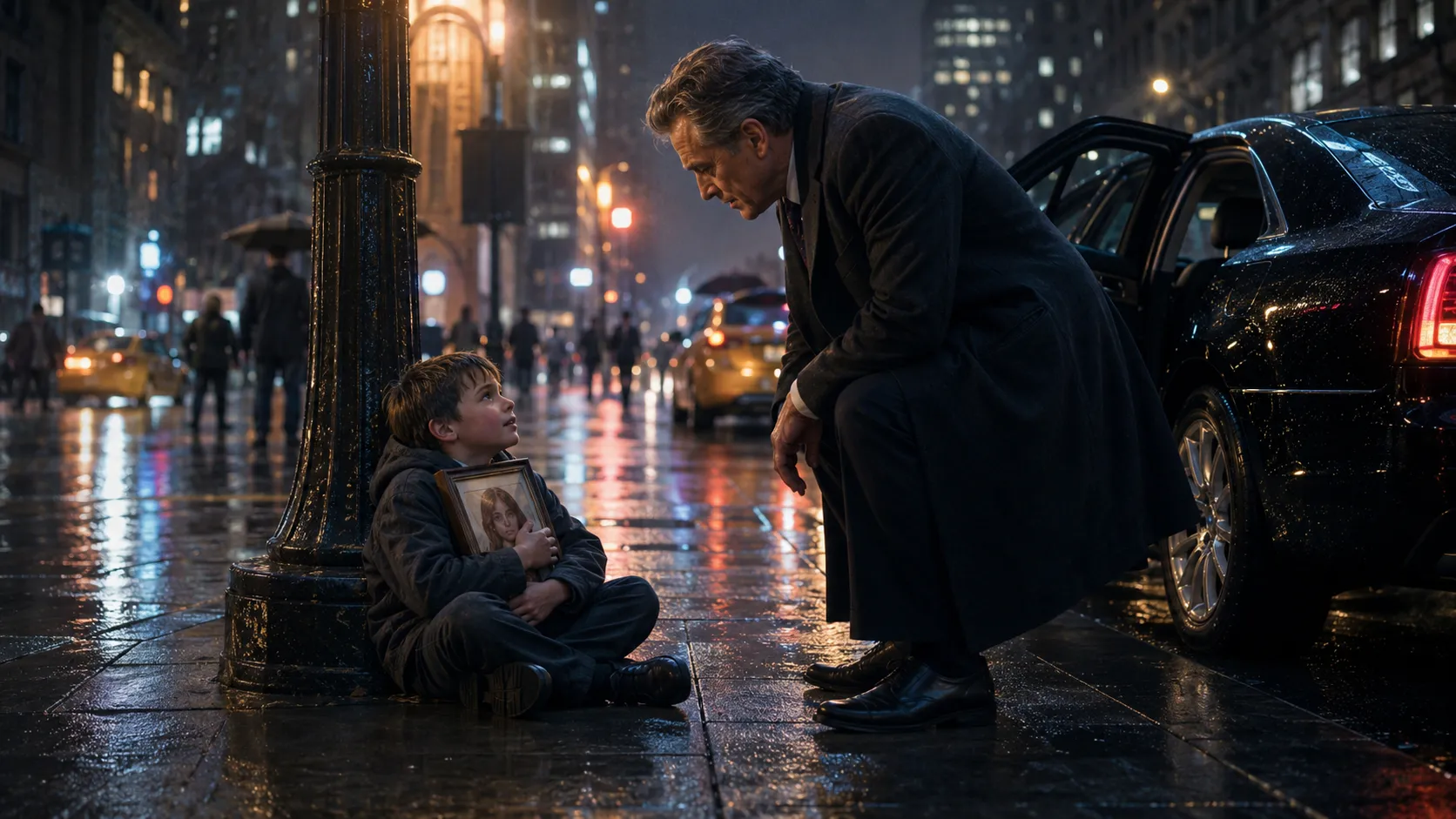
For three days, a little boy sat alone on a New York street corner, clutching a photograph of a woman named Rebecca. When billionaire Daniel Carter finally saw her face in the boy’s hands, the past he had buried for seven years came back alive.
The little boy had been standing on the same street corner for three days.
People passed him every hour.
Businessmen with briefcases. Teenagers laughing into their phones. Mothers rushing home with grocery bags cutting into their fingers. Delivery riders swerving through the rain. Nobody stopped long enough to ask his name.
Some dropped coins near his feet.
Some looked away.
Some pretended not to see him at all.
But the boy never left.
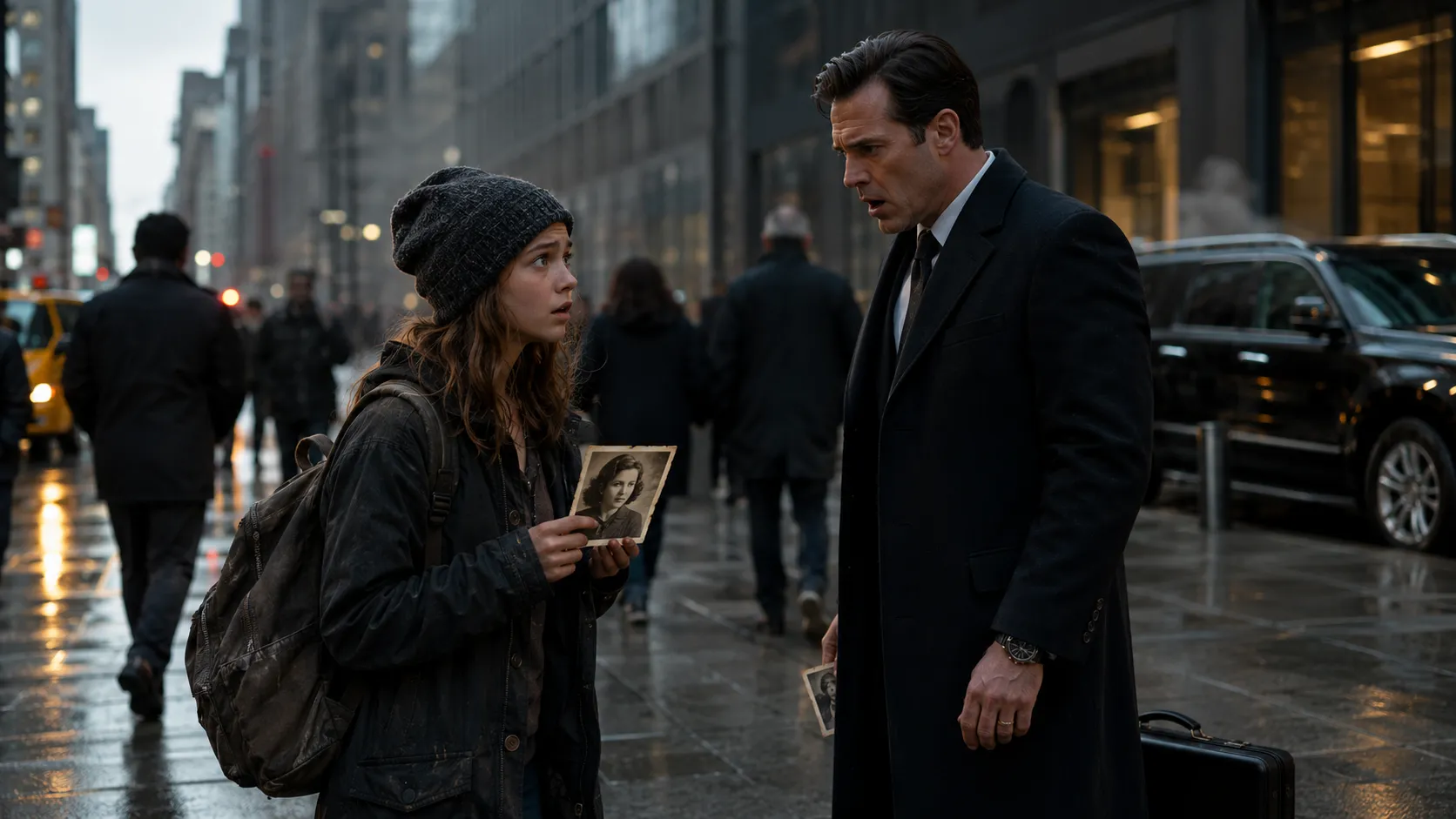
Every evening, he sat beneath the flickering streetlamp on the corner of West 43rd Street, hugging an old framed photograph against his chest as if it were the only thing in the world that still belonged to him.
And every evening, he cried.
Not loudly.
Not dramatically.
Just quiet, tired tears that seemed too heavy for a child that small.
On the third night, the rain came harder.
Cold November rain swept through Manhattan and turned the sidewalk black. Taxis hissed along the curb. Neon signs trembled in puddles. The city kept moving because cities rarely stop for children who have nowhere to go.
Daniel Carter almost walked past him too.
He stepped out of a black luxury car near the curb, pulling the collar of his charcoal coat up against the rain. At thirty-eight, Daniel looked like a man built by money and distance. Expensive suit. Controlled face. Driver waiting behind him. A phone buzzing with meetings no human being needed at nine o’clock at night.
He had spent the past seven years becoming exactly the kind of man he once despised.
Successful.
Polished.
Unreachable.
His company owned towers, technology contracts, and enough influence to make people lower their voices when he entered a room. Reporters called him self-made. Investors called him brilliant. Employees called him demanding.
But nobody who knew him now would have guessed that seven years earlier, Daniel Carter had been a man on his knees in an empty apartment, calling the same woman’s number until the voicemail filled.
Rebecca Lane.
The name still lived somewhere inside him.
Not gently.
Like a wound that never properly closed.
Daniel was halfway toward the restaurant entrance when he saw the boy.
At first, it was only a shape beneath the streetlamp.
Small shoulders.
Wet hair.
Bare hands red from the cold.
Then the boy shifted the photograph against his chest, and the glass caught the light.
Daniel stopped walking.
Something about the woman in the picture pulled at him before his mind understood why.
He took one step closer.
Then another.
The boy did not look up.
Daniel stood in front of him, rain sliding from the edge of his coat.
“Hey,” he said softly. “Are you lost?”
The boy sniffled but did not answer.
Daniel crouched slowly, careful not to frighten him.
“What’s your name?”
The boy hugged the frame tighter.
Daniel glanced at the photograph.
And the city seemed to disappear.
The woman in the picture had golden-brown hair, kind green eyes, and the same half-smile Daniel had spent seven years trying not to remember.
Rebecca.
His breath caught.
For a moment, he could not move.
The rain felt suddenly colder.
His hand lifted toward the frame, then stopped before touching it.
“Where did you get that?” he asked.
The boy finally looked up.
His eyes were swollen from crying, but sharp with fear.
“It’s my mom.”
Daniel stared at him.
“No,” he whispered.
The boy frowned.
“What?”
Daniel swallowed hard.
“Her name… was her name Rebecca?”
The child’s face changed instantly.
“How do you know her?”
Daniel’s knees nearly weakened beneath him.
The last time he had seen Rebecca, she had been standing in his apartment doorway at two in the morning with tears on her face and a trembling hand pressed against her stomach.
“You don’t understand, Daniel,” she had said. “I’m pregnant.”
He had been angry then.
Too angry.
Not because he did not love her.
Because love had arrived at the worst possible time, right as his company was about to close the biggest deal of his life and Rebecca had started asking questions about the men behind it.
They fought.
He accused her of trying to trap him.
She accused him of becoming someone she no longer recognized.
By morning, she was gone.
Daniel searched for her for months. Private investigators. Hospitals. Police reports. Airports. Old friends. Nothing.
It was as if Rebecca Lane had stepped out of the world and taken every answer with her.
The boy wiped his nose with his sleeve.
“She died five years ago.”
Daniel closed his eyes.
Five years ago.
Rebecca disappeared seven years ago.
The boy looked about seven.
The terrible arithmetic formed before Daniel was ready for it.
He opened his eyes slowly.
“How old are you?”
“Seven.”
Daniel felt something inside him break.
“What’s your name?”
The boy hesitated.
“Ethan.”
“Ethan what?”
“Ethan Lane.”
Lane.
Rebecca’s last name.
Daniel looked at the child’s face more carefully now. The curve of the mouth was Rebecca’s. The eyes were hers too. But the shape of the chin, the stubborn set of the jaw, the little crease between the eyebrows when he was frightened—
Daniel had seen those in his own mirror.
The sidewalk seemed to tilt.
“Ethan,” he said carefully, “where is the person who was taking care of you?”
The boy’s lower lip trembled.
“I ran away.”
“From who?”
Ethan looked past Daniel.
His whole body went rigid.
A black SUV had pulled to the curb across the street.
Its lights stayed on.
Two men stepped out wearing dark coats, their faces hidden beneath rain-slicked hoods. They did not look like policemen. They did not look like worried relatives.
They looked like men who knew exactly who they had come to find.
Ethan made a small sound and grabbed Daniel’s coat.
“They found me.”
Daniel stood immediately, placing himself between the child and the street.
“Who are they?”
Ethan shook his head.
“They hurt my mom.”
The words entered Daniel’s chest like ice.
The two men crossed through traffic without waiting for the light.
One pointed toward the boy.
“There he is.”
Daniel’s driver, Marcus, opened the car door behind him.
“Mr. Carter?”
Daniel lifted one hand without looking back.
The first man stopped a few feet away.
“Hand over the kid.”
Daniel’s voice was flat.
“Who are you?”
The man smiled.
“People who don’t answer to you.”
The second man stepped around him, reaching toward Ethan.
Daniel caught his wrist hard.
“I asked who you are.”
The man’s smile faded.
“You don’t want to be involved in this.”
Daniel looked at Ethan’s small fingers clutching his coat.
“I think I already am.”
Everything happened too quickly after that.
The first man swung at him.
Daniel dodged badly but stayed upright. The second man reached inside his coat. Daniel saw the movement, the shape of the weapon, the sudden seriousness in the man’s eyes.
Gun.
Daniel grabbed Ethan and threw both of them behind a parked taxi as the first shot cracked through the rain.
People screamed.
A woman dropped her shopping bag and ran.
Traffic stopped.
Marcus moved fast. Daniel had hired him as a driver, but before that Marcus had been a Marine, a fact Daniel had never asked too many questions about. In three seconds, he was out of the car, weapon drawn, using the open door as cover.
“Mr. Carter, stay down!”
The attackers had not expected resistance.
That saved their lives.
The gunman tried to fire again, but Marcus shouted once, low and firm, and the man froze long enough for Daniel to grab a loose metal construction pipe from beside the curb.
He struck the man’s wrist.
The gun skidded across the wet pavement.
Marcus tackled the other attacker against the SUV hard enough to dent the door.
Police sirens wailed in the distance.
The men broke free and ran.
Not because they were beaten.
Because they had failed the first attempt.
Their SUV tore away into traffic.
Daniel stayed crouched behind the taxi, one arm around Ethan’s shaking shoulders.
“Are you hurt?”
The boy shook his head.
Daniel looked into the rain where the SUV had disappeared.
Then down at Rebecca’s photograph, still clutched against Ethan’s chest.
For seven years, Daniel had believed Rebecca left because she hated him.
Now he understood something far worse.
Rebecca had been running from someone.
And she had been running with his child.
An hour later, Ethan sat wrapped in a blanket on the couch inside Daniel Carter’s penthouse.
The apartment looked down over the city from the fifty-second floor, all glass walls, dark wood, quiet art, and furniture too expensive to feel warm. Ethan sat very still near the fireplace, holding a bowl of soup in both hands as if afraid someone might take it from him.
Daniel stood across the room with his tie loosened and blood drying along one knuckle.
Marcus had checked every entrance twice. Two private security men waited downstairs. Daniel’s attorney had been called. So had an old friend from the district attorney’s office.
But none of that mattered yet.
Not until Daniel understood the boy.
He opened a locked storage cabinet near the study and pulled out a box he had not touched in years.
Inside were old photographs.
Rebecca at Coney Island, laughing with her hair blown across her face.
Rebecca asleep on his couch with a book open across her chest.
Rebecca standing beside him on a beach in Montauk, her chin lifted, her green eyes full of life and certainty.
Daniel carried that photograph to Ethan.
The boy stared at it for a long time.
“That’s her,” Ethan whispered.
Daniel sat across from him.
“Yes.”
“You knew my mom.”
Daniel’s throat tightened.
“I loved your mom.”
Ethan looked at him cautiously.
“She told me you were good once.”
The words hurt more than an accusation would have.
“Once,” Daniel repeated softly.
The boy looked down into the soup.
“She said if anything bad happened, I had to find Daniel Carter.”
Daniel went still.
Ethan reached into the pocket of his wet hoodie and pulled out a tiny folded paper sealed inside a piece of plastic. The edges were worn from being unfolded too many times.
Daniel took it with trembling fingers.
Three words were written in Rebecca’s handwriting.
Trust Daniel only.
He could not speak for a moment.
Rebecca had trusted him.
After the fight.
After the things he said.
After all the years he spent believing she had erased him.
She had still trusted him with the one thing that mattered most.
Her son.
Their son.
Daniel pressed the paper gently against his mouth and closed his eyes.
“I’m sorry,” he whispered.
Ethan’s voice was small.
“For what?”
Daniel opened his eyes.
“For not finding you sooner.”
The boy looked away.
“My mom said you didn’t know.”
“That doesn’t make it hurt less.”
Ethan’s fingers tightened around the bowl.
For a while, neither of them spoke.
The fire snapped softly. Rain slid down the windows. Below them, Manhattan kept glowing like nothing had changed.
Daniel finally asked the question he had been afraid to ask.
“How did your mother die?”
Ethan’s face emptied.
Not because he did not remember.
Because he remembered too clearly.
“We lived in a small apartment in Queens,” he said. “Not our first one. We moved a lot. Mom said we had to keep moving because bad people were looking for something.”
“What something?”
Ethan touched his chest.
Daniel noticed then, for the first time, a thin silver chain around the boy’s neck.
“My key.”
Daniel leaned forward.
“What key?”
Ethan pulled the chain from beneath his shirt.
A small metal key hung from it, plain and old-fashioned, with a number stamped near the top.
17-B.
Daniel stared at it.
“What does it open?”
“Mom said it unlocks proof.”
“Proof of what?”
Ethan’s voice dropped.
“She said powerful men were taking women and making them disappear.”
The room went colder.
Rebecca had been an investigative journalist before she vanished. Not famous, not yet, but stubborn enough to make enemies far above her pay grade. Before their final fight, she had been working on a story Daniel had dismissed as paranoia: shell companies, illegal transport routes, missing women, private security firms, charity galas that hid darker business underneath.
She had believed someone inside Daniel’s biggest investment deal was involved.
Daniel had refused to listen.
Because listening would have endangered everything he was building.
“What happened the night she died?” he asked.
Ethan’s eyes filled instantly.
“She woke me up and told me to put on shoes. But I couldn’t find one, and she was scared, so she picked me up. Then someone knocked at the door.”
Daniel’s hands curled into fists.
“She hid me in the closet,” Ethan whispered. “She said, ‘No matter what you hear, don’t open it.’”
His voice cracked.
“I heard men yelling. One said she had the key. She said she didn’t. Then there was a loud bang.”
Daniel closed his eyes.
Ethan kept going because children sometimes tell the worst things quickly, as if stopping would make them real.
“She came back bleeding. She crawled to the closet. She gave me the picture and the note. She put the key around my neck and said, ‘Find Daniel. He’ll know how to be brave this time.’”
Daniel covered his mouth.
This time.
Rebecca’s last message to him had not been forgiveness.
It had been a challenge.
“She told me to hide under the floor,” Ethan continued. “There was a loose board in the closet. I stayed there until everything got quiet.”
“How did you survive after that?”
“A woman from the building found me. Mrs. Alvarez. She knew Mom. She took care of me for a while.”
“Where is she now?”
Ethan looked down.
“She got sick. Then a man came asking questions. She told me to run.”
“How long have you been alone?”
“Six days.”
Daniel stood abruptly and walked to the window.
Not because he wanted to leave the boy.
Because if he stayed seated, he was afraid the grief would crush him.
Six days.
His son had been alone in one of the richest cities in the world for six days, holding a dead woman’s photograph and waiting for a father who did not know he existed.
Behind him, Ethan spoke again.
“Are you mad?”
Daniel turned immediately.
The boy was watching him with fear in his eyes.
Not fear of strangers now.
Fear of rejection.
The kind Daniel himself had known as a child, before money, before power, before he learned how to make the world fear him first.
Daniel crossed the room and knelt in front of him.
“No,” he said. “I’m not mad at you.”
“Because Mom said you might not want me.”
Daniel’s eyes filled.
“She was wrong about that.”
Ethan searched his face.
“You don’t know me.”
“No,” Daniel admitted. “But I know enough.”
“What do you know?”
Daniel’s voice broke.
“I know you’re Rebecca’s son.”
Ethan waited.
Daniel forced himself to say the rest.
“And maybe mine.”
The boy looked down.
“She said you were.”
Daniel inhaled unsteadily.
“Then I believe her.”
For the first time, Ethan’s face softened.
Not a smile.
Not yet.
But something close to resting.
Daniel placed one hand gently over the boy’s small cold fingers.
“You don’t have to be afraid alone anymore.”
Ethan looked at him for a long moment.
Then he asked, “Does that mean I can sleep here tonight?”
Daniel almost laughed, but it came out like pain.
“Yes,” he said. “It means you can sleep here tonight.”
He paused.
“And tomorrow night.”
“And after?”
Daniel looked at Rebecca’s photograph on the table.
“And after.”
At six the next morning, Daniel Carter stopped being a businessman and became a man trying to repair the worst mistake of his life.
The key led them first to a bank on the Lower East Side.
Not a famous bank.
Not the kind men like Daniel used.
A small old building wedged between a bakery and a pharmacy, with brass handles worn smooth by decades of ordinary people protecting important things in small boxes.
Daniel arrived with Ethan, Marcus, two attorneys, and a retired judge named Helen Moore, who had once served on the board of Rebecca’s journalism foundation and still owed Daniel no favors at all.
That was why he trusted her.
The bank manager was nervous before he even finished reading the name on the lockbox records.
Rebecca Lane.
Box 17-B.
The signature card was seven years old.
Daniel looked at Ethan.
The boy’s fingers tightened around the key.
“You don’t have to do it,” Daniel said quietly.
Ethan shook his head.
“Mom said I had to.”
Inside the private viewing room, the box was placed on the table.
Ethan inserted the key.
The lock turned with a soft click that seemed too small for everything it opened.
Inside was a stack of envelopes, a flash drive sealed in wax paper, a small notebook, three passports under different names, and a letter addressed in Rebecca’s handwriting.
To Daniel, if I failed.
Daniel could not open it at first.
His hands would not obey him.
Judge Moore opened the notebook instead.
By the time she finished the first page, her face had changed.
“What is it?” Daniel asked.
She did not answer.
She kept reading.
Then she looked up slowly.
“This is not just trafficking,” she said. “This is a ledger.”
The notebook listed names.
Dates.
Payments.
Routes.
Private security firms.
Dock numbers.
Charity event locations.
Politicians.
Judges.
Businessmen.
Daniel saw three names he recognized immediately.
One was a former senator.
One was the head of a shipping company.
And one was Martin Vale, the man who had been Daniel’s earliest investor and the person who had introduced him to the deal Rebecca begged him not to sign.
Daniel felt sick.
“She tried to warn me,” he whispered.
Judge Moore inserted the flash drive into an offline laptop Marcus had brought.
Files opened slowly.
Photographs.
Scanned contracts.
Recorded calls.
Bank transfers.
Private flight manifests.
Missing persons reports Rebecca had cross-referenced by hand.
And one video.
Rebecca appeared on the screen sitting in what looked like a cheap motel room. She looked tired, younger than Daniel remembered and older than she should have been. Her hair was shorter. There were shadows under her eyes.
In her arms was a baby.
Ethan.
Daniel stopped breathing.
Rebecca looked directly into the camera.
“Daniel,” she said, “if you are watching this, then I either failed to stay hidden, or Ethan found you.”
Ethan moved closer to Daniel’s side.
The room fell silent.
Rebecca continued.
“I know what you think happened. I know you think I left because I hated you. I wanted to. Some days I did hate you. But I left because I was being followed. I left because the men behind your deal were not just corrupt. They were dangerous.”
Her voice trembled, but she did not look away.
“I tried to tell you. You told me I was trying to destroy your future. Maybe I was. Maybe your future needed destroying before it destroyed you.”
Daniel lowered his head.
“I was pregnant when I left. I almost told you where I was a hundred times. But every time I tried, someone got too close. I couldn’t risk him.”
Rebecca looked down at the baby.
“He has your eyes when he’s angry.”
Ethan glanced up at Daniel.
For one second, something almost gentle passed between them.
Rebecca looked back at the camera.
“If I’m gone, protect him. But don’t just protect him with money. Protect him with the truth. I loved you, Daniel. That was the most inconvenient thing about my life. And I hope, when the time comes, you become the man I thought you were.”
The video ended.
Nobody spoke.
Daniel took one step backward and sat down because his legs no longer felt steady.
Ethan stood beside him, clutching the edge of his coat.
“Is she mad at you?” the boy asked.
Daniel wiped his eyes with the heel of his hand.
“Yes.”
“Did she love you?”
Daniel looked at the blank screen.
“Yes.”
“Can both be true?”
Judge Moore answered quietly before Daniel could.
“At our age, sweetheart, most important things are.”
By noon, Judge Moore had contacted the United States Attorney’s Office.
By evening, the FBI was involved.
By midnight, three federal agents sat in Daniel’s penthouse with laptops, evidence bags, and the tired expressions of people realizing a case that had been buried for years was suddenly alive again.
Agent Rebecca Stone led the team.
The irony of her first name was not lost on anyone.
She was in her fifties, sharp-eyed, patient, and uninterested in Daniel’s money.
That comforted him.
“We need to move the child to protective custody,” she said.
Ethan immediately looked at Daniel.
Daniel’s jaw tightened.
“No.”
Agent Stone did not blink.
“This is not negotiable.”
“He just found me.”
“And the people who killed his mother just found him too.”
Daniel looked toward Ethan.
The boy was trying to be brave.
Trying and failing.
Daniel softened his voice.
“What would protective custody mean?”
“A safe location. Federal protection. Limited contact until arrests are made.”
Ethan’s eyes filled.
“No.”
Daniel knelt in front of him.
“Ethan—”
“You said I could stay after.”
“I know.”
“You said after.”
Daniel felt the word like a knife.
“I did.”
“Then don’t give me away.”
Agent Stone looked at Daniel with something like sympathy, but not enough to change her mind.
Daniel stood.
“I’ll go with him.”
She frowned.
“That is not how this works.”
“It is now.”
“You are a civilian.”
“I am also the only adult he trusts.”
“You are a target.”
“Then protect us both.”
Agent Stone studied him for a long moment.
“You understand your money cannot control this investigation.”
Daniel looked at Rebecca’s photograph on the table.
“My money is the reason I didn’t listen seven years ago. I’m not asking it to control anything now.”
By morning, Daniel Carter disappeared from public view.
The business channels speculated.
Investors panicked.
His board demanded explanations.
Daniel gave none.
He and Ethan spent nine days in a federal safe house outside the city, a plain brick home with reinforced doors, old furniture, and agents who changed shifts every eight hours.
It was the first home Daniel had lived in that did not look expensive.
It was also the first place in years where he felt something like purpose.
Ethan had nightmares.
Every night.
Sometimes he woke calling for his mother. Sometimes he woke silent, sitting upright with his eyes open but not seeing the room.
Daniel did not know how to be a father.
Not naturally.
Not well.
He burned toast. He folded laundry badly. He bought Ethan shoes two sizes too large because he did not understand children’s sizing. He tried to make pancakes and set off the smoke alarm.
The agents laughed about that for two days.
Ethan did not laugh at first.
But on the fourth morning, when Daniel cracked an egg directly onto the counter instead of into the bowl, the boy made a sound Daniel had never heard from him before.
A small laugh.
Barely there.
Daniel froze like a man hearing music after years underground.
“What?” he said.
“You’re bad at breakfast.”
“I run a multibillion-dollar company.”
“You can’t run eggs.”
Daniel looked at the mess on the counter.
“That is unfortunately accurate.”
Ethan smiled.
A real smile this time.
Daniel turned away quickly, pretending to reach for a towel, because the sight of it nearly broke him.
That afternoon, the DNA results arrived.
Agent Stone handed Daniel the sealed envelope without ceremony.
He stared at it for a long time.
Ethan watched from the couch.
“Does it say?”
Daniel nodded.
“You don’t have to open it,” Ethan said.
Daniel looked at him.
“Why?”
The boy shrugged too carefully.
“Because maybe if it says no, you’ll leave.”
Daniel crossed the room and sat beside him.
“Ethan, listen to me carefully.”
The boy would not meet his eyes.
Daniel placed the envelope on the coffee table unopened.
“I don’t need paper to decide whether you matter.”
Ethan’s mouth trembled.
Daniel continued.
“But I think your mother wanted us to know the truth.”
He opened the envelope.
Read the first line.
Then the second.
His vision blurred before he reached the percentage.
Biological father.
Daniel folded the paper slowly.
Ethan whispered, “Is it yes?”
Daniel nodded once.
“Yes.”
The boy stared at him.
Neither moved for a second.
Then Ethan climbed into his lap like a child much younger than seven and buried his face against Daniel’s chest.
Daniel held him carefully at first.
Then tightly.
Not enough to hurt.
Enough to promise.
For the first time since Rebecca disappeared, Daniel Carter allowed himself to cry without trying to control how it looked.
The arrests began two days later.
Federal agents raided a warehouse near the Brooklyn waterfront, a private security office in Newark, two luxury apartments in Manhattan, and a charity foundation headquarters that had once held galas Rebecca tried to investigate.
Martin Vale was arrested at a private airport, carrying a passport under another name.
When agents found him, he was not alone.
Three young women were hiding in a locked service room beneath the hangar.
Alive.
Terrified.
But alive.
The news broke open like a storm.
At first, Daniel’s name appeared everywhere as a former business partner of Vale’s network. Commentators asked what he knew. Reporters circled his building. His company stock dropped. Old enemies called him complicit before any facts were clear.
Daniel did not defend himself immediately.
That surprised everyone.
Instead, through Judge Moore, he released Rebecca’s files to investigators and agreed to testify under oath about every meeting, every contract, every warning sign he had ignored because profit had made him comfortable.
His attorneys begged him to be careful.
Daniel told them careful was what had ruined him.
The trial lasted eleven weeks.
Rebecca became the center of it.
Not as a victim only.
As a journalist.
Her notes exposed what powerful men had spent years hiding. Her recordings placed voices with money. Her timelines connected disappearances that had once looked unrelated. Her final video to Daniel was played in court, and for the first time, the public saw the woman behind the photograph.
Ethan did not attend most of the trial.
Daniel refused to let his son become a courtroom symbol.
But on the day Martin Vale testified, Ethan asked to come.
Daniel hesitated.
Agent Stone advised against it.
Judge Moore did too.
But Ethan stood in the hallway outside the courtroom wearing a navy jacket Daniel had bought him and holding Rebecca’s photograph under one arm.
“I want him to see me,” he said.
Daniel crouched in front of him.
“You don’t have to prove you survived.”
“I know.”
“Then why?”
Ethan looked toward the courtroom doors.
“Because Mom didn’t get to.”
Daniel had no answer for that.
So he walked in with his son.
Martin Vale sat at the defense table in a gray suit, looking older, smaller, and far less powerful than he had in boardrooms. When he saw Ethan, his face changed.
Only for a second.
But the jury saw it.
Everyone did.
The prosecutor asked Daniel to take the stand after lunch.
He told the truth.
Not the polished version.
Not the legally convenient version.
He told the court that Rebecca had warned him. That he had dismissed her. That he had chosen ambition over conscience. That powerful men rarely need to pull triggers themselves when silence does enough of the work.
The defense attorney tried to use that against him.
“So, Mr. Carter, you admit you ignored serious warnings because those warnings threatened your fortune?”
Daniel looked at the jury.
“Yes.”
“And now you expect this court to believe you are some kind of hero?”
Daniel shook his head.
“No.”
The courtroom grew very still.
“I am not the hero of this story,” he said. “Rebecca Lane is. I am the man who should have listened sooner.”
For the first time all morning, the defense attorney had nothing ready.
The verdict came five days later.
Guilty.
On trafficking charges.
Conspiracy.
Murder connected to Rebecca Lane.
Witness intimidation.
Financial crimes.
The list was long enough that by the time the clerk finished reading it, Ethan had fallen asleep against Daniel’s side in the back row.
Daniel looked down at his son’s face.
He wished Rebecca had been there.
Then he realized, in the only way that mattered, she was.
Six months after the trial, Daniel stood on a small stage at a journalism school in New York.
Behind him was a photograph of Rebecca.
Not the sad one from the street corner.
A different one.
Rebecca standing in a newsroom with a pencil tucked behind her ear and her arms crossed, looking directly into the camera as if daring the world to lie to her.
Daniel had funded the Rebecca Lane Investigative Fellowship with half the profits from the deal he had once nearly signed.
Not because money could repair what had happened.
It could not.
But because money that had once helped silence the truth could now help protect those who chased it.
Ethan sat in the front row beside Judge Moore and Agent Stone.
He wore new shoes that fit.
He still carried the old framed photograph sometimes, though less often now.
Healing did not come all at once.
Some nights, Ethan still woke screaming.
Some mornings, Daniel still reached for his phone to call Rebecca before remembering there was no number left to dial.
But the penthouse had changed.
There were children’s books on the coffee table now.
A crooked drawing taped to the refrigerator.
A small pair of sneakers by the door.
Warmth where there had once been only expensive silence.
After the ceremony, Daniel and Ethan walked to the corner of West 43rd Street.
The same streetlamp still flickered.
The same traffic roared past.
The same city ignored almost everything.
Ethan stood beneath the light and looked down at the place where he had waited for three days.
Daniel did not rush him.
Finally, the boy asked, “Would you have stopped if you didn’t see her picture?”
Daniel could have lied.
He wanted to.
He wanted to say yes, of course, always.
But fatherhood, he was learning, could not be built on the kind of lies that made adults comfortable.
“I don’t know,” he said quietly.
Ethan looked up.
Daniel swallowed.
“I hope I would have. But I don’t know.”
The boy thought about that for a long moment.
Then he nodded.
“Mom would like that answer.”
“Why?”
“Because it’s true.”
Daniel looked down at him.
Ethan reached for his hand.
This time, Daniel did not freeze at the gesture.
He took it.
Across the street, a woman hurried past with an umbrella tilted low. A man in a business suit stepped around a homeless veteran without looking. A delivery cyclist shouted at a taxi. The city remained the city.
But Daniel was not the same man walking through it.
That evening, he made a quiet decision.
His company would fund a permanent outreach program for missing children, homeless youth, and families hiding from violence. Not a charity gala. Not a branding campaign. A real program, run by people who had spent their lives doing the work long before Daniel discovered his conscience.
When the first center opened, Ethan chose the name.
Rebecca House.
On opening day, he stood beside Daniel near the front door, holding a pair of scissors too large for his hands.
Reporters called his name.
He looked nervous.
Daniel leaned down.
“You don’t have to say anything.”
Ethan nodded.
Then, after a moment, he stepped toward the microphone anyway.
“My mom told me to find Daniel Carter,” he said softly. “But I think she also wanted him to find himself.”
Daniel closed his eyes.
The cameras flashed.
The ribbon fell.
And somewhere in the crowd, an older woman began to cry.
Years later, Daniel would remember that sentence more than any verdict, headline, or business award.
Because Ethan had been right.
Rebecca had not only left him a son.
She had left him a final chance to become someone worthy of being found.
That night, after the guests left and the new center grew quiet, Daniel and Ethan sat together on the front steps.
The old photograph rested between them.
Rebecca’s smile glowed softly under the porch light.
Ethan leaned against his father’s arm.
“Do you think she knows?”
Daniel looked at the photo.
At the woman he had loved too late.
At the boy she had protected with the last strength she had.
At the doorway behind them, where other frightened children would soon walk in from the cold and find someone waiting.
“Yes,” Daniel said.
For once, he did not feel like he was guessing.
“I think she knows.”
Ethan nodded.
Then he picked up the photograph and held it gently, not like the only thing keeping him alive anymore, but like a piece of home he could finally carry without fear.
Above them, the streetlamp flickered once.
Then steadied.