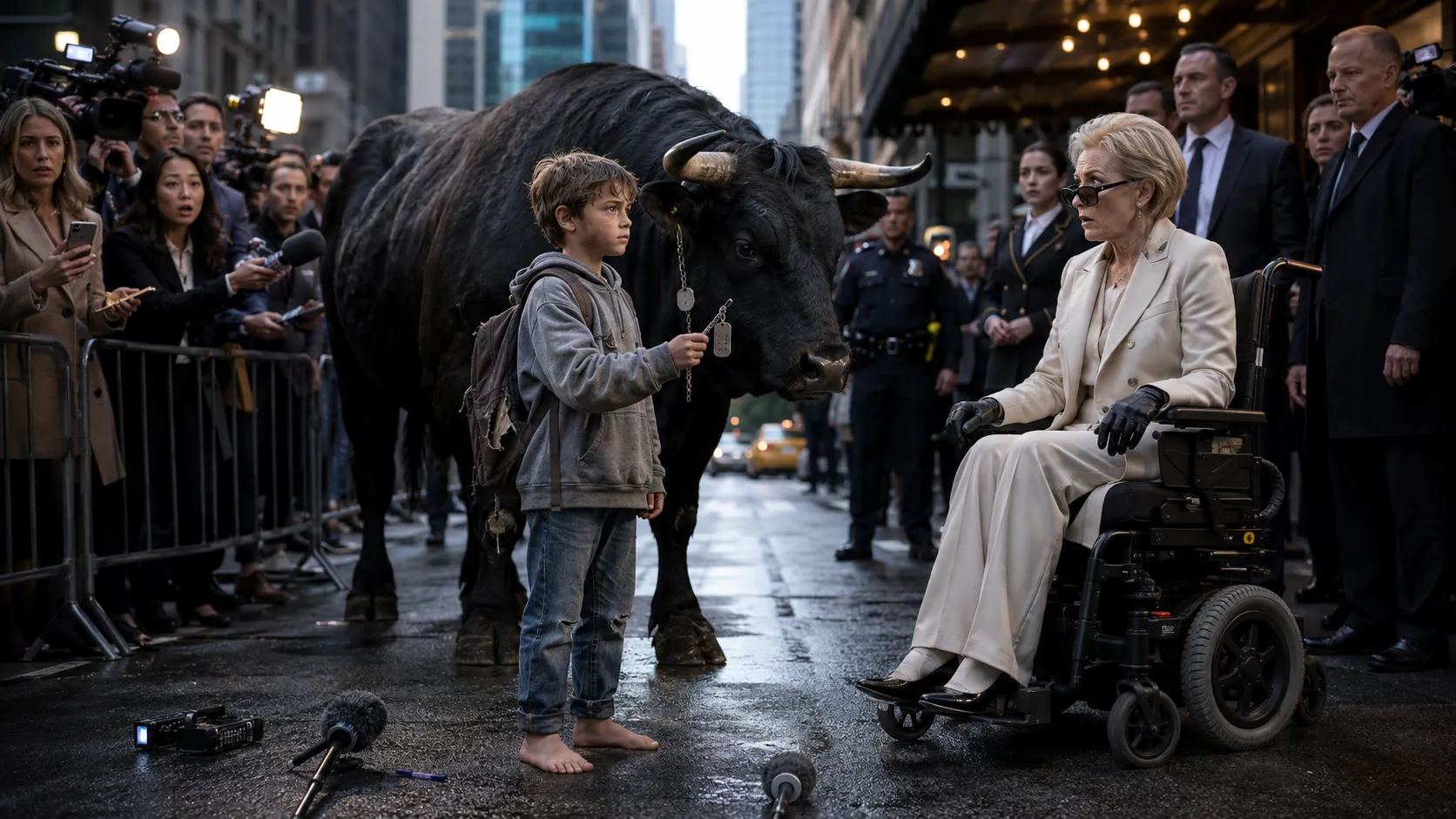
Everyone thought the bull would kill the billionaire in the wheelchair. But when a barefoot little boy stepped into the street and the animal bowed its head before him, the city finally saw the secret she had buried for fifteen years.
The bull should have killed her.
That was what everyone said afterward.
Not because the animal was weak.
Not because the police had control.
And not because Victoria Hale deserved mercy.
The bull should have killed her because nothing else on Lexington Street that afternoon had been strong enough to stop it.
At 2:17 p.m., downtown Chicago was packed with office workers, tourists, bike couriers, shoppers, reporters, bodyguards, and people too busy to notice the world changing around them. Sunlight flashed off the glass towers. Food carts smoked along the curb. Taxi horns cut through the noise. A warm wind carried the smell of hot asphalt and roasted peanuts between the buildings.
Then a livestock transport truck crashed through a red light.
The truck struck a delivery van, jumped the curb, and slammed into a line of parked cars with a metallic scream that made every head on the street turn at once.
For one second, there was only stunned silence.
Then the rear door of the transport burst open.
A massive black bull came out like a nightmare.
It hit the street hard, hooves striking sparks from the pavement. Foam flecked its mouth. Its neck was thick with muscle, its horns curved forward like polished bone, and its eyes were wild with fear so intense that it looked like rage.
People screamed.
A cyclist threw himself sideways and crashed into a newspaper stand. A vendor abandoned his cart without closing the lid. A woman grabbed her child and ran into a clothing store as the bull smashed through a sidewalk barrier and sent metal posts spinning across the road.
Police officers shouted over radios.
“Clear the street!”
“Get everyone inside!”
“Animal control is five minutes out!”
Five minutes was too long.
The bull lowered its head and charged again.
This time, directly toward the entrance of the Meridian Royale Hotel, where cameras, reporters, and security teams had gathered for the most anticipated business announcement of the year.
Victoria Hale was seated outside the hotel in a sleek electric wheelchair, wearing a cream-colored designer suit, black gloves, and dark sunglasses. Two bodyguards stood behind her. Three assistants hovered nearby. Reporters waited behind barricades with microphones lifted, eager for a statement about Hale Industries’ merger with one of the largest medical technology firms in Europe.
Victoria was fifty-nine years old and looked carved rather than born.
Beautiful.
Cold.
Perfectly arranged.
The newspapers called her the Ice Queen of Wall Street. Investors called her untouchable. Former employees called her worse things, but only in private and never with their names attached.
Her company controlled medical research laboratories, defense contracts, AI surveillance systems, private neurological clinics, and enough pharmaceutical patents to influence entire hospitals.
But there were rumors too.
Quiet ones.
Ugly ones.
Children had disappeared near old facilities linked to Hale subsidiaries.
Animal trials had been sealed without explanation.
Whistleblowers had resigned, vanished, or changed their stories after sudden payments.
Nothing was ever proven.
Victoria’s lawyers were too good.
Her security teams were too loyal.
Her money was too deep.
And the people who knew the truth were either dead, bought, or too afraid to speak.
That afternoon, Victoria was not thinking about any of that.
She was thinking about cameras.
About stock prices.
About the merger.
Then she heard the screams.
One bodyguard turned first.
His expression changed instantly.
“Move her!”
The electric wheelchair jerked backward, but the front wheels caught against the curb.
Victoria’s hand tightened on the control stick.
“Move me,” she snapped.
The second bodyguard grabbed the chair handle and pulled.
Too late.
The bull had already seen movement.
Its body shifted.
Its head lowered.
And suddenly eight hundred pounds of terrified muscle was thundering straight toward her.
Reporters scattered.
A microphone hit the ground.
A camera operator cursed and fell backward.
Victoria’s face went pale behind her sunglasses.
For the first time in years, every person watching saw something real on her face.
Fear.
The bull came closer.
Thirty feet.
Twenty.
Ten.
The bodyguards abandoned the wheelchair and dove aside.
One reporter screamed, “She’s going to die!”
Then a child walked into the street.
He was small.
Maybe eight years old.
Barefoot on the hot pavement.
He wore faded jeans, a gray hoodie far too large for him, and a backpack with one torn strap hanging over his shoulder. His dark hair fell across his forehead. His face was thin, almost too calm, with eyes that did not belong to someone his age.
He stepped directly between Victoria Hale and the charging bull.
The whole street froze.
“Kid!” a police officer shouted. “Move!”
The boy did not move.
The bull thundered toward him.
A woman covered her eyes.
A man shouted a prayer.
Victoria stared over the boy’s shoulder, unable to speak.
The bull reached him.
Then stopped.
Not gradually.
Not because anyone pulled it back.
It stopped so violently that its hooves scraped long black marks across the street.
Its breath burst out in heavy clouds.
Its head hovered inches from the boy’s chest.
The boy raised one hand.
Slowly.
Carefully.
He placed his palm between the animal’s eyes.
The bull trembled.
Then lowered its massive head.
Not in defeat.
In recognition.
The entire block went silent.
The boy stood beneath the creature’s horns and whispered something no one nearby could hear.
The bull closed its eyes.
Victoria watched the impossible unfold in front of her.
And then the boy turned around.
He walked toward her wheelchair as if the bull behind him were not a threat, but a guardian.
The reporters who had run away now lifted their cameras again.
A livestream camera, still rolling from the pavement, caught the moment perfectly: the billionaire in the cream suit, the boy with bare feet, and the massive black bull standing behind him like a dark wall.
The boy stopped beside Victoria.
His eyes found hers.
“You can’t die yet,” he said.
Victoria’s lips parted.
The boy leaned closer.
“Not before you give me all my answers.”
The color drained from her face.
“Who are you?” she whispered.
The boy studied her.
For a moment, he almost looked disappointed.
“You really don’t remember me.”
Victoria’s gloved fingers shook on the wheelchair armrest.
A reporter shouted from behind the barricade, “Mrs. Hale! Do you know this child?”
Victoria did not answer.
The boy reached into his hoodie pocket and pulled out a thin metal tag on a broken chain.
He held it up.
The tag was scratched and old, but the stamped letters were still visible.
D-17.
Victoria stopped breathing.
The bull behind the boy stepped forward.
As it turned its neck, the cameras caught another detail: the same marking, burned into the thick scarred skin beneath its dark fur.
D-17.
A murmur moved through the crowd.
“What is that?”
“Is that a military tag?”
“Why does the animal have the same number?”
Victoria’s hand moved toward her assistant.
“Get me out of here.”
But the boy stepped closer.
“No.”
One word.
Quiet.
Absolute.
And somehow Victoria stayed where she was.
The boy’s voice sharpened.
“My name is Daniel Mercer.”
Victoria closed her eyes.
Just for a second.
But it was enough.
Every camera caught it.
Every reporter saw the tiny collapse behind the mask.
When she opened her eyes again, the Ice Queen of Wall Street looked fifteen years older.
“That’s impossible,” she whispered.
Daniel tilted his head.
“That’s what the death certificate said.”
A police officer moved cautiously closer.
“Son, step away from the woman.”
Daniel did not look at him.
“She knows what she did.”
Victoria’s bodyguard reached for the boy’s arm.
The bull growled.
Not loudly.
Worse.
Low and deep, like thunder under the street.
The bodyguard froze.
Daniel placed a hand lightly against the bull’s neck.
“Easy, Atlas,” he murmured.
The name made Victoria flinch.
Daniel noticed.
“You remember him too.”
Victoria stared at the animal.
The bull’s left eye was clouded by an old injury. Pale scars crossed its shoulder and ribcage. There were surgical lines beneath the fur if a person knew how to look.
Victoria knew.
Of course she knew.
Fifteen years earlier, inside a research facility buried beneath the Nevada desert, there had been a file labeled:
PROJECT D-17
SUBJECT GROUP: CHILD-ANIMAL NEURAL CONDITIONING
STATUS: TERMINATED
Investors were told the project had failed.
Federal inspectors were shown empty rooms.
Insurance companies were given fire reports.
Families were given ashes.
None of them were told the truth.
Project D-17 had not been a medical trial.
It had been an attempt to manufacture obedience.
Children with no parents. Children whose paperwork could be lost. Children taken from broken systems, remote clinics, private foster contractors, overseas conflict zones.
Animals too.
Calves.
Dogs.
Primates.
Anything with a nervous system that could be trained, frightened, manipulated, broken, and rebuilt.
The scientists called it behavioral bonding.
The investors called it defense innovation.
Victoria Hale had called it necessary.
At least at first.
Daniel Mercer had been Subject 8.
Atlas had been Animal Pair D-17-B.
They were supposed to die in the facility fire that erased the evidence.
Victoria remembered signing the final order.
Terminate biological assets.
That was the phrase.
Not children.
Not animals.
Assets.
Now one of those assets stood in front of her barefoot on a Chicago street.
And the other lowered its scarred head beside him.
Daniel reached into his backpack and removed a small cracked keycard.
The Hale Industries logo was faded but still visible.
Victoria stared at it in horror.
“You kept that?”
Daniel looked at the cameras.
“The underground facility still exists.”
The crowd erupted.
Reporters pushed forward.
“What facility?”
“Mrs. Hale, is this true?”
“Were children tested by your company?”
“Who is Daniel Mercer?”
Victoria’s assistant tried to step in front of the cameras, but nobody listened anymore.
The livestream had already spread.
Thousands of viewers became hundreds of thousands.
Then millions.
Daniel lifted the keycard higher.
“You destroyed the records,” he said. “Not the place.”
Victoria’s voice trembled.
“You don’t understand.”
“I was eight.”
The words stopped her.
Daniel’s eyes did not soften.
“I understood enough.”
The bull breathed heavily beside him.
The police were confused now. Animal control had arrived but stayed back, unwilling to approach the creature that had gone from chaos to perfect stillness. Reporters were shouting. Traffic was frozen. People stood in windows high above the street filming from offices.
Victoria looked trapped in a way money had never allowed before.
“There were people above me,” she said quietly.
Daniel’s face hardened.
“But you still signed.”
She looked away.
The silence between them said everything.
Then came the first gunshot.
The sound cracked across Lexington Street and shattered a hotel window behind Victoria.
People screamed and dropped to the pavement.
A second shot struck the hood of a police cruiser.
Daniel did not flinch.
Atlas did.
The bull shifted instantly between the boy and the line of fire.
Black SUVs without plates turned sharply onto the street from both directions. Their windows were dark. Their tires shrieked against the pavement. Men in tactical gear jumped out before the vehicles fully stopped.
No insignias.
No police markings.
No hesitation.
One of them shouted, “Secure the child!”
Another aimed at the bull.
Victoria looked toward them and went white.
“They found us,” she whispered.
Daniel looked at her.
“Us?”
Before she could answer, the street exploded into chaos.
Police shouted for the armed men to drop their weapons. The tactical team ignored them. Civilians crawled behind cars and concrete planters. Reporters ducked but kept filming. Glass rained from the hotel facade.
Atlas charged.
Even the officers nearest the scene stumbled backward.
The bull hit the first tactical man with enough force to throw him across the hood of an SUV. Another fired twice, but the bullets struck the pavement as Atlas lowered its head and slammed into the vehicle’s side, denting the door inward.
Daniel grabbed Victoria’s wheelchair and pulled it behind a concrete barrier.
She stared at him.
“You saved me.”
He crouched beside her, his small hand still gripping the chair.
“I told you,” he said. “You don’t get to die yet.”
A bullet struck Atlas.
The sound that came from the animal was not rage.
It was pain.
Daniel’s calm broke for the first time.
“No!”
Atlas staggered but stayed upright.
Another armed man raised his weapon directly toward the boy.
“End Subject 8.”
Victoria looked at Daniel.
Then at Atlas.
Then at the cameras still recording.
Something in her face changed.
Not enough to erase the past.
Not enough to make her innocent.
But enough to make her choose.
“Stop!” she screamed.
Everyone near the barrier froze.
The tactical leader turned toward her.
Victoria’s body shook as she pushed herself upward from the wheelchair.
The crowd gasped.
For six years, the world had believed Victoria Hale could not walk.
Medical complications, her company had said.
A rare degenerative condition.
A tragic accident.
But Victoria stood.
Unsteady.
Pale.
Terrified.
But standing.
Daniel stared at her, stunned.
The tactical leader removed his glasses.
“You were told never to break cover,” he said.
Victoria’s voice was thin.
“You told me the children were terminal.”
The man’s expression barely changed.
“They were assets.”
“You told me Project D-17 was closed.”
“It evolved.”
Victoria swayed on her feet.
The words seemed to hit her harder than any accusation Daniel had made.
“It evolved where?”
The man lifted his weapon again.
“This conversation is over.”
Atlas moved first.
Wounded or not, the bull threw itself between Daniel and the gunman. Its shoulder struck the tactical leader and knocked him through the glass wall of a storefront with a crash that sent people screaming again.
The remaining men retreated as police reinforcements arrived from both ends of the street. Helicopters thundered overhead. Sirens filled downtown. The SUVs reversed violently, tires smoking as they tore away through a gap in traffic.
In less than ninety seconds, they were gone.
But the cameras had caught everything.
The gunmen.
The command.
The name Subject 8.
Victoria standing.
Atlas protecting the boy.
The lie was no longer contained.
Daniel knelt beside the wounded bull, both hands pressed gently against the animal’s neck.
“Stay with me,” he whispered. “Please.”
Atlas lowered its massive head into his lap.
The creature that had terrified an entire city now looked almost gentle.
Victoria stood a few feet away, shaking so badly one of her assistants tried to help her.
She pushed the assistant aside.
“What do you want from me?” she asked Daniel.
He looked up at her.
“The truth.”
The reporters had begun closing in again, carefully now.
Police shouted for them to stay back, but the circle tightened. Cameras focused on Victoria’s face. Phones hovered in the air. The world was watching a woman who had spent her entire life managing what the world was allowed to see.
For the first time, she could not manage it.
Her eyes filled.
“There were eighty-three children,” she whispered.
The crowd went silent.
“Louder,” Daniel said.
Victoria looked at him.
The boy’s face was wet now, not with fear, but with tears he refused to wipe away.
She turned toward the cameras.
“There were eighty-three children in the first phase of Project D-17.”
A reporter covered her mouth.
Another lowered his microphone.
Victoria continued, each word tearing something out of her.
“We experimented on memory, fear, pain response, attachment conditioning, and obedience triggers. Children and animals were paired to study cross-species neurological bonding. The project was illegal. The consent forms were falsified. The children were not terminal patients. They were taken.”
Daniel closed his eyes.
The police officers around her stiffened.
An older detective stepped forward slowly.
“Mrs. Hale, are you making a confession?”
Victoria gave a bitter little laugh.
“Yes,” she said. “Finally.”
The detective nodded to another officer.
“Keep recording.”
Victoria looked back at Daniel.
“I tried to stop it.”
Daniel opened his eyes.
His voice was quiet.
“When?”
She had no answer.
“That’s what I thought,” he said.
Her face crumpled.
“I was afraid.”
“So was I.”
The words broke her.
Daniel looked down at Atlas, stroking the animal’s scarred muzzle.
“My mother,” he said.
Victoria closed her eyes.
He did not ask the full question.
He did not need to.
Victoria whispered, “She found the facility after you disappeared.”
Daniel’s hand stopped moving.
“She came to Nevada?”
Victoria nodded.
“She was relentless. She found records no one else had found. She contacted journalists, lawmakers, anyone she thought might listen.”
“What happened to her?”
Victoria’s lips trembled.
“She died looking for you.”
Daniel’s face went still.
Not empty.
Worse.
Too full.
Atlas shifted weakly and nudged his hand.
The boy pressed his forehead against the animal’s neck.
For a moment, the entire city seemed to pause around him.
Then Victoria spoke again, so softly that at first only Daniel heard.
“There is another facility.”
Daniel lifted his head.
Victoria leaned closer.
“And the others are still alive.”
The detective beside her heard enough to turn sharply.
“What others?”
Victoria looked toward him.
“The surviving subjects.”
The words changed the day again.
Two hours later, Victoria Hale was taken into federal custody.
Not through a private entrance.
Not shielded by public relations staff.
Not smuggled away behind tinted glass.
She was escorted past the same cameras that had once adored her.
Reporters shouted questions.
“Where is the second facility?”
“How many children survived?”
“Who ordered the attack?”
“Did Hale Industries fake your disability?”
Victoria did not answer.
As she was placed into the federal vehicle, she turned once toward Daniel.
He stood beside the ambulance where veterinarians and emergency responders worked on Atlas. His bare feet were stained with street dust. His hoodie was torn. His face looked too old and too young at once.
Victoria said only one thing before the door closed.
“I am sorry.”
Daniel did not respond.
Because some apologies are not gifts.
They are evidence that the speaker finally understands the size of the wound.
Atlas survived the first surgery.
Barely.
The veterinarians at the city animal trauma center had never treated anything like him. His body carried old fractures, implanted fragments, scar tissue, and evidence of procedures that made several doctors leave the room in silence.
Daniel refused to leave him.
Federal agents brought him blankets, food, shoes, counselors, and finally a woman from child protection who spoke gently and never tried to touch him without asking first.
Her name was Marisol Reyes.
She had spent twenty years working with children who had learned not to trust adults.
She sat on the floor outside the surgical recovery room and waited until Daniel finally spoke.
“They’re going to put him down.”
“No,” she said.
“They always kill what they don’t understand.”
Marisol watched the boy carefully.
“Not today.”
Daniel looked at her for the first time.
“How do you know?”
“Because now everyone is watching.”
That answer seemed to matter to him.
For the next three days, America learned the name Project D-17.
The story broke open in stages.
First came Victoria’s confession.
Then the leaked facility diagrams.
Then the footage from Lexington Street.
Then the list.
Eighty-three children.
Forty-two confirmed deceased.
Nineteen unaccounted for.
Eleven believed transferred.
Seven possibly alive.
Four names redacted by federal court order.
One confirmed survivor: Daniel Mercer.
News anchors struggled to speak around the facts. Senators demanded investigations. Hale Industries stock collapsed. Three executives resigned before subpoenas reached them. Two board members fled the country and were detained in Zurich. A former research director was found hiding in a private clinic in Montana.
But the public cared most about the boy and the bull.
The image was everywhere.
Daniel barefoot in the street.
Atlas towering behind him.
Victoria Hale staring at a past she could no longer bury.
Some called Daniel a miracle child.
He hated that.
He was not a miracle.
He was evidence.
On the fourth night, a federal convoy left Chicago under heavy secrecy.
Daniel was inside the second vehicle, seated beside Agent Clara Wynn from the FBI’s crimes against children division. Marisol Reyes sat behind him. Atlas, still weak but alive, was being transported separately in a reinforced veterinary unit because Daniel refused to move without him nearby.
They were heading to Nevada.
To the desert.
To the place Victoria had finally named.
Facility D-19.
The official records called it a decommissioned agricultural research station. Satellite images showed three old buildings, a collapsed water tower, and miles of fencing across empty land.
But beneath the station was a bunker.
Victoria had drawn the entrance from memory during her first interrogation.
“There will be guards,” she had said.
“How many?” Agent Wynn asked.
Victoria looked exhausted.
“Enough to prove I am not the worst person involved.”
The convoy reached the desert before dawn.
The sky was still dark when federal teams surrounded the property. Tactical agents moved in from three directions. Drones crossed silently overhead. No news cameras were allowed near the site, but the country seemed to sense something was coming. Millions stayed awake refreshing updates they were not supposed to have.
Daniel waited in the vehicle, hands clenched around the old D-17 keycard.
“You don’t have to go inside,” Agent Wynn told him.
Daniel looked toward the dark facility.
“They won’t believe you.”
“They will.”
“No,” he said. “They’ll believe me.”
Agent Wynn did not answer.
She knew he was right, and she hated it.
At 5:42 a.m., agents breached the underground entrance.
The first radio transmission came five minutes later.
“Multiple rooms. Medical equipment present.”
Then:
“We have files.”
Then:
“Possible children located. Need medical teams now.”
Daniel’s body went rigid.
Agent Wynn opened the vehicle door.
“Stay close to me.”
Inside the bunker, the air was cold and stale.
The walls were white but stained by years of neglect. Emergency lights flickered overhead. The floor smelled of disinfectant and dust. Somewhere far below, a machine hummed steadily as if the building itself had been sleeping with one eye open.
Daniel walked through the corridor slowly.
Every step returned a memory.
Not this exact facility.
But the feeling.
The lights.
The cameras in the corners.
The smell of metal.
The quiet voices of adults who spoke about children as if children could not understand words like dosage, response, termination, failure.
Marisol walked behind him, close but not touching.
Then they reached the holding wing.
Three children sat inside a room behind reinforced glass.
One boy about twelve.
One girl perhaps nine.
One smaller child curled under a blanket in the corner.
They stared at the agents without moving.
Agent Wynn spoke gently through the intercom.
“You’re safe now.”
None of them reacted.
Daniel stepped forward.
The twelve-year-old boy’s eyes moved to him.
Daniel pressed the old D-17 tag against the glass.
The boy’s face changed.
Recognition.
Not of Daniel himself.
Of the number.
Of what it meant.
Slowly, the boy lifted his sleeve.
On the inside of his wrist was a small burned mark.
D-19.
Daniel’s throat tightened.
“They told us D-17 was dead,” the boy said through the speaker.
Daniel looked at him.
“They told me you didn’t exist.”
The boy stood.
Behind him, the girl began to cry.
Not loudly.
Just silently, with both hands pressed against her mouth.
The locks were opened.
Medical teams entered carefully.
No one rushed the children.
No one grabbed them.
Daniel knew better than anyone that rescue could feel like another kind of capture if adults moved too quickly.
He crouched in the doorway.
“My name is Daniel,” he said.
The twelve-year-old boy stared at him.
“I’m Noah.”
The girl whispered, “I’m Grace.”
The little child under the blanket said nothing.
Daniel nodded.
“We’re leaving.”
Noah looked past him toward the hallway.
“They said the outside is poison.”
Daniel’s face tightened.
“They lied.”
Grace wiped her face.
“They said no one wanted us.”
Daniel thought of his mother dying while searching for him. He thought of Atlas lowering his head in the street. He thought of all the names buried under laboratory codes.
“They lied about that too.”
The little child finally lifted their head.
“Are there animals outside?”
Daniel’s chest hurt.
“Yes,” he said softly. “One is waiting.”
Atlas arrived in Nevada two days later.
The doctors hated the idea, but Marisol understood something the medical reports did not: Daniel’s healing and Atlas’s healing were tangled together. Separating them too cleanly would harm both.
The first meeting happened outside a secure recovery center at the edge of federal land.
Daniel stood with Noah, Grace, and the youngest child, whose name was later confirmed as Eli.
Atlas stepped carefully down the ramp of the transport trailer.
He was thinner now.
Bandaged.
Slower.
But alive.
Grace gasped when she saw him.
Noah stepped back at first.
Eli moved forward.
Daniel reached for him, afraid the animal’s size would terrify him, but Eli only stared at Atlas with wide, wondering eyes.
“D-17,” Eli whispered.
Daniel knelt beside him.
“His name is Atlas.”
Eli looked at Daniel.
“People can have names?”
Daniel’s eyes filled instantly.
“Yes,” he said. “People can have names.”
Eli looked down at his own hands.
“Can I keep mine?”
Marisol turned away, wiping at her face.
Daniel swallowed hard.
“Yes,” he said. “Nobody gets to take it again.”
The legal reckoning took months.
Then years.
Victoria Hale’s testimony brought down people she had once feared too much to name: research directors, defense contractors, investors, attorneys, federal consultants, private security leaders, and officials who had looked away because Hale money funded things no one wanted to question.
Some prosecutors wanted to offer Victoria a deal in exchange for testimony.
The public hated the idea.
Daniel hated it too.
But Marisol told him something one evening as they sat outside Atlas’s enclosure watching the animal sleep under a desert sunset.
“Justice is not always the same as satisfaction.”
Daniel stared at the ground.
“She signed the orders.”
“Yes.”
“She let them take us.”
“Yes.”
“She lied until cameras forced her to stop.”
“Yes.”
“Then why does her testimony matter more than what she deserves?”
Marisol was quiet for a while.
“It doesn’t matter more,” she said. “It matters too.”
Daniel did not answer.
He was still a child.
A child who had survived things adults could barely hear about.
People wanted him to become a symbol because symbols are easier than wounded children. Symbols do not wake screaming. Symbols do not refuse food because metal spoons remind them of labs. Symbols do not sit beside wounded bulls at midnight because they are afraid sleep will steal the only living creature who remembers.
But Daniel was not a symbol.
He was a boy.
And healing came badly.
Some days he spoke to no one.
Some days he sat with Atlas for hours, one hand on the animal’s neck.
Some days he was angry enough to scare himself.
But slowly, names replaced numbers.
Noah learned to ride a bicycle.
Grace discovered she loved drawing birds.
Eli planted tomatoes outside the recovery center and checked them every morning as if they might vanish.
Daniel began wearing shoes.
Not always.
But sometimes.
That was enough for Marisol to mark it quietly as progress.
One year after Lexington Street, the federal trial began.
The courtroom was sealed for much of the evidence, but on the final day, Daniel chose to speak publicly.
He stood behind a microphone in a dark blue sweater that Marisol had helped him pick because he refused to wear a suit.
The courtroom was packed.
Victoria Hale sat at the defense table, thinner now, her hair streaked with gray, her face stripped of makeup and power.
She looked at Daniel once.
Then lowered her eyes.
The judge asked if he wished to give a victim impact statement.
Daniel looked at the paper in his hands.
Then folded it.
“I don’t want to be called Subject 8 anymore,” he said.
The room went silent.
“My name is Daniel Mercer. My mother’s name was Anna Mercer. She was a nurse. She made pancakes badly, sang off-key, and searched for me until she died. I don’t remember her face clearly. That is one of the things they took.”
Victoria began to cry silently.
Daniel did not look at her.
“Atlas was not Animal Pair D-17-B. He was a calf who was hurt because adults wanted control more than they wanted mercy.”
He gripped the podium.
“Noah is not D-19. Grace is not D-21. Eli is not D-24. We are not assets. We are not data. We are not failures. We are children you hoped the world would forget.”
A woman in the gallery sobbed.
Daniel continued.
“I don’t know what punishment is enough. I don’t think there is one. But I want everyone who signed a paper, approved a budget, erased a file, drove a van, guarded a door, or looked away to hear this: we remember.”
He looked at Victoria then.
For the first time, directly.
“And so do you.”
Victoria bowed her head.
The sentencing lasted two days.
The prison terms were long.
Not long enough for some.
Too long for others who suddenly remembered mercy only after being caught.
Victoria Hale received life in federal prison after pleading guilty to conspiracy, kidnapping, unlawful human experimentation, obstruction, and crimes connected to the deaths of multiple children. Her cooperation exposed others, but it did not free her from what she had done.
Hale Industries was dismantled in pieces.
Some divisions were sold.
Some were seized.
The medical patents tied to illegal research were placed under federal control.
A victim trust was created with billions from liquidated assets.
Daniel did not care about most of the money.
But Marisol made sure his portion was protected.
“You may not care now,” she told him, “but future Daniel deserves choices.”
Future Daniel.
He had never thought of himself that way.
After the trial, Daniel returned once to Lexington Street.
Not for cameras.
No reporters were told.
He went early on a Sunday morning with Marisol, Noah, Grace, Eli, Agent Wynn, and Atlas.
The street had been repaired.
The broken storefront glass replaced.
The hotel entrance cleaned.
There was no sign of the chaos except a small plaque near the corner where the city had marked the event in careful official language:
IN MEMORY OF THE CHILDREN OF PROJECT D-17
AND ALL WHO WERE DENIED A NAME
Daniel stood before it for a long time.
Atlas lowered his head beside him.
Grace placed a paper bird at the base of the plaque.
Noah stood with his hands in his pockets.
Eli touched the engraved letters carefully.
“Is this us?” he asked.
Daniel looked down.
“Yes.”
“Are we dead?”
“No.”
“Then why does it say memory?”
Daniel thought about that.
Then he crouched beside Eli.
“Because some people didn’t get out. We remember them too.”
Eli nodded slowly, accepting the answer with the seriousness only children can bring to impossible things.
Atlas shifted his weight and nudged Daniel’s shoulder.
Daniel smiled faintly.
“He’s hungry,” Noah said.
“He’s always hungry,” Grace replied.
For the first time in months, Daniel laughed.
It was small.
A little rusty.
But real.
Marisol heard it and did not comment.
Some moments break if adults point at them too quickly.
Years later, people would still talk about the day a little boy stopped a charging bull in downtown Chicago.
Some remembered the spectacle.
Some remembered the confession.
Some remembered Victoria Hale standing up from the wheelchair everyone believed she needed.
Some remembered the attack, the arrests, the trials, the headlines, the fall of an empire.
But Daniel remembered something else.
He remembered Atlas lowering his head when every other creature was running.
He remembered the first time Eli asked if he could keep his name.
He remembered Grace drawing birds because birds looked free even when paper held them still.
He remembered Noah whispering that the outside smelled bigger than he expected.
And he remembered his mother, not clearly, not the way he wanted, but enough.
A song.
A warm hand.
Pancakes that burned at the edges.
A voice saying, Daniel, come here.
At seventeen, Daniel Mercer stood at the edge of a wide pasture in Colorado watching Atlas move slowly through tall grass under a soft evening sky.
The bull was old now.
Scarred.
Still huge.
Still watchful.
But peaceful in a way the world had never allowed him to be before.
Behind Daniel, the recovery center had become a permanent sanctuary for children rescued from experimental abuse, trafficking, and hidden institutional crimes. It was not called a facility. Daniel had insisted on that.
Facilities had numbers.
Sanctuaries had names.
This one was called Anna House.
For his mother.
Marisol stood beside him with her arms folded.
“You ready?” she asked.
Daniel looked toward the small crowd gathered near the main building. Survivors. Advocates. Doctors. Investigators. A few journalists who had earned trust slowly and honestly. Noah stood near the podium, now taller than Daniel. Grace had painted the mural on the front wall. Eli was handing out name tags to visitors with great seriousness.
Daniel had been asked to speak.
He still hated microphones.
But he had learned something over the years.
Silence protected the wrong people.
He walked to the podium.
Atlas lifted his head from the pasture as if listening.
Daniel looked at the crowd.
“When I was eight,” he began, “people with power decided my name was inconvenient. They replaced it with a code. D-17. For a long time, I thought surviving meant keeping that code hidden.”
He paused.
“But surviving is not the same as living.”
The wind moved through the grass.
Daniel continued.
“Living began when someone finally believed us. It began when we found the others. It began when we stopped asking why monsters did what they did and started asking what the rest of us would do now.”
Marisol’s eyes softened.
Daniel looked toward Atlas.
“This place exists because children should not have to become evidence before adults protect them.”
The crowd was silent.
“And because every living thing deserves more than survival.”
When he stepped away from the microphone, nobody clapped at first.
Then Eli did.
One small pair of hands.
Then Grace.
Then Noah.
Then everyone.
Atlas, startled by the sound, snorted loudly from the pasture.
The laughter that followed was gentle.
Human.
Alive.
That evening, after the visitors left, Daniel walked alone to the fence.
Atlas came to him slowly.
Daniel rested his forehead against the animal’s broad head.
For a long time, neither moved.
The sun lowered behind the mountains.
The sky turned gold.
And for once, Daniel did not feel like the child from Project D-17.
He felt like Daniel Mercer.
A boy who had been stolen.
A son who had been searched for.
A survivor who had found the others.
And somewhere in the soft grass beside him, the great scarred bull breathed quietly, no longer a weapon, no longer a subject, no longer proof of someone else’s cruelty.
Just Atlas.
Remembered.
Named.
Free.