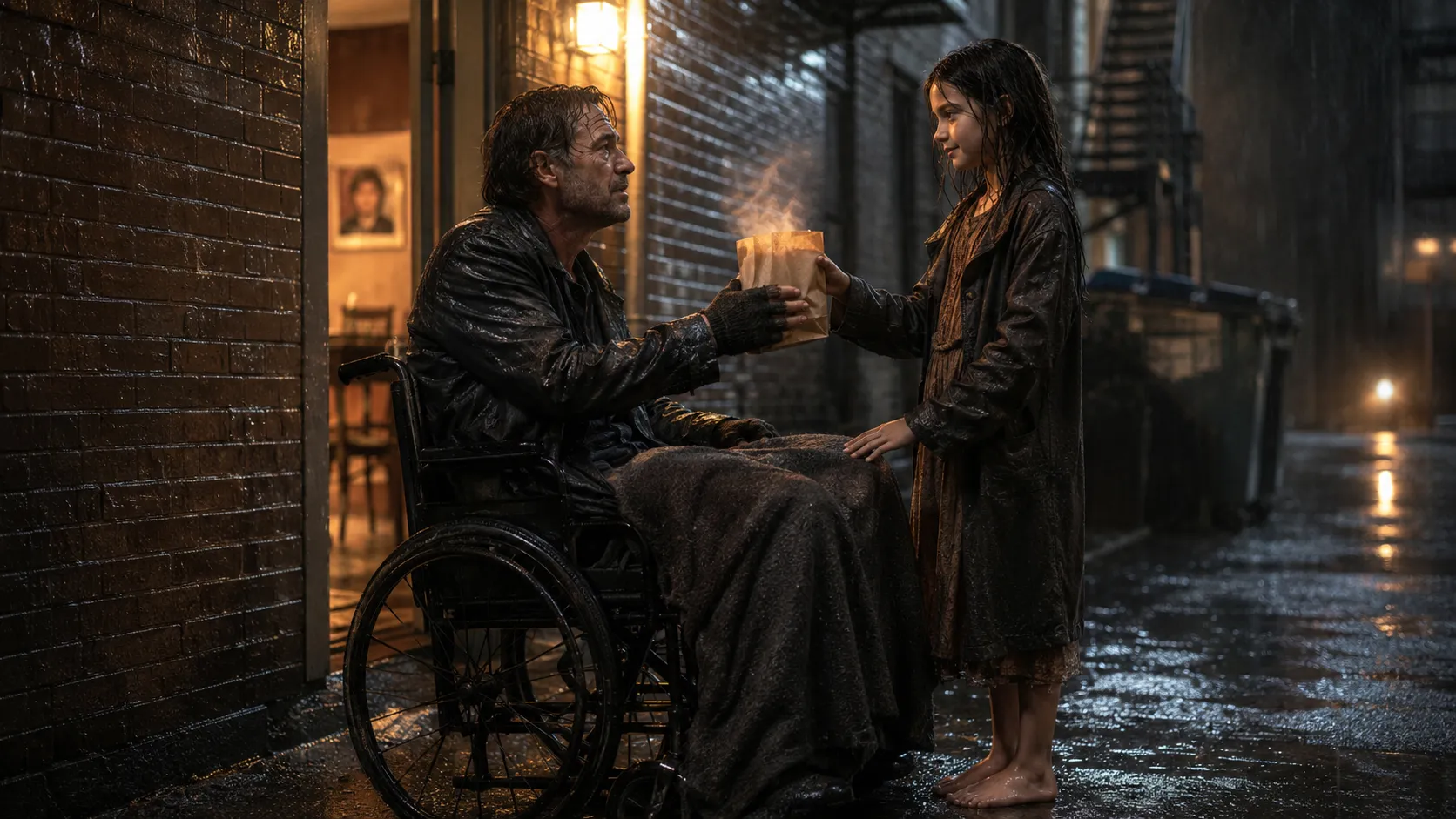
Daniel gave his last meal to a barefoot thirteen-year-old girl in the rain. That night, she knocked on his door and told him to stand… but by morning, he learned the girl who healed him should not have existed at all.
The scream came from the alley behind Miller’s Diner just after sunset.
Most people on the South Side of Chicago had learned not to follow screams.
They heard them, of course. Everyone did. Through apartment walls. Behind grocery stores. Under train tracks. Near bus stops after dark. But trouble had a way of spreading to anyone who stepped too close, and people who were already tired often protected themselves by pretending they had not heard anything.
Daniel Carter heard it.
And for several seconds, he did nothing.
He sat in his wheelchair beside the diner’s back entrance with a paper cup of cold coffee in his hand and rain dripping from the metal fire escape above him. His coat was too thin for November. His left glove had a hole in the thumb. A paper bag hung from the back handle of his chair containing one wrapped cheeseburger, the last thing he had bought with the last six dollars in his wallet.
He was thirty-five years old and felt eighty.
Six years earlier, Daniel had been a construction supervisor with strong shoulders, quick hands, and a fiancée who used to say he walked like every street owed him space.
Her name was Claire.
After the accident, nobody said things like that anymore.
Now people moved around him with polite sadness. They opened doors too quickly. They spoke too loudly. They pretended not to see the unpaid bills folded in his pocket or the way he sometimes stared at stairs as if they were enemies.
The scream came again.
“Please… stop.”
A girl’s voice.
Daniel’s hand tightened around the coffee cup.
He told himself someone else would help.
Someone younger.
Someone stronger.
Someone who could run.
Then came laughter.
Boys laughing.
That was what made him move.
Daniel set the coffee on the wet ground, gripped the rims of his chair, and rolled toward the mouth of the alley.
Three teenagers stood near a dumpster beneath a broken security light. They had cornered a girl against the brick wall. She was thin, barefoot, and no older than thirteen. Her brown dress was torn at the hem. Her hair hung in dark, tangled waves around a face too pale for the cold.
One of the boys held a small piece of bread above her head.
The girl did not jump for it.
She simply watched him.
Not angrily.
Not fearfully.
Patiently.
That bothered Daniel before he knew why.
“Give it back,” she said quietly.
The boy grinned.
“This?”
The others laughed.
Daniel rolled forward until the front wheels of his chair struck a shallow puddle.
“Leave her alone.”
The boys turned.
For a second, they looked startled.
Then the tallest one smiled when he saw the wheelchair.
“Oh yeah?” he said. “Or what?”
Daniel felt the old humiliation rise inside him. The kind that arrived whenever men who would have feared him years ago now saw the chair before they saw him.
But the girl was watching.
So he kept his voice steady.
“Or I call the police and tell them three cowards are stealing food from a child.”
The shortest boy scoffed.
“You gonna chase us if we don’t?”
The words hit exactly where they were meant to.
Daniel looked at him for a long moment.
“No,” he said. “But I’ll remember your faces. And boys who steal from hungry girls usually grow into men everyone regrets knowing.”
Something shifted in the alley.
Not fear.
Shame.
The boys tried to laugh it off, but the sound had lost its teeth. The tallest one tossed the bread into a puddle near the girl’s feet.
“Crazy old cripple,” he muttered.
They walked away, still pretending to be amused.
Daniel waited until their footsteps faded.
Then he turned toward the girl.
“You shouldn’t eat that,” he said.
She bent, picked up the soaked bread, and held it carefully in both hands.
“Food is food.”
“That food is dirty.”
She looked at him then.
Her eyes were dark, calm, and strangely old. Daniel had seen children who had been forced to grow up too fast. He had seen fear, hunger, suspicion, anger.
This was different.
This child looked as if she had been waiting for him specifically.
“Are you hungry too?” she asked.
The question caught him off guard.
He almost laughed, but the sound would not come.
“Not as hungry as you.”
“That is not what I asked.”
Daniel studied her.
Rainwater slid down the side of his face. His legs sat beneath the blanket across his lap, useless and thin beneath the worn fabric. He could not remember the last time someone had looked at him and asked about his hunger like it mattered.
He reached behind his chair and removed the paper bag.
The cheeseburger inside was still warm.
Barely.
He held it for a second, feeling the weight of his own need.
Then he gave it to her.
“Here.”
The girl stared at the bag.
“All of it?”
“All of it.”
“But it was yours.”
“Now it’s yours.”
She accepted it with both hands, almost reverently.
“Thank you.”
Daniel shrugged.
“Just eat it before those idiots come back.”
She unwrapped the burger but did not bite immediately.
Instead, she stepped closer.
“If you give me food,” she said softly, “I can make your legs work again.”
The rain seemed to go silent.
Daniel blinked.
“What?”
“I can help you walk.”
A bitter smile moved across his face before he could stop it.
“Kid, doctors with machines worth more than this whole neighborhood couldn’t fix me.”
“That is because they only looked at your body.”
Daniel stared at her.
“What else were they supposed to look at?”
The girl’s eyes lowered to the blanket over his knees.
“The place where you stopped forgiving yourself.”
His smile vanished.
“Don’t talk like that.”
“You still dream about the car.”
Daniel’s hands froze on the wheels.
The girl continued quietly.
“You dream about the rain. The bridge. The woman beside you screaming your name.”
His throat went dry.
Nobody knew that.
Not the therapists. Not his brother. Not the doctors who asked about pain levels, medication, and spinal response. Nobody knew that in his dreams, Claire was always alive for a few seconds before the impact. Always turning toward him. Always reaching across the seat.
Daniel’s voice came out rough.
“Who are you?”
The girl took one more step forward.
“My name is Anna.”
Then she placed her small hand on his knee.
Pain shot through him like lightning.
Daniel screamed.
The wheelchair jerked backward as his hands seized around the rims. His legs, dead and silent for six years, burned with a sudden terrible heat that tore through muscle, bone, scar tissue, and memory all at once.
“What did you do?” he gasped.
The pain stopped.
Instantly.
Daniel sat trembling in the rain, breathing so hard he felt sick.
Then he looked down.
His right foot had moved.
Not much.
Only a small twitch beneath the blanket.
But he had felt it.
His foot.
His real foot.
Warmth spread across his toes, faint and impossible.
Daniel’s eyes filled with terror.
Then hope.
Hope was worse.
Hope was dangerous.
Hope had nearly destroyed him in the first two years after the accident, when every new specialist, every new procedure, every new therapy program promised just enough to make losing it again unbearable.
Anna stepped back.
“I’ll come tonight,” she said.
“Wait.”
She turned.
Daniel gripped the wheel rims, suddenly afraid she would disappear into the rain and take the impossible with her.
“How did you know about Claire?”
The girl’s face softened.
“She still says your name kindly.”
Daniel could not speak.
Anna lifted the cheeseburger bag slightly.
“Thank you for dinner.”
Then she walked away down the alley.
Daniel watched her bare feet move through the puddles.
And only when she reached the streetlight did he notice something that made the blood leave his face.
The rain was falling hard.
The alley was full of water.
But beneath Anna’s feet, the puddles did not ripple.
By midnight, Daniel had convinced himself he was losing his mind.
He had returned to his apartment three blocks from the diner, a small second-floor unit in a building with cracked plaster and an elevator that worked only when it felt charitable. He had taken off his wet coat, warmed a can of soup, and sat in the dark staring at his legs.
The warmth was still there.
Faint.
Deep.
Real.
Twice he tried to move his toes again.
Nothing happened.
Then, just when he decided exhaustion had tricked him, his left foot twitched beneath the blanket.
Daniel covered his mouth.
He did not sleep.
The apartment smelled of dust, old radiators, and instant coffee. Rain tapped against the window. A single lamp flickered near the couch. On the wall above the table hung the last photograph he had kept of Claire.
She was standing on a lakeside trail in a yellow sweater, laughing at something outside the frame.
Daniel had almost thrown the photo away a dozen times.
He never could.
At 12:17 a.m., three soft knocks came at the door.
Daniel stared.
The building door downstairs was locked.
No one visited him after dark.
Another knock came.
Soft.
Patient.
He rolled forward and opened the door.
Anna stood in the hallway.
Barefoot.
Dry.
The storm behind the stairwell window still raged, yet not one drop of water clung to her hair or dress.
Daniel’s voice barely worked.
“How did you find me?”
“You wanted to walk.”
“That’s not an answer.”
“It is the only one you need.”
She stepped inside without asking.
Daniel should have stopped her. He knew that. A strange child appearing in the middle of the night should have frightened him more than it did.
But the apartment felt different with her inside.
Not safer exactly.
More honest.
Anna looked around the room.
Her eyes rested on Claire’s photograph.
“She was kind,” she said.
Daniel’s jaw tightened.
“You don’t know anything about her.”
“She told you to slow down that night.”
He turned cold.
Anna looked at him.
“You were angry. Not at her. At yourself. But she was the person beside you, so you gave the anger to her.”
“Stop.”
“She reached for the wheel when the truck crossed the line.”
Daniel’s hands began to shake.
The accident had happened on a rainy highway outside Joliet. A delivery truck lost control and crossed into their lane. Police reports said Daniel had tried to swerve. Doctors said the impact crushed his spine. Claire died before the ambulance arrived.
But there was one thing Daniel had never told anyone.
They had been arguing.
Not about anything important.
Money. Work hours. His pride. Her worry that he was becoming too hard, too quick to dismiss people who needed him.
Daniel had shouted.
Claire had cried.
Then the headlights came.
And for six years, Daniel had carried the belief that if his last words to her had been kinder, maybe the world would have been kinder too.
Anna knelt in front of his chair.
“You did not kill her.”
Daniel looked away.
“You don’t get to say that.”
“She does.”
His eyes snapped back to her.
Anna held out both hands.
“Stand up.”
Daniel let out a broken laugh.
“I can’t.”
“You can.”
“No, Anna. I can’t. My spine was damaged. My muscles are weak. My legs haven’t held weight in six years.”
“Then let them remember.”
Daniel shook his head.
“This is cruel.”
“No,” she said. “Cruel is when someone is given back a life and refuses to use it.”
The words struck deeper than he expected.
Anna took his hands.
The pain came again.
This time it did not arrive as lightning.
It arrived as fire.
Daniel cried out as heat surged down his thighs, into his knees, through his calves, into feet that had been strangers for half a decade. His toes curled. His muscles tightened violently. The chair rattled beneath him.
“I can’t,” he sobbed.
Anna’s small hands gripped his.
“Stand.”
“I can’t.”
“Daniel.”
Her voice changed.
It filled the room.
Not loudly, but completely, as if the walls themselves had decided to listen.
“Stand.”
Daniel pushed against the armrests.
His shoulders rose.
His hips lifted.
His legs trembled so violently he thought they would snap beneath him.
For one terrible second, he hovered between the life he knew and the one he had stopped believing in.
Then his feet touched the floor.
Held.
And Daniel Carter stood.
He made a sound that did not feel human.
Half sob.
Half prayer.
Tears blurred the room. His knees shook. His hands reached blindly for balance, but Anna did not let go.
“I’m standing,” he whispered.
“Yes.”
“I’m standing.”
He took one step.
Then another.
On the third, his strength gave out and he collapsed to the floor.
Not into despair.
Into grief.
Years of buried pain tore loose all at once. Daniel lay on the worn carpet clutching his own legs, weeping like a child. He wept for the accident. For Claire. For the man he had been before bitterness made him small. For every morning he had woken angry that he had survived.
Anna stood beside him silently.
When he finally lifted his head, she was walking toward the door.
“Please,” Daniel said. “Don’t leave.”
She paused.
“Who are you really?”
Anna turned back.
For the first time, she looked like the thirteen-year-old girl she appeared to be.
Small.
Hungry.
Tired.
“Someone who was hungry once.”
Then she opened the door and walked out into the storm.
By morning, Daniel could walk across the apartment holding onto the wall.
Not gracefully.
Not safely.
But enough.
Enough to make the first doctor stare.
Enough to make the second doctor call for new scans.
Enough to make a nurse drop a clipboard when Daniel took four trembling steps between parallel bars in the rehabilitation room.
“This is medically impossible,” one specialist said.
Daniel had heard that phrase many times in six years.
Usually it had meant bad news.
Now it meant no one knew what to do with hope when it arrived without paperwork.
Hospital staff whispered. Someone filmed him walking during a therapy session and leaked it online. By evening, local news called him the “South Side Miracle Man.”
Reporters called.
Churches called.
Doctors called.
A morning show producer left twelve messages.
Daniel ignored all of them.
He was looking for Anna.
He returned to Miller’s Diner first.
The owner remembered him, but not her.
“No barefoot girl,” the man said. “We get kids hanging around sometimes, but not one like that.”
Daniel checked the alley.
Nothing.
No footprints.
No dropped wrapper.
No sign she had ever been there.
He searched shelters. Soup kitchens. Bus stations. Churches. Underpasses. The small encampments near the tracks where people built homes out of tarps and grocery carts.
Some people were kind.
Some were suspicious.
Some asked for money.
Daniel gave what little he had.
By the fourth day, his legs ached constantly. Walking was slow and painful. He still needed the chair for long distances, but he could stand now. He could move. That alone felt like walking through a dream someone might take away if he stopped proving he deserved it.
On the fifth day, an old homeless man near the Red Line station stared at the sketch Daniel had drawn of Anna on the back of a grocery receipt.
The man’s face changed.
“Where’d you see her?”
“Near Miller’s Diner.”
The old man crossed himself.
Daniel leaned closer.
“You know her?”
The man shook his head quickly.
“No. Not like that.”
“What does that mean?”
“You need to ask Father Michaels.”
“Who is that?”
The old man pointed toward a small brick church wedged between a pawn shop and an empty laundromat.
“St. Brigid’s. He knew her when knowing still mattered.”
Daniel found Father Thomas Michaels in the church basement stacking cans of soup onto metal shelves.
The priest was in his late sixties, broad-shouldered, white-haired, with tired eyes and hands that looked more like a mechanic’s than a clergyman’s. He listened quietly while Daniel explained the alley, the cheeseburger, the apartment, the walking.
At first, his face showed polite concern.
Then Daniel showed him the sketch.
The can in Father Michaels’s hand slipped and struck the floor.
For a long moment, the priest only stared.
“Where did you get this?”
“I drew it.”
“When?”
“After I saw her.”
Father Michaels sat down slowly on a folding chair.
“Mr. Carter…”
“Please don’t tell me I imagined her.”
The priest looked up.
“I don’t think you did.”
He stood with difficulty and walked to a locked cabinet near the back wall. From inside, he removed a cardboard box. It was full of old church records, photographs, funeral cards, newspaper clippings, and donation envelopes tied with string.
He searched through the box until he found a plastic sleeve.
Inside was a newspaper clipping.
Daniel saw the photograph first.
Anna.
Same tangled hair.
Same calm eyes.
Same narrow face.
Same torn dress.
The headline read:
HOMELESS GIRL, 13, KILLED SAVING CHILD FROM HIT-AND-RUN
The date was two years earlier.
Daniel sat before his legs could fail him.
“No.”
Father Michaels said nothing.
Daniel took the clipping with trembling hands.
The article said the girl had been known only as Anna. No last name. No family found. She had lived on the streets near the South Side for nearly a year. People remembered her sharing food with younger children, sleeping near churches, and refusing to enter shelters where older boys frightened her.
She died pushing a six-year-old boy out of the path of a speeding car outside a grocery store.
The driver fled.
The boy survived.
Anna died before sunrise.
Daniel read the article three times.
Each time, the words made less sense.
“She came to my apartment,” he whispered.
Father Michaels sat across from him.
“I believe you.”
Daniel looked at him sharply.
“Why?”
The priest opened the box again and removed a small photograph.
It showed Anna standing outside the church, holding a paper plate of food and smiling faintly at someone off camera. Around her neck hung a tiny silver cross.
Daniel’s mouth went dry.
“She wore that.”
Father Michaels nodded.
“She never took it off.”
“Where is it now?”
The priest looked toward the sanctuary above them.
“She was buried with it.”
Daniel closed his eyes.
The apartment. The alley. The burger. The hand on his knee. The warmth in his feet.
“Before she died,” Father Michaels said quietly, “the paramedics said she kept repeating one sentence.”
Daniel opened his eyes.
“What sentence?”
The priest’s voice softened.
“Tell them not to stop helping each other.”
The words landed in Daniel’s chest like a key turning.
He thought of the alley.
Of his last cheeseburger.
Of Anna asking if he was hungry too.
Of a girl who had known hunger and still thought of others first.
Father Michaels leaned forward.
“Maybe she came because you were the first person in a long time who gave her something without asking what she could give back.”
Daniel’s eyes filled.
“I did ask.”
“No,” the priest said. “You didn’t. Not at first.”
Daniel looked down at his hands.
“What am I supposed to do with this?”
Father Michaels looked toward the shelves of canned food.
“That is usually the real miracle, Mr. Carter.”
“What?”
“Not being healed.”
The priest’s eyes held his.
“Deciding what the healing was for.”
Daniel visited Anna’s grave the next morning.
The cemetery sat beyond the city, near a road lined with bare trees. Her grave was small, marked by a simple stone paid for by donations from the church.
ANNA
BELOVED CHILD OF GOD
SHE SHARED WHAT LITTLE SHE HAD
No last name.
No dates of birth.
Nothing that proved she had belonged to anyone.
Daniel stood there for a long time with his cane in one hand and flowers in the other.
He had not brought roses.
Roses felt too formal.
He brought a paper bag from Miller’s Diner containing a cheeseburger wrapped in foil.
It was foolish.
He knew that.
Still, he placed it beside the flowers.
“I don’t know why you chose me,” he said.
Wind moved through the cemetery grass.
Daniel swallowed.
“I was angry for a long time. Angry that Claire died. Angry that I lived. Angry that people looked at me and saw a burden. I thought I had nothing left to give.”
He looked down at the grave.
“But you were hungry. And somehow you still gave everything.”
His voice broke.
“I’m sorry nobody saved you.”
The wind lifted again.
For one second, Daniel thought he heard footsteps behind him.
Bare feet in wet grass.
He turned quickly.
No one was there.
Over the next few weeks, Daniel tried to return to normal life.
But normal had moved.
His apartment felt too small now, not because of the walls, but because of what he knew. Every corner of the city seemed full of people he had once trained himself not to see: men sleeping under cardboard, women pushing carts with all their possessions, teenagers pretending not to be cold, children asking for change with eyes that looked too old.
Before Anna, Daniel had believed suffering was a room he alone had been locked inside.
Now he saw the whole city was full of locked rooms.
He began small.
At first, he bought extra meals from Miller’s Diner and handed them out near the train station. Then he started bringing coffee. Then socks. Then gloves. Father Michaels helped him set up a weekly food table in the church basement.
Daniel was not good at it in the beginning.
He asked the wrong questions.
He made assumptions.
He tried to fix people too quickly.
An older woman named Ruth, who had lived on the street for thirteen years and trusted nobody with soft hands, finally snapped at him one evening.
“You think because you can walk now, you know how to save everybody?”
Daniel stopped.
The old Daniel might have argued.
The wounded Daniel might have left.
The new Daniel only nodded.
“No.”
Ruth squinted at him.
“Then stop looking at us like projects.”
That night, Daniel went home ashamed.
The next morning, he came back and asked Ruth what they actually needed.
She stared at him for almost a full minute.
Then she said, “Laundry.”
So Daniel found a laundromat owner willing to donate two hours every Wednesday morning.
Then someone needed prescription refills.
Then someone needed help replacing an ID.
Then a mother needed bus fare to take her son to a clinic.
Then a veteran named Lewis needed a safe place to sleep after being beaten under the bridge.
Slowly, Anna’s food table became Anna’s Room.
Not a shelter exactly.
Not a charity with photographers and speeches.
A place.
A warm basement under St. Brigid’s where anyone could come in, eat, wash up, charge a phone, sit quietly, or speak to someone who knew how to listen.
Daniel gave interviews only after Father Michaels insisted.
“People need to know,” the priest said.
“I don’t want to become a miracle story.”
“Then don’t talk about yourself.”
So Daniel talked about Anna.
The thirteen-year-old girl with no last name.
The child who died saving another child.
The child who had shared food before anyone shared anything with her.
People responded.
Some sent money.
Some sent clothes.
Some came to volunteer once and never returned.
Some stayed.
A retired nurse named Patricia offered medical checks twice a week. A lawyer helped people with paperwork. A barber gave free haircuts every Saturday. A schoolteacher organized books and quiet tutoring for children whose lives had been interrupted by poverty too many times.
Daniel learned to walk better.
Slowly.
Painfully.
He never became the man he was before the accident. His legs hurt in cold weather. He used a cane on bad days. Sometimes, after too many hours standing at Anna’s Room, he still had to sit down before his body gave out.
But he no longer hated the sitting.
He no longer hated the chair either.
It stayed folded near the wall of his apartment.
Not as a prison.
As a reminder.
Six months after Anna appeared in the alley, Daniel received a letter.
There was no return address.
Inside was a single photograph of a boy standing beside a woman outside a suburban house. The boy had a gap-toothed smile and one hand lifted shyly toward the camera.
A note was folded behind it.
Mr. Carter,
My son Joshua was the little boy Anna pushed out of the road two years ago.
For a long time, I could not speak about her without breaking down. She saved my child and died before I could thank her. I heard what you are doing in her name.
Please tell people she mattered.
Please tell them my son is alive because she was brave.
—Miriam Blake
Daniel sat at his kitchen table for nearly an hour holding the letter.
Then he called the number Miriam had written at the bottom.
They met at St. Brigid’s the following Sunday.
Joshua was eight now. He stayed close to his mother at first, hiding behind her coat while Father Michaels introduced everyone.
Then he saw Anna’s photograph on the wall.
He stepped toward it.
“That’s her,” he said.
Miriam covered her mouth.
Daniel knelt carefully beside him.
“You remember her?”
Joshua nodded.
“She smiled at me.”
Daniel felt his throat close.
“When?”
“Before the car.” Joshua touched the frame gently. “She pushed me hard. I was mad because I fell. Then Mom was screaming.”
Miriam began to cry silently.
Joshua looked at Daniel.
“Is she an angel?”
Daniel did not know how to answer.
Father Michaels, standing nearby, said softly, “Maybe angels are sometimes just people who love harder than the world expects.”
Joshua thought about that.
Then he pulled something from his pocket.
A small silver cross on a broken chain.
Daniel went still.
Father Michaels stepped forward slowly.
Miriam looked confused.
“Joshua found it in his backpack the night after the accident,” she said. “We never knew where it came from.”
Father Michaels’s face had gone pale.
Daniel stared at the cross.
It was Anna’s.
The same one from the photograph.
The one the priest said she had been buried with.
Joshua held it out.
“I think she wants you to have it.”
Daniel could not move.
“I can’t take that.”
The boy looked at him with the simple seriousness of children.
“She helped me live first,” he said. “Then she helped you. Maybe now you help other people.”
Daniel took the cross with both hands.
It was warm.
That night, Daniel dreamed of Claire for the first time without the crash.
They were standing near the lake where he had taken her on their third date. The sky was gold. Her yellow sweater moved softly in the wind.
Daniel wanted to apologize.
He had apologized a thousand times in nightmares.
But in the dream, Claire only smiled.
“You finally listened,” she said.
Daniel woke before sunrise with tears on his face and Anna’s cross on the table beside him.
One year after Anna healed him, the city gave Daniel an award.
He almost refused.
Ruth told him not to be stupid.
“Take it,” she said. “Then ask for money while they’re clapping.”
So he went.
The ceremony was held in a downtown hall with bright lights, polished floors, and officials who used the word community many times. Daniel wore a dark suit that felt too formal and held his cane in his left hand. Father Michaels sat in the front row beside Miriam and Joshua. Ruth sat beside them wearing a purple hat and an expression daring anyone to comment on it.
When Daniel reached the microphone, the applause lasted longer than he wanted.
He waited it out.
Then he looked at the room full of donors, politicians, journalists, and people who had probably never followed a scream into an alley in their lives.
“I’m not here because I became special,” he said. “I’m here because a hungry child asked me if I was hungry too.”
The room quieted.
Daniel took Anna’s cross from his pocket and held it carefully.
“Her name was Anna. She was thirteen years old. She had no home, no family anyone could find, and no last name on her grave. She died saving a little boy from a car. Before that, she fed other hungry people with whatever she had. After that…”
He stopped.
How could he explain the alley?
The apartment?
The impossible heat in his legs?
The barefoot footsteps that did not disturb the rain?
He looked toward Father Michaels.
The priest nodded once.
Daniel turned back to the microphone.
“After that, she still changed my life.”
No one moved.
“For a long time, I thought my suffering made me empty. Anna taught me something different. Pain does not make us empty. It makes us responsible for recognizing pain in others.”
Ruth wiped her eyes angrily with the heel of her hand.
Daniel continued.
“So tonight, I’m not asking you to admire a miracle. I’m asking you to fund meals, laundry, IDs, medical care, safe beds, and people who know how to listen. I’m asking you not to stop helping each other.”
Father Michaels lowered his head.
The room remained silent for one deep second.
Then the applause came.
This time, Daniel did not mind it.
Because Ruth was right.
While they clapped, people opened checkbooks.
Anna’s Room became Anna House.
A year later, it moved from the church basement into a renovated building with showers, counseling rooms, a kitchen, a laundry area, and emergency beds for children and women who had nowhere safe to sleep. The front door stayed open twelve hours a day. Volunteers rotated through shifts. Doctors came twice a week. A small garden was planted behind the building because Ruth said people who only see concrete forget they are alive.
On the wall near the entrance hung a photograph of Anna.
Beneath it were the words:
TELL THEM NOT TO STOP HELPING EACH OTHER.
Nobody knew who first began leaving cheeseburgers near her grave.
Maybe Daniel.
Maybe Joshua.
Maybe strangers who had heard the story.
But every few weeks, someone found one there, wrapped neatly in paper, usually beside fresh flowers.
Daniel visited often.
Sometimes to pray.
Sometimes to think.
Sometimes simply because gratitude needs somewhere to go.
On the second anniversary of the night in the alley, he arrived near dusk.
Snow fell lightly over the cemetery. His cane sank into the thin white layer covering the path. Anna’s grave stood beneath a bare tree, small and quiet.
Someone had already been there.
A paper bag from Miller’s Diner rested beside the stone.
Daniel smiled faintly.
“Looks like you already ate.”
The wind moved softly through the branches.
He stood there for a while, then placed Anna’s cross gently against the top of the grave marker.
“I tried to give it back,” he said.
The cemetery remained still.
Daniel looked down at the name on the stone.
ANNA.
Only Anna.
He had searched records for months. Police reports. Shelter documents. Missing child databases. Hospital notes. Nothing had given her a last name.
At first, that had hurt him.
Now he understood something else.
Maybe the city had failed to name her fully.
But it would not fail to remember her.
“You have a house now,” he said. “A real one. With heat. And food. And children laughing sometimes. You would like Ruth. She pretends to be mean, but she cries during cartoons.”
He breathed out a small laugh.
Then his voice softened.
“I still don’t know why you came to me.”
The snow continued falling.
A sound came from behind him.
Soft footsteps.
Daniel turned.
Near the cemetery gate stood a small figure in a brown dress.
Bare feet on the snow.
Dark hair moving gently in a wind that did not touch the trees.
Anna.
She looked the same as she had that night.
Thin.
Calm.
Not quite sad.
Not quite smiling.
Daniel could not breathe.
For a moment, neither moved.
Then Anna lifted one hand.
Not goodbye.
Not hello.
Something in between.
Daniel’s eyes filled.
“Did I do enough?” he whispered.
Anna’s voice came across the snow so softly he might have imagined it.
“Keep going.”
Then she turned and walked toward the gate.
The snow beneath her feet remained untouched.
Daniel took one step forward.
Then stopped.
This time, he did not call after her.
He understood now.
Some gifts are not meant to be held.
Only carried forward.
Anna disappeared beyond the cemetery gate as the evening bells of St. Brigid’s began to ring in the distance.
Daniel stood by her grave until the last sound faded.
Then he picked up his cane and walked back toward the road.
Slowly.
Painfully.
Gratefully.
And somewhere behind him, under the falling snow, the small stone with one name seemed less lonely than before.
Because Anna had not been forgotten.
And because the man she healed had finally understood what walking was for.