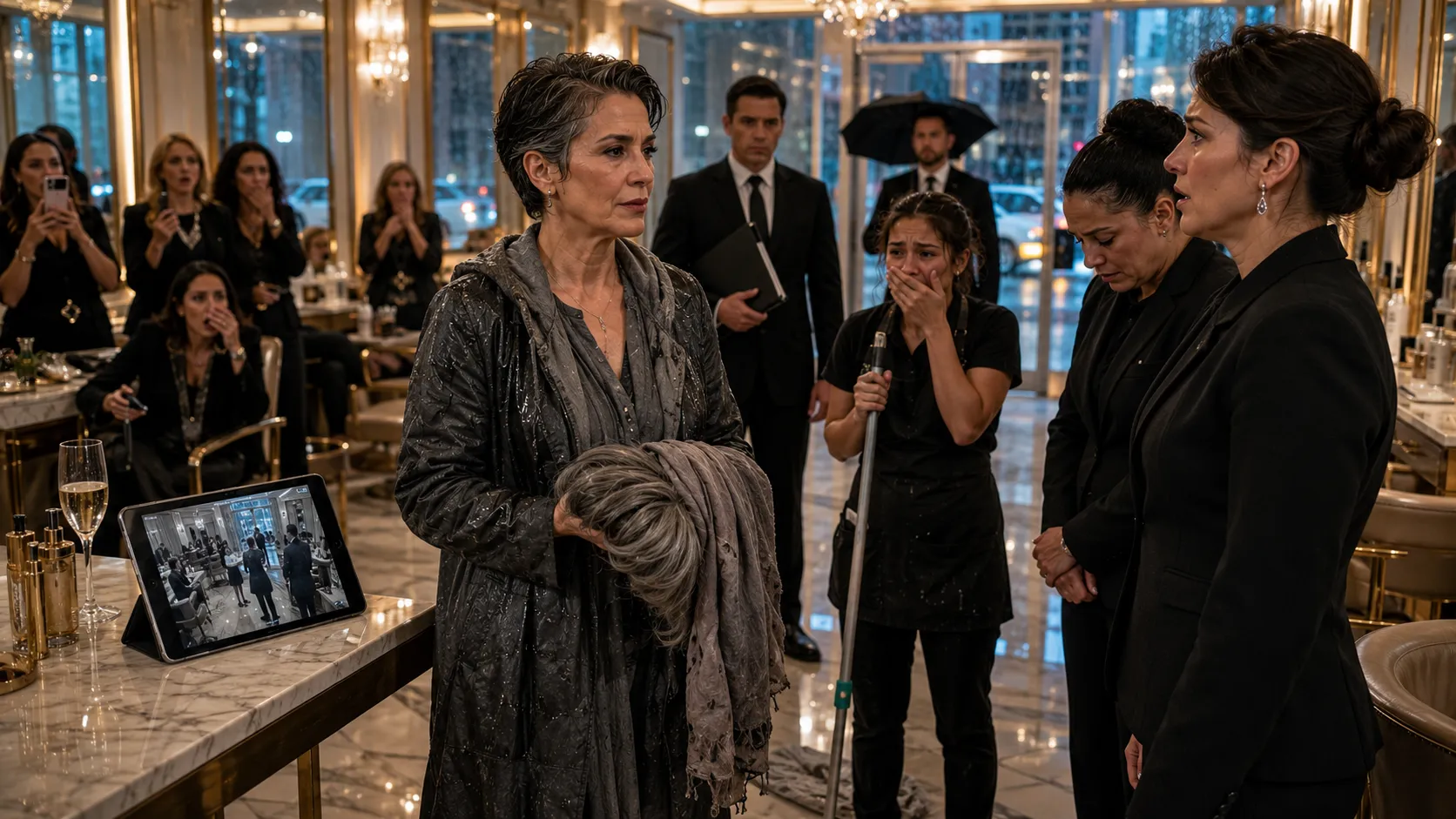
The salon manager thought the soaked woman in broken shoes had walked in to beg. But when the woman returned with men in black suits, removed her dirty scarf and wig, everyone realized they had just humiliated the billionaire who owned the building.
The woman outside the salon looked invisible.
That was exactly how she wanted it.
Rainwater dripped from the edge of her torn gray hood as she stood across the street from Maison Aurelia, the most exclusive beauty salon in downtown Chicago. Through the giant glass windows, she could see golden lights, marble counters, velvet chairs, champagne flutes, polished mirrors, and women laughing under perfect hair.
Everything inside looked warm.
Expensive.
Untouchable.
Outside, the woman’s shoes were split at the soles. Her coat was stained near one sleeve. A dirty scarf covered most of her hair. Her hands trembled slightly, not from weakness, but from the cold rain running down her wrists.
Cars rolled past behind her.
Nobody looked twice.
That was the strange thing about poverty. It did not only make a person suffer. It trained the world to look around them.
The woman lifted her eyes toward the small black security camera above the salon entrance.
Somewhere six blocks away, in a private office on the forty-second floor of Hale Tower, two men watched the live feed.
One was Daniel Price, chief counsel for Hale Luxury Group.
The other was Adrian Cole, head of corporate security.
Daniel stood with his arms folded, jaw tight.
“I still think this is a mistake,” he said.
Adrian did not look away from the monitor.
“She insisted.”
“She’s the owner of a billion-dollar company. That doesn’t make every idea wise.”
On the screen, the woman in the torn coat adjusted her scarf and stepped toward the crosswalk.
Adrian exhaled quietly.
“No. But it does make her hard to stop.”
Daniel turned toward a third monitor showing multiple camera angles from inside Maison Aurelia: reception desk, styling chairs, waiting lounge, product wall, corridor near the staff room, and the glass entrance.
“Are the cameras recording?”
“Every angle.”
“The livestream?”
“Private for now.”
Daniel looked at him sharply.
“For now?”
Adrian’s expression remained flat.
“She gave instructions.”
Daniel muttered something under his breath.
On the street below, the woman crossed carefully through the rain.
Inside Maison Aurelia, soft French music played through hidden speakers. The air smelled of perfume, hairspray, expensive shampoo, and money. A blonde influencer in a pink silk blouse filmed herself in the mirror while a stylist curled her hair. Two clients drank champagne near the waiting area. A woman with diamond bracelets complained that the salon’s rose water tasted “too ordinary.”
Behind the front desk stood Olivia Grant, the salon manager.
Thirty-eight years old.
Sharp makeup.
Sharper voice.
A smile that appeared whenever wealthy clients looked at her and vanished whenever staff did.
Olivia had worked for fifteen years to reach this position. Maison Aurelia was not just a salon. It was a social gate. Politicians’ wives came there. Influencers came there. Real estate wives, charity board members, luxury brand consultants, and women who did not ask prices came there.
And Olivia protected the atmosphere with religious devotion.
No noise.
No disorder.
No cheapness.
No visible suffering.
That was why the moment the front door opened and the tiny bell rang, her entire body tightened.
The woman in the torn coat stepped inside.
Rainwater dripped from her hem onto the pale marble floor.
Every conversation stopped.
A client in the first chair slowly lowered her champagne glass.
The blonde influencer turned her phone slightly, then whispered, “Oh my God.”
The woman stood just inside the door, blinking under the bright salon lights as if she had entered another world.
Her voice was soft.
“I’m sorry. I need a little help.”
Nobody moved.
A stylist near the shampoo bowls covered her nose.
Another employee muttered, “Why do these people always come in here?”
Olivia came around the desk, heels clicking against marble.
“Ma’am,” she said coldly, “you can’t be here.”
The woman lowered her eyes.
“I know this isn’t the right place. I only need to use a phone. Please.”
Olivia’s smile was thin enough to cut.
“There’s a public library four blocks east.”
“It’s closed.”
“Then try the police station.”
The woman looked toward the clients.
A few smirked.
The blonde influencer continued recording, pretending she was filming her own hair but clearly angling the camera toward the stranger.
“I’m not dangerous,” the woman said.
Olivia’s nostrils flared slightly.
“I didn’t say you were.”
“No. You only looked at me that way.”
That made the room still.
For one second, Olivia seemed less certain.
Then one of the clients gave a small laugh, and the laugh restored her cruelty.
“Listen carefully,” Olivia said. “This is a private luxury establishment. Our clients come here for comfort, safety, and a certain standard.”
The woman looked at the chandeliers.
Then the champagne.
Then the rows of products priced higher than most grocery bills.
“A standard,” she repeated.
“Yes.”
“What standard requires turning away a woman in the rain?”
Olivia’s face hardened.
“The standard that keeps this place from becoming a shelter.”
A few clients laughed.
Not loudly.
Just enough.
The woman stood very still.
Across the salon, a young assistant named Mia Reyes stopped folding towels.
She was twenty-three, new, and still gentle in ways the salon had not yet trained out of her. She watched the woman’s wet sleeves, the trembling hands, the small cut near one knuckle.
Mia took one step forward.
Olivia saw it immediately.
“Mia,” she snapped.
The girl froze.
“Back to work.”
Mia lowered her eyes.
The woman noticed.
For a brief moment, their eyes met.
Mia looked ashamed before she even understood why.
The security guard approached from the hallway near the product room.
Her name was Tessa.
Tall, muscular, impatient, wearing a black blazer and an earpiece she used more as decoration than necessity. Tessa liked the authority of removing people. She liked the way rich clients looked relieved when she stepped in.
“You heard the manager,” Tessa said.
The woman turned to her.
“I’m leaving.”
“Good.”
Tessa grabbed her arm anyway.
The woman looked down at the hand gripping her sleeve.
“You don’t need to touch me.”
“Then move.”
“I said I was leaving.”
“Not fast enough.”
Tessa shoved her toward the door.
The woman stumbled. Her shoulder struck the glass wall beside the entrance with a dull, painful sound. A few clients gasped. One laughed.
Mia’s hands flew to her mouth.
“Tessa, stop,” she whispered.
But nobody heard her.
Or nobody wanted to.
The woman tried to regain her balance, but the marble floor was slick under her wet shoes. Tessa pushed again, harder this time, and the woman fell through the open doorway onto the sidewalk.
Her knees hit first.
Then her palms.
Rain struck her face.
Inside the salon, someone said, “Disgusting.”
Another voice said, “Somebody sanitize the entrance.”
The bell above the door rang again as Tessa stepped back inside and shut the door.
Olivia turned to the nearest employee.
“Mia. Mop that immediately.”
Mia did not move.
Olivia’s eyes narrowed.
“Now.”
Mia picked up the mop with shaking hands.
Outside, the woman remained on the pavement.
Motionless.
For several seconds, rain gathered in the folds of her coat.
Then slowly, she lifted her head.
And smiled.
Not because she was amused.
Not because she was unhurt.
Because the answer had arrived exactly as she expected, and somehow that made it hurt more.
Across the street, a black SUV pulled to the curb.
Then another.
Then a third.
Inside Maison Aurelia, the blonde influencer noticed first.
“Uh…” she said, lowering her phone. “Guys?”
Everyone turned toward the windows.
Three men in dark suits stepped out into the rain.
They did not hurry.
They did not look confused.
One opened a large black umbrella and walked directly to the woman on the sidewalk. He did not speak down to her. He did not grab her. He lowered his head slightly, offering his hand with formal respect.
The salon went silent.
Olivia’s face changed.
Tessa took one step back from the door.
The woman accepted the man’s hand and rose slowly.
Her posture changed before her appearance did.
A minute earlier, she had looked like someone asking permission to exist.
Now she looked like someone deciding who would be allowed to remain.
The suited men escorted her back across the sidewalk.
The bell above the salon door rang again.
This time, nobody laughed.
The woman stepped inside with the umbrella held over her shoulder by Adrian Cole himself.
Daniel Price followed behind them carrying a slim leather folder.
Olivia forced a smile.
“Look,” she began, “if this is about what happened, we can explain—”
“Lock the door,” the woman said calmly.
Adrian turned the lock.
A client stood.
“Excuse me. You can’t lock us in.”
Daniel Price faced her.
“No one is being detained. If you want to leave, Mr. Cole will open the door for you. But I recommend staying if your name, face, or voice appeared in the recording.”
The client sank slowly back into her chair.
Olivia whispered, “Recording?”
The woman reached for the dirty scarf around her head.
She untied it.
Then she removed the gray wig beneath it.
Gasps spread through the room.
The woman who stood before them now had short silver-black hair, sharp dark eyes, perfect posture, and the kind of stillness that belonged to people who had spent decades walking into rooms where everyone wanted something from them.
Olivia’s face went white.
“No,” she whispered.
Tessa looked as if she might be sick.
The blonde influencer’s phone slipped from her hand and landed on her lap.
Everyone in Chicago knew that face.
Victoria Hale.
Founder and majority owner of Hale Luxury Group.
Billionaire investor.
Owner of hotels, spas, salons, private clubs, skincare companies, and half the building Maison Aurelia leased.
The same Victoria Hale whose company had been quietly considering Maison Aurelia for a national luxury partnership.
The same woman Olivia had spent months trying to impress.
Victoria looked directly at her.
“Yes,” she said. “Me.”
Nobody spoke.
Daniel Price placed a tablet on the front desk and tapped the screen.
The salon’s own security footage appeared.
Every angle.
Every word.
Every laugh.
The woman entering.
The stylist covering her nose.
Olivia saying, “This isn’t a shelter.”
Tessa grabbing her arm.
The shove.
The fall.
The customer saying, “Disgusting.”
Olivia saying, “Sanitize the entrance.”
The sound echoed through the salon speakers.
No one looked beautiful anymore.
The mirrors, which had been designed to flatter, now seemed merciless.
Olivia’s mouth opened.
No sound came out.
Victoria folded her hands behind her back.
“I visit businesses like this every year,” she said. “Not as a billionaire. Not as an owner. Not as someone whose name opens doors. I enter as someone with nothing to offer except need.”
She walked slowly through the salon.
Past the velvet chairs.
Past the product wall.
Past frozen employees and pale clients.
“I do it because polished companies lie very well. Reports lie. Managers lie. Customer satisfaction scores lie. But people rarely lie when they believe the person in front of them has no power.”
She stopped beside Mia.
The young assistant was still holding the mop.
Her eyes were full of tears.
Victoria looked at her, then continued walking.
“Today, Maison Aurelia answered clearly.”
Olivia found her voice.
“Ms. Hale, please. We didn’t know who you were.”
Victoria turned.
“That is exactly the problem.”
The sentence landed like a hammer.
Olivia swallowed.
“We thought—”
“You thought I was homeless.”
Olivia looked down.
“Yes.”
“And that made humiliation acceptable?”
“No. I mean, of course not. But we have safety concerns. Clients expect—”
“Clients expect basic humanity to be suspended at the door?”
The salon went silent again.
Victoria looked toward Tessa.
“You put your hands on me after I told you I was leaving.”
Tessa’s voice shook.
“I was doing my job.”
Victoria’s eyes hardened.
“No. You were enjoying it.”
Tessa looked away.
Daniel Price tapped the tablet again.
Numbers appeared.
Live viewers.
Comments.
Shares.
The count was climbing so quickly that the screen seemed alive.
Olivia gripped the edge of the desk.
“What is that?”
“The livestream,” Daniel said.
The blonde influencer gasped.
“You streamed this?”
Victoria did not look at her.
“My company did.”
Olivia’s knees nearly gave out.
“No. Please. Please, Ms. Hale, you can’t put that online.”
Victoria’s face remained calm.
“You put your character on display before I touched a camera.”
The livestream had been private until the moment Tessa shoved her.
That had been Victoria’s line.
She had told Daniel the rules before leaving Hale Tower: if they turn me away, keep recording; if they insult me, keep recording; if they touch me, stream it.
Daniel had argued.
Victoria had not changed her mind.
Because she knew something he did not fully understand.
Cruelty hidden in luxury survives by being treated as a misunderstanding.
Cruelty shown clearly becomes harder to excuse.
The comments flooded.
I know that salon.
That manager did my wedding hair.
The guard shoved her like trash.
Who was the young assistant? She looked horrified.
They only care because she’s rich.
That last comment caught Victoria’s eye.
She stared at it for a moment.
Then looked up.
“Someone online just wrote: They only care because she’s rich.”
No one moved.
Victoria nodded slowly.
“They’re right.”
The words surprised the room.
“Every one of you is afraid because I turned out to be wealthy. Because I own leases, contracts, reputations, and lawyers. But when you believed I had nothing, you laughed.”
Her voice lowered.
“That is the ugliest thing about this room.”
A client began crying quietly.
Olivia stepped forward.
“I’m sorry.”
Victoria looked at her.
“Are you sorry for what you did, or for who you did it to?”
Olivia’s face crumpled.
“I…”
She had no answer.
Victoria turned toward the mirrors.
For a moment, her own reflection looked back at her: expensive blouse beneath the torn coat, rain on her face, the disguise half-removed, the woman she was and the woman the world had just rejected sharing the same body.
She had not always been rich.
That was the part newspapers liked to mention but never understood.
Victoria Hale had grown up in a one-bedroom apartment above a laundromat on the South Side. Her mother, Grace, cleaned hotel rooms and did hair in the kitchen for women who could not afford salons. She could turn a tired woman into someone who stood straighter before walking back into a difficult life.
“Beauty is not vanity,” Grace used to say while pressing curls with an old iron comb. “Sometimes beauty is the first place a woman remembers she is still human.”
When Victoria was sixteen, Grace lost the hotel job after injuring her back.
Then the apartment.
Then, for several months, dignity became something they carried in grocery bags between shelters.
One winter afternoon, Grace walked into a salon and asked if they needed help sweeping floors.
Victoria waited outside in the cold.
Through the window, she watched a manager look her mother up and down, laugh, and point to the door.
Grace came out smiling, because mothers often smile when they do not want daughters to see the wound.
But Victoria saw.
Two years later, Grace died of pneumonia after refusing to go to the emergency room until breathing became impossible.
Victoria never forgot the salon window.
The bright lights.
The women laughing.
Her mother smiling through shame.
When Victoria built Hale Luxury Group, she told herself beauty businesses under her name would never become places where suffering was treated like dirt on the floor.
Apparently, she had been wrong.
She faced the salon again.
“As of this moment, Maison Aurelia is closed pending investigation.”
Olivia gasped.
“No. Please.”
Daniel opened the leather folder.
“Your lease includes ethics and conduct provisions. Your partnership proposal is terminated. Staff will be individually reviewed. Any employee found to have participated in abuse or discrimination will not be transferred within Hale Luxury Group.”
Tessa whispered, “I’m fired?”
Victoria looked at her.
“You’re lucky if that is the worst consequence. I fell on a public sidewalk because you used force against a nonviolent woman. Legal will handle the rest.”
Tessa sat down heavily in the nearest chair.
A stylist began sobbing.
The blonde influencer picked up her phone with shaking hands, then froze when she realized millions of people were already watching her face.
Victoria turned toward the clients.
“You came here to purchase beauty. Some of you joined the cruelty. Some of you watched. A few of you looked uncomfortable. None of you stood up.”
The older woman with diamond bracelets whispered, “I didn’t know what to do.”
Victoria’s gaze softened by only a fraction.
“That is what people say when doing nothing has become a habit.”
The woman lowered her eyes.
Then Victoria turned to Mia.
The young assistant stiffened.
“You,” Victoria said.
Mia looked terrified.
“Yes, ma’am?”
“You didn’t laugh.”
Mia’s tears spilled over.
“I didn’t help either.”
The room shifted.
That answer mattered.
Victoria studied her.
“Why not?”
Mia wiped her face with the back of her hand.
“I was scared.”
“Of me?”
Mia shook her head.
“Of losing my job.”
Olivia closed her eyes.
Mia continued, voice trembling. “My mom’s rent comes from my paycheck. My little brother’s medication comes from my paycheck. I wanted to tell them to stop, but I froze. I’m sorry.”
Victoria was quiet for a long time.
Then she asked, “Would you like to learn how not to freeze next time?”
Mia looked up.
“Yes.”
Victoria took a business card from Daniel’s folder and handed it to her.
“When this place closes, call my office.”
Mia stared at the card.
“Why?”
“Because guilt is useless if it does not become courage.”
Mia held the card like it might disappear.
Olivia’s voice cracked.
“What about me?”
Victoria turned back to her.
For the first time, Olivia did not look like a manager.
She looked like a woman realizing that every compromise she had made to climb had finally turned into a mirror.
“Please,” Olivia said. “I have worked my whole life for this.”
Victoria’s expression did not change.
“So did the woman you threw into the rain.”
Olivia flinched.
The words ended the conversation.
Victoria walked toward the door.
Before leaving, she stopped one last time and looked back at the room.
“You thought power looked expensive,” she said quietly. “Sometimes power walks in wearing broken shoes.”
Then she stepped outside into the rain.
The black SUV doors opened.
And just like that, she was gone.
Inside Maison Aurelia, no one moved.
Phones buzzed nonstop.
Notifications.
Messages.
News alerts.
Screenshots.
Comments.
Millions of people were watching.
And every person inside understood the same thing.
The salon had not been destroyed by a disguise.
It had been exposed by one.
By morning, the video had reached forty million views.
By noon, every news channel in the country had replayed at least part of it.
The headlines were predictable.
BILLIONAIRE DISGUISES HERSELF AS HOMELESS WOMAN, SHUTS DOWN SALON AFTER ABUSE.
LUXURY BEAUTY CHAIN FACES BACKLASH AFTER SHOCKING LIVESTREAM.
“WE DIDN’T KNOW WHO YOU WERE” — THE SENTENCE THAT ENDED A SALON.
People argued immediately.
Some praised Victoria.
Some called it a stunt.
Some said she was cruel for streaming employees online.
Some said the staff deserved worse.
Some said rich people should not test poor workers.
Some said poor workers should not need a billionaire’s disguise to prove discrimination exists.
Victoria read everything.
Not because she enjoyed it.
Because public anger, like beauty, could become shallow when admired too long in mirrors.
Daniel found her the next morning in her office, still wearing the bandage over her cut palm.
“You should rest,” he said.
“I’m fine.”
“You’re not.”
She looked at him.
He did not look away.
Daniel had worked for her for fourteen years. He was one of the few people who still told her the truth when truth was inconvenient.
“Say it,” she said.
He closed the door behind him.
“You proved your point.”
“No. They proved it.”
“You knew they might.”
“I hoped they wouldn’t.”
Daniel’s expression softened.
“That part I believe.”
Victoria turned toward the window.
Chicago looked clean from above. Rain washed cities into temporary innocence.
Daniel came closer.
“People online are asking why you didn’t simply fund shelters instead of humiliating salon workers.”
“I do fund shelters.”
“They’re asking why you streamed it.”
“Because if I had reported it privately, Olivia would have called it a misunderstanding, Tessa would have called it procedure, clients would have denied laughing, and the company would have reduced the problem to training language.”
Daniel said nothing.
She looked at him.
“Am I wrong?”
“No.”
“But?”
“But now you own what happens next.”
Victoria turned back to the window.
That was the sentence that stayed.
Not the praise.
Not the outrage.
Not the viral quotes.
Now you own what happens next.
Three days later, Olivia Grant came to Hale Tower.
She had not been invited by Victoria.
She had requested a meeting twelve times.
Daniel denied the first eleven.
On the twelfth, Victoria said, “Let her in.”
Olivia entered the conference room wearing no sharp makeup, no heels, no manager’s armor. Her hair was pulled back simply. Her eyes were swollen. She looked as if she had not slept.
Victoria sat at the far end of the table.
Daniel stood near the wall.
Olivia placed a folder in front of her.
“I’m not here to ask for my job back,” she said.
Victoria waited.
“I was at first,” Olivia admitted. “For the first day. Maybe the second. I kept thinking about the lease, my career, the humiliation, the comments online, my family seeing it.”
Her hands tightened.
“Then I watched the video without sound.”
Victoria’s eyes narrowed slightly.
Olivia continued, “Without sound, I could not hide behind what I meant. I could only see what I did.”
She opened the folder.
Inside were printed stills from the footage.
Victoria entering.
Olivia pointing toward the door.
Tessa grabbing her.
Mia holding the mop.
Olivia’s mouth forming the word sanitize.
Olivia touched that last image.
“This one,” she said quietly. “I stared at this one for an hour.”
Victoria said nothing.
“My grandmother cleaned office buildings,” Olivia said. “She raised three children on work people pretended not to see. When I became a salon manager, I told myself I had escaped that world. But I didn’t escape it. I started policing the door against people who reminded me of it.”
Her voice broke.
“That is not an excuse.”
“No,” Victoria said.
“It is the ugliest truth I have.”
The room stayed silent.
Olivia pushed the folder forward.
“I wrote statements for every employee. Who laughed. Who touched you. Who said what. Who stayed silent. Who tried to object. I won’t protect myself in the investigation.”
Daniel took the folder.
Victoria looked at Olivia for a long time.
“What do you want?”
Olivia swallowed.
“To do something useful with the shame.”
Victoria leaned back slightly.
“Shame burns hot and briefly. Useful work is slower.”
“I know.”
“No,” Victoria said. “You don’t. Not yet.”
Olivia nodded.
“Then teach me.”
That surprised Daniel.
Victoria looked toward him, then back at Olivia.
“You will not manage people for me.”
“I understand.”
“You will not represent Hale publicly.”
“I understand.”
“You will apologize privately to every employee you harmed, but you will not ask them to comfort you.”
Olivia’s eyes filled.
“I understand.”
“And if you truly want useful work, there is a shelter partnership on Mercer Street that needs someone to clean floors, answer phones, set chairs, and shut up long enough to learn.”
Olivia inhaled sharply.
Not because the work was beneath her.
Because a week earlier, she would have believed it was.
She nodded.
“I’ll go.”
Victoria studied her.
“If you quit after the cameras leave, I will know.”
Olivia met her eyes.
“I know.”
After Olivia left, Daniel looked at Victoria.
“Did you just give her a second chance?”
“No,” Victoria said. “I gave her a place to begin earning one.”
Maison Aurelia never reopened.
Not under that name.
For several months, the storefront remained dark, its windows covered with brown paper. People still stopped outside to take pictures. Some wrote insults on the glass. Others left flowers, though no one had died there. That bothered Victoria most.
Public shame loved rituals more than repair.
So she changed the building.
Six months after the livestream, the brown paper came down.
The marble floors were still there.
The mirrors remained.
But the champagne bar was gone.
The velvet rope was gone.
The front desk had been replaced by a long wooden table, warm and simple.
The new sign above the entrance read:
GRACE HOUSE BEAUTY COLLECTIVE
A place for women rebuilding their lives.
Haircuts.
Job interview styling.
Skincare support for patients recovering from illness.
Training programs for young workers from shelters, foster care, domestic violence recovery programs, and low-income neighborhoods.
Free services on Mondays.
Sliding-scale services the rest of the week.
Paid appointments from wealthy clients, yes — but every paid appointment funded care for someone else.
No back entrance.
No shame policy.
No one turned away for looking like life had been hard.
Victoria named it after her mother.
On opening day, reporters gathered outside, but Victoria refused to cut a ribbon.
Instead, she asked the first client to open the door.
Her name was Angela Morris.
Fifty-two.
Recently housed after two years living in her car.
Former nurse.
Mother of two grown sons she had not seen in months because she was ashamed of what homelessness had done to her.
Mia Reyes greeted her at the entrance.
Not as an assistant anymore.
As trainee director.
Her hands still trembled slightly, but this time she did not freeze.
“Welcome,” Mia said. “We’re glad you’re here.”
Angela looked around suspiciously.
“How much?”
“Today, nothing.”
Angela’s face hardened automatically.
“I don’t need charity.”
Mia nodded.
“Then call it maintenance. Everyone needs maintenance.”
Angela almost smiled.
Victoria watched from the side of the room.
Angela sat in the chair.
The stylist touched her shoulder gently and asked before touching her hair.
That small question made Angela cry.
Not loudly.
Just silently, while the stylist combed through hair that had been cut unevenly with gas station scissors.
By the time they finished, Angela looked into the mirror and covered her mouth.
“I forgot,” she whispered.
Mia leaned closer.
“Forgot what?”
Angela touched her own face.
“That I was still in here.”
Victoria turned away before anyone could see what those words did to her.
Later that day, Olivia arrived wearing plain black pants and a simple sweater.
No one announced her.
No camera filmed her.
She carried boxes of towels from the delivery truck to the back room.
Mia saw her.
For a moment, both women froze.
Olivia said quietly, “I’m sorry.”
Mia held her gaze.
“I know.”
“I should have listened to you.”
“Yes.”
“I made you afraid of doing the right thing.”
Mia’s face tightened.
“Yes.”
Olivia nodded, accepting each answer like a weight she had agreed to carry.
“I’m working in the back today,” she said. “If that makes you uncomfortable, I’ll leave.”
Mia looked toward Victoria, who did not intervene.
Then back at Olivia.
“No,” Mia said finally. “Stay in the back.”
It was not forgiveness.
It was not friendship.
It was a boundary.
And for the first time in a long while, Olivia respected one without trying to manage it.
The first year of Grace House was difficult.
The internet moved on within weeks.
Outrage always has a short attention span.
But the work remained.
Some clients arrived angry, ashamed, suspicious, or silent. Some cried in the chair. Some flinched when people stood behind them. Some refused mirrors. Some wanted bright lipstick after chemo. Some wanted their old professional haircut before a court hearing. Some only wanted someone to wash their hair without talking.
Mia learned that beauty work could be holy when done without vanity.
She learned to ask:
“May I touch your shoulder?”
“Would you like the mirror turned away?”
“Do you want quiet today?”
“What name should I use?”
She made mistakes.
She apologized.
She learned.
Olivia stayed in the back for four months.
Then six.
She answered phones.
Folded towels.
Cleaned stations.
Sorted donations.
Sat through training sessions on poverty, trauma, racism, domestic violence, disability, and the economics of appearance. She listened to women describe being refused job interviews because they looked “unstable,” being followed in stores because of old clothes, being treated as dirty by medical staff, being called dramatic when shame made them angry.
She did not speak much.
That was wise.
One afternoon, a woman came in wearing a wet gray hoodie and broken shoes.
For one second, Olivia stopped breathing.
The woman was not Victoria.
She was younger, maybe thirty, with a swollen eye and a plastic grocery bag clutched in one hand.
Mia was busy in the back.
The front desk was empty except for Olivia.
The woman hesitated by the door.
“I’m sorry,” she said. “I think I’m in the wrong place.”
Olivia felt the old instinct rise.
Assess.
Control.
Protect the atmosphere.
Then she heard her own voice from the video.
This isn’t a shelter.
Sanitize the entrance.
She stood slowly.
“No,” Olivia said, keeping her voice gentle. “You’re in the right place.”
The woman looked ready to run.
“I don’t have an appointment.”
“That’s okay.”
“I don’t have money.”
“That’s okay too.”
The woman’s face crumpled.
“I have a job interview in two hours. I slept in the bus station. I can’t go looking like this.”
Olivia came around the desk.
Not too fast.
Not too close.
“We can help.”
The woman stared at her.
“Why?”
Olivia swallowed.
Because I failed someone once.
Because I became the woman at the door.
Because someone gave me work instead of letting shame rot into self-pity.
But she said only, “Because that’s what we do here.”
Mia walked in just in time to hear it.
She looked at Olivia.
Olivia looked back.
Something shifted between them.
Not erased.
Never erased.
But altered.
Two years after the livestream, Victoria held a private gathering at Grace House.
No press.
Only staff, clients, volunteers, and a few donors who had proven they could sit quietly without needing their names on walls.
The mirrors had been covered with handwritten notes from women served by the collective.
I got the job.
I looked like myself again.
My daughter said I was beautiful.
They called me ma’am at the interview.
I didn’t cry today.
Thank you for asking before touching my hair.
Victoria stood near her mother’s framed photograph by the entrance.
Grace Hale smiled from the picture in her old apartment kitchen, a comb in one hand, laughing at someone outside the frame.
Mia approached with two paper cups of coffee.
“You’ve been staring at that photo for ten minutes,” she said.
Victoria accepted the cup.
“She would have corrected the lighting.”
Mia smiled.
“She was a beauty woman?”
“She was a dignity woman. Hair was just the tool.”
Mia nodded.
Across the room, Olivia was helping Angela Morris fill out a form for the training program. Angela had become a part-time receptionist after reconnecting with one of her sons. She still had hard days, but now hard days happened with people expecting her back.
Mia followed Victoria’s gaze.
“Do you trust Olivia?”
Victoria considered the question.
“Trust is too large a word.”
Mia smiled faintly.
“That sounds like you.”
“She shows up. For now, that is enough.”
Mia looked around the room.
“Do you ever regret the livestream?”
Victoria did not answer immediately.
Outside, rain began tapping against the windows.
The same sound.
The same glass.
A different room now.
“Yes,” she said.
Mia turned to her, surprised.
“Really?”
“I regret that pain had to become public before people believed it. I regret that I used a trap because softer methods had failed. I regret that you were frightened.”
Mia looked down.
“But?”
Victoria’s face hardened slightly.
“I don’t regret exposing what was true.”
Mia nodded slowly.
“Truth is expensive.”
Victoria looked at her.
Mia shrugged.
“I learned from the best.”
Victoria almost smiled.
Later that night, after everyone left, Victoria stayed behind to lock up.
She did not usually do that.
Security hated when she did ordinary tasks because ordinary tasks complicated protocols.
She did it anyway.
The salon was quiet.
The chairs stood clean and empty.
The mirrors reflected soft lamps instead of performance.
Near the door, the old bell still hung — the same one from Maison Aurelia.
Mia had asked why they kept it.
Victoria said, “Because rooms should remember what happened inside them.”
She stood at the entrance with her hand on the light switch.
For a moment, she saw the old room again.
The champagne.
The laughter.
The shove.
Her body on the sidewalk.
Then she saw her mother outside another salon window forty years earlier, smiling through humiliation because she had a daughter watching.
Victoria whispered, “I’m sorry it took so long.”
The room did not answer.
But it no longer felt empty.
Three years later, Grace House Beauty Collective had expanded to five cities.
Not as a luxury chain.
As a model.
Each location partnered with shelters, hospitals, reentry programs, workforce centers, and community colleges. Paid beauty services helped fund free care. Training graduates were placed in salons that agreed to dignity standards and independent audits.
Mia became national director.
She still kept Victoria’s business card in her desk.
Not because she needed it.
Because it reminded her of the day guilt became a decision.
Olivia completed two years of back-of-house work and training before Mia offered her a supervised role teaching salon operations to women entering the workforce.
Olivia cried when offered the position.
Mia said, “This is not forgiveness.”
Olivia nodded.
“I know.”
“It is responsibility.”
“I know.”
“You answer to the women here. Not to your old ambition.”
Olivia looked toward the training room where six students waited with notebooks open.
“That’s better,” she said quietly.
It was.
The original Maison Aurelia video never disappeared from the internet.
Nothing ever does.
People still reposted it with angry captions.
Some mocked the employees forever.
Some turned Victoria into a superhero, which annoyed her almost as much.
The truth was less convenient.
Victoria had not saved anyone by wearing a disguise.
She had revealed a door.
Other people had to decide whether to walk through it.
On the fifth anniversary of Grace House, Victoria visited the Chicago location alone.
She arrived without cameras, without suits, without an SUV at the curb.
Just a woman in a dark coat, carrying flowers for her mother’s photograph.
It was raining.
Near the entrance, a woman stood under the awning looking uncertain.
Older.
Gray hair.
Worn coat.
Wet shoes.
She looked through the glass at the warm lights, the chairs, the women inside, then stepped back as if deciding she did not belong.
Victoria stopped beside her.
“First time?” she asked.
The woman startled.
“I’m sorry. I was just looking.”
“You can go in.”
“I don’t have money for a place like this.”
Victoria looked through the window.
Mia was at the front desk, laughing with a client. Olivia was showing a trainee how to sanitize tools properly. Angela was arranging appointment cards.
“Yes,” Victoria said. “You do.”
The woman frowned.
“I said I don’t have money.”
Victoria smiled faintly.
“I heard you.”
She opened the door.
The bell rang once.
Everyone looked up.
Not with disgust.
Not with suspicion.
With welcome.
Mia saw Victoria and smiled, but she did not rush to her.
She looked first at the woman in the worn coat.
“Come in,” Mia said. “You’re in the right place.”
The woman hesitated.
Then stepped inside.
Victoria followed her.
The rain remained outside.
No one sanitized the entrance.
No one laughed.
No one asked who she was before deciding how much humanity she deserved.
And for Victoria Hale, who had spent a lifetime learning that beauty without dignity was just another kind of cruelty, that was the only ending worth building.