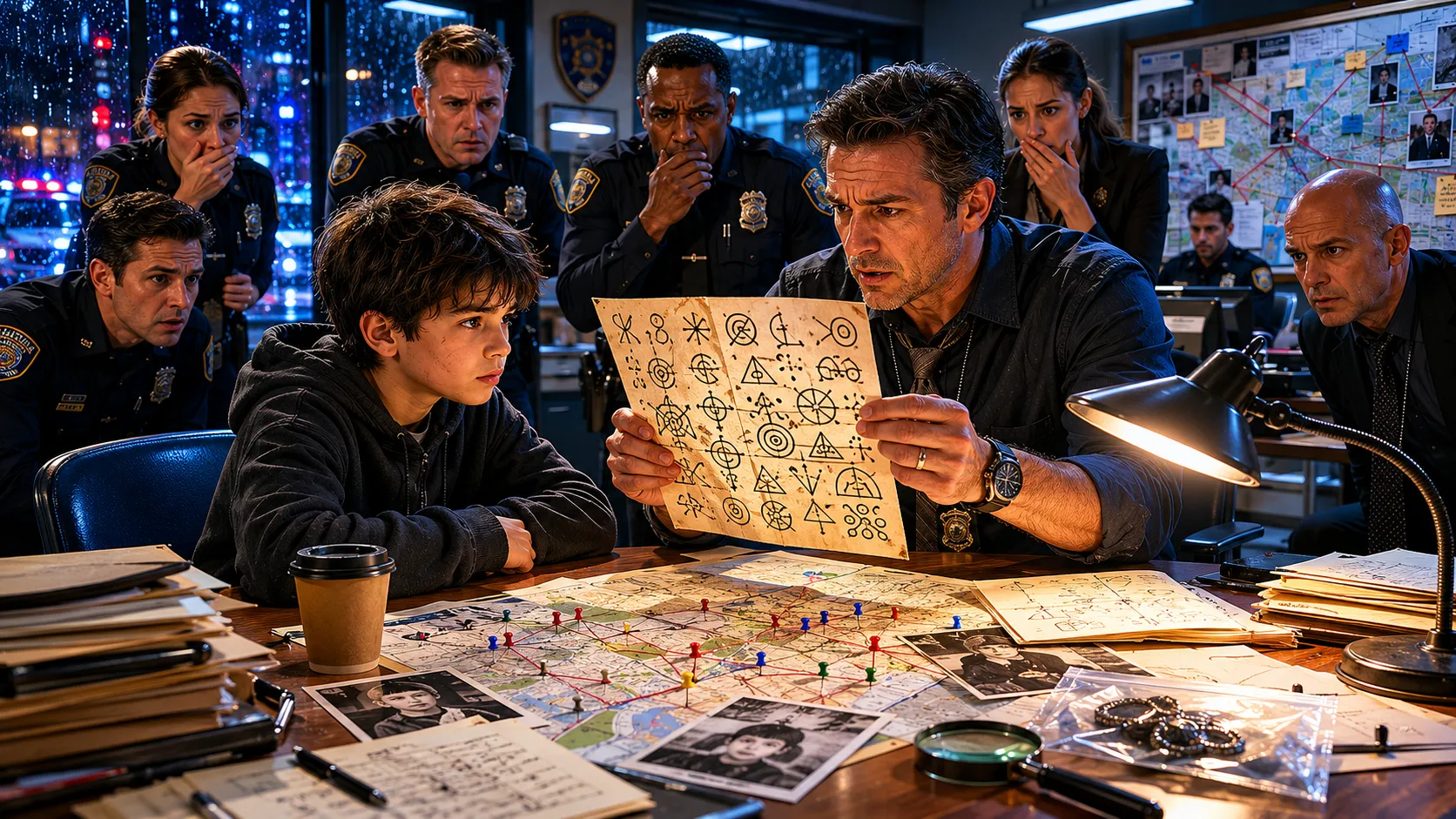
Detective Marcus Hale thought the strange symbols were impossible to read until a silent boy behind bars said, “That isn’t a code. It’s a language.” Everyone laughed at the child — until his translation led police to a man tied up in a flooded tunnel and exposed a case buried for twelve years.
The police station smelled like old coffee, rain-soaked jackets, and frustration.
Detective Marcus Hale stood in the middle of the bullpen with one sheet of paper in his hand, staring at it as if the paper had personally chosen to ruin his life.
Around him, phones rang. Officers typed reports. A woman cried quietly near the front desk while giving a statement about her stolen car. Two patrolmen argued over who had eaten the last vending machine sandwich. Somewhere in the back, a printer jammed and someone cursed at it like it was a suspect refusing to talk.
But Marcus heard almost none of it.
His entire attention was fixed on the symbols in front of him.
Curved lines.
Broken triangles.
Dots arranged with intention.
A spiral shape repeated three times, always near the left margin.
It was not random.
Marcus knew that immediately.
He had worked homicide for fifteen years. He had seen fake codes written by attention seekers, gang markings copied by teenagers, jailhouse nonsense, paranoid messages, occult-looking graffiti, and ransom notes assembled by people who watched too many movies.
This was different.
It was clean.
Structured.
Older than a code, somehow.
Smarter.
And worse, it had been found at the apartment of a missing woman named Elena Price.
Thirty-two years old.
Elementary school music teacher.
Last seen leaving Roosevelt Elementary at 5:42 p.m.
Her car had been found near the river.
Her phone had been smashed under the driver’s seat.
Her apartment showed no sign of forced entry, no blood, no struggle.
Only that sheet of paper placed neatly on her kitchen table.
No fingerprints.
No DNA.
No digital trace.
Just symbols.
And by morning, two more people were missing.
Marcus turned toward the room and lifted the paper.
“Alright,” he said loudly. “Who can decipher this?”
Half the bullpen looked up.
Officer Ruiz leaned back in his chair, squinting.
“That a joke?”
“No.”
A younger detective walked over, glanced at it, and shrugged.
“Looks like someone spilled ink and called it ancient.”
Another officer said, “Run it through the database.”
“We did.”
“AI scan?”
“Done.”
“Linguistics?”
“Waiting.”
“FBI?”
“They said send better photos and stop calling every thirty minutes.”
That earned a tired laugh from the room.
Marcus did not laugh.
“Three people are missing,” he said. “This was left at the first scene. I don’t need jokes. I need someone to tell me what it says.”
The room quieted for a moment.
Then went back to its noise.
That was how panic often looked inside a police station.
Routine wearing a mask.
Marcus lowered the paper, jaw tight.
Then a calm voice came from the holding cells.
“I can read it.”
The room stilled again.
Not completely.
Just enough.
Marcus turned slowly.
Behind the metal bars of the nearest holding cell sat a boy.
He was small, maybe eleven or twelve, wearing an orange county jumpsuit too large for his thin frame. His dark hair fell into his eyes. His hands rested neatly on his knees. He sat with the strange stillness of a child who had learned that sudden movement made adults nervous.
Marcus had noticed him earlier only in passing.
A runaway, he assumed.
Or a shoplifting case.
Or another kid picked up because adults had failed him long before police found him.
Now the boy was looking directly at the paper.
Not curious.
Recognizing.
Officer Ruiz stood.
“You talking to us, kid?”
The boy nodded once.
Marcus walked toward the cell.
The closer he got, the younger the child looked. Thin wrists. Pale face. Shoes with one lace missing. A bruise near his cheekbone, yellowing at the edges.
But his eyes did not match the rest of him.
They were focused.
Careful.
Too old.
Marcus stopped outside the bars.
“You said you can read this?”
“Yes.”
“What’s your name?”
The boy hesitated.
Not like he was deciding whether to lie.
Like he was deciding how much truth the room deserved.
“Arin,” he said.
“Arin what?”
“Just Arin.”
Ruiz muttered, “Of course.”
Marcus held up the sheet.
“You know what these symbols are?”
“Yes.”
“How?”
“I’ve seen them before.”
“Where?”
Arin did not answer.
Marcus narrowed his eyes.
“Kid, this is not a game.”
“I know.”
“There are people missing.”
“I know that too.”
The answer landed badly.
Ruiz stepped closer.
“How would you know that?”
Arin looked at him.
“Because that is what the message says.”
The bullpen had gone quiet now. Officers stood from desks. Someone stopped mid-phone call. Even the woman near the front desk looked over, wiping her face with a tissue.
Marcus studied the boy.
In his experience, children lied for obvious reasons: fear, attention, protection, hunger, loyalty, shame. This boy was afraid, Marcus could see that. But he was not performing. He was not trying to impress anyone.
He was waiting for adults to catch up.
Marcus slid the paper carefully through the small opening in the bars.
“Read it.”
Arin took the sheet with both hands.
He treated it gently.
That was the first thing that bothered Marcus.
A kid showing off would grab it quickly. A liar would make a production of studying it. Arin simply looked at the symbols and breathed out, almost sadly.
Ruiz crossed his arms.
“Well?”
Arin looked up.
“This isn’t a code.”
Ruiz scoffed.
“Then what is it, genius?”
“A language.”
Marcus felt the first small shift inside him.
“What’s the difference?”
“A code hides meaning inside something familiar,” Arin said. “A language carries meaning on its own. This doesn’t use English, numbers, or substitution patterns. It has its own grammar.”
The room stayed silent.
Ruiz gave Marcus a look that said: Are we really listening to this?
Marcus ignored him.
“What does it say?”
Arin looked down again.
His lips moved slightly, not sounding out words exactly, but following structure.
Then he began to read.
“The first is already gone.”
A chill moved through the bullpen.
Marcus stepped closer.
Arin continued.
“The second waits where the river forgets its name.”
Ruiz stopped smirking.
“The third will follow when the clock loses its shadow.”
No one spoke.
Marcus slowly took the paper back.
“The first is already gone,” he repeated.
Elena Price.
The first missing victim.
Ruiz swallowed.
“The second waits where the river forgets its name.”
Marcus turned sharply toward the city map on the wall.
“The river forgets its name,” he muttered.
Arin spoke from behind the bars.
“It means a place where water stops being called the river.”
Marcus looked back.
“What place?”
“Where it disappears. Where it is forced underground.”
Ruiz snapped his fingers.
“The old Eastbank drainage tunnel. The river runoff feeds into it beneath the industrial district.”
Marcus was already moving.
“Send units. Now.”
The bullpen came alive.
Officers grabbed radios. Chairs rolled back. Phones came off hooks. Ruiz ran toward dispatch, shouting for patrol units and rescue crews near Eastbank.
Marcus turned back to the boy.
“How did you know that?”
Arin’s face had changed.
He was not proud.
He was worried.
“They’re running out of time.”
“Who are they?”
“The ones he took.”
Marcus gripped the paper.
“How many?”
Arin looked down.
“Three. For now.”
“For now?”
The boy’s eyes lifted.
“This language is not used for finished things. It is used for instructions.”
Marcus stared at him.
“To who?”
Arin did not answer.
Marcus reached for the cell key on Ruiz’s desk.
A uniformed officer stepped forward.
“Detective, you can’t just take him.”
Marcus looked at him.
“Why is he here?”
The officer checked the booking sheet.
“Picked up last night inside the old municipal library. Trespassing. Wouldn’t give a full name. Had bolt cutters in his bag.”
Marcus looked at Arin.
“Why were you in the library?”
Arin looked away.
“Reading.”
“With bolt cutters?”
“The door was chained.”
Ruiz returned, breathless.
“Units are heading to Eastbank.”
Marcus unlocked the cell.
“You’re coming with us.”
The officer objected again.
“Detective—”
Marcus looked at him.
“If this kid is lying, I’ll bring him back. If he isn’t, someone may still be alive because he read one sentence before we did.”
Arin stepped out of the cell.
He was shorter than Marcus expected.
Smaller than the voice had made him seem.
Ruiz looked down at him.
“Try anything stupid, and I swear—”
“He won’t,” Marcus said.
Arin looked at Marcus for the first time with something almost like gratitude.
Then he said quietly, “You need to hurry.”
The ride to the old industrial district took fourteen minutes.
It felt longer.
Rain streaked across the windshield. Sirens cut through late afternoon traffic. Ruiz drove while Marcus sat in the passenger seat, one hand gripping the translated sheet. Arin sat in the back, silent, watching the city pass.
Marcus kept glancing at him in the mirror.
The boy did not fidget. Did not ask where they were going. Did not react to the siren.
That was not normal.
Children reacted to sirens.
Even scared ones.
Especially scared ones.
Marcus turned slightly.
“Arin.”
The boy looked at him.
“How old are you?”
“Twelve.”
“Where are your parents?”
Arin’s face became unreadable.
“That depends what you mean.”
Ruiz muttered, “Here we go.”
Marcus held up a hand.
“What does that mean?”
“My father is dead,” Arin said. “My mother is missing.”
Marcus straightened.
“Missing when?”
“Eight years ago.”
The answer was too quick.
Too flat.
A practiced answer.
Marcus lowered his voice.
“What was her name?”
Arin looked out the window again.
“Dr. Mara Voss.”
Ruiz looked at Marcus.
The name meant nothing to him.
But it meant something to Marcus.
Not immediately.
A shape in memory.
A case file.
An old headline.
A brilliant linguist.
A university fire.
A child reported missing.
Marcus turned fully now.
“Dr. Mara Voss from Harlan University?”
Arin’s hands tightened in his lap.
“You know her?”
“I know the case.”
The boy’s eyes sharpened.
“What did they tell you?”
Marcus hesitated.
“That she died in a lab fire.”
Arin looked out the window again.
“No,” he said.
The car went quiet except for the wipers.
Ruiz slowed near the industrial district.
Old warehouses rose on both sides of the street, their windows broken, their brick walls dark with rain. Police lights flashed ahead near a concrete access road leading down toward the drainage system.
As soon as the car stopped, Arin opened the door.
Marcus caught his arm.
“Stay close.”
Arin looked down at the hand.
Marcus released him immediately.
“Sorry.”
The boy nodded once.
They approached the drainage entrance where officers were already setting up portable lights. Water rushed beneath a rusted grate, disappearing into a wide concrete tunnel. The air smelled of wet metal and rot.
A patrol officer hurried over.
“We heard something inside. Could be water, could be a voice.”
Marcus looked at Arin.
The boy stared into the tunnel.
“He’s there.”
“You’re sure?”
Arin nodded.
“Left side. Past the second turn. Above the waterline.”
Marcus turned to the rescue team.
“Move.”
They entered the tunnel with flashlights and weapons drawn.
The sound changed inside.
The city disappeared behind dripping concrete, echoing footsteps, and the constant rush of water beneath the walkway. Marcus led, Ruiz behind him, Arin held back by an officer near the entrance despite his protests.
“Police!” Marcus shouted. “If anyone can hear me, make a sound!”
Nothing.
They moved past the first turn.
Then the second.
Ruiz stopped.
“Did you hear that?”
A faint sound came from ahead.
Not water.
A voice.
“Help…”
Marcus ran.
The victim was tied to an old pipe above the runoff channel, soaked, shaking, wrists raw from struggling, duct tape hanging from one side of his mouth. He was alive but barely conscious.
Marcus cut him free while Ruiz radioed for medics.
“What’s your name?” Marcus asked.
The man’s lips trembled.
“David Kim.”
The second missing person.
Marcus felt both relief and dread at once.
David grabbed his coat with weak fingers.
“He said nobody would find me.”
“Who?”
David shook violently.
“The man with the silver hand.”
Marcus froze.
“What?”
But David’s eyes rolled back, and the medics rushed in.
By the time Marcus returned to the tunnel entrance, Arin was standing under the rain with his arms wrapped around himself.
“You found him,” the boy said.
“Yes.”
Arin did not smile.
“That was only the second.”
Marcus looked down at the paper again.
The third will follow when the clock loses its shadow.
Ruiz, overhearing, wiped rain from his face.
“What does that mean? A clock tower? Sundial? Midnight?”
Arin’s expression tightened.
“Not midnight.”
“How do you know?”
“Because a clock losing its shadow is not about time passing,” the boy said. “It is about time being hidden.”
Ruiz threw up one hand.
“That clears up nothing.”
Marcus looked at Arin.
“Does it mean anything to you?”
The boy hesitated.
Then he said, “Maybe.”
“Tell me.”
“My mother once took me somewhere she called the place where time has no shadow.”
Marcus waited.
Arin swallowed.
“The old Harlan University observatory.”
Ruiz frowned.
“Why would a clock have no shadow there?”
Marcus answered slowly, remembering now.
“The observatory had a solar clock in the courtyard. Famous one. It was damaged in the fire.”
Arin nodded.
“The fire that supposedly killed my mother.”
Rain struck harder around them.
Marcus stared at the boy.
“What are we walking into?”
Arin looked past him at the dark tunnel.
“Something that started before I was born.”
They took Arin back to the station first.
Not because Marcus wanted to.
Because procedure finally caught up with urgency.
A child advocate was called. A lieutenant demanded explanations. Federal databases were checked. The boy’s fingerprints returned no match. His name returned nothing. No Arin Voss. No Arin connected to Mara Voss. No recent missing child record.
It was as if the boy had grown out of the floor of the holding cell.
Marcus sat across from him in an interview room with Ruiz, a child advocate named Helen Price, and a camera recording in the corner.
Arin looked at the camera.
“I won’t say anything important with that on.”
Ruiz leaned forward.
“You’re not in charge here.”
Arin turned to him.
“That is why people keep dying.”
Ruiz opened his mouth.
Helen lifted one hand.
“Officer.”
Marcus studied Arin.
“What do you need?”
“The camera off.”
“We can’t do that.”
“Then I can’t help.”
“Arin.”
The boy’s face tightened.
“You think recording makes people tell the truth. It doesn’t. It makes powerful people prepare.”
Marcus felt the sentence in his gut.
Helen said gently, “Who taught you that?”
“My mother.”
Marcus looked at the camera.
Then at the two-way mirror.
Then he stood and unplugged the recording cable.
Ruiz stared.
“Marcus.”
“Write me up later.”
Arin watched him carefully.
The red light on the camera went dark.
Marcus sat again.
“Talk.”
Arin folded his hands on the table.
“My mother studied extinct and constructed languages. Not fantasy languages. Not puzzles. Real systems people created for secrecy, ritual, trade, resistance, survival.”
“Like the symbols?”
He nodded.
“She called this one Edranic.”
Ruiz frowned.
“Never heard of it.”
“You wouldn’t have.”
Marcus asked, “Who used it?”
Arin’s voice lowered.
“A group called the Meridian Society.”
Helen’s face changed.
Marcus noticed.
“You know that name?”
Helen hesitated.
“I saw it in child welfare files years ago. Not officially. Rumors. Wealthy families, private schools, strange custody arrangements. It sounded like conspiracy nonsense.”
“It isn’t,” Arin said.
Marcus leaned forward.
“What is it?”
“A private network,” Arin said. “Judges. donors. researchers. executives. collectors. People who believe intelligence, memory, and obedience can be engineered if you start young enough.”
The room went cold.
Ruiz said, “That’s a big accusation.”
Arin’s eyes did not move from Marcus.
“My mother found their records hidden inside Harlan’s language archive. They used Edranic because almost no one living could read it. She broke part of it.”
“And then the lab burned.”
Arin nodded.
“She hid me before they came.”
Marcus’s voice softened.
“You were four.”
“I remember smoke. I remember her putting me in a service elevator. I remember her saying, ‘Do not let them name you.’”
Helen looked down.
Marcus felt his jaw tighten.
“Who raised you?”
Arin looked at the table.
“Different people. Some kind. Some afraid. Some paid to look away.”
“Where have you been living recently?”
“The old library. Abandoned tunnels. Churches sometimes.”
Ruiz whispered, “Jesus.”
Marcus tapped the paper.
“And the person leaving these messages?”
Arin’s expression hardened.
“He wants me to read them.”
“Why?”
“Because he knows I can.”
“Who is he?”
The boy hesitated too long.
Marcus waited.
Finally, Arin said, “Dr. Elias Crowe.”
Helen’s eyes closed.
Marcus looked at her.
“What?”
Helen’s voice was quiet.
“Elias Crowe ran a private youth cognition clinic twelve years ago. It shut down after allegations of abuse. Nothing stuck.”
Arin nodded.
“He worked with my mother before she discovered what he was.”
“What is the silver hand?” Marcus asked.
The first visible fear crossed Arin’s face.
“He lost his real hand in the Harlan fire.”
Ruiz sat back.
“David Kim said the man who took him had a silver hand.”
Marcus stood.
“Get every unit near the old Harlan observatory.”
Arin stood too.
“I’m coming.”
“No.”
“You need me.”
“No, I need you safe.”
Arin’s eyes flashed.
“That is what adults say right before they lock children away from the truth that belongs to them.”
Marcus stopped.
Helen looked at him.
The room held the weight of the choice.
Finally, Marcus said, “You stay in the car until I say otherwise.”
Arin nodded once.
It was not agreement.
It was a temporary truce.
Harlan University had closed its old observatory after the fire.
The main campus moved west years later. The observatory remained on a hill above the city, fenced off, its dome rusted and half-collapsed, its stone courtyard overgrown with weeds.
At the center of the courtyard stood the old solar clock.
A circular platform of stone with metal markers arranged around it. Once, a brass column in the center cast a shadow across the hour lines. After the fire, the column had been removed.
A clock with no shadow.
Police surrounded the hill just before dusk.
Marcus stood beside the command vehicle, watching the observatory through binoculars.
No movement.
No lights.
No obvious sign of life.
Arin sat in the back of the cruiser with Helen beside him.
He had not spoken for twenty minutes.
Then he suddenly lifted his head.
Marcus opened the door.
“What?”
“The third isn’t inside the observatory.”
“How do you know?”
Arin pointed toward the courtyard.
“The clock loses its shadow because the shadow was moved.”
Marcus looked toward the old solar clock.
“What does that mean?”
“The brass column. They removed it after the fire.”
“Yes.”
“Where did they put it?”
Ruiz pulled up old campus records on his tablet.
“Maintenance storage, maybe. Or scrap.”
Arin shook his head.
“No. My mother said nothing disappears from Harlan. It only goes underground.”
Marcus looked at the hill.
The observatory sat above old service tunnels connecting former university buildings.
“Below the clock,” he said.
They found the hatch beneath a layer of moss and broken stone behind the solar platform. It was sealed with a modern electronic lock disguised under rusted metal.
Ruiz stared.
“This is not university maintenance.”
Marcus drew his weapon.
“No.”
The tactical team cut through the hatch.
Beneath it, stairs descended into darkness.
Marcus looked at Arin.
“You stay.”
Arin’s face was pale.
“She might be down there.”
Marcus went still.
“Your mother?”
Arin looked toward the opening.
“I never believed she died.”
Helen touched his shoulder.
“Arin…”
He shook his head.
“I know. But I never believed it.”
Marcus did not know what to say.
So he said only, “Then I’ll look.”
They descended.
The tunnel beneath Harlan was not abandoned.
That was clear within seconds.
The lights worked.
Air moved through hidden vents.
Security cameras watched from ceiling corners.
The walls had been painted recently.
At the bottom of the stairs, a hallway stretched beneath the hill, clean and white and horribly quiet.
Rooms lined both sides.
Observation rooms.
Records rooms.
A medical station.
A classroom with small desks.
Marcus felt rage beginning to build in his chest.
Not hot.
Cold.
There were children’s drawings pinned to one wall.
Not old.
Recent.
Ruiz whispered, “What the hell is this place?”
Marcus moved forward.
The third victim was found in Room 6.
A young woman named Priya Shah, the third missing person, tied to a chair but alive, her mouth taped, her face streaked with tears. A symbol had been drawn on the wall behind her.
A spiral.
Three dots.
A broken triangle.
Arin would have read it instantly, Marcus knew.
He was almost glad the boy was not there to see it.
Priya began sobbing when Marcus cut the tape.
“He said the child would come,” she gasped.
“Crowe?”
She nodded violently.
“He said the child always comes back to the first wound.”
A shout came from down the hall.
Then gunfire.
Controlled panic erupted.
Officers moved room to room. Someone shouted that a suspect had fled through a rear access corridor. Marcus ran after the sound, Ruiz behind him.
The corridor ended at an old archive vault.
Inside stood a man in a long dark coat beside a metal desk covered in papers.
He was in his sixties, tall, thin, with white hair and a face that might once have been handsome before cruelty carved all softness from it.
His right hand was silver.
Not a hook.
Not a simple prosthetic.
A polished mechanical hand, elegant and inhuman under fluorescent light.
Dr. Elias Crowe.
He looked at Marcus without fear.
“Detective Hale.”
Marcus aimed his weapon.
“Hands where I can see them.”
Crowe lifted both hands slowly.
The silver fingers opened with a faint mechanical whisper.
Ruiz came in behind Marcus, weapon raised.
Crowe smiled slightly.
“You brought him, didn’t you?”
Marcus stepped closer.
“On the ground.”
“Arin is here.”
“On the ground.”
Crowe ignored the order.
“Does he still tilt his head when translating complex syntax? His mother did that.”
Marcus’s finger tightened on the trigger.
“Stop talking.”
Crowe’s smile widened.
“Mara Voss was the finest mind I ever tried to save from ordinary morality.”
Marcus moved closer.
“Where is she?”
Crowe looked almost pleased.
“Ah. He asked that.”
“Where?”
The old man’s eyes flicked toward a locked door at the back of the vault.
Marcus saw it.
Crowe saw him see it.
Then the lights went out.
Gunfire cracked in the dark.
Ruiz shouted.
Marcus dropped, rolled behind the metal desk, and fired toward the emergency exit as a door slammed open. Red backup lights flickered on three seconds later.
Crowe was gone.
The back door remained locked.
Marcus ran to it and kicked once.
Solid steel.
Ruiz shouted from the hall, “He went through the east tunnel!”
Marcus made a choice.
Crowe fleeing.
Or the locked room.
He shot the lock.
Once.
Twice.
The door opened inward.
Inside was not a prison cell.
It was worse because someone had tried to make it comfortable.
A bed.
Books.
A desk.
A lamp.
A wall covered in handwritten symbols.
And a woman sitting in a chair near the far wall.
Thin.
Gray-haired before her time.
Alive.
Marcus lowered his weapon.
“Dr. Mara Voss?”
The woman turned slowly.
Her eyes were tired, but when she looked at him, they were fiercely present.
“Did he bring my son?”
Marcus’s throat tightened.
“He’s upstairs.”
Her hand covered her mouth.
For a moment, the years fell through the room without sound.
Then she whispered, “He lived.”
Marcus nodded.
“He lived.”
Crowe was captured twelve minutes later at the east tunnel exit after two patrol units blocked the service road. He did not run once surrounded. Men like Crowe rarely imagined themselves running. He simply adjusted his coat with one hand and said, “You have no idea what you interrupted.”
Marcus arrived in time to hear him.
“Yes,” he said. “I do.”
Crowe looked past him toward the hill.
“Arin belongs to a study that began before he was born.”
Marcus hit him.
Not hard enough to break anything.
Hard enough to end the sentence.
Ruiz grabbed Marcus’s arm.
“Detective.”
Marcus stepped back, breathing hard.
Crowe smiled with blood on his lip.
“There he is,” he said softly. “The emotional man pretending justice is procedure.”
Marcus leaned close.
“No. The procedure starts now.”
Arin saw his mother in the ambulance bay.
Nobody planned it that way.
Police tried to manage the scene. Paramedics wanted to take Mara Voss directly to the hospital. Helen wanted to prepare the boy first. Marcus wanted one minute to think.
But Arin stepped out of the cruiser just as they brought her up from the tunnels wrapped in a gray emergency blanket.
Everything stopped.
Mara Voss turned her head.
Arin stood ten feet away.
For eight years, he had trained himself not to hope in front of anyone.
Hope made people careless.
Hope made adults lie.
Hope made disappointment lethal.
But when his mother said his name, all of that training broke.
“Arin.”
The boy ran.
He collided with her so hard the paramedic had to steady them both. Mara wrapped both arms around him and made a sound Marcus had heard from parents at accident scenes, hospitals, crime scenes, and courtrooms — the sound of a person receiving back a life they had already buried.
Arin did not cry at first.
He only clung to her.
Then his shoulders shook.
“I remembered,” he sobbed. “I remembered the language.”
Mara held his head against her chest.
“I know.”
“I tried to find you.”
“I know.”
“I didn’t let them name me.”
Her face broke.
“My brave boy.”
“I was scared.”
“I know.”
“I thought you were dead.”
Mara closed her eyes.
“So did I, sometimes.”
Helen turned away, wiping her face.
Ruiz stared at the ground.
Marcus stood in the rain near the ambulance doors and felt something inside him loosen and ache at the same time.
They had found the missing victims.
They had found the old crime.
But the boy’s lost years were still gone.
No arrest could give them back.
The federal investigation began before sunrise.
The underground facility beneath Harlan University belonged on paper to a private research foundation called The Meridian Institute. Officially, it studied gifted children, pattern recognition, language acquisition, trauma adaptation, and memory retention.
Unofficially, it had spent decades identifying children with unusual cognitive ability, pressuring families, influencing custody cases, funding private placements, and burying anyone who threatened exposure.
Mara Voss had discovered the archive twelve years earlier.
She had been recruited by Crowe to help translate old Edranic documents collected by the institute’s founders. At first, she believed it was academic work. Rare manuscripts. Dead languages. Hidden histories.
Then she found the living files.
Children labeled by capability.
Memory.
Compliance.
Resistance.
Emotional response.
Breakability.
Arin was in the prenatal file.
Crowe had targeted Mara before Arin was born because her linguistic ability, combined with his father’s mathematical talent, made their child valuable to the institute.
When Mara realized the truth, she began copying records.
Crowe set the lab fire.
Arin escaped in the service elevator because she hid him.
Mara survived because Crowe needed her alive to finish translating the oldest Meridian texts — records that proved the institute had not begun as science, but as a century-old network of powerful families using language, secrecy, and child custody systems to create obedient brilliance.
For eight years, she refused to finish the work.
So Crowe changed tactics.
He staged the missing-person case using Edranic messages because he knew Arin would eventually come near the symbols.
“He was bait,” Marcus said in the federal interview room, disgust thick in his voice.
Mara sat across from him, hospital bracelet still on her wrist.
“Yes.”
“And the victims?”
“Pressure. Theater. Crowe always believed fear was a more efficient teacher than love.”
Marcus looked through the glass where Arin sat with Helen, eating a sandwich slowly, as if he still did not trust food to remain available.
“He lived on the streets because of this.”
Mara’s eyes filled.
“I know.”
Her voice did not defend herself.
That made Marcus respect her more.
She had survived captivity, but she did not use survival to erase his.
“Dr. Voss,” Marcus said carefully, “Crowe’s lawyers are already preparing. They’ll claim the institute was legitimate research. That you were unstable. That Arin was manipulated.”
Mara looked at him.
“Then we will answer with records.”
“There are thousands.”
“I remember how they are organized.”
Marcus stared.
“After eight years?”
Mara’s mouth curved with no humor.
“Detective, memory was why they chose us.”
The trial took eleven months to begin.
During that time, Arin lived with Mara in a protected apartment arranged through federal witnesses services, though he hated the word protected.
“It means watched,” he told Marcus.
“Sometimes,” Marcus admitted.
“It means controlled.”
“Sometimes.”
“It means safer?”
Marcus paused.
“Sometimes.”
Arin considered that.
“I prefer honest adults.”
Marcus almost smiled.
“They are rare.”
“I noticed.”
Their relationship grew in a strange way.
Not father and son.
Not exactly friends.
Marcus became the adult Arin called when he distrusted every other adult in the room. Mara accepted this with visible pain and gratitude. She understood that love did not automatically restore trust. Her son had survived eight years without her. He had built his own map of safety.
She had to earn a place in it again.
Some days were good.
Arin and Mara sat together at the kitchen table translating harmless children’s books into Edranic as a way to reclaim the language from Crowe’s cruelty.
Some days were terrible.
Arin woke screaming from dreams of locked doors.
Mara stood in the hallway crying silently because he would not let her touch him.
Some days they were simply awkward.
“What do you like for breakfast now?” she asked one morning.
Arin looked at her.
“Food.”
She winced.
He immediately looked down.
“I’m sorry.”
“No,” she said. “Don’t apologize for what hunger taught you.”
That sentence stayed with him.
At school, he lasted three days before refusing to return.
Too many questions.
Too many people.
Too many adults pretending not to know his name from the news.
So Mara taught him at home with tutors who understood trauma, unusual learning, and the fact that a child can solve cryptographic language structures while still needing reminders to eat lunch.
Marcus visited once a week.
Officially, to update them on the case.
Unofficially, because Arin trusted him and Marcus had stopped pretending he was only doing his job.
One evening, he brought a chess set.
Arin looked offended.
“You think because I’m strange, I play chess?”
Marcus shrugged.
“I think because I’m bad at it, you might enjoy humiliating me.”
Arin studied him.
Then sat down.
He beat Marcus in nine minutes.
Marcus frowned at the board.
“That was unnecessary.”
“You made three emotional moves.”
“Chess moves are emotional?”
“Yours are.”
Mara laughed from the kitchen.
It was the first time Marcus heard her laugh.
He understood then that homes are rebuilt in fragments.
A laugh.
A sandwich.
A child sleeping four hours instead of two.
A detective losing badly at chess.
When the trial began, the courtroom was sealed for parts of testimony involving minors.
But the public learned enough.
The Meridian Institute had influenced custody courts.
Funded private psychiatric placements.
Buried complaints from parents.
Paid police consultants.
Purchased silence through donations.
Targeted children considered “exceptionally adaptive” after trauma.
That phrase made Marcus want to break something every time he heard it.
Exceptionally adaptive.
As if survival were consent.
As if children became interesting to powerful people only after being hurt.
Mara testified for three days.
She described the language archive, the hidden files, the fire, her captivity, the forced translation work, and Crowe’s obsession with Arin.
Crowe watched without expression.
Until Arin entered the courtroom.
The boy was thirteen by then.
Still small.
Still pale.
But he walked to the witness stand with his head up.
Marcus sat behind him.
Mara sat beside Helen.
Crowe’s eyes followed the boy like a collector watching a stolen object return to the room.
The prosecutor asked softly, “Can you state your name?”
Arin looked at Crowe.
Then at the jury.
“Arin Voss.”
Mara closed her eyes.
The name was his choice.
Not the one Crowe wanted.
Not the nameless answer from the holding cell.
His.
The prosecutor asked about the symbols, the holding cell, the message, the drainage tunnel, the observatory.
Arin answered clearly.
Then Crowe’s attorney stood.
A polished man with silver hair, gentle tone, and cruel questions dressed as concern.
“Arin, you lived without stable guardianship for many years, correct?”
“Yes.”
“You slept in abandoned buildings?”
“Yes.”
“You stole food?”
Marcus stiffened.
Arin looked at the attorney.
“Yes.”
“You broke into a public library?”
“Yes.”
“You claim to understand a language most experts have never heard of?”
“I do understand it.”
The attorney smiled sadly for the jury.
“Is it possible you created meanings from symbols because you wanted to feel important?”
Mara’s hands tightened in her lap.
Marcus leaned forward.
Arin did not move.
“No.”
“You’re certain?”
“Yes.”
“Children who survive trauma sometimes invent systems to make chaos feel controlled.”
Arin tilted his head.
“That is true.”
The attorney blinked.
“You agree?”
“Yes. But true things can be used dishonestly.”
A ripple moved through the courtroom.
The attorney’s smile thinned.
“Explain that.”
“You are saying trauma can distort memory. That is true. Then you are trying to make the jury believe all traumatized children are unreliable. That is dishonest.”
The judge looked down to hide a reaction.
Marcus almost smiled.
The attorney recovered.
“You believe Dr. Crowe targeted you personally?”
“Yes.”
“Because you are special?”
“No,” Arin said. “Because he is sick.”
Crowe’s expression changed for the first time.
Arin continued, voice steady.
“He calls children special when he wants to own them. My mother calls children beloved when she wants them free.”
The courtroom went silent.
The attorney sat down sooner than expected.
The verdict came after six days.
Guilty.
Conspiracy.
Kidnapping.
Illegal human experimentation.
Fraud.
Obstruction.
Attempted murder.
Murder connected to the Harlan fire.
Additional charges related to children whose cases would take years to untangle.
Crowe stood when the verdict was read.
He did not collapse.
Did not rage.
Did not beg.
He turned once toward Arin.
“You will translate the rest one day,” he said.
Marcus moved before the bailiff did.
But Arin lifted one hand.
Stopping him.
The boy looked at Crowe.
“No,” Arin said.
Crowe smiled.
“You will want answers.”
Arin’s voice remained calm.
“I already have the important one.”
Crowe’s smile faded.
Arin said, “I am not yours.”
The bailiffs took Crowe away.
After sentencing, Marcus found Arin outside the courthouse sitting on the steps with Mara beside him.
Reporters waited behind barriers at the bottom, shouting questions.
Arin ignored them.
Marcus sat on the other side of him.
For a while, none of them spoke.
Then Arin asked, “What happens now?”
Marcus looked at the city.
“I don’t know.”
“That’s not comforting.”
“No,” Marcus said. “But it’s honest.”
Mara touched Arin’s shoulder.
This time, he let her.
That was its own verdict.
Years passed.
The Meridian Institute was dismantled slowly.
Too slowly, in Marcus’s opinion.
Institutions with wealthy donors do not die cleanly. They rename themselves, sell assets, shift blame, issue apologies with legal review, and hope the public becomes tired.
Mara did not become tired.
Neither did Arin.
Together, they helped identify children taken through Meridian-linked programs. Some were adults now. Some wanted answers. Some wanted nothing to do with the case. Some families had been destroyed beyond repair.
Arin learned that truth did not always heal.
Sometimes truth only gave people a correct name for the wound.
That still mattered.
At sixteen, he returned to the old municipal library.
Not by breaking in.
The city reopened it after renovation, and one room became the Mara Voss Language Archive, dedicated to endangered languages, children’s literacy, and ethical research.
Arin hated the name at first.
Mara did too.
Marcus said, “You both hate being honored. That’s probably why it’s safe.”
The opening was small.
No gala.
No wealthy donors with speeches.
Just librarians, teachers, survivors, detectives, families, and children sitting on colorful rugs with books in their laps.
Arin stood near the back, uncomfortable in a blue shirt Mara had bought him.
Marcus handed him a paper cup of punch.
“You look like you want to escape through a vent.”
“I know three exits.”
“Only three?”
“I’m trying to relax.”
Marcus nodded.
“Good work.”
Mara spoke briefly at the front.
“When language is used to hide harm, it becomes a weapon,” she said. “When language is used to tell the truth, it becomes a door.”
She looked at Arin.
“My son found a door inside a sheet of symbols when adults saw only a puzzle. May this room teach children that their minds are not property, their questions are not disobedience, and their voices are not evidence against them.”
Arin looked down.
He did not like being seen.
But he was learning that being seen safely was different from being captured.
After the ceremony, a little girl approached him with a notebook.
“Are you the boy who read the secret writing?”
Arin glanced at Marcus.
Marcus gave him a look that meant: Your choice.
Arin crouched to the child’s level.
“I read one secret writing.”
“Can you teach me?”
He thought about Crowe.
Then his mother.
Then the holding cell.
Then the sheet of paper that had begun everything.
“Yes,” he said. “But we start with writing your own name.”
The girl frowned.
“That’s not secret.”
“It can be,” Arin said. “If someone tried to take it from you.”
She did not understand.
Not fully.
That was good.
Children should not understand everything too early.
At twenty-four, Arin Voss became a forensic linguist.
He did not work for the police full-time.
He had inherited his mother’s distrust of institutions and Marcus’s habit of showing up when called anyway.
He consulted on missing-person cases, coercive letters, cult documents, coded threats, and forged suicide notes. He specialized in the language people used when power was hiding behind politeness.
His office was inside the old library.
Not by accident.
On his wall hung a framed copy of the original Edranic message.
Not because he admired it.
Because it reminded him of the day someone finally listened.
Beneath it was his own translation, written by hand:
The first is already gone.
The second waits where the river forgets its name.
The third will follow when the clock loses its shadow.
Beside that, another line.
One he wrote years later:
The fourth was the child no one thought to ask.
Marcus, now retired, visited on rainy Thursdays whether invited or not.
He still played chess badly.
Arin still beat him quickly but sometimes took longer on purpose.
One afternoon, Marcus studied the board and said, “You let me have that bishop.”
“I did.”
“Why?”
“You become unpleasant when losing too quickly.”
Marcus looked offended.
“I am pleasant under all conditions.”
“You yelled at a printer for six minutes last week.”
“It was withholding evidence.”
Arin smiled faintly.
Mara, older now but still sharp, entered with tea.
“Are you two arguing about chess or masculinity?”
“Both,” Arin said.
Marcus muttered, “I liked him better in the holding cell.”
“No, you didn’t,” Mara said.
Marcus looked at Arin.
“No,” he admitted. “I didn’t.”
That was the closest they came to saying certain things.
They did not need to say them often.
One winter night, twelve years after the police station, a new detective came to Arin’s office.
She was young, tense, rainwater on her coat, a sealed evidence bag in her hand.
“I was told you might understand this,” she said.
Inside the bag was a small sheet of paper covered in unfamiliar marks.
Not Edranic.
Something else.
Arin looked at it for a long time.
The detective shifted nervously.
“Can you read it?”
He thought of Marcus standing in the bullpen with a page nobody understood.
He thought of a boy behind bars saying, I can read it.
He thought of the adults who laughed until the truth became useful.
Then he looked at the detective.
“Maybe.”
Her face fell slightly.
“Only maybe?”
Arin opened a notebook.
“Maybe is where honest work starts.”
She sat down.
This time, nobody laughed.
Outside, rain touched the library windows.
Inside, under warm light, Arin began to read.
Not because Crowe had made him special.
Not because Meridian had marked him.
Not because trauma had turned him into a tool.
Because his mother had taught him that languages are doors.
Because Marcus had opened a cell.
Because three missing people had lived.
Because a child once refused to let adults mistake the truth for nonsense.
And because somewhere, in every city, there is always a message someone powerful hopes no one poor, young, frightened, or forgotten will know how to read.