Richard Harrington laughed when an eight-year-old girl said his billion-dollar empire belonged to her. Then she lifted a silver pendant he had given her mother years ago — and the past he abandoned walked back into his life with his daughter’s face.
The little girl stood at the bottom of Harrington Global’s marble steps like a secret Richard Harrington had spent years trying not to remember.
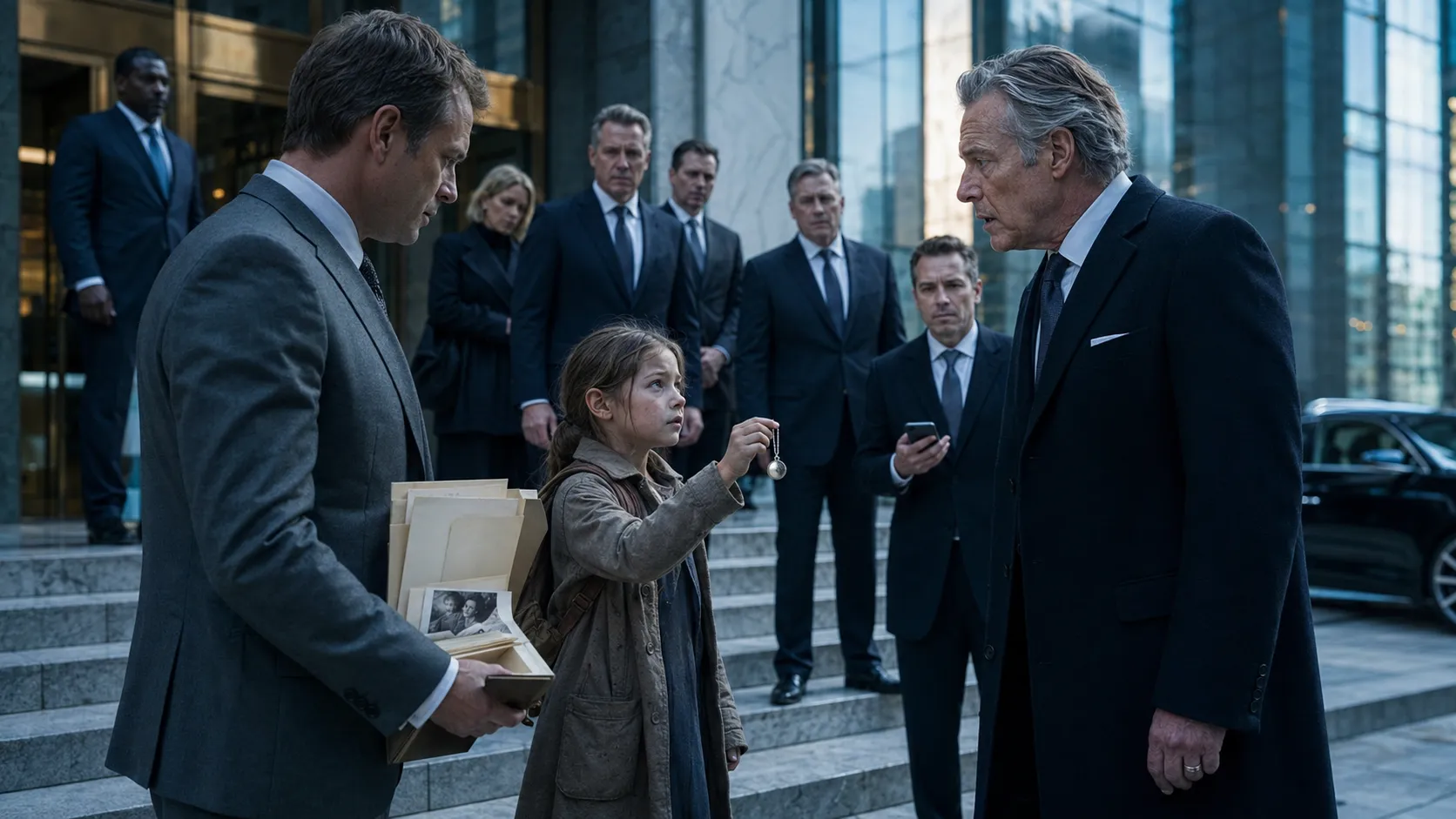
She was eight, wearing dusty shoes and a faded coat. Around her neck hung a silver pendant. Beside her stood a quiet man in a gray suit.
Richard stood outside his skyscraper with executives. His name shone above them.
Then the girl looked up and said, “This company belongs to me.”
The executives laughed.
Richard almost did too.
“And what makes you believe that?” he asked.
The girl lifted the pendant.
Sunlight struck the silver.
Richard’s smile died.
He had given that necklace to Emily Carter twelve years earlier, when he had nothing but debt and impossible plans. Emily had believed in him before anyone else did and told him success would mean nothing if he lost himself chasing it.
Then success came close.
Richard chose investors, meetings, and the company. He told Emily he would return when life became stable.
He never did.
The girl held the pendant tighter. “My mother said you gave this to her.”
Richard’s voice broke. “Where is Emily?”
The girl’s calm face cracked.
“She died three weeks ago.”
The laughter vanished.
The man beside her spoke. “I’m Noah Grant, Emily’s attorney. She raised Ava alone. She never asked for your money or your name. Before she died, she wanted her daughter to know the truth.”
Richard stared at the child.
Ava.
His daughter.
He saw Emily’s eyes, his own stubborn mouth, and a courage no eight-year-old should have needed.
Ava pulled a folder from her backpack. “Mom said to give this to you if you laughed.”
Inside were returned letters, school photos, a birth certificate, and one final letter.
Richard,
I am not writing to punish you. Ava is the best thing my life gave me.
I kept her away from your world because I feared she would become another thing you measured by usefulness.
But she deserves truth. Do not give her money first. Give her time. Give her honesty. Give her the apology I stopped waiting for.
Do not make our daughter inherit your absence.
Emily
Richard could not speak.
For years, he had controlled boardrooms and billion-dollar decisions. Now he stood before a child with dusty shoes, unable to defend a single year of his life.
Ava watched him carefully. “Mom said you might be sorry.”
“I am,” Richard whispered.
“She said sorry is small if it comes alone.”
Emily’s voice, through their daughter.
“Yes,” he said. “She was right.”
One executive stepped closer. “Sir, the Chicago call—”
Richard turned. “Cancel everything.”
“But the board—”
“Everything.”
Then he crouched in front of Ava, leaving enough space for her to feel safe.
“I can’t fix what I did,” he said. “I can’t bring your mother back. I can’t give you the years I missed.”
Ava’s eyes filled, but she did not cry.
“Then what can you do?”
Richard looked at the tower behind him. For the first time, it looked less like success and more like evidence.
“I can start by listening.”
Noah studied him. “That will be tested.”
“It should be.”
Ava touched the necklace. “Mom said you used to be kind.”
Richard’s face broke.
“I was kinder when I had less to protect.”
“No,” Ava said softly. “She said you were kinder when you remembered people.”
Richard took Ava to a small conference room, ordered soup and hot chocolate, and sat across from her while Noah stayed beside her.
She asked everything.
Why did you leave?
Did you know about me?
Did you love my mother?
Will you leave again?
Each answer hurt. Each answer was late. But Richard did not polish his words until they protected him. He told the truth plainly: he had been ambitious, ashamed, cowardly, and wrong.
By evening, the news had spread. The board demanded control.
Richard ignored them.
He called his lawyers only to protect Ava from the press and to give Noah authority over her interests until trust could be earned, not assumed.
That night, Richard went alone to Emily’s old apartment. It was nearly empty. On the kitchen wall, Ava had left one drawing: a tall building with a tiny girl outside.
Under it, she had written:
He lives there.
Richard sat on the floor and wept.
Months passed before Ava called him Dad.
He did not ask for it.
He came every Saturday. Then Wednesday evenings. Then school plays, doctor appointments, and quiet dinners where she watched to see whether he would return.
He learned she hated peas, loved old music, and kept Emily’s scarf under her pillow. He learned that money could arrange care, but it could not buy trust.
On Ava’s ninth birthday, Richard gave her no diamond, no mansion, no spectacle.
He gave her a small box containing copies of Emily’s letters and one promise written by his own hand.
I will not confuse providing with loving.
I will not call absence sacrifice.
I will come back when I say I will.
Ava read it twice.
Then placed it beside her mother’s necklace.
“Okay,” she said.
It was not forgiveness.
It was the beginning of evidence.