Jackson Crowell didn’t disguise himself to play a game. He wanted to know whether the company his father built still respected working people—or whether Northstar had become the kind of place that only bowed to expensive suits.
Jackson Crowell had built his life around numbers.
Quarterly growth. Market share. Customer retention. Inventory turnover. Margin reports, expansion models, acquisition opportunities. At fifty-two, he could read a balance sheet faster than most men could read a menu, and for years that skill had helped turn Northstar Motors from a respected regional dealership chain into a national name associated with polish, performance, and wealth.
But on that gray Tuesday morning, it wasn’t the numbers on his desk that held his attention.
It was the stack of handwritten letters.
Real paper. Folded by hand. Some on lined notebook sheets, some on stationery, some barely legible. Jackson had asked his assistant to stop filtering them and send him the customer complaints that felt “too personal” for corporate channels. He wanted the ones people wrote after they had given up on being heard.
He had read three before sunrise.
The first came from a truck driver in Ohio:
I came in after a fourteen-hour run, still in my work clothes. They looked at my boots and decided I couldn’t afford to breathe their air. I left before anyone handed me a brochure.
The second came from a retired school custodian:
My wife always wanted to sit in one of your sedans, just once, before we’re too old to drive. Your salesman told me, “Sir, these models aren’t for browsing.” I’m seventy-one, not invisible.
The third was short enough to fit on an index card, and it was the one that kept him staring at the window long after he finished reading:
Choose your customers. Don’t waste time on people who look poor.
Jackson read that sentence again.
Then again.
Across from his desk, mounted on the brick wall of his office, hung an old photograph of his father standing in the first Northstar garage. Frank Crowell was smiling in the picture, grease on his hands, a wrench tucked into his belt, the collar of his coveralls dark with sweat. He had not been a polished man. He had been a mechanic who believed that if someone worked hard enough to walk through your door, the least you owed him was respect.
Jackson could still hear his father’s voice.
Never shame a man for the clothes he earns his living in.
That had been Frank Crowell’s rule.
Not in a speech. Not framed behind a desk. Just said plainly, in the little cinderblock garage where Northstar began, while handing coffee to farmers, electricians, factory foremen, widows, plumbers, and young couples who counted every dollar twice before signing anything.
Jackson leaned back in his chair and closed his eyes.
Somewhere along the way, Northstar had become sleek enough to forget who built it.
He stood, walked to the closet behind his office, and pushed past the expensive suits he wore for investors and television interviews. At the back, hanging untouched for years, was an old reflective safety vest. The orange had faded toward rust. One pocket had been stitched twice. A trace of dried plaster still clung to the hem.
It had belonged to Frank.
Jackson took it down carefully.
He set it beside a pair of scuffed work boots he used to wear on site visits, then found an old hard hat from a construction charity event and a generic roadwork identification card someone in operations had once made as a joke for an industry trade show. He looked at the pieces laid out across the chair and felt something in him settle into place.
If his people only respected polished shoes, they did not deserve the name on the building.
An hour later, the CEO of Northstar Motors disappeared.
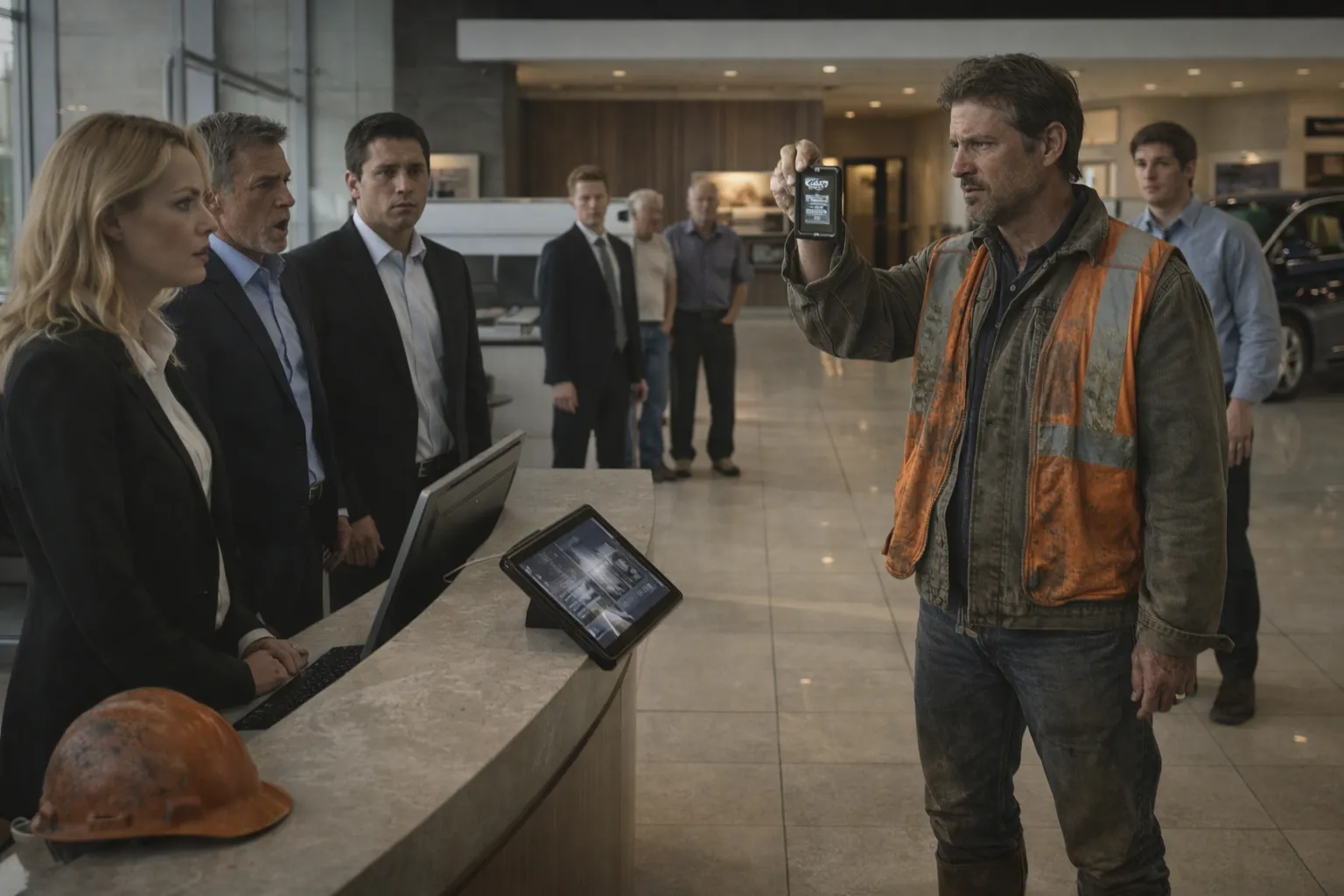
In his place stood a tired, middle-aged man in dusty boots, worn denim, a faded safety vest, and a hard hat tucked under one arm. He left his tailored coat behind. His real identification went into the deepest inside pocket. The fake worksite card rested where it could be seen first.
Then Jackson Crowell got into an ordinary rental sedan and drove to the Northstar flagship dealership on the north side of the city.
The showroom was exactly what the branding consultants loved.
Glass walls. White stone floors. Soft music. Espresso on request. Luxury vehicles displayed like sculpture beneath carefully angled light. The building did not smell like oil, rubber, and work, the way Frank Crowell’s first garage had. It smelled like leather, cologne, and expensive calm.
Jackson opened the glass door and stepped inside.
The receptionist looked up first.
Ms. Readington was crisp, immaculate, and efficient in the way that can easily harden into disdain. Her lipstick was perfect. Her blouse had not a wrinkle in it. Her smile, when she offered one, tended to stop before reaching her eyes.
That morning, she didn’t smile at all.
Her gaze moved from Jackson’s boots to the dirt on his vest, then up to his face.
“Yes?” she said.
The single word carried more dismissal than inquiry.
Jackson adjusted the hard hat under his arm. “Morning, ma’am. I was hoping to take a look at that blue sedan near the center platform.”
Readington followed his gaze to the newest Meridian Signature.
The car was deep blue, almost black under the lights, with a hand-stitched interior and a price tag that would buy some people a small house.
She gave a short, brittle laugh.
“Do you have an appointment?”
“No, ma’am.”
“Then you’ll want to check the pre-owned inventory around back.”
Jackson kept his tone even. “I’m actually interested in this model.”
Readington leaned back in her chair and folded one manicured hand over the other.
“Sir, those vehicles are generally shown to qualified buyers.”
There it was.
Not a policy. A judgment.
Nearby, a salesman named Doyle had overheard enough to wander closer. He was in his forties, broad in the chest, slick in manner, and had the slightly bloated confidence of a man who had been rewarded too long for the wrong instincts.
He glanced at Jackson, then at the car, and smirked.
“That one starts at eighty-eight before options,” he said loudly enough for the floor to hear. “Most folks who look at it already know what their financials are.”
A younger salesman leaning against the counter chuckled and lifted his phone.
Clyde.
Jackson had seen his name in personnel reports before—strong sales numbers, weak peer reviews, a warning about “immature conduct” brushed aside after a record quarter.
Now Clyde angled his phone just enough to capture Jackson without being obvious about it.
“This’ll be good,” he muttered under his breath. “Luxury shopping in steel-toe boots.”
Two more employees looked over.
Ms. Taber, all sharp cheekbones and colder voice, joined the little cluster by the Meridian. “Test drives are for serious buyers,” she said. “We usually ask for proof of funds or financing pre-approval before moving forward.”
Jackson looked at her. “I just asked to see the car.”
“This isn’t a place for free dreaming,” she replied.
For a moment, no one said anything.
The words hung in the air like a slap.
Jackson felt the old anger rise—not hot and impulsive, but deep and heavy. The kind of anger that comes not from being insulted, but from recognizing that the insult has been repeated so many times it has become culture.
Near the waiting area, an older man in a baseball cap lowered the brochure he had been pretending to study. Beside him, his wife—small, gray-haired, careful in her movements—looked down at her purse, as if she had already decided it might be better to leave than risk being next.
Jackson noticed them.
And the sight of that woman shrinking into herself in his showroom did more to harden his resolve than all the complaint letters combined.
Then someone else spoke.
Quietly.
“If you’d like, sir, I can walk you through the features.”
Jackson turned.
A young man stood near one of the desks, shoulders slightly hunched, name tag reading MILLS – INTERN. He couldn’t have been more than twenty-two. His tie was crooked, and he looked terrified of his own courage.
Readington snapped before Jackson could answer. “Mills, return to your station.”
The young man swallowed.
Then he looked back at Jackson. “I’m sorry,” he said softly. “That isn’t how we should be speaking to you.”
It was the only honest sentence in the room.
Jackson gave him a small nod. “Thank you.”
That was when the manager appeared.
Mr. Halcom’s office sat behind glass at the rear of the showroom, and he had clearly been watching long enough to decide the problem needed his authority. He walked toward Jackson with the heavy confidence of a man used to enforcing invisible boundaries without ever naming them directly.
“Sir,” Halcom said, stopping just inside personal distance, “this is a high-end retail environment. If you’re not here to conduct actual business, you’re disrupting operations.”
Jackson met his gaze. “I asked about financing.”
Halcom folded his arms.
“You are not our target customer.”
The room went still.
He had said aloud what the others had only implied.
Jackson glanced at the older couple again. The husband’s face had gone tight with embarrassment, as though he had heard some version of those same words before and expected them to be true now as well.
Halcom leaned in slightly.
“If you leave now, we can end this politely. Otherwise I’ll have security escort you out.”
Jackson stood there for one long, silent second.
Then he set his hard hat on a nearby chair.
Slowly, with the calm of a man who no longer needs the room’s approval, he slipped his hand inside the vest and reached into the inner pocket.
Clyde’s phone lifted a little higher, expecting a wallet, perhaps, or some crumpled paperwork that could be mocked later online.
Instead, Jackson withdrew a black identification badge and held it where everyone could see.
JACKSON CROWELL
CHIEF EXECUTIVE OFFICER
NORTHSTAR MOTORS
No one moved.
No one breathed.
The color drained from Readington’s face first. Doyle’s mouth actually fell open. Clyde lowered the phone too late; his hand had already begun to tremble. Taber took an involuntary step backward. Halcom’s expression changed in stages—annoyance, disbelief, horror.
Jackson let the silence work.
Then he spoke.
“I’ve spent the last month reading handwritten complaints from people who said they were made to feel small in dealerships carrying my father’s name.”
He looked directly at Readington.
“You were the first face I saw this morning. And you made your judgment before I had finished my first sentence.”
Her lips parted. “Mr. Crowell, I—”
He raised a hand. Not angrily. Simply enough to stop the performance before it began.
He turned to Clyde. “Give your phone to Human Resources when they arrive. Do not delete that video. It belongs to the company now.”
Clyde swallowed hard. “Sir, I was joking.”
“No,” Jackson said. “You were turning a stranger into entertainment because you believed he had no power to hurt your career.”
He shifted his gaze to Halcom.
“You said I was not your target customer.”
Halcom began, “Mr. Crowell, with respect—”
“You’ve had none to offer anyone in this room who couldn’t strengthen your numbers,” Jackson replied.
He turned slightly so the whole showroom could hear him.
“My father opened the first Northstar location with two lifts, one desk, and a coffee pot that leaked on the floor. Farmers came in with mud on their boots. Pipefitters came in after night shifts. Widows came in clutching insurance checks. He treated every one of them like they were worthy of being listened to.”
Then he looked back at Halcom.
“This culture did not appear on its own. It was taught. It was tolerated. It was rewarded.”
Halcom’s face went gray.
“Effective immediately,” Jackson said, “you are removed as showroom manager.”
The words landed like dropped glass.
He turned to Readington.
“You are no longer employed at Northstar Motors.”
Her hand flew to her throat.
To Clyde:
“Your employment ends today.”
Then he looked at Doyle and Taber—not with fury, but with something more devastating. Disappointment.
“How many people have you turned away,” he asked quietly, “because they didn’t look profitable enough to deserve your time?”
Neither answered.
Jackson gave a brief nod, as though silence itself had confirmed what he needed to know.
“You are both suspended pending review,” he said. “If the footage and customer logs match what I suspect, you will not be returning.”
He did not shout. He did not threaten. He did not grandstand for the customers watching.
That made it worse.
Because everyone in the room could feel that this was not a performance of authority.
It was judgment.
A woman near the coffee station began to clap softly.
Then another customer joined.
The older man in the baseball cap looked down at the floor and shook his head once, as if trying to process what he had just witnessed.
Jackson turned toward Mills.
The intern stood frozen, as though he would have preferred to vanish rather than become the center of anyone’s attention.
“You apologized when you believed I was just a road worker with no appointment and no status,” Jackson said. “That matters more to me than sales numbers.”
Mills blinked rapidly. “I only did what felt right.”
“That,” Jackson said, “is exactly why you’re staying.”
A faint ripple of relieved laughter moved through the room.
Jackson went on. “You’re entering our full sales and leadership training program. Effective immediately, you report directly to regional development. I’ll review your progress myself.”
Mills looked genuinely stunned. “Sir… I don’t know what to say.”
“Start by helping people well,” Jackson replied.
Then he addressed the showroom as a whole.
“Close the floor for one hour.”
There were startled looks all around.
“You heard me,” he said. “No sales. No tours. No champagne. No curated nonsense. Everyone who remains employed at noon will attend a full conduct meeting.”
His gaze moved from one face to the next.
“From this day forward, no customer at Northstar will be judged by boots, uniforms, accent, credit questions, or whether they know the difference between trim packages before they walk in. You will explain. You will listen. You will treat them like human beings.”
Then, after a brief pause, he added, “Because the man in work clothes may be the one who built the road you drove to work on.”
No one laughed this time.
No one would dare.
When Human Resources and corporate compliance arrived forty minutes later, Jackson did not leave. He stayed in the building, sat at a temporary desk, and began reviewing archived complaints, surveillance clips, secret shopper reports, and sales-floor messaging. What he found was worse than one ugly morning.
It was a pattern.
Customers redirected away from premium inventory because of their clothing.
Jokes in internal chat threads.
Salespeople bragging about “protecting the floor” from “time-wasters.”
A receptionist note tagging one elderly couple as “not likely buyers—redirect.”
A manager directive prioritizing “wealth-signaling customers.”
By the end of the day, it was not just Halcom, Readington, and Clyde who were gone.
Three more staff members from previous shifts were terminated after footage confirmed similar conduct. Doyle and Taber were dismissed before sunset. In one long, blistering day, nearly half the front-end team at the flagship showroom was gone.
The newspapers later said Jackson fired half the staff in a single morning.
That wasn’t quite true.
What he did was harsher.
He made the company look at itself, and then he cut out the rot.
The next week, Jackson returned to the flagship again—this time in his own clothes. But the building no longer felt like it had that first morning. The music was lower. The reception desk had been restructured. Every customer was now greeted with an offer of water, a seat, and a full explanation of options before any assumptions were made about budget.
On the wall behind the front desk hung a new framed statement:
EVERY PERSON WHO WALKS THROUGH THESE DOORS DESERVES DIGNITY BEFORE DISCUSSION.
Underneath it, in smaller lettering:
— Frank Crowell
Jackson had not ordered the quote to be placed there.
Mills had.
The older man in the baseball cap returned that Friday with his wife.
Jackson recognized them immediately.
The husband looked embarrassed to be remembered. “I was here the other day,” he said. “Didn’t mean to come back and make trouble.”
“You didn’t make trouble,” Jackson said. “You were treated badly in a building that should have known better.”
The man twisted the brim of his cap in his hands. “My wife always liked that blue Meridian. We can’t buy one. But I thought maybe…” He trailed off, suddenly ashamed of wanting too much.
Jackson smiled.
“There’s nothing shameful about wanting to sit in a beautiful car.”
He turned toward Mills, who was standing nearby.
“Take them out,” Jackson said. “Show them the Meridian. Every feature. Full test drive.”
The wife’s eyes widened. “Oh no, that’s far too much trouble.”
Mills shook his head at once. “Not trouble at all, ma’am.”
And this time, when he led them toward the car, there was no mockery in the room. No smirking. No whispered judgment. Just a young man opening a door with both hands, and an older woman settling into the leather seat as if some small, long-postponed wish had finally been granted the dignity of being taken seriously.
No sale was made that day.
Jackson never expected one.
But as he watched the Meridian roll out of the showroom with Mills beside the older couple, he felt something return to Northstar that quarterly reports could never measure.
Not brand recovery.
Not customer confidence.
Character.
A month later, Jackson expanded the conduct review to every Northstar location nationwide. Dress-code bias, income profiling, and disrespect-based sales filtering were written into termination policy. Training changed. Incentives changed. Secret shopper programs doubled. A new customer dignity standard became part of every manager’s performance review. And once a year, Northstar began hosting a Working Hands Open House—special early access hours for teachers, mechanics, nurses, tradespeople, truckers, and retirees who often felt invisible in premium retail spaces.
Some investors complained that Jackson was becoming sentimental.
He told them they were confusing sentiment with standards.
One evening, long after the scandal had faded from the news cycle, Jackson returned to his office and found the old letters still stacked on his desk. He picked up the one that had cut deepest.
Choose your customers. Don’t waste time on people who look poor.
He turned it over and wrote only six words on the back before filing it away beneath his father’s photograph.
Then we forgot who we were.
But Northstar had remembered.
Or at least it had begun to.
And for Jackson, that mattered more than the headlines, more than the applause, more even than the symbolic satisfaction of seeing polished arrogance walked out through the same showroom doors it once guarded so proudly.
Because the real victory had not been the firing.
It had been the correction.
The rebuilding of a standard his father understood long before consultants turned respect into slogans: that a person’s worth is not measured by the shine on his shoes, the cut of his coat, or whether he knows how to pronounce the name of a luxury engine package.
A man can wear dust on his sleeves and still carry dignity into every room he enters.
And any business that forgets that truth deserves to be humbled by it.