Ricardo Reio had built a fortune large enough to command a mansion, a company, and the respect of powerful men. But one rain-soaked lunch beneath a tree forced him to see the shame, silence, and humiliation that had been living inside his own home for far too long.
That morning the sky hung low and bruised over the city, heavy with rain that had not stopped since dawn.
The gardens surrounding Ricardo Reio’s mansion were dark with water. Gravel glistened. Rose bushes drooped beneath the weight of the storm. The stone path leading to the side entrance shone like polished slate. Everything looked expensive, orderly, and untouched by discomfort.
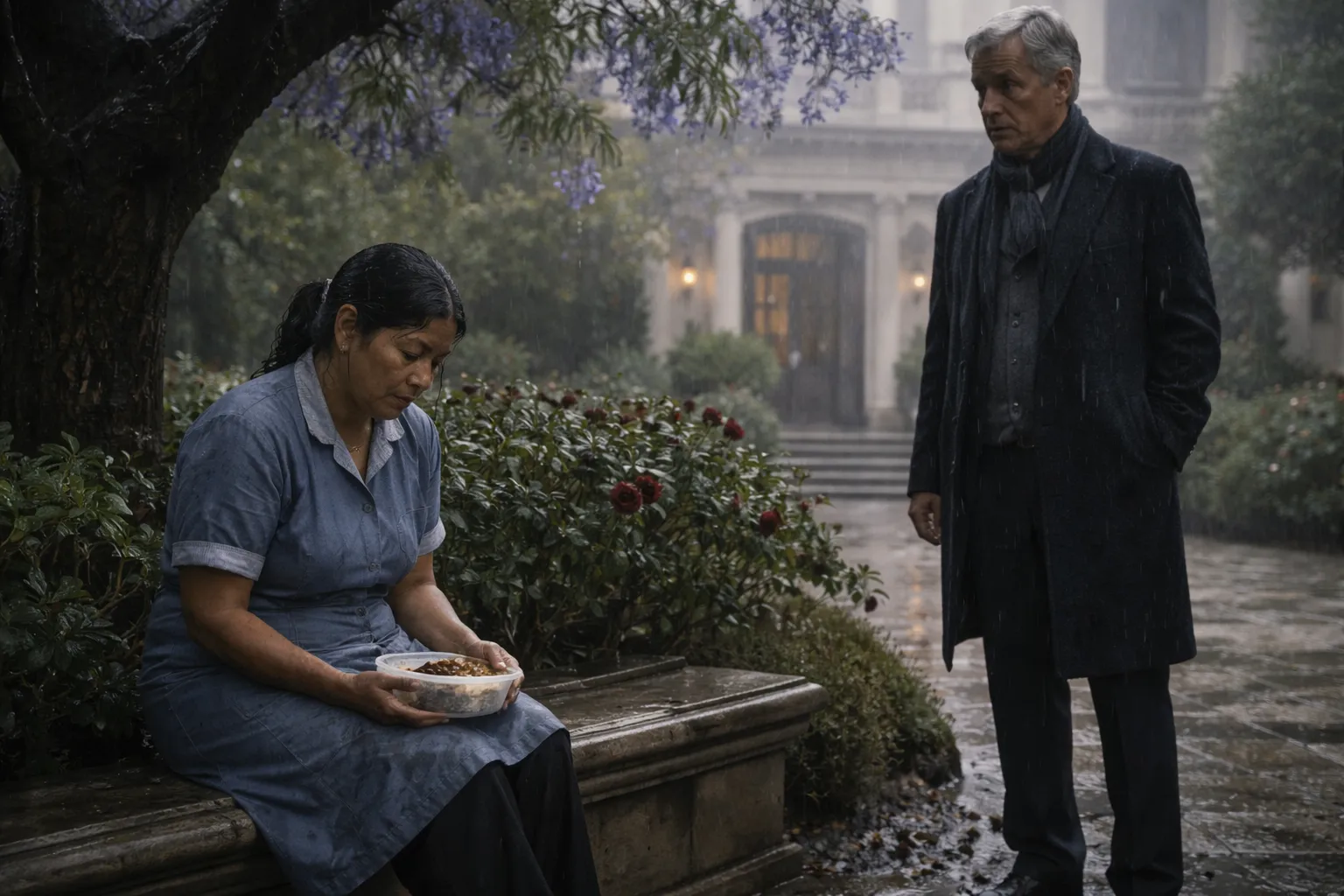
Then Ricardo noticed the woman beneath the jacaranda tree.
She wore a faded blue uniform, the kind meant to disappear into the background of other people’s comfort. Her shoulders were rounded against the cold. Rain slid down her hair, down her face, down the trembling hand that held a fork over a small plastic lunchbox already filling with water. She tried to shield it with one arm, but the food was soaked anyway — a little rice, a spoonful of beans, nothing more.
For a moment Ricardo thought she must have stepped out only seconds before.
Then he saw the look on her face.
Not surprise.
Not inconvenience.
Resignation.
This was not a woman waiting for the rain to pass.
This was a woman who had expected no better place to sit.
Ricardo remained inside the car longer than he meant to. At fifty-nine, he was a man accustomed to moving quickly, deciding quickly, being obeyed quickly. His days were built on schedules, numbers, contracts, and polished rooms where hesitation was treated as weakness. He had spent decades turning ambition into wealth so formidable that entire neighborhoods carried his name in conversation. Hotels, warehouses, real estate, transport — he had built an empire broad enough to make people speak softly when he entered a room.
And yet, watching that woman eat in the rain, he felt something he had not felt in a very long time.
Unease.
He stepped out of the car without taking the umbrella his driver offered.
By the time he reached the tree, the maid had already scrambled to her feet. She clutched the lunchbox to her chest as if she had been caught stealing rather than eating.
“Sir,” she said quickly. “I’m sorry.”
Ricardo frowned.
“Sorry for what?”
She did not answer.
Up close, he recognized her at once. Maria. One of the housemaids. Quiet. Reliable. Middle-aged. Widowed, if he remembered correctly — though he was no longer certain whether he knew that because someone had told him once or because he had read it somewhere on a staffing file he scarcely remembered seeing. Employees passed through his life like background details: uniforms moving through hallways, trays appearing and disappearing, rooms tidied while he was elsewhere deciding matters of greater supposed importance.
“Why are you out here?” he asked.
Maria lowered her eyes.
“It’s alright, sir.”
“That wasn’t my question.”
Her fingers tightened around the lunchbox.
“I didn’t want to disturb anyone.”
The answer was so carefully chosen that it irritated him at once. Not because it was insolent. Because it was incomplete.
Rain ran down the side of her face. She did not wipe it away.
Ricardo looked past her toward the house. Inside were two kitchens, a breakfast room, a staff pantry, and a small sitting room near the service corridor where employees were meant to take short breaks between duties. There was no earthly reason for anyone working in that house to be eating beneath a tree in the rain.
He almost said so.
Instead, he heard himself ask, more quietly this time, “Have you nowhere else to go?”
Maria shook her head too fast.
“No, sir. I’m fine.”
She was clearly not fine. But whatever had put her there had also taught her that explanation was dangerous.
Ricardo looked at the lunchbox once more. Then at the rain. Then back at her.
“Go inside,” he said.
“Yes, sir.”
But even as she answered, he knew she would not.
That evening, the image followed him through dinner, through a conference call with São Paulo, through the portfolio review he should have been concentrating on, through the glass of wine he abandoned half-finished near midnight.
Maria beneath the tree.
Maria apologizing for eating.
Maria looking like a woman who had learned that even hunger must sometimes be kept discreet.
At last, irritated with himself for caring so much about a detail he could not yet explain, Ricardo sent for Álvaro, the longtime butler who had served the household long enough to know where its silences lived.
Álvaro entered the study with the composure of a man who had spent years managing other people’s wealth without ever mistaking it for virtue.
“You asked for me, sir?”
Ricardo did not bother with preamble.
“Why was Maria eating outside in the rain?”
Something changed in the older man’s face — not surprise, but a kind of tired caution.
“I wondered when you might notice,” Álvaro said.
Ricardo straightened.
“Notice what?”
Álvaro hesitated only briefly, then answered with the honesty of someone who had long ago decided that loyalty without truth is merely polished cowardice.
“Several months ago,” he said, “some guests arrived early for luncheon. Maria had just come off the morning cleaning and was in the breakfast room finishing her meal. One of the ladies complained about the smell of detergent on her uniform. Another said she did not think ‘the help’ should be visible while guests were being seated.”
Ricardo felt heat rise under his collar.
“And?”
“And your house manager, hoping to avoid embarrassment, suggested that staff take meals out of sight when guests were present.”
Ricardo stared at him.
“Out of sight where?”
Álvaro’s silence gave him the answer.
Outside.
Behind the house.
Along the service path.
Under a tree, if necessary.
Ricardo rose slowly from behind the desk.
“Who told Maria that?”
“Mrs. Duarte passed along the instruction,” Álvaro replied. “But Maria took it to heart more deeply than most. Even after the room was available again, she never went back. I think…” He paused. “I think humiliation can become a habit when it enters a person quietly enough.”
The study seemed to narrow around Ricardo.
He remembered the luncheon now — vaguely. Not clearly enough to save himself. He remembered investors, imported flowers, two women from the cultural foundation, the smell of roasted sea bass, a minor complaint about timing. He remembered taking a call halfway through the meal and returning only when the matter had already been smoothed over.
Smoothed over.
That was how cruelty often survived in wealthy houses: not through great acts of violence, but through little indignities someone efficient made invisible before the important people had to feel them.
He looked at Álvaro.
“And you let this continue?”
The butler met his gaze steadily.
“I work in the house you built, sir,” he said. “I do not govern the conscience inside it.”
The words landed harder than Ricardo expected.
When Álvaro had gone, Ricardo remained standing in the center of the study for a long time, staring at nothing.
For years he had believed the great moral failures of rich men announced themselves with obvious ugliness — corruption, betrayal, greed, public scandal. He had never considered that moral failure might also look like not noticing who had been pushed outside so the silverware could shine more comfortably.
The next day, just before noon, Ricardo made sure he was home.
He did not announce himself.
He did not call Maria in.
He simply watched from the conservatory window as she left the service corridor with the same small lunchbox in her hands and walked, with the quiet certainty of routine, straight back to the jacaranda tree.
No rain this time.
Only a pale, hesitant sun after the storm.
She sat on the low stone edge near the roots, opened the container, and began to eat slowly — not because she was savoring it, but because there was so little of it.
Ricardo stepped outside.
Maria looked up and rose at once.
“Sit,” he said.
She remained standing.
“Please, sir, I can go—”
“No.” He approached more gently than he had the day before. “I asked you once why you eat out here. I would like a real answer now.”
Maria pressed her lips together.
He waited.
At last she spoke without looking at him.
“The first time was because I was told the guests shouldn’t see me.”
Her voice was calm, but there was old pain in the control of it.
“After that…” She swallowed. “After that I felt ashamed going back in.”
Ricardo said nothing.
Maria gave the small, embarrassed shrug of someone forced to explain a humiliation so petty it sounds foolish out loud and yet has still governed her life.
“They said I smelled like bleach,” she continued quietly. “And soap. I know it’s not pleasant when someone is about to eat. So I thought it was better not to cause discomfort.”
Ricardo looked at her lunch.
“A bit of rice and beans causes no discomfort,” he said.
Maria managed the faintest smile, though it barely held.
“It wasn’t the food.”
No, Ricardo thought.
It had not been the food.
It had been class. Proximity. The ancient human ugliness of people wanting service without evidence of the person who provides it.
He sat down on the wet stone bench opposite her before she could protest.
“Maria,” he said, and the use of her name startled her enough that she finally looked up, “how long have you worked here?”
“Four years, sir.”
“And during those four years, how many times have you eaten lunch properly at a table inside this house?”
She hesitated.
“Not many.”
The answer shamed him more than accusation would have.
In the days that followed, Ricardo began watching more carefully — not Maria alone, but the house itself.
He learned what he should have known long ago.
Maria arrived nearly two hours before her shift because she walked a long distance from her neighborhood rather than paying for two buses. She often left the mansion and went directly to a second job cleaning offices in the city center. She was a widow. Her husband had died of a stroke five years earlier. Since then she had been raising her son alone and sending part of every paycheck toward his schooling, though “schooling” turned out to mean far more struggle than the word suggested.
One evening, without telling anyone except his driver, Ricardo went to the district where Maria lived.
It sat on the far edge of the city where asphalt gave way to patched concrete and unfinished walls held up roofs by stubbornness more than engineering. Laundry sagged on lines between narrow houses. A mechanic worked beneath a broken streetlamp. Children played barefoot with a deflated ball in the alley. Everything about the neighborhood spoke of lives held together by effort rather than ease.
Ricardo found Maria’s address and remained in the car longer than dignity required before finally stepping out.
Through a half-open window he saw a small room lit by a weak hanging bulb. At a table too narrow for comfort sat a teenage boy bent over a stack of borrowed books. One elbow rested near an anatomy drawing carefully copied by hand. On the wall above him hung three pictures: a stethoscope drawn in blue pen, a hospital bed sketched in pencil, and a woman in a maid’s uniform standing beside a boy in a white coat.
Ricardo stood outside in silence.
The boy noticed him first.
He rose immediately, uncertain but polite.
“Can I help you, sir?”
Ricardo introduced himself.
The boy’s face changed — first confusion, then alarm, then the stiff respect poverty teaches children to give powerful men before they know whether power has come to help or punish.
Maria appeared from the back room a second later and nearly dropped the basin she was carrying.
“Sir?”
Ricardo raised a hand.
“I didn’t come to intrude,” he said. “I wanted… to see.”
It was the clumsiest sentence he had spoken in years.
Maria, perhaps too tired to question him properly, stepped aside.
Their house was clean in the way poor homes often are when order is the only luxury a family can control. The floor had been scrubbed. Two cups dried upside down on a cloth. The curtains were mended by hand. A single fan turned slowly in the corner, stirring warm air rather than cooling it.
The boy’s books were stacked with reverence.
“You study medicine?” Ricardo asked.
The boy nodded.
“I want to become a doctor.”
Ricardo glanced at the drawings on the wall.
“For the salary?”
The boy looked almost offended by the question.
“No, sir,” he said. “For my mother.”
Maria lowered her eyes.
The boy continued, now more softly.
“She gets up before daylight and comes home after dark. She has cleaned all her life. I want…” He hesitated, embarrassed by the size of what he meant. “I want her to rest one day. And I want to help people who are treated like they should be grateful just to be seen.”
Ricardo turned toward the wall because all at once the room had become too small to hold what he was feeling.
He had built towers taller than churches.
He had closed deals so large newspapers described them as historic.
He had employed thousands.
And yet standing in that modest room, looking at a widow’s son studying under a dim bulb beside a drawing of his mother in uniform, he understood with punishing clarity that success had made him efficient without making him good.
He left soon afterward, saying little.
Maria walked him to the door.
“Sir,” she said hesitantly, “if I’ve done something wrong—”
“You have done nothing wrong,” Ricardo interrupted.
His voice came out rougher than he intended.
Then, after a pause, he added, “The wrong was mine. I simply didn’t know it yet.”
The next morning every senior household employee was called to the mansion’s main dining room at nine sharp.
They arrived nervous.
Men like Ricardo Reio did not summon staff before breakfast unless something serious had shifted.
Maria entered last, clearly certain she was about to be dismissed.
Instead, she found not accusation but a long polished table, coffee set out for everyone, and Ricardo standing at the head of the room without a jacket, without files, without the usual polished distance he wore like a second skin.
He waited until all were seated.
Then he spoke.
“For too long,” he said, “there has been a rule in this house more powerful than any written policy. The rule was simple: some people here matter more than others, and those who serve are most acceptable when invisible.”
No one moved.
Ricardo’s gaze traveled from face to face — the cook, the groundskeeper, the drivers, the laundry women, the younger maids, Álvaro, Mrs. Duarte, and finally Maria.
“That rule ends today.”
Mrs. Duarte opened her mouth to explain, but Ricardo lifted a hand.
“No. You may listen first.”
She closed it again.
Ricardo continued more slowly.
“Months ago, one of our staff members was humiliated because guests found the smell of soap and detergent inconvenient near their lunch. Instead of defending the employee who had spent the morning cleaning the very house they enjoyed, this household taught her to remove herself. She began eating outside. In silence. In shame. Even in the rain.” He paused. “And I did not notice.”
The admission fell into the room like a weight.
“I am responsible for what is permitted under my roof,” he said. “If I was too busy, too distracted, or too proud to see what was happening, that is not an excuse. It is the failure itself.”
Then, turning to Maria directly, he said the words she never expected to hear from him.
“Maria, I owe you an apology.”
Her hand flew to her mouth.
The room remained utterly still.
“No one who works in this house with honesty should ever be made to feel unworthy of a chair, a table, or ordinary human respect,” Ricardo said. “Not by guests. Not by management. Not by me.”
Maria’s eyes filled immediately, but she held herself together with the same dignity that had carried her through years of harder days than this one.
Ricardo went on.
“From this day forward, the breakfast room beside the east kitchen will be reserved as a proper staff dining room during break hours. It will remain open, furnished, and maintained with the same standard of care as every other room in this house. No employee will be asked to hide while eating. No guest who cannot respect the people who serve here will be welcome here for long.”
At that, even Álvaro lowered his eyes briefly, as if to hide relief.
Ricardo then placed an envelope on the table before Maria.
She looked at it as though touching it might be dangerous.
“Please open it.”
Inside was a formal letter from one of the best preparatory academies in the city, followed by a scholarship agreement covering tuition, transportation, books, and a living stipend through university entrance.
Maria stared down at the pages without breathing.
“It’s for your son,” Ricardo said quietly. “If he wishes to study medicine, he will not abandon that dream because his mother spent her life carrying too much alone.”
Maria began to cry.
Not loudly.
Not dramatically.
Just the exhausted, astonished tears of a woman who had taught herself never to expect rescue because disappointment is easier to survive when you see it coming.
“Sir… I don’t know what to say.”
“You don’t need to say anything yet.”
He placed a second document beside the first.
“This is an offer for a new position. Cleaning Supervisor. Higher salary. Fewer hours on the floor. Management training paid by the company, if you choose to accept it.”
Mrs. Duarte turned pale.
Ricardo did not glance at her.
“Kindness is not a qualification for management,” he said to the room. “But without it, management becomes a polished form of cruelty. I have no intention of funding that any longer.”
Maria looked as if the floor had vanished beneath her.
“I never asked for this.”
“No,” Ricardo replied. “You asked for nothing. That is why I should have seen more.”
The changes did not end with the meeting.
Within weeks, wages were reviewed. Break schedules were formalized. Staff uniforms were improved so employees were no longer expected to make old fabric survive past dignity. A guest code of conduct was quietly but firmly established. The east breakfast room was repainted in warm colors and fitted with proper tables, soft light, and windows left open to the garden. Ricardo’s family, startled at first by the force of his attention, soon noticed that the house itself had changed mood.
Employees laughed more.
Footsteps sounded less cautious in the hallway.
People met one another’s eyes.
Maria, now supervising with calm authority, turned out to be one of those rare women whose gentleness had always been mistaken for weakness by people too shallow to tell the difference. Younger staff trusted her. Older staff respected her. Problems that once festered in silence were brought to her early and resolved cleanly.
As for Ricardo, the transformation embarrassed him precisely because it seemed so obvious in retrospect.
He began learning the names of the people who worked for him — and not only the names. Who had children. Who had aging parents. Who was studying at night. Who had once been a pastry chef before divorce brought her back into service work. Who sent half his wages home to a sister. Who walked. Who limped. Who smiled too quickly because life had taught them rich men preferred cheerful labor.
His family noticed the difference first at dinner.
He listened more.
Interrupted less.
Asked questions that did not begin and end with business.
His daughter, who had once accused him of mistaking provision for love, watched him quietly over the rim of her glass one evening and finally said, “You look like a man who has discovered something expensive he should have learned for free.”
Ricardo almost smiled.
“She’s right,” his wife murmured.
Years passed.
Maria’s son studied harder than anyone expected and complained less than he had a right to. He commuted long hours, worked evenings, earned distinctions, and eventually entered medical school with the kind of determined humility that tends to outlast brilliance because it is built on sacrifice rather than talent alone.
Ricardo kept his promise.
Not as charity.
Not as patronage to soothe his own conscience.
As a debt to dignity.
On the day of graduation, the auditorium was full of proud families, tired flowers, borrowed suits, and mothers pretending their hands were not shaking. Maria sat in a navy dress she had bought only after being persuaded she deserved something new. Ricardo and his wife sat beside her, not in a special section, not as benefactors demanding acknowledgment, but as witnesses.
When Maria’s son crossed the stage with honors, she cried openly this time.
So did Ricardo, though he disguised it poorly as a sudden need to clear his throat.
After the ceremony, amid embraces and photographs, the young doctor turned toward the man who had once watched his mother eat in the rain.
“Thank you,” he said.
Ricardo shook his head.
“No,” he replied softly. “Your mother taught me what that word means before I ever deserved to hear it.”
Maria stood between them, one hand in each of theirs.
The afternoon was bright. The future, at last, felt larger than memory.
Later, when the crowd thinned and the flowers began to wilt at the edges, Maria looked at Ricardo with the same steady dignity she had carried even in humiliation and said, “You changed our lives.”
Ricardo answered her honestly.
“So did you.”
Because that was the truth of it.
He had spent half a lifetime believing that wealth was the power to command comfort, silence inconvenience, and move the world aside when necessary.
But real wealth, he now understood, had very little to do with what a man could purchase.
It had to do with whether he noticed who had been sent outside so his comfort could remain undisturbed.
It had to do with whether he corrected the wrong once he saw it.
And it had to do with whether, after all his years of success, he was still humble enough to be taught by a woman in a faded blue uniform holding a rain-soaked lunchbox beneath a tree.
Sometimes transformation does not begin with a grand speech, a public scandal, or a crisis large enough to frighten newspapers.
Sometimes it begins with something far smaller and far more difficult:
the moment a powerful man is forced to admit that the cruelest thing in his house was not what others had done,
but what his own indifference had allowed.
And from that day on, no one in Ricardo Reio’s mansion ever ate in the rain again.