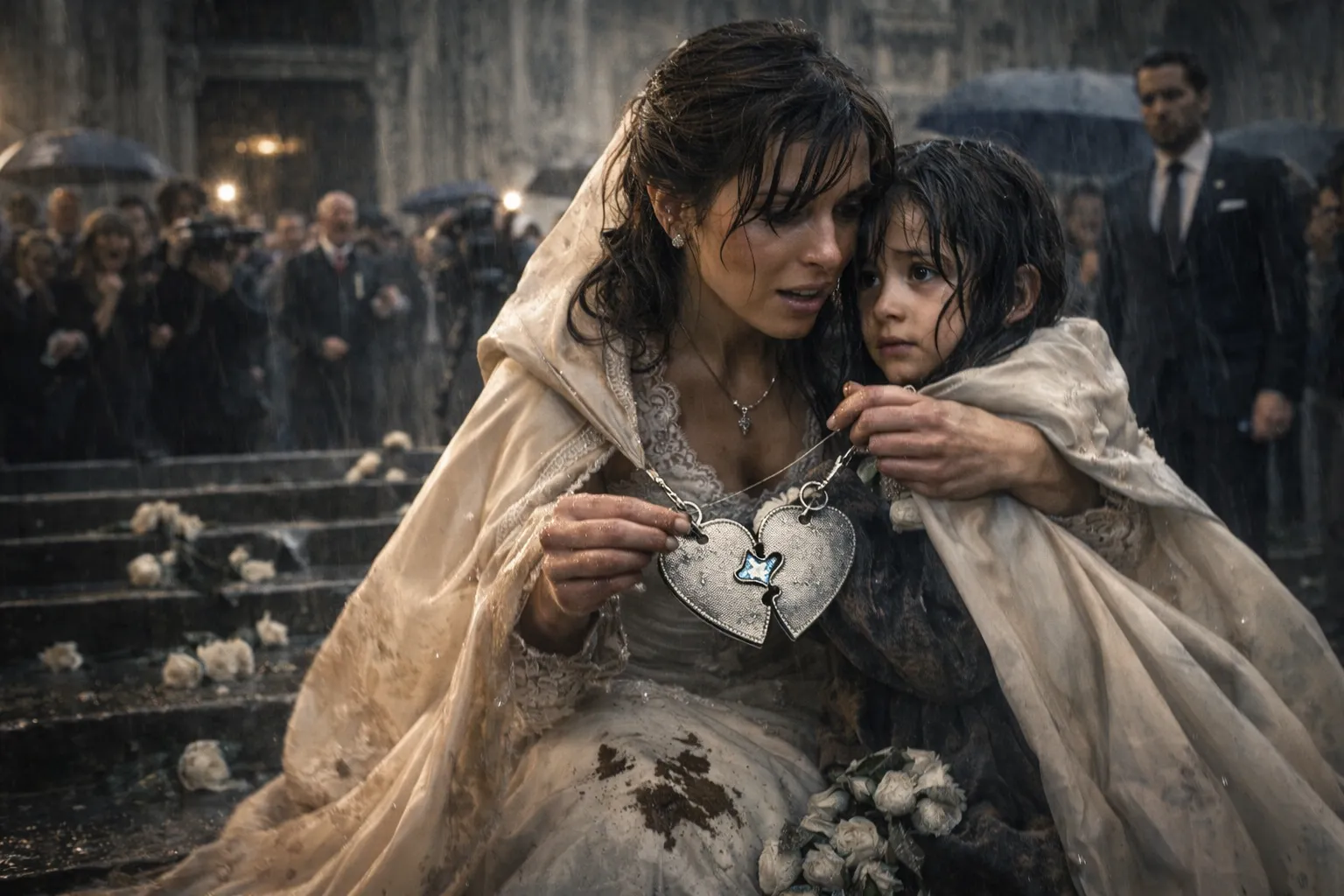
Bianca Moretti thought the worst thing that could happen on her wedding day was a frightened child staining six layers of white silk in front of cameras, guests, and a furious mother. But when the little girl’s broken silver heart locked perfectly into the necklace Bianca had worn since the day she was told her baby died, the entire cathedral became a courtroom — and the life Bianca had been living began to collapse in public.
The first scream that afternoon did not come from Bianca.
It came from her mother.
Bianca Moretti had just stepped out of a white Bentley at the top of the cathedral steps in Milan when a rain-soaked girl slipped beneath the velvet rope and collided with the side of her gown. The child could not have been older than eleven. She clutched a fistful of white roses in one hand, and when she lost her footing on the wet marble, her muddy fingers caught six layers of Bianca’s silk to keep herself from falling.
A brown handprint bloomed across the dress like an accusation.
The crowd gasped.
Phones rose instantly.
Someone laughed.
Someone whispered, “Who let her through?”
Bianca had spent the entire morning holding herself together by force. Her mother had tightened her corset until breathing hurt. Her fiancé, Adrian Belli, had been smiling for photographers as if the wedding were an acquisition and Bianca just another signature he expected by nightfall. Under the lace at her throat, hidden from the cameras, Bianca wore the one thing she never removed: a small silver half-heart necklace with a blue enamel star at its center.
It was the only thing left from the baby she had been told died eleven years earlier.
When the child’s muddy hand struck her gown, something hot and ugly broke loose inside Bianca.
“Get her off me.”
She tore the skirt free. The girl stumbled and fell to her knees. The white roses scattered over rain-dark stone.
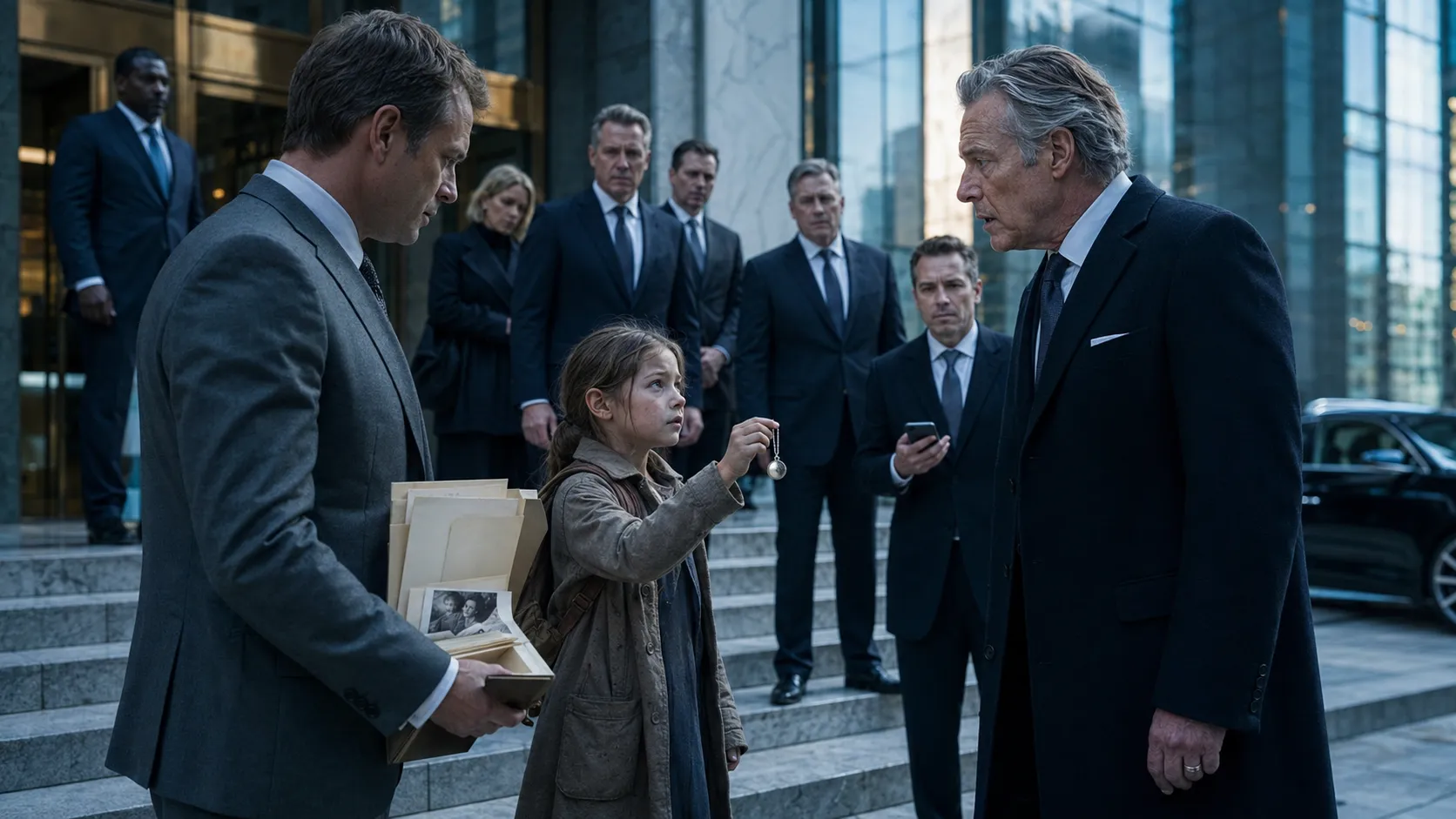
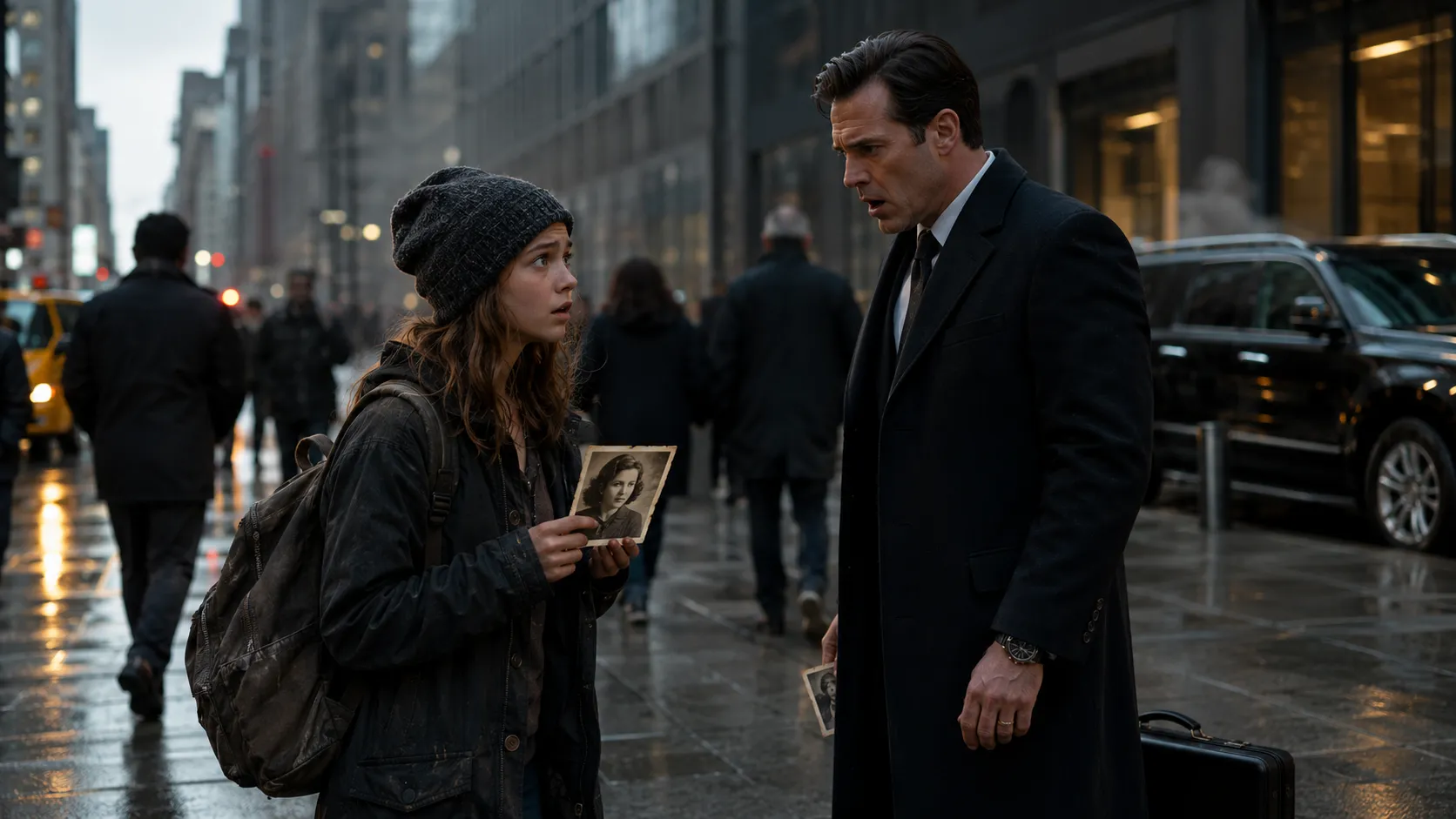
“I’m sorry,” the child whispered, shaking from cold and fear. “But I had to show you something before you marry him.”
Bianca barely heard her. In that first furious second she saw only the stain, the cameras, her mother’s horror, Adrian’s irritation, and the fact that one more thing had slipped out of her control.
Then the girl reached under her collar and pulled out a broken silver pendant.
Bianca’s breath stopped.
At that exact moment, her own necklace slipped loose from the lace at her throat.
The two halves swung toward each other and met with a tiny metallic click.
Perfect fit.
A heart made whole.
And in the center, where the seam closed, the little blue enamel star caught the rain-light.
The world did not end with thunder or fire.
It simply went silent.
There had only ever been two halves like that in the world.
Matteo had made them from an old silver coin during the hottest summer of Bianca’s life, back when she was nineteen and reckless enough to believe love could protect her from family, money, and consequence. One half had stayed on Bianca’s neck. The other had been tied to the blanket of the newborn daughter she had held for only a few minutes before the private clinic told her the baby was gone.
Her mother had said the pendant had been buried with the body.
Bianca stared at the girl.
“Where did you get that?”
The child lifted frightened eyes.
“Aunt Mara said my mother would have the other half,” she said. “She said if you started crying, I should tell you the thunder song still works.”
Bianca nearly dropped to the marble.
Only one person in the world knew about the thunder song.
The lullaby she had sung to her newborn beneath a hospital window while rain struck the glass and the baby’s tiny fingers closed around nothing but air.
Livia Moretti moved first. Bianca’s mother stepped toward the child, face hard as cut glass.
“This is extortion,” she snapped. “Security, remove her.”
Bianca threw out one arm without taking her eyes off the girl.
“Nobody touches her.”
The crowd fell still.
Even the bells seemed to hesitate.
Adrian came up the steps, elegant in black, already tense beneath the polish.
“Bianca, the guests are waiting.”
Bianca turned toward him slowly, still holding the joined pendant halves between both hands.
“Did you know?” she asked.
His eyes flickered.
Not confusion.
Not shock.
Calculation.
That was answer enough.
The child was shivering now, soaked through, cheeks hollow from too many hard days. Bianca removed the ivory cape from her own shoulders and wrapped it around the girl. Another ripple passed through the crowd. Two minutes earlier they had watched a bride shove away a street seller. Now that same bride was kneeling on wet marble, fastening her wedding cape around her.
“What is your name?” Bianca asked.
“Mila.”
“How old are you?”
“Eleven.”
Exactly.
Bianca closed her eyes.
Mila reached into her dress and pulled out a creased envelope sealed with trembling strips of tape.
“Aunt Mara said I had to give you this if I found the other half.”
The name hit Bianca before she could place it.
Mara.
A nurse from San Vittore Private Clinic.
The one with kind hands.
The one who had looked at Bianca strangely the morning they told her the baby was dead.
The one Bianca had remembered for years without understanding why.
Bianca took the envelope.
Then she stood, turned toward the priest, the photographers, the altar, the guests, and the man waiting to marry her, and said with perfect clarity:
“The wedding is over.”
Livia’s face drained.
Adrian stepped forward at once.
“Bianca, don’t be dramatic.”
She looked at him as if seeing his true size for the first time.
“You tried to buy silence from a child.”
Mila’s voice, thin and frightened, rose beside her.
“He came yesterday. He said I should take the money and go somewhere far.”
Now no one was pretending it was confusion anymore.
Bianca walked into the side room off the sacristy with Mila still wrapped in her cape. The walls smelled of old stone and extinguished candles. Her hands trembled so badly she could barely tear open the envelope.
Inside was a letter, a yellowed hospital bracelet, and a copy of a birth record with one name blacked out.
The letter began:
If this reaches Bianca Moretti, then I have finally run out of cowardice.
Bianca had to sit down before she could keep reading.
Mara wrote that she had been the night nurse at San Vittore eleven years earlier, when Bianca had arrived bleeding after a car accident and delivered early. Bianca had begged to see her baby. Livia had begged the clinic to save Bianca’s reputation.
Matteo, the baby’s father, had been poor. Wrong family. Wrong future. Wrong last name.
Livia had paid the clinic director and an adoption broker to tell Bianca the baby died hours after birth. The infant was supposed to be taken out of the country under sealed arrangements.
Mara had been the one ordered to carry the newborn downstairs.
But when the baby curled her hand around Mara’s finger, the nurse broke.
Instead of handing the child over, she ran.
She took the baby to her widowed sister in Ancona and claimed the girl as her niece. For years Livia’s money bought the silence — debts paid, rent handled, warnings delivered through lawyers and intermediaries. Mara convinced herself she was protecting the child from powerful people who would only take her away again. Then her sister died. Then Mara got sick. Then the money stopped.
And three days earlier, Adrian Belli himself had come to Mara’s apartment with an envelope of cash and one instruction:
Bianca must never know.
The last lines of the letter were shakier than the rest:
Your child is alive. I was wrong to keep her from you this long. I was also wrong to believe your mother would stop if her future was threatened. Do not marry the man who already knows what was done to your daughter and calls it inconvenient. Her name is Mila because she needed a name, but the bracelet proves who she is. I am sorry for every year I stole.
Bianca read the letter twice.
Then a third time.
When she finally looked up, Mila was perched on the far edge of a wooden bench, still wrapped in the ivory cape, staring at the floor as if she expected at any moment to be thrown back into the rain.
Bianca crossed the room slowly and crouched in front of her.
“Did Mara love you?” she asked.
Mila nodded at once.
“Very much.”
“Did she ever hurt you?”
“No.”
Bianca closed her eyes for one aching second.
She could hate Mara for the lost years and still know that, in one terrible moment, the woman had chosen mercy while everyone else chose money, fear, or convenience.
When Bianca opened her eyes again, Mila was watching her carefully.
“Are you angry?” the girl asked.
Bianca swallowed.
“At you? Never.”
Something in Mila’s face softened and cracked all at once.
Bianca reached out, then stopped an inch from her cheek.
“May I?”
Mila gave the smallest nod.
Bianca brushed the wet hair from her forehead.
The same dark lashes.
The same small notch in the left eyebrow Bianca had inherited from her father.
The same stubborn mouth.
Her daughter.
Her daughter had been selling roses in the rain while Bianca prepared to marry a man who already knew and had chosen silence.
Bianca stood up so quickly the bench scraped the floor.
When she returned to the nave, the guests were no longer pretending this was a private family crisis. News travels quickly where money gathers. Livia stood near the altar, rigid with fury. Adrian’s father was on the phone. Adrian himself wore the face of a man sorting rapidly through possible lies.
Bianca walked straight up the aisle, dragging rain and mud behind her like a second train.
She stopped in front of Adrian first.
“You knew before today,” she said.
He lowered his voice, still trying to keep the performance contained.
“Listen to me carefully. Whatever happened years ago, we can manage this quietly. The press doesn’t need—”
Bianca pulled off her engagement ring and dropped it into his palm.
“I hope it cuts you.”
Then she turned to her mother.
Livia had gone pale, but not soft.
“I saved your life,” she hissed. “You were a child. That pregnancy would have ruined everything.”
Bianca looked at her for a very long time.
“No,” she said. “You ruined everything.”
Livia’s eyes flicked toward the sacristy.
“You don’t even know if that girl is yours.”
Bianca lifted the yellowed hospital bracelet.
It held the date.
The clinic code.
Her surname.
Then she raised the rejoined silver heart so the room could see the seam and the blue star.
“And if the DNA test somehow fails,” Bianca said, voice cold as cut stone, “I will still know more about truth from one frightened child than I ever learned from my own mother.”
Livia opened her mouth, but nothing came.
The priest stepped back.
Someone near the front pews started crying softly.
Phones remained fixed in the air.
Bianca took out her phone and made one call.
When her lawyer answered, she said only four words:
“Open San Vittore’s files.”
The scandal detonated before sunset.
By evening, every major paper in Milan was carrying the same image: Bianca in her wedding dress kneeling in the rain beside a flower-selling child, the silver heart held between them like evidence from another life.
The DNA test came back two days later.
Mila was hers.
The clinic director denied everything until police found old payment records, private adoption correspondence, and an archived file Livia believed had been destroyed. Adrian denied involvement until the building concierge from Mara’s apartment identified him from a photo lineup. His family’s merger with Moretti Holdings collapsed in less than a week. Livia was charged with fraud, coercion, conspiracy, and falsifying medical records.
Bianca did not attend the first hearings.
She was too busy learning how to stand near her own daughter without frightening her.
That turned out to be harder than rage.
Harder than scandal.
Harder even than grief.
Mila didn’t call her Mom.
She asked permission before touching anything in the apartment.
She hid bread rolls in her sleeves.
She slept curled on top of the blanket, fully dressed, as if she might need to flee in the middle of the night.
When Bianca bought her new clothes, Mila thanked her like a guest.
The first time Bianca tried to hug her, the child went stiff as wood — not because she didn’t want comfort, but because she had never learned what safety felt like when it arrived without conditions.
So Bianca stopped trying to force the miracle everyone wanted from them.
She sat on the floor outside Mila’s room at night and told stories through the half-open door.
She learned Mila hated loud blenders, loved pear jam, and counted every exit in every room.
She learned that Mara had taught her to read from opera programs, food labels, and supermarket flyers.
She learned that whenever Mila felt anxious, she lined up buttons by color because order felt like protection.
She learned, with a pain so deep it humbled her, that love can survive in other people’s hands for eleven years and still come home starving.
One evening, a month after the wedding that never happened, a storm rolled over Milan.
The first thunderclap made the kitchen lights flicker.
Bianca was standing over two mugs of hot chocolate when Mila appeared in the doorway wearing oversized socks and holding the rejoined pendant in both hands.
“Did you really sing to me?” she asked.
Bianca leaned against the counter because suddenly her knees no longer felt reliable.
“Only once,” she said. “At the clinic. It was raining.”
Mila looked down at the silver heart.
“Mara remembered part of it. She called it the thunder song.”
Bianca’s throat closed.
“Do you want to hear it?”
Mila nodded.
So Bianca set down the mugs, lowered herself to the kitchen floor because that was where Mila seemed to feel safest, and began to sing the words she had carried inside her body for eleven years.
Little star, don’t fear the thunder.
Night is loud, but I am near.
When the dark forgets your name,
Follow my voice. I will be here.
By the second line, Mila was no longer standing across the room.
By the third, she was sitting beside Bianca, one shoulder pressed lightly against her arm.
By the fourth, she was crying.
Bianca kept singing.
When the lullaby ended, the silence between them was no longer empty. It was alive, fragile, and full of all the years they had lost.
Mila turned the pendant over in her hands, looked up with tear-bright eyes, and asked in a voice barely stronger than breath:
“Can I call you Mom… even if I’m still learning how?”
Bianca laughed and sobbed at the same time.
She opened her arms slowly enough for Mila to pull away if she wanted.
Mila didn’t.
Outside, rain ran down the windows in silver lines. Inside, the broken heart rested whole between them.
And for the first time since the cathedral steps, Bianca did not feel as if fate had struck her.
She felt as if, after eleven unforgivable years, it had finally returned what was hers.