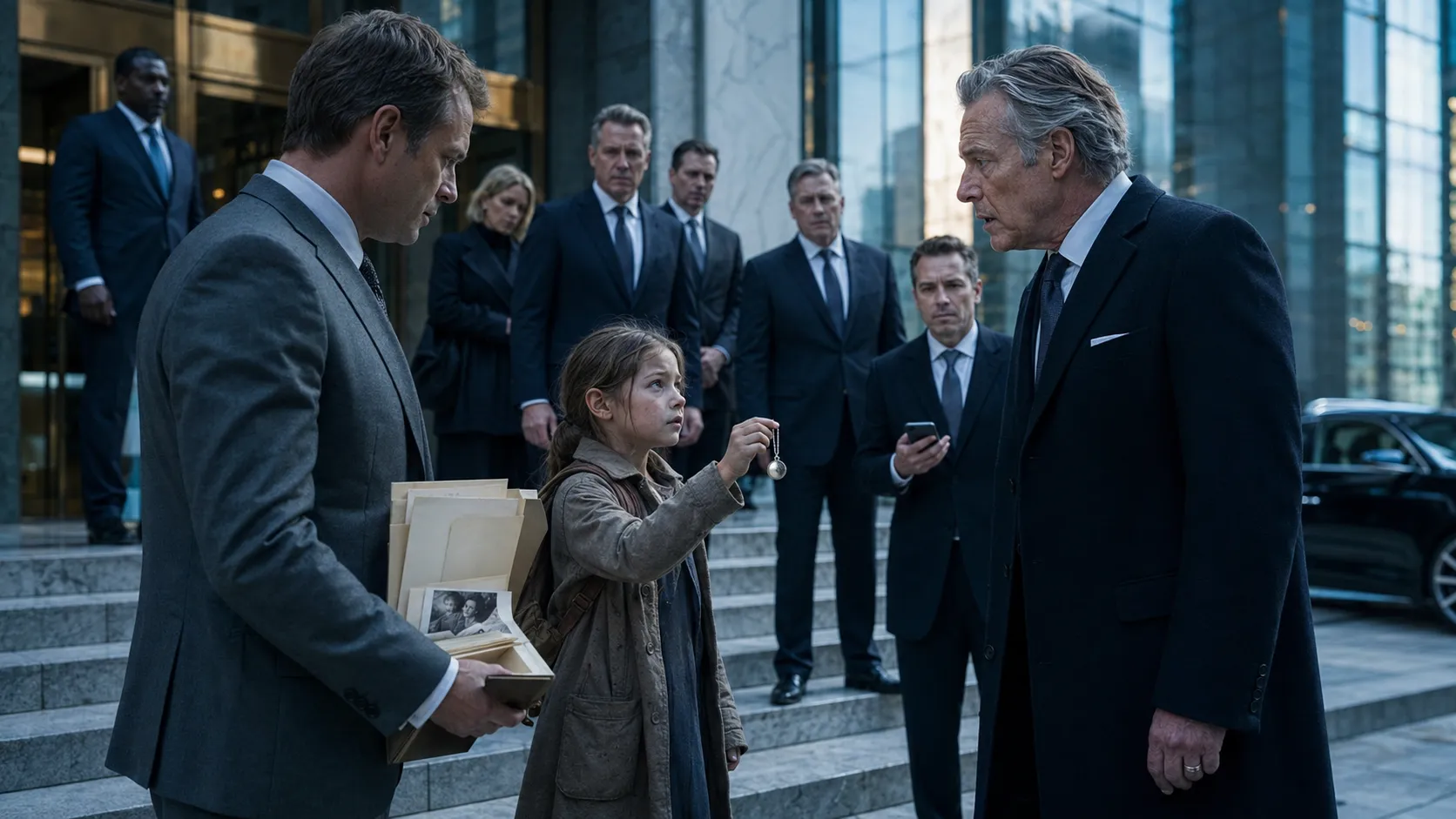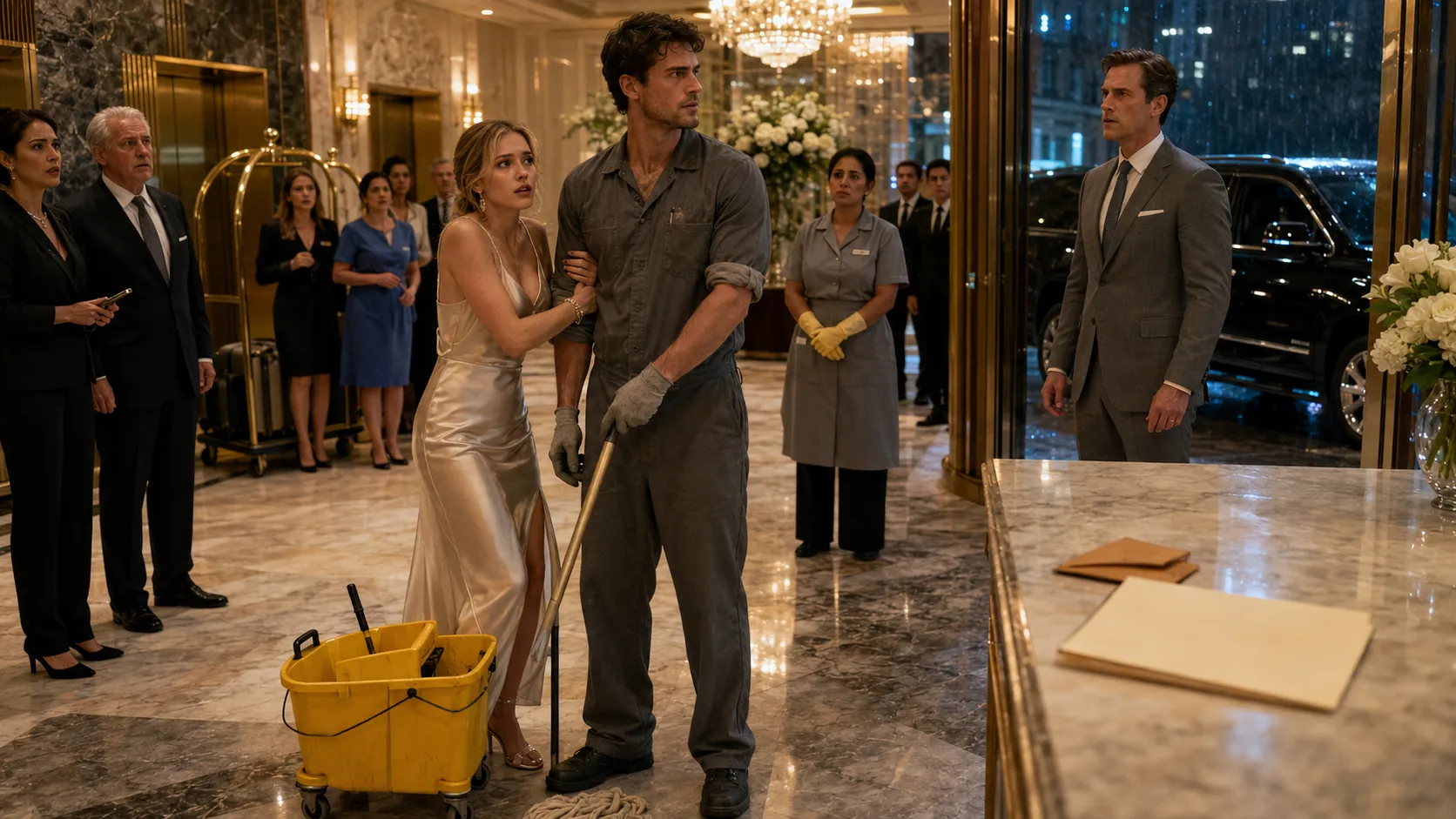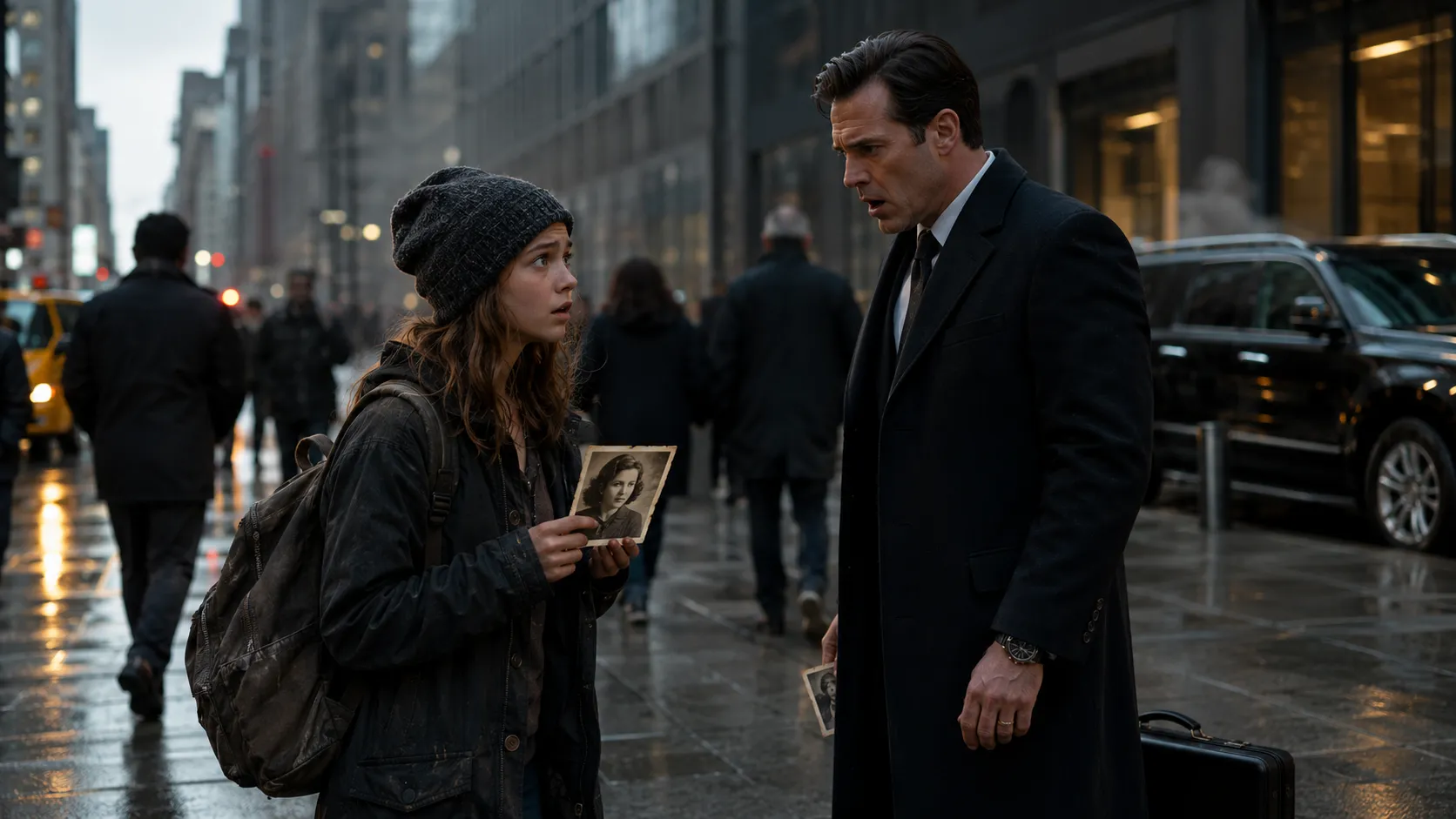

Sebastian Morel thought the soaked child running across his reopening gala was just another threat to be removed before the cameras caught it. But when a red-greased bolt spun across the marble and the glass elevator shuddered with his daughter still half inside, the billionaire realized too late that the boy he had shoved was the only person in the building trying to save her life.
At 9:12 p.m., Aurelia Tower was exactly where Sebastian Morel believed it belonged: in every camera in the city.
Fifty-eight floors of glass, gold, and engineered prestige had been polished into perfection for reopening night. Below the mezzanine, the atrium spilled downward in rings of light and marble like a chandelier turned inside out. Donors in black tie floated through the lower level. Violinists played on a raised platform. Waiters threaded silver trays between clusters of money and perfume. Journalists angled for clean shots of the balcony where Sebastian stood with his daughter framed by the open doors of the panoramic west lift.
It had taken eighteen months to rebuild the place after the fire, the lawsuits, the insurance war, and the quiet collapse of everything that had once felt stable after Claire died.
Sebastian had rebuilt the tower the same way he rebuilt everything else in his life: fast, flawlessly, and at a cost nobody else could afford.
Ava stood beside him in a velvet coat the color of honey, one hand in his and the other wrapped around a small stuffed fox she refused to surrender even at formal events.
“Can I press the button this time?” she whispered.
For one second, he almost smiled.
“That,” he said, “is the only reason you agreed to come.”
He had not wanted to bring her. His advisers insisted. The reopening was the first major public event since Claire’s death, and investors liked symbols they didn’t have to think too hard about. Grieving widower. Courageous little daughter. Family continuity. Legacy surviving loss in glass and gold.
So Sebastian had given them what they wanted: a black tuxedo, a controlled expression, and his eight-year-old daughter standing beside him like the last honest thing left in the building.
Julian Kade, his chief operating officer, stood three steps back, speaking smoothly into two phones at once.
“Once you’re in the lobby, the foundation speech, then the ribbon, then the camera wall,” he murmured. “Twelve minutes total.”
Sebastian nodded without really hearing him.
Then a boy came running out of the service corridor.
He was maybe twelve or thirteen. Thin, rain-soaked, all panic and momentum. He wore gray maintenance coveralls with one sleeve torn at the cuff. Grease streaked one side of his face. One lace had come loose from his shoe. He looked like the kind of child the city trains itself not to notice until he becomes disruptive enough to force acknowledgment.
“Don’t let her get in there!” he shouted.
Security was slow by a heartbeat.
The boy reached the lift before anyone else and slammed his hand between the glass doors.
Ava startled.
The stuffed fox slipped from her arm.
The nearest guests gasped and turned.
Sebastian reacted the way men like him often react when fear arrives disguised as disorder.
He shoved the boy hard.
“Get away from my daughter.”
The child hit the marble shoulder-first and skidded sideways across the mezzanine.
Then something metal flew out of his hand, bounced once near the threshold, spun in a tight silver circle, and came to rest with a hard ringing clang.
A steel bolt.
Its threads were wet with thick red grease.
For one irritated second, Sebastian still saw only a dirty intruder and a scene unraveling in public.
Then the boy pushed himself up on one elbow and said, breathless and shaking, “Please. My mother said if the red-striped bolt was missing, the lift would fall.”
Sebastian turned.
Above the right-hand door track, inside the exposed edge of the housing, a fresh smear of red grease glistened beneath the gold lights.
The doors twitched.
Not fully.
Not enough for the crowd below to understand.
Just a dry metallic jerk that made the hair rise on his arms.
The head engineer standing near the press line went white.
“Sir,” he said far too quickly, “step back from the car.”
Sebastian did not remember crossing the distance. One second Ava was still inside the threshold, confused, one hand reaching instinctively for the fox she had dropped. The next he had yanked her against his chest so hard she cried out.
The doors tried to close again.
The car dropped half an inch with a brutal steel cough.
Women screamed below.
A glass shattered.
The engineer lunged for the emergency cut-off.
The indicator lights went black. The car shuddered and hung at an angle.
For the first time that night, Julian Kade stopped looking composed.
“What the hell is this?”
The boy was already scrambling toward the fallen bolt. He grabbed it in both hands and held it up like proof.
“I took it from the service bin,” he said. “It came out of the brake housing. My mother told me to watch for the red stripe.”
Security finally reached him and seized his arms.
“Don’t touch him,” Sebastian said.
No one moved after that.
Not the guards.
Not the guests.
Not Julian.
Sebastian set Ava behind him and looked at the boy properly for the first time.
He was thin in the way children become thin when food is managed like logistics. Not filthy. Not feral. Just overworked. A small cut ran across one knuckle. His eyes were too alert for his age.
“What’s your name?” Sebastian asked.
“Leo.”
“Your last name.”
“Ramires.”
The name meant nothing to him.
“Where is your mother?”
Leo swallowed hard.
“I don’t know. She cleans the executive floors at night. She called me crying. Then the line cut. She told me if I couldn’t find her, I had to stop you from using the west lift.”
“Why me?”
Leo looked not at Sebastian, but at Ava.
“Because she said the little girl would be with you.”
That changed something in the air.
Sebastian felt Ava’s hand fist against the back of his jacket.
Julian stepped forward at last, polished irritation flowing back into his features.
“This is insane. He stole a bolt from maintenance and now he’s inventing a story because he got caught in a restricted area.”
Leo shook his head violently.
“No. She sent me this.”
He fumbled with a cracked phone in the chest pocket of his coveralls. His hands shook so badly he nearly dropped it. When he finally hit play, the first sound was static and hurried footsteps.
Then a woman’s voice.
Breathless. Low. Terrified.
“Leo, listen to me. If they lock me out, go to the west lift. Check the brake housing above the door. If the red-striped bolt isn’t there, do not let Mr. Morel’s girl step into that car. Do you hear me? Not the girl. Not even for one second.”
A crash sounded behind her.
Then she spoke again, faster now.
“If anything happens to me, tell him Julian was in the machine room after sign-off.”
The recording cut out.
No one breathed.
Julian laughed first.
Too quickly.
“A forged audio clip from a stolen phone? Is that what this is?”
But Sebastian wasn’t looking at him.
He was looking at the red smear now streaked across Ava’s velvet sleeve where his hand had dragged her to safety.
The same red as the bolt.
The same red as the mark inside the housing.
The head engineer crouched beneath the open panel and no longer bothered to hide his fear.
“Sir,” he said quietly, “another fastener is loose. The governor clamp’s been tampered with. If that car had gone into full descent—”
He stopped because Ava was listening.
Sebastian understood anyway.
If the engine had fully engaged and the car had moved under load, this would not have been a scare.
It would have been a funeral.
He turned to the security chief.
“Seal every exit. No one leaves this floor or the machine room.”
Julian’s expression sharpened.
“Sebastian, don’t be ridiculous. We have guests. Board members. Press—”
“That,” Sebastian said, “is exactly why no one leaves.”
Then he pointed at Leo.
“Let him go.”
The guards released him.
Leo staggered once, rubbing his wrists as though he expected blame to return in another form at any second.
Ava, still pale, bent to retrieve her stuffed fox. Her voice came out small but clear.
“He wasn’t trying to hurt us, Papa.”
Sebastian shut his eyes for one fraction of a second.
“No,” he said. “He wasn’t.”
The service corridors behind the mezzanine smelled of warm wires, detergent, and the kind of secrecy rich buildings depend on. Everything that glittered in the atrium was built on these fluorescent veins no donor ever saw.
Leo led them there at a run.
“My mother was on thirty-seven when she called,” he said. “She was cleaning the executive lounge. She heard Mr. Kade fighting with someone from maintenance. She wasn’t supposed to hear.”
Sebastian followed with the security chief, the head engineer, and one medic. Ava had been taken to a locked office with two women from guest relations and every toy from the gift suite. She had clung to his sleeve before letting go and only relaxed when he promised he would come back himself.
Now his pulse hammered with a cold precision he had not felt since the night Claire died.
“What did your mother hear?” he asked.
Leo shook his head.
“Not all of it. She just said, ‘You can’t put a child in that lift,’ and then she called me.”
They found Mara Ramires in the linen loading bay between floors thirty-six and thirty-seven.
She was on the concrete beside an overturned cage of towels, wrists bound with packing tape, one side of her face dark with the beginning of a bruise. Her left ankle lay twisted at the wrong angle. Her cleaning cart was overturned nearby, mop water sliding toward a drain. A maintenance binder had been kicked halfway under it.
“Mamá!”
Leo dropped to his knees beside her.
Mara’s eyes opened at the sound of his voice. Confusion became relief in an instant.
“You got there.”
“I stopped them,” he said. “I got there.”
Her gaze lifted to Sebastian.
For a moment she looked as though she still expected him to be part of the threat.
Then she saw the security team, the engineer, the broken housing photos, the bolt in Leo’s hand, and some of the fear left her.
“Your daughter?” she asked.
“Alive,” Sebastian said. “Because of him.”
Mara shut her eyes and let out one shaking breath.
The medic began cutting away the tape.
Sebastian crouched in front of her. He never crouched. Not for employees. Not for staff. Not for anyone he could address from above.
But standing over people had already caused one unforgivable thing tonight.
“What did Julian do?”
Mara licked dry lips.
“He didn’t expect anyone on thirty-seven. The machine room door was open. I saw him with Marcek from elevator maintenance. They had the west car locked at the upper brake housing. Marcek was scared. Kade wasn’t.” She swallowed. “He said once the descent started, the cameras in the atrium would catch everything. He said it would look like a catastrophic failure during reopening.”
Sebastian’s voice came out flat.
“Why?”
Mara stared at him as if she could not understand how he did not already know the answer.
“Because if you and your daughter died together,” she said, “control passes to the emergency trustee until probate settles.”
Everything inside him went still.
Emergency trustee.
Julian.
Of course.
Claire’s father had insisted on a continuity clause years earlier when the company went public, arguing that a family empire required an emergency structure if anything happened at once. Sebastian had signed the documents between flights and acquisitions and sleepless nights with a new baby in the next room.
Julian had drafted the clause.
Julian had made himself indispensable.
Then next in line.
Mara kept speaking.
“I told Marcek I’d call the police. Kade said I should worry more about keeping my job. I tried to photograph the logbook. Marcek grabbed for the phone. I ran. Kade caught me here.”
She lifted her bound wrists a fraction.
There was no drama in her voice.
Only fact.
That made it worse.
Sebastian stood slowly.
Then he turned to the security chief.
“Get the police here now. Quietly if possible. Loudly if necessary.”
To the engineer, he said, “Find Marcek before Julian does.”
Then to Mara: “You’re going to the hospital.”
She caught his sleeve with surprising strength.
“He’ll say I’m lying.”
Sebastian looked at Leo’s cracked phone.
“Then he can say it on camera.”
By the time Sebastian walked back onto the mezzanine, the gala had collapsed into the elegant version of panic wealthy people prefer: lowered voices, clenched smiles, clustered donors pretending that if they stood still enough none of this would become their problem.
No one had left.
That pleased him.
Julian stood near the open elevator as if proximity to the scene might still read as authority instead of guilt.
Sebastian crossed the marble without hurrying. The slower he moved, the quieter the room became.
“Where’s Ava?” Julian asked.
“Safe.”
“That’s good.” Julian nodded toward the disabled lift. “Now we manage optics. Some unstable maintenance situation nearly created a scene. We keep the child out of it, compensate the woman generously, and—”
“You mean the woman you had taped to a loading cage?”
The words landed hard and clear.
The atrium below them seemed to stop breathing.
Julian’s face barely moved.
But barely was enough.
“You’re tired,” he said softly. “This is exactly why executives shouldn’t make decisions during an adrenaline spike.”
Sebastian gave the slightest nod to security. One of them rolled a portable monitor from the press setup into place. Another connected a live feed.
Julian saw it and lost just enough color to confirm everything.
Onscreen, black-and-white footage bloomed from a corridor camera outside the machine room.
Timestamp: 8:41 p.m.
Marcek entered first.
Julian followed two minutes later.
At 8:49, Mara appeared at the end of the corridor with her phone out.
At 8:50, the feed glitched as someone yanked loose one of the overhead lights.
At 8:52, Mara ran back through frame.
At 8:53, Julian came after her.
No audio.
No confession.
But enough.
More than enough.
Guests stared at the screen with the fascinated sickness people reserve for disasters that are elegant enough to belong to their class. Board members went pale. Phones rose again.
Julian’s voice dropped.
“You can’t convict anyone with hallway footage.”
“No,” Sebastian said. “That’s what the bolt is for. And the logbook. And Mara’s statement. And Marcek’s call records. And the trust clause you wrote yourself.”
For the first time that night, Julian stopped pretending to be the injured party.
“You signed every page without reading them,” he said.
He meant it as an insult.
It landed as an accusation.
Sebastian held his gaze.
“You used my daughter as leverage.”
Julian’s mouth tightened.
“Your daughter was bad math. If you died alone, the board still had to account for her guardians. If both of you died, continuity was clean.”
There was a sound then — not loud, but unforgettable. The shared revulsion of people who had just crossed the line beyond which power stops looking sophisticated and starts looking diseased.
Leo had slipped back onto the mezzanine by then, still clutching Ava’s fox because he’d found it near the elevator threshold. He stood near the service doors with one of the female staff members, hearing everything.
Julian saw him and made one final mistake.
“This is all because of a janitor’s boy and a woman who should have stayed in the service corridors.”
Sebastian crossed the distance so fast Julian had no time to retreat.
He did not hit him.
That would have been simple.
Satisfying.
Beneath the scale of what had nearly happened.
Instead he leaned close enough that only the nearest board members heard him clearly.
“The child you call a janitor’s boy saved my daughter’s life while you were rehearsing where to stand for the cameras.”
Then he straightened and said to security, in a voice loud enough for the entire atrium to hear:
“Take him.”
The crowd below erupted.
Not wildly.
Worse.
With relief.
There is nothing the rich enjoy more than a moral realignment when the evidence has become impossible to deny and the champagne is still cold.
Security moved in. Julian twisted once, furious now, the mask gone.
“You’ll all thank me when you see what panic does to the stock!”
No one answered.
Because every board member in the room had already understood the deeper horror: he might be right.
And that was exactly why they would destroy him.
The story detonated before midnight.
By one in the morning, clips of Leo being shoved, the steel bolt spinning across marble, and the disabled west lift had spread everywhere. By dawn, reporters had found Marcek in custody, the emergency-trustee clause from Claire’s estate, and old complaints about Julian’s unauthorized access to engineering approvals he should never have held alone.
Marcek talked within thirty-six hours.
Julian was charged with attempted murder, conspiracy, unlawful detention, and fraud tied to falsified maintenance authorizations.
The press called it the elevator plot.
Ava called it “the night Leo said stop.”
That was the name Sebastian preferred.
Because it held the only part of the story he could still survive inhabiting.
Not the clause.
Not the betrayal.
Not the cameras.
Just a boy saying stop when every adult with money, rank, or power had found silence more convenient.
Sebastian went to the hospital the next morning alone.
No lawyers.
No assistant.
No PR team.
Just a man in yesterday’s tuxedo carrying a paper bag from the hospital bakery because he had realized on the drive over that flowers would have been absurd.
Leo opened Mara’s room door a crack and stared at him.
Sebastian spoke the only sentence worth speaking first.
“I was wrong.”
Leo did not move.
Sebastian swallowed.
“You warned me, and I put my hands on you. You saved my daughter, and I treated you like the threat because you came through the wrong door.” He looked down at the bruise already darkening along the boy’s collarbone. “I am sorry.”
Children can smell performance faster than adults.
Leo studied his face for it and apparently found none.
“My mother says elevators don’t care how rich people are,” he said.
Something almost like a laugh escaped Sebastian.
“She’s right.”
Mara, propped up against white pillows, watched them both.
Then she said, still hoarse from pain and painkillers, “Apologies are nice. Policies are nicer.”
Sebastian nodded.
“I’ve started both.”
And he had.
By noon, every elevator authorization in the hotel group required dual engineering sign-off and outside review. No maintenance override could be approved from an executive terminal alone. Staff reporting bypassed management entirely. Every succession document Julian had touched was under legal review.
When Mara’s ankle healed, Sebastian asked if she would consider returning.
Not as cleaning staff.
As the hotel group’s first independent safety auditor.
That pleased him more than he admitted when three vice presidents objected.
But the change that mattered most happened with Ava.
For weeks after the gala, she refused to step into any elevator.
Not the one in the townhouse.
Not the one at the pediatric clinic.
Not even the wide museum lift with the glass walls she had once loved.
She would stand in front of the doors, face pale and brave, clutching the fox, then choose the stairs no matter how many flights there were.
Sebastian let her.
He took the stairs too.
Then one rainy afternoon, while Mara was at physical therapy and Leo sat at the kitchen table doing arithmetic badly and enduring private tutoring with visible insult, Ava walked in holding the stuffed fox and asked him:
“What does the red line mean again?”
Leo looked up.
“On the bolt?”
She nodded.
“It means someone checked it and closed it right,” he said. “If the line’s still whole, nobody opened it after.”
Ava thought about that.
“So if the line is whole, it’s safe?”
“If the line is whole and the log matches and the inspection sticker isn’t fake,” Leo said, because Mara had taught him never to trust one system when three could confirm it.
Ava smiled then.
Just a little.
Sebastian saw it from the doorway and felt something in his chest loosen for the first time since the crash.
Three weeks later, after the west lift had been stripped, rebuilt, recertified, and inspected by people who considered paranoia a professional virtue, Sebastian asked if Ava wanted to see it.
She said no.
The next day she said maybe.
The day after that, Leo went with them.
The hotel was closed to guests. Morning light poured into the atrium so cleanly it made the marble look innocent. The west lift stood open and harmless, all polished glass and clean steel. The same place. The same doors. But no crowd, no donors, no Julian, no orchestra — just the three of them and the quiet hum of a building finally learning honesty.
Ava held the fox in one hand and Leo’s sleeve in the other.
He stepped toward the opening, crouched, and pointed.
“There.”
A neat red inspection stripe crossed the new housing bolt and continued onto the bracket beside it in one clean line.
Then he tapped the laminated maintenance card.
“Date matches.”
Then the seal.
“Sticker’s right.”
He stood up and looked at her.
“It’s safe.”
Ava turned to her father.
Not for permission.
For truth.
Sebastian nodded once.
She took a breath and stepped inside.
Half a step first.
Then a full one.
Leo followed.
Sebastian came last.
The doors began to close.
Ava stiffened.
Leo pointed at the bolt again.
“It’s still whole,” he said.
The car began to descend.
Smooth.
Silent.
Perfect.
Ava’s grip on the fox loosened slowly. By the second floor, her breathing had evened out. By the tenth, she was looking through the glass at the atrium widening beneath them.
By the time the lobby opened below in a sweep of gold and stone, she was smiling.
Not because she had forgotten.
Because she hadn’t.
Because now she knew what safety looked like.
The doors opened.
Ava stepped out first, then turned and took Leo’s hand as if it had always belonged there.
“Come on,” she said. “You check things better than adults.”
Leo tried not to smile and failed.
Sebastian followed them into the bright lobby, where staff no longer froze when executives passed and service corridors no longer looked like the mouths of another world.
He had spent most of his life building height.
Standing there beside the boy he had shoved and the daughter that boy had saved, he finally understood what he should have been building all along.
Not towers.
Not legacy.
Not spectacle.
Trust that traveled both ways.
Above them, the west lift rose cleanly through the shaft, the red line unbroken, carrying nothing but light.The boy screamed just before the glass elevator doors kissed shut.