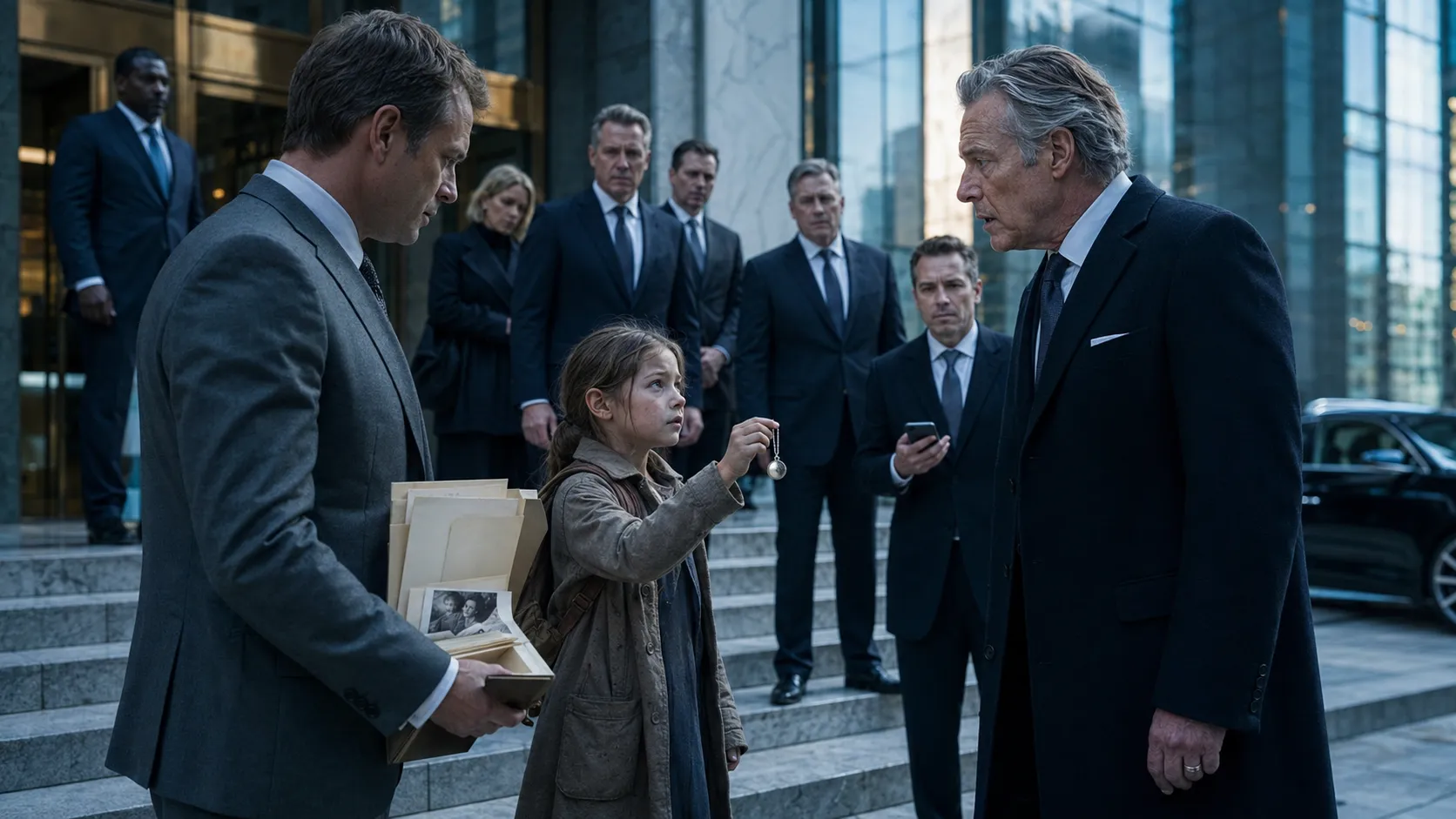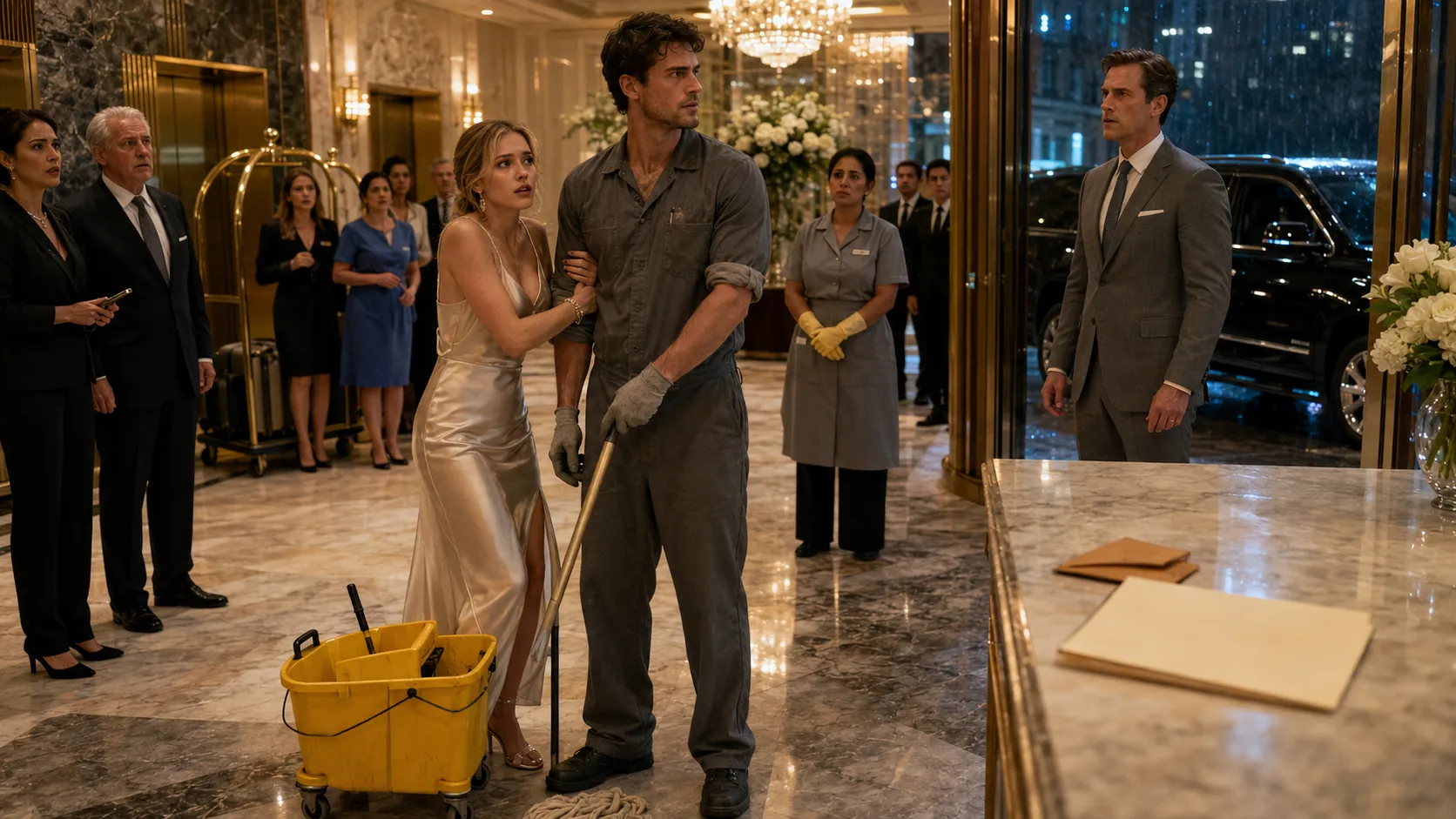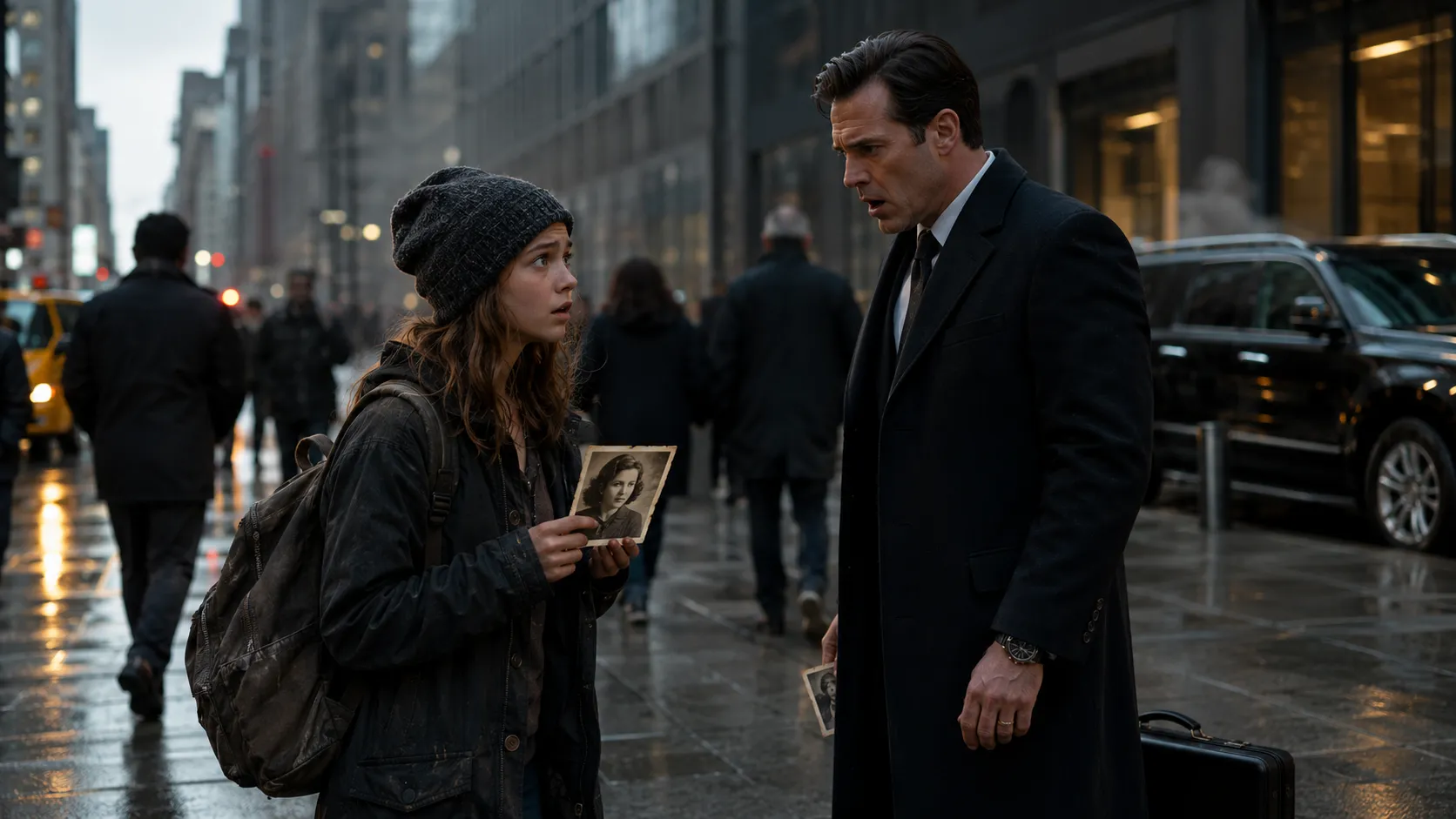
Vittoria Ferrante believed she had planned every second of her daughter’s wedding launch down to the fireworks, the music, and the final photograph on Lake Como. But when a soaked dock boy grabbed the mooring rope and begged them not to start the engine, the steel anchor on his wrist snapped into hers — and the man she had blamed for her husband’s death began rising from the ruin of a lie.
The fireworks were supposed to begin the moment the wedding boat pulled away from the dock.
That had been Vittoria Ferrante’s idea.
In truth, almost everything that evening had been her idea.
The white roses braided through the railings.
The lanterns floating over the black water of Lake Como.
The string quartet under the lower terrace arch.
The antique mahogany launch polished until it reflected the lights like a second sky.
Even the exact timing of her daughter Lucia’s final walk down the dock had been measured so photographers would catch the satin of her gown, the glow of the villa behind her, and the lake opening in front of her like dark velvet.
Vittoria trusted beauty most when it had been scheduled.
She had not trusted chance since the night water took her husband.
So she stood at the edge of the dock in a deep green gown, one hand lifted toward the waiting launch, the other resting unconsciously over the bracelet she had worn for eleven years: a diamond cuff fitted with a small steel half-anchor, cold against the pulse of her wrist.
No one outside the family knew what it was.
The anchor had once belonged to Matteo Ferrante, her husband, who had built a shipping empire from one battered launch, one dock, and a mechanic who could hear an engine lie from twenty paces. Matteo had worn one half. His chief mechanic, Paolo Serra, had worn the other. A promise between working men from the years before money taught them to hide every sincere thing beneath polish.
Then Matteo died in a boat fire.
Paolo was blamed.
And Vittoria had worn Matteo’s half-anchor ever since like a relic, a weapon, and a wound.
Behind her, Lucia laughed softly at something Enzo had whispered. They were beautiful in the way the young are beautiful on nights when life still seems willing to keep its promises. Lucia’s gown was simple and luminous, her hair pinned low with pearls. Enzo looked pale with relief now that the vows were spoken and no disaster had yet intruded.
“Ready?” Vittoria asked.
Lucia smiled. “You’re asking as if I can still escape.”
“You can,” Vittoria said dryly. “But not before the photographs.”
That got a real laugh from her daughter.
Good.
The planner relaxed. The board members lowered their shoulders. Guests lifted glasses. Somewhere farther down the shore, the fireworks crew waited for the signal.
And then a boy came running out of the service passage beside the boathouse.
He was not part of the wedding. That was obvious in a single glance.
Too thin.
Too wet.
Too frantic.
He looked thirteen at most. His dark work jacket was soaked at the cuffs. One shoe was untied. His hair stuck to his forehead in damp black strands, and his chest heaved as if he had run half the hillside to get there.
“Stop!” he shouted. “Don’t untie that rope!”
Everything broke at once.
The quartet faltered. Guests turned. Security moved. Lucia froze with one satin heel already on the boat step.
The boy reached the launch first.
He grabbed the thick white mooring rope with both hands and planted his feet on the slick dock planks as if his weight might matter against money, momentum, and a hundred people already committed to a perfect evening.
“Don’t start the engine,” he gasped. “Please—”
Vittoria reacted before his sentence ended.
The crack of her hand against his face snapped across the dock sharper than any violin note.
The boy stumbled sideways, lost his footing on the rain-slick boards, and dropped to one knee hard enough for the nearest guests to gasp.
Phones rose instantly.
Of course they did.
A billionaire widow slapping a dock boy at her daughter’s wedding was exactly the kind of thing people pretended to despise and could never resist preserving.
“Get him away from the boat,” Vittoria snapped.
The boy looked up at her, one hand pressed to his reddening cheek. Shock passed across his face first.
Then desperation drowned it.
“I’m sorry,” he said, voice shaking. “But if they light the fireworks and that engine turns over, your daughter will—”
Something silver snapped loose from beneath the cuff of his jacket.
It swung once in the lantern light and struck against Vittoria’s bracelet with a tiny metallic click.
Both of them looked down.
The piece dangling from the boy’s wrist was a steel half-anchor.
Thin blue enamel along one edge.
The same shape.
The same cut.
The same impossible fit.
It had locked perfectly onto hers.
For one impossible second, the dock vanished.
Not the guests.
Not the lake.
Not Lucia’s startled voice.
Just a workshop from years ago, all metal dust and engine oil and young men still poor enough to make promises with their hands instead of their lawyers. Matteo laughing. Paolo Serra holding up two fresh-cut steel anchors and saying, If the sea takes one of us, the other half will still know the way home.
Only two had ever been made.
One had burned against Matteo’s body the night he died.
The other had disappeared with Paolo Serra, the mechanic the police said had sabotaged the boat and fled before the fire could reach him.
Vittoria stared at the boy.
“What is your name?”
He swallowed.
“Leo.”
“Your last name.”
“Serra.”
The lake seemed to tilt beneath the dock.
Before Vittoria could ask anything else, the old marine engineer standing near the stern of the launch stiffened so visibly that even the nearest guests noticed.
His face drained.
“Signora,” he said, much too quickly, “nobody boards that boat.”
The air changed instantly.
He was already crouching near the engine housing, fingers hovering over chrome and polished wood.
A rainbow sheen shimmered across the black water near the stern.
Fuel.
Even the guests who knew nothing about boats knew what that meant.
Enzo swore under his breath and yanked Lucia back from the step.
The engine gave a low, sick cough without fully turning over.
A second later the smell hit the air — raw fuel, hot wiring, metal, and something waiting to become flame.
Vittoria moved before thought could slow her.
She grabbed Lucia’s arm and dragged her backward so hard her daughter cried out. Half the guests stumbled away from the dock. Someone dropped a champagne glass. The planner shouted into her radio for the fireworks crew to stop the ignition sequence.
The engineer opened the rear housing and froze.
Then he looked up at Vittoria with the face of a man who had just seen death arrive five minutes early.
“The fuel return line’s been opened,” he said. “And the vent lock’s been half-cut. If the engine had fully turned over and the fireworks went up—”
He didn’t finish.
He didn’t need to.
Leo was already fumbling with a cracked phone in his pocket.
“My mother sent me,” he said. “She told me to run if she didn’t come back.”
His hands shook so badly it took him three tries to hit play.
At first there was only wind and hurried footsteps.
Then a woman’s voice came through, breathless and low.
“Leo, listen to me. Go to the Ferrante dock. The wedding boat, not the service launch. If they’re still there, stop them before the engine starts. And if the woman in green still wears the other half-anchor, show her yours. Do you hear me? Show her before anyone takes it.”
A heavy sound interrupted the recording — a door being forced open.
Then the woman again, faster now, fear splintering her words.
“If anything happens to me, tell Vittoria Ferrante that Cesare Valdini is using the same trick he used on Matteo.”
The message cut off.
No one moved.
No one even seemed to breathe.
Cesare Valdini was standing six feet away.
Ferrante Shipping’s chief financial officer. Matteo’s old adviser. The man who had sat beside Vittoria for eleven years at board meetings, speaking in careful numbers while grief did the work of trusting him.
He gave a short, disbelieving laugh.
“This is absurd.”
But his voice was wrong.
Too thin.
Too quick.
Too dry.
Vittoria turned to him slowly.
He raised both hands in a gesture meant to look reasonable.
“This is panic,” he said. “A cleaner, a street boy, and suddenly everyone wants a conspiracy.”
Leo shouted over him.
“She didn’t lie! She heard you in the boathouse!”
Security had reached the boy by then. One guard caught his arm.
“Don’t touch him,” Vittoria said.
The man let go immediately.
“Where is your mother?” Vittoria asked Leo.
He pointed with shaking fingers toward the service passage.
“In the lower boathouse. She called me and said she found the maintenance log. Then somebody took her phone.”
Vittoria looked once at the dark passage, then back at Cesare.
He smiled.
That was his mistake.
Not because it was smug.
Because it was tired.
A tired smile belongs to a man who has been certain too long.
“Seal the gates,” Vittoria said to her security chief. “No one leaves the villa grounds. Not guests. Not staff. Not the board. And certainly not Cesare.”
Lucia’s voice came thin and shaken beside her.
“Mama…”
Vittoria took her daughter’s face in both hands.
“Go inside with Enzo. Now.”
For the first time in years, Lucia obeyed instantly.
The lower boathouse smelled of varnish, wet rope, engine oil, and fear.
Leo ran ahead of everyone, because children do not wait for permission when the person they love might be bleeding in the dark.
They found his mother beside the service winch cage.
Elena Serra was half-hidden in shadow, wrists bound with zip ties, one cheek already darkening with bruises. She was upright only because the metal frame behind her was keeping her from collapsing. Her cleaning cart lay overturned nearby. A maintenance binder had been kicked under it as if someone had meant to hide it and ran out of time.
“Mamá!”
Leo dropped beside her so fast his knees cracked against the concrete.
Elena opened her eyes at the sound of his voice and let out one shaking breath of relief.
“You got there.”
“I stopped them,” he said, crying openly now because the danger had moved from possibility to memory. “I showed her.”
Her gaze lifted to Vittoria.
For a second, Elena’s face tightened as if she still expected to be treated as the least believable person in the room.
Then she saw the security team.
The engineer.
The open fuel housing.
The anchor joined at Vittoria’s wrist.
And some of the fear left her.
“He kept it?” she whispered.
Leo nodded.
Elena closed her eyes briefly. “Good.”
A medic knelt to cut the restraints.
Vittoria crouched across from her.
“Tell me everything.”
Elena licked blood from the corner of her lip and spoke with the clipped discipline of someone who had spent years understanding that rich people only heard the details that survived documentation.
“Tonight I was cleaning the upper boathouse office. Mr. Valdini came in with Pietro Lanza from marine maintenance. They thought everyone was upstairs at the cake table. I heard them say the wedding launch only had to stay stable until it cleared the dock. After that, the fireworks would do the rest.”
Leo went very still beside her.
Vittoria did not.
“Why?” she asked.
Elena’s eyes flicked toward the black water beyond the open doors.
“Because Monday morning Lucia Ferrante was signing an audit order with her husband,” she said. “My sister works in the executive office. She overheard it. They were going to open the offshore fuel contracts and the shell companies tied to them. Valdini said one more accident on the water would bury everything for another decade.”
The engineer made a sick sound under his breath.
Vittoria felt something inside her grow calm in a way rage never does.
“Matteo,” she said.
Elena nodded.
“My husband’s death was not an accident.”
“No,” Elena said. “And Paolo knew it.”
The name landed heavier than the slap had.
Vittoria stared at her.
“He didn’t sabotage Matteo’s boat,” Elena said. “He tried to stop it. Matteo had found missing money in the fuel accounts. Paolo saw Valdini tamper with the vent lock before the launch left. When Paolo confronted him, Valdini told him nobody would believe a mechanic over a man with a board seat and a lawyer.”
She reached weakly toward the overturned cleaning cart.
Leo scrambled and pulled free a sealed plastic pouch shoved beneath it.
Inside was a grease-stained notebook, two old photographs, and a folded letter.
Elena looked at Vittoria.
“Paolo kept everything he could steal back that night. Valve readings, serial numbers, dates, photographs from the marina camera before they wiped it. He tried to go to the police. By morning there was already a warrant saying he had tampered with the boat himself.”
The engineer opened the notebook and went white.
The pages were dense with tiny square handwriting, diagrams, maintenance notes, copied numbers, names, dates.
Not panic.
Not obsession.
Evidence.
Elena’s voice broke only once, on Paolo’s name.
“He spent the rest of his life trying to clear himself. No one with money would meet him. No one without money could help him. He died last winter still telling Leo the Ferrantes were not the enemy. Just blind.”
Vittoria looked at the half-anchor attached to her wrist and understood, in one brutal breath, what that word meant.
For eleven years she had hated Paolo Serra because hate was easier to survive than uncertainty. Easier than guilt. Easier than admitting she had allowed a man in a suit to explain a mechanic’s disappearance and never once asked why Paolo had vanished without taking so much as a cent.
“Why didn’t you come to me?” she asked.
Elena gave a broken little laugh.
“I cleaned your offices for three years. You never learned my name.”
Vittoria said nothing.
There was nothing to say that did not deserve to be spoken later, in public, and with consequence.
The security chief’s radio crackled.
“Signora, Valdini is trying to leave through the north drive.”
Vittoria rose.
“Bring him back.”
They brought Cesare Valdini back to the dock in front of everyone.
Vittoria made sure of it.
If he had planned to turn her daughter’s wedding into a floating funeral, then he could answer under the same lanterns, cameras, and flowers he had meant to hide behind.
The guests had clustered beneath the terrace awning in frightened knots. Lucia, still in her gown, stood beside Enzo with her veil gone and her face white with the kind of shock that either hardens a person into adulthood or breaks something permanent. The planner had collapsed onto an overturned flower crate. The board members were no longer drinking.
When security pushed Cesare toward the center of the dock, a low murmur passed through the crowd.
He still tried dignity first.
Then offense.
“This is madness,” he said. “You are humiliating me because a cleaner and her son invented a melodrama.”
Vittoria took one of the photographs from the pouch and held it up.
It showed the marina fuel platform eleven years earlier, time-stamped twenty-three minutes before Matteo’s fatal launch. Grainy, but clear enough. Matteo near the stern. Paolo below. And Cesare, half-hidden at the vent housing, one hand exactly where it should never have been.
Cesare’s face changed.
Not much.
Enough.
The engineer stepped beside Vittoria and opened the notebook to a marked page.
“These vent numbers match the replacement order that disappeared after the fire.”
Enzo, standing near Lucia, looked down at his phone and said quietly, “And Pietro Lanza has already decided prison isn’t worth loyalty. He’s talking.”
That broke the room.
Not with outrage at first.
With recognition.
The awful recognition of wealthy people realizing a man they had defended over cocktails might soon require very public disavowal.
Cesare stopped pretending to be injured.
“Matteo would have ruined the company,” he said flatly. “He wanted audits, transparency, union safety reviews, proper fuel sourcing. He was sentimental enough to believe profit should survive daylight.”
Vittoria stared at him.
“And Lucia?”
He looked straight at her daughter in satin and pearls.
“She was going to make the same mistake. Marriage makes people brave. Very inconvenient.”
Lucia made a sound that was half laugh, half sob.
The whole dock seemed to wait on Vittoria.
She could have slapped him.
The crowd would have loved it.
The cameras would have preserved it forever.
And it would have made everyone feel that justice had become satisfyingly physical.
Instead, she turned toward the police officers hurrying up from the drive and said, in a voice so calm it carried farther than shouting ever could,
“This man murdered my husband, tried to murder my daughter tonight, and framed the mechanic who tried to stop him. Arrest him.”
Cesare lunged then — not for her, but for the evidence pouch.
Leo moved first.
He snatched it back and stumbled away just as security drove Cesare hard into the railing and pinned him there. The guests recoiled. Lucia closed her eyes. And Vittoria, watching the man who had sat at her table for eleven years being cuffed under wedding lanterns, understood something she should have learned long before:
people do not become monsters only in the dark.
They become them in offices.
In signatures.
In condolences.
In the patient management of other people’s grief.
The scandal devoured half of northern Italy by breakfast.
By noon, every paper had some version of the same image: a soaked dock boy on one knee, a wealthy widow frozen above him, and the two halves of a steel anchor locked together at her wrist.
By evening, the story had split into two obsessions.
The attempted wedding-boat explosion.
And the resurrection of Paolo Serra’s name.
Old records surfaced quickly once the first lie cracked: missing procurement invoices, insurance inconsistencies, deleted maintenance logs restored from archived servers, a witness statement buried eleven years earlier, enough evidence to drag the past out by its throat and force it into daylight.
Cesare Valdini was charged before the wedding flowers had finished browning in their vases.
Matteo Ferrante’s case was reopened.
Paolo Serra was cleared.
Not quietly, either.
Vittoria made sure of that.
She called a press conference herself — not her lawyers, not her PR staff, but herself. She stood at the Ferrante marina in a black coat with the lake behind her and told the truth. She said Paolo’s name in full. She admitted she had believed the wrong man because he had spoken the right language. She apologized to Elena on camera and to Leo by name. She announced a permanent independent safety division at Ferrante Shipping and named it after Paolo Serra.
The apology did not erase anything.
It was not supposed to.
But it landed.
Elena cried in the second row and hated herself for crying in public. Leo stared at the ground the whole time until Vittoria stepped down afterward and said, quietly enough for only him to hear,
“I was the first person to hurt you that night, and you still saved my daughter. I will spend the rest of my life trying to deserve that.”
Leo looked up.
Children are ruthless judges of sincerity.
Apparently he found enough to answer.
“My father used to say engines tell the truth if somebody bothers to listen.”
Vittoria nodded once.
“Your father was right about more than engines.”
Lucia and Enzo did not leave for a honeymoon.
For two weeks, Lucia woke from dreams of fuel, fire, and engines catching just before dawn. Enzo stayed. He made terrible tea, answered calls she didn’t want, and sat beside her in the silence without trying to improve it.
When Vittoria asked on the tenth day whether she wanted the wedding annulled and redone later, Lucia shook her head.
“No,” she said. “I want the marriage. I just don’t want that night.”
So three weeks later, at dawn, they stood again on the Ferrante dock.
No fireworks.
No press.
No board members.
No speeches.
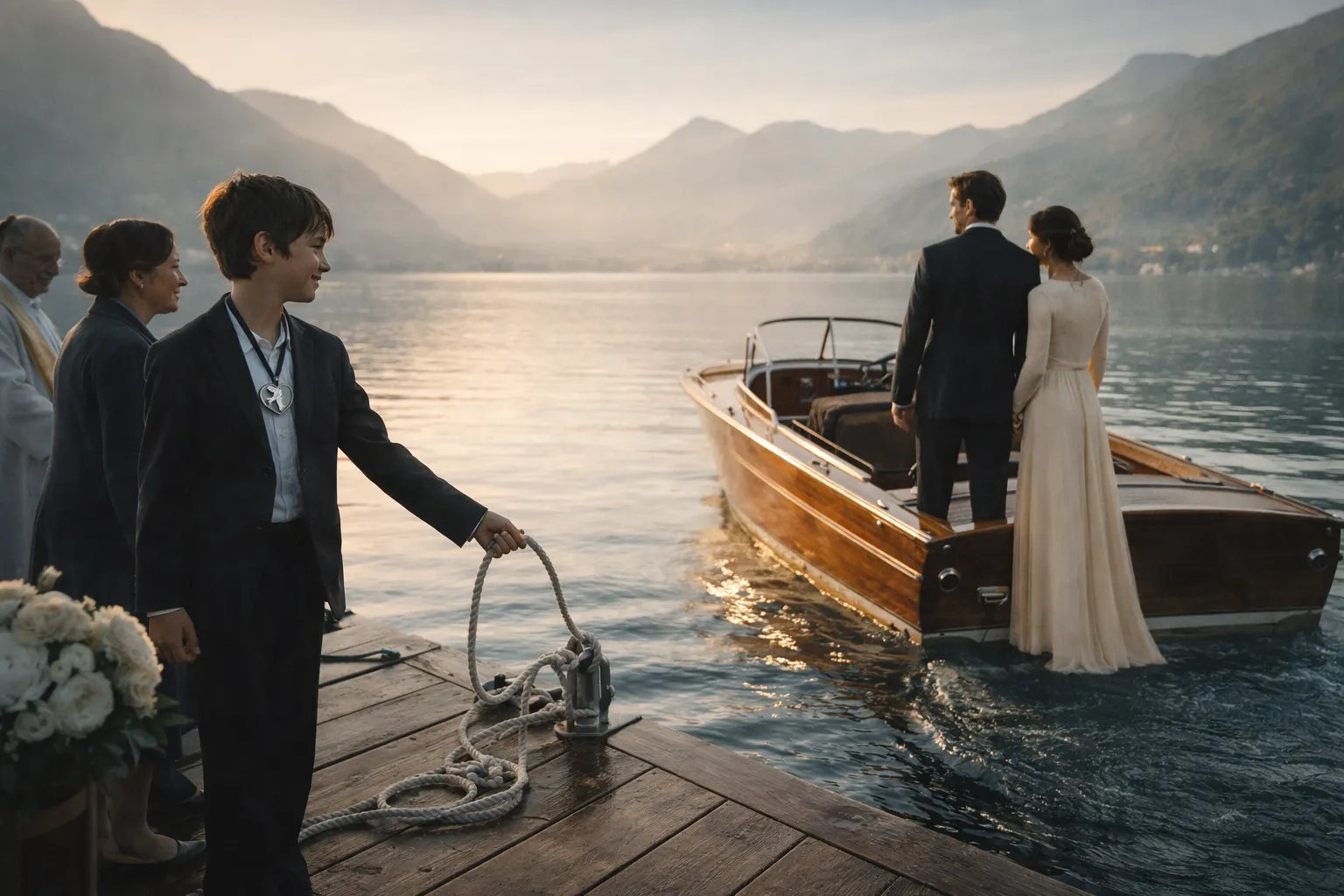
Just family, a priest uninterested in photographers, the lake lying pale and still, and a small row of white chairs where Elena Serra sat in a navy coat with Leo beside her, both of them looking as if they still half-expected someone to tell them they had wandered into the wrong life.
Lucia wore a simple cream dress this time, almost severe in its quietness. Enzo wore charcoal, no tie. Vittoria wore soft gray and no diamonds at all.
Before the ceremony began, she crossed the dock to Leo.
He had been scrubbed into dark shoes and a suit too formal for his age. It made him look both younger and older at once.
In her hands was the anchor.
No longer split.
She had not melted the original halves down. She had them repaired exactly at the seam, the line of blue enamel restored but still visible if one looked closely enough.
“Your father kept one half alive,” she said. “Mine kept the other. I think that means neither of them intended it to stay broken forever.”
Leo stared at the repaired anchor as if it belonged in a museum.
Then Vittoria surprised everyone, perhaps herself most of all.
She fastened it not back onto her own wrist, but around his neck on a plain dark cord.
It settled against his shirt.
Elena covered her mouth.
Lucia smiled through tears.
When the priest asked for the rings, it was Leo who carried them.
His fingers shook only a little.
When the vows were done and the quiet applause rose, Vittoria turned toward the launch.
The same boat had been stripped, rebuilt, inspected, dismantled, and certified safe by engineers who considered paranoia a professional virtue. Every valve had been checked by men with no loyalty to Ferrante management and no reason to lie.
Lucia looked at the boat, then at Leo.
“Would you untie the rope this time?” she asked.
For the first time since the terrible wedding night, he smiled without caution in it.
He bent, loosened the white mooring line, and stepped back.
The launch drifted an inch from the dock.
The water caught the first gold of morning and gave it back.
Lucia and Enzo stepped aboard together. No one flinched. No one smelled fuel. No one heard anything except the soft, honest turn of an engine doing exactly what it had been built to do.
As the boat pulled away, Vittoria looked at the lake, the anchor at Leo’s throat, Elena’s tears, and her daughter alive in the morning light.
The first time, the water had carried fire and lies.
This time, it carried only light.