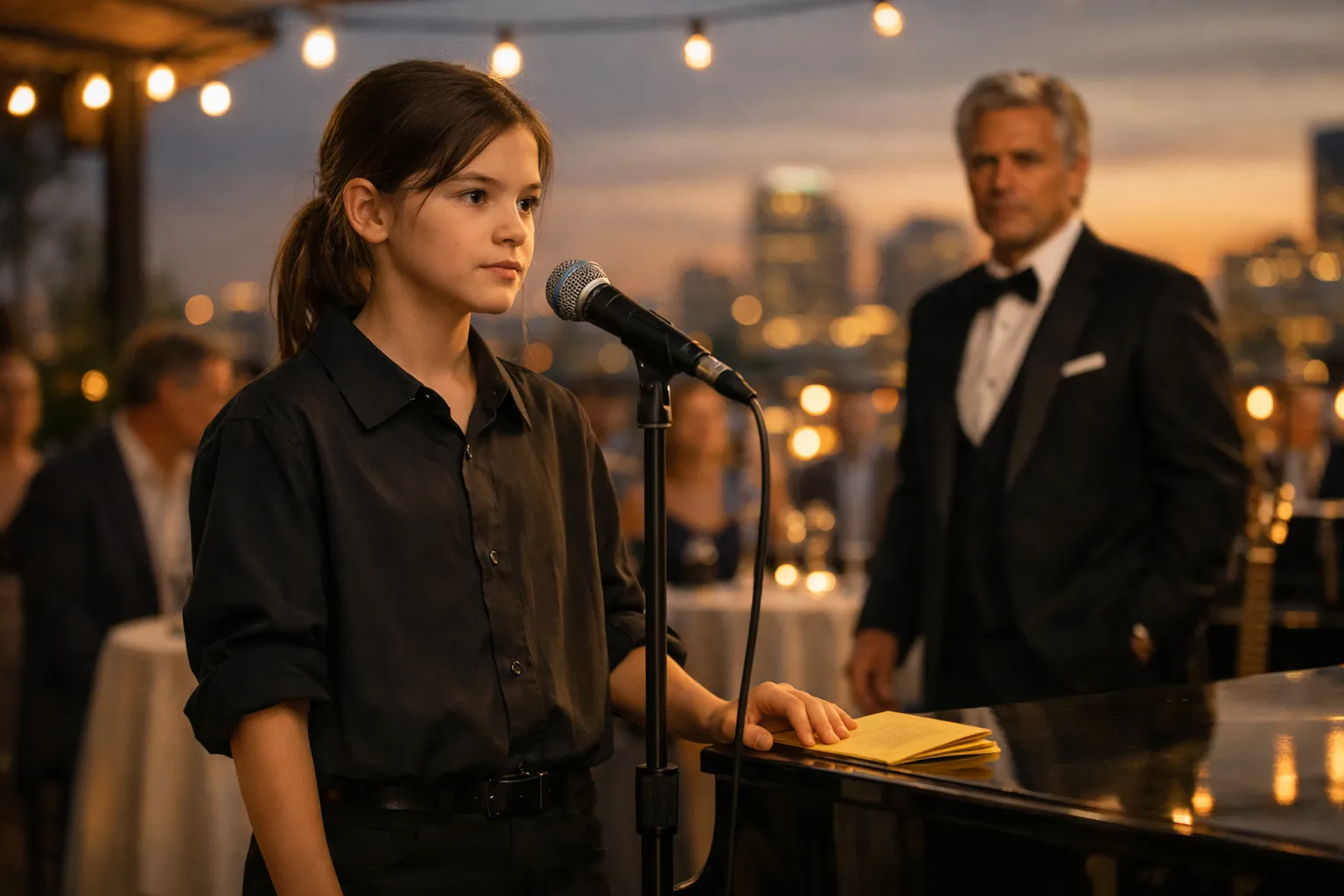
Ellie Harper only came to the rooftop gala to carry glasses and keep her grandmother’s motel room paid through Friday. But when Wade Colton mocked her hunger and dared her to earn a meal at the piano, he accidentally put a dead songwriter’s daughter in front of the one song he had spent fifteen years pretending was his.
By the time Ellie Harper slipped onto the service elevator, the gala above her had already begun to glitter.
She could hear the bass through the metal walls before the doors even opened. Laughter rose and fell in expensive waves. Silver trays clinked. Somewhere overhead, a master of ceremonies was warming up a room full of donors with polished jokes about music, legacy, and “giving young Southern voices a chance.”
Ellie was twelve years old and wore a black banquet shirt with the sleeves rolled twice because it belonged to someone older.
In one hand she carried a tray of empty champagne flutes. Tucked flat inside the waistband of her apron was a folded sheet of yellow paper, so worn at the creases it felt ready to split in half if she unfolded it one too many times.
It was her mother’s lyric page.
And if Ellie pressed her hand against her apron, she could still feel it there like a second heartbeat.
The rooftop of the Halcyon Hotel opened around her in a wash of gold light, cream linen, and polished money. Nashville glowed below like it had been built out of amber and chrome. Broadway flickered in the distance. The last orange of the sunset still clung to the river. Glass heaters burned between white hydrangeas. A glossy black piano waited near the stage under a halo of warm lamps.
And behind it all, larger than life, rose the screen:
THE HOLLOW CREEK FOUNDATION
Raising Up the Next Generation of Songwriters
The first time Ellie had seen that name on television, she had gone cold.
Because Hollow Creek wasn’t Wade Colton’s phrase.
It had belonged to her mother.
June Harper had used it for years in notebook margins, on cassette labels, on scraps of paper tucked into cookbooks and church bulletins. “Hollow creek, full moon, rusted screen door, old light in the kitchen,” she used to sing while scrambling eggs in the little apartment before the money ran out and the sickness moved in.
When June got sick, the notebooks got boxed.
When June died, the boxes moved with Ellie and Grandma Mae from apartment to apartment, then from cousins’ couches to the Blue Lantern Inn on Murfreesboro Pike, where the walls were thin, the carpet smelled damp even in dry weather, and the motel manager only ever promised you the room through Friday.
Three weeks earlier, while looking for an inhaler in an old plastic tote, Ellie had found the yellow lyric page folded inside a faded church bulletin.
At the top was the title of Wade Colton’s biggest hit.
Hollow Creek Baby
But this page was older.
Coffee-stained.
Creased.
Marked in blue pen down the margin.
And at the bottom, in June Harper’s unmistakable hand, were the words that had changed everything:
June Harper — don’t let Wade take this one too
Ellie had stared at that line until the motel room blurred.
Grandma Mae had tried to take the page from her.
Then she sat down on the bed, old lungs rattling with grief and defeat, and told the truth she had buried for years because truth had never once paid their bills.
June Harper had written songs.
Real songs.
Good songs.
Wade Colton had been a hungry nobody when they met — sleeping on couches, borrowing guitars he couldn’t restring, turning gratitude into charm because charm was often the only thing he had to trade. June let him hear her demos. Helped him shape verses. Gave him titles. Trusted him because talented people, especially women without money, are too often taught to mistake need for sincerity.
Then came one song too good to share.
Wade took it.
Cut her out.
Sold it as his own heartbreak.
And when it climbed country radio and began paying for his life, he told the world he had written it alone in the front seat of his truck under a Tennessee moon no one could verify.
June fought at first.
Then she got sick.
Then the lawyers’ letters came.
Then the bills got louder than justice.
Then fighting became a luxury.
“People don’t believe broke women over famous men,” Grandma Mae had said that night in the motel. “Not in this town. Not in any town that profits from the story.”
Ellie had folded the lyric page carefully and said, with a calm that frightened even her,
“Then they’ll believe me when I sing it.”
Now, standing beside the dessert station at Wade Colton’s gala, she pressed one hand against her apron and felt the page still there.
Onstage, Wade accepted a bourbon from a donor and smiled his famous weathered smile into the microphone.
“People ask me all the time,” he said, “why I started the Hollow Creek Foundation. And the answer’s simple. When I was a nobody, somebody believed in my songs.”
Warm laughter.
Warm applause.
Ellie felt her throat burn.
Because that part, at least, was true.
He just never said her mother’s name.
She moved between tables with her tray and watched the room adore him.
A woman in diamonds lifted a glass and said, “That song got me through my divorce.”
A label executive called him “the voice of Tennessee.”
A city councilman spoke about Wade’s devotion to “lifting up forgotten talent.”
Ellie looked down at her cousin’s old shoes and thought about Grandma Mae trying to stretch canned soup into dinner with stale crackers and pepper packets from the motel lobby.
By the time Wade moved toward the piano for what the program called a “surprise acoustic moment,” Ellie had already decided she was not leaving quietly.
She did not have money.
She did not have lawyers.
She did not have an industry contact or a publicist or a famous last name.
What she had was her mother’s voice still living somewhere inside her.
And one song.
A donor near the stage called out, “Play the old one!”
Wade laughed and adjusted the mic.
“You know I always do.”
The rooftop lights dimmed to amber. The skyline glowed behind the railings. The pianist touched the first familiar chords, and the room sighed in recognition.
That was when Ellie stepped out from behind the catering bar.
At first, almost no one noticed.
Then the nearest waitress froze.
Then the pianist looked up.
Then a man in a navy suit turned halfway in his chair.
Ellie walked straight toward the stage steps.
One of the event staff moved to stop her, but Wade lifted a hand, amused. There was something about public men like him that always made them believe they could turn interruption into charm.
“Well now,” he said into the microphone, smiling down at her. “Did somebody lose a server?”
A few people laughed.
Ellie stopped at the bottom of the stage and looked up at him.
Her voice came out small, but steady.
“Can I sing one?”
That got a bigger laugh.
Not cruel, exactly.
Worse.
Indulgent.
Wade leaned forward, his smile still in place.
“Sweetheart, this isn’t open mic night.”
“I know.”
“What do you want to sing?”
Ellie touched the lyric page inside her apron.
Then she looked him in the eye and said:
“Please, sir… my mama wrote this one.”
The laugh died before it finished.
Wade’s smile remained for half a second too long.
Then cracked.
He recovered quickly — men like him build careers on recovering quickly — but not quickly enough to hide that the words had landed somewhere real.
The whole rooftop changed temperature.
A donor lowered her glass.
The pianist’s hands hovered above the keys.
Someone in the back whispered, “What did she say?”
Wade exhaled into the microphone.
“Well,” he said, “that’s one way to get the room’s attention.”
Ellie climbed the two low stage steps.
No one stopped her now.
She crossed to the standing microphone, the entire gala watching a banquet girl in cheap shoes walk into the center of Nashville’s most expensive kind of silence.
Wade remained near the piano stool, one hand still around the bourbon glass.
Ellie didn’t look at him.
She looked at the pianist.
Then at the band.
Then out at the room.
And then she sang.
Not the opening everybody knew.
Not the chorus that had sold millions.
Not the hook that drunks in bars still loved to mangle after midnight.
She sang the missing bridge.
The bridge June Harper had written.
The one Wade never performed live because it had never made it into the official version.
The one about porch light rain, dishwater hands, and a woman standing at a sink praying the man she loved would come home honest.
The first line left Ellie’s mouth, and the pianist flinched.
The second line hit the rooftop like judgment.
By the third, Wade Colton’s bourbon glass had tipped visibly in his hand.
The room went still.
Not merely quiet.
Still.
Because all at once the guests were no longer hearing a cute stunt from a catering girl.
They were hearing a song they thought they knew open up into something deeper, older, and truer than the version they had bought.
Ellie kept singing.
Her voice was not huge.
It didn’t need to be.
It was clear, Southern, and heartbreakingly direct — the kind of voice that carried church pews, porches, cheap kitchens, and every woman who had ever loved a man before he learned how profitable her gifts could be.
Halfway through the bridge, the yellow lyric page slipped from Ellie’s apron.
It fluttered once and landed on the glossy black piano lid.
The pianist saw the blue-ink edits first.
Then the signature.
Then the coffee-ring stain at the corner.
He went white.
In the front row, an elderly man in a dark western jacket pushed himself up from his chair so suddenly it scraped hard across the floor.
Boots McCall.
Session guitarist. Sixty years in Nashville. One of the last men still alive who had played on Wade’s earliest demos before the suits arrived and scrubbed history clean enough to sell.
He stared at the page.
Then at Ellie.
Then at Wade.
“Oh, no,” he said. “No, no, no.”
Wade set the bourbon glass down too quickly.
It missed the stool, hit the stage, and shattered.
The crack of it made three women near the rail jump.
Ellie finished the bridge anyway.
At the last line, silence held the rooftop for one long impossible heartbeat.
Then Boots McCall stepped forward, picked up the lyric page with both hands, and turned toward Wade Colton.
“This is June Harper’s hand.”
No one breathed.
Boots lifted the page so the nearest phones could see.
“Blue edits in the margin. She always marked rhythm changes in blue. I watched her write this bridge at Sweetwater when you still couldn’t keep time without stomping your boot.”
Wade said nothing.
He couldn’t.
Because the whole roof was full of cameras now.
Because the giant screen behind him said Raising Up the Next Generation of Songwriters.
Because the dead woman’s daughter was standing under the stage lights singing the verse he had buried.
And because the one man old enough to verify the page had just done it in public.
Ellie looked at Boots.
Then at the crowd.
Then back at Wade.
“My grandma said he promised to help her,” she said. “Instead he took her song, got rich, and let us end up in a motel.”
Wade found his voice again.
Barely.
“This is complicated.”
It was the worst possible thing he could have said.
Boots let out a hard, humorless laugh.
“No,” he said. “It’s ugly. Complicated is for weather and pedal steel.”
A sharp, startled laugh broke through the crowd.
Not warm.
Not kind.
The kind that strips power instead of feeding it.
Ellie stood very still at the microphone.
“This foundation uses her title,” she said. “But my grandma still worries every Thursday if Friday morning’s gonna throw us out.”
A woman near the stage whispered, “Jesus.”
The board chair of the foundation lowered her phone and said, far too clearly, “I wrote a check tonight.”
The executive director took one quiet step away from Wade, as if theft itself might be contagious.
And somewhere behind the catering station, the captain who had spent the whole night telling Ellie not to be seen started crying into a linen napkin.
Wade tried one last time to gather the room back under his control.
“She gave me ideas,” he said. “We all traded lines back then. That’s how songs happen.”
Boots didn’t even let him finish.
“Not that bridge,” he snapped. “You never had that bridge. She kept that page in her purse because she said you stole the last two and she wasn’t stupid anymore.”
That ended it.
Phones kept filming.
Nobody clapped for Wade.
Nobody moved to protect him.
For the first time in fifteen years of carefully polished myth, he looked exactly like what he was:
A man who had built a legend out of a dead woman’s page and trusted the dead to stay quiet.
By midnight, the clip was everywhere.
Not the donor speeches.
Not the glittering tables.
Not even the shattered glass.
Just Ellie in the black banquet shirt under warm rooftop lights, saying, “Please, sir… my mama wrote this one,” and then singing the verse the whole country had never heard.
By sunrise, someone had found an old June Harper demo on a fan forum.
By noon, two former studio assistants had given interviews saying June’s name had been erased from early session notes.
By evening, the Hollow Creek Foundation board had frozen all fundraising activity pending review.
And the next morning, a music-rights attorney in Franklin offered to represent Mae and Ellie for free.
Wade Colton called it a misunderstanding.
Then a collaboration dispute.
Then unauthorized family exploitation.
None of it held.
Because the rooftop had seen his face when Ellie sang the bridge.
And because the internet had slowed that face down frame by frame.
Boots McCall gave a statement.
So did the retired pianist from the original session.
Then came an envelope from an old storage locker containing two cassette demos in June Harper’s voice, dated three weeks before Wade’s “solo-writing” notebook entries.
The credits shifted six months later.
Not neatly.
Not all at once.
Not in the way justice is supposed to arrive in movies.
But they shifted.
Hollow Creek Baby was legally amended to include June Harper as co-writer.
A second lawsuit followed over royalties.
A third over the foundation’s misuse of her title and work.
The motel manager stopped asking about Friday after the county music association quietly paid six months in advance.
Mae got new inhalers.
Ellie stopped taking banquet shifts.
The first royalty money did not go anywhere glamorous.
It paid old bills.
Then bought real groceries.
Then moved them into a small white duplex with a pecan tree in front and a kitchen window above a real sink, where Mae stood the first morning and cried because the light came in clean and stayed there without a checkout deadline attached to it.
The best part came later.
A month after the credits were restored, Boots McCall arranged a songwriter’s night at the Bluebird Annex in June Harper’s name.
No gala.
No donor banners.
No tuxedos.
No speeches about “uplifting voices” from people who only liked voices once they were profitable.
Just a brick room, folding chairs, one microphone, and a handwritten sign over the stage:
JUNE HARPER SONG NIGHT
Ellie wore a denim dress and boots someone from church had bought because they knew she was growing too fast for hand-me-downs to keep up. Mae sat in the front row with a tissue already in one hand and no intention of pretending otherwise.
Before Ellie went onstage, Boots bent beside her and said quietly, “No one’s laughing tonight.”
She nodded.
Then she stepped into the light, placed the yellow lyric page on the stool beside her, and sang the whole song the way June had written it.
Not Wade’s hit.
Her mother’s song.
When she reached the missing bridge, the room did not gasp.
It knew it was coming.
That made the moment even better.
Because what the world had treated like a shocking reveal was, to Ellie, something simpler and more sacred.
Restoration.
When she finished, the applause rose slowly and honestly — not because she was young, not because people felt sorry for her, not because the story had gone viral.
But because the song was good.
Because June Harper had been good.
And because sometimes the most powerful thing in the world is not scandal.
Sometimes it is a child putting a stolen name back where it belongs.