William Harrison had spent three years trying to buy his children a future that guilt had stolen from them. Then an eleven-year-old boy with mud on his hands knocked on the window of his car, asked for food, and spoke one impossible sentence with the calm certainty of someone who had already lost too much to waste words: “Your children will be okay.”
Every morning, before the city had fully decided what kind of day it wanted to be, the boy woke on the same park bench near Madison Square.
He was eleven years old, thin enough that hunger seemed to have carved its own shape into him, and usually barefoot unless someone had given him shoes sturdy enough to last more than a few days. He slept curled on one side with one arm tucked under his head, as if even in sleep he understood how little space in the world belonged to him.
When he opened his eyes, he always looked upward first.
The sky above New York was never the same two mornings in a row. Some days it was pearl gray. Some days pale blue. Some days it pressed down with the weight of rain.
“Good morning,” he whispered to it all the same.
Then he sat up slowly, rubbed feeling back into his legs, and spoke as if someone kind and patient might still be listening.
“I need food today. If you can.”
His name was Lucas.
He had no father anyone talked about, no mother anymore, and no place in the city that could honestly be called his. He had learned to wash at a cracked public faucet near the square, to drink carefully so none spilled, and to move through crowds without expecting kindness. But for reasons he could not have explained, bitterness had not yet reached him.
By eight o’clock the city was already too busy to notice him.
Men in polished shoes passed close enough to brush his shoulder.
Women carrying takeaway coffee stepped around him without ever lowering their eyes.
Taxi horns snapped through the wet morning air.
Construction roared.
Screens glowed.
Money moved.
Lucas kept walking, not because he knew where he was going, but because standing still made hunger feel louder.
Across the city, William Harrison stood in a bathroom larger than most apartments and watched himself in the mirror with the tired contempt of a man who no longer believed success meant anything.
At forty-four, William had everything people were taught to envy: a fortune, a name on buildings, a driver waiting downstairs, and an Upper East Side townhouse that made interior designers sigh and guests lower their voices.
What he did not have was peace.
Three years earlier, on a rain-slick road outside Westchester, he had looked down at a business call for two seconds too long.
Two seconds.
That was all it had taken.
The crash left his eleven-year-old twins, Liam and Ava, with severe leg injuries and nerve damage. Surgeries followed. Then braces. Then private rehab. Then specialists so expensive that ordinary people would have mistaken their names for miracles.
The children lived.
On good days they could stand with support.
On difficult days they could manage a few determined steps between bars or with crutches.
But fear had settled into their bodies as deeply as pain. Outside therapy, neither of them wanted to try anymore.
William paid for the best of everything.
Therapists.
Machines.
Programs.
Second opinions.
Experimental consults.
He signed checks with the speed of a man trying to outspend guilt.
Nothing restored the easy, careless movement his children once had.
His wife, Olivia, moved through the house as if underwater. She dressed, attended appointments, answered when spoken to, and sat beside the children with unwavering tenderness. But whatever had once been bright in her had dimmed after the crash. Some nights William found her untouched tea cooling beside medication she had forgotten to take.
They were living in the same grief.
They were not living in it together.
The only person in the house who still spoke about hope out loud was Thomas, the driver.
William no longer argued with him.
He simply lacked the energy.
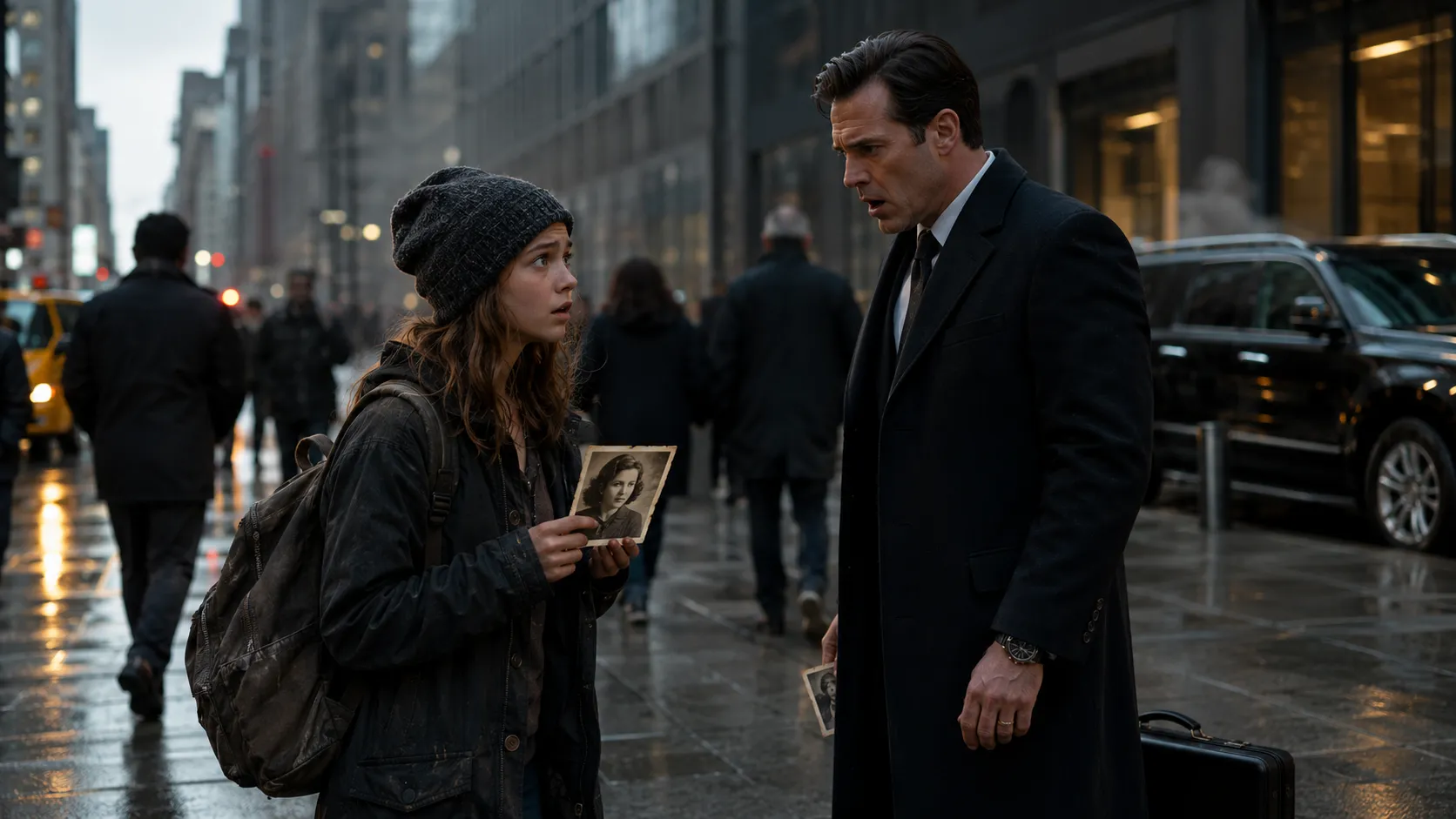
That morning Thomas stopped at a red light near Forty-Second Street. William was reviewing numbers on his phone when a soft knock sounded against the rear passenger-side window.
He ignored it at first.
Then Thomas lowered the glass halfway.
“What do you need, son?” the driver asked.
Lucas stood outside, shoulders hunched against the damp cold.
“Food,” he said.
Thomas reached without hesitation for the lunch wrapped in linen beside him and held it out. Lucas accepted it with both hands, as though someone had just placed something breakable and sacred there.
“Thank you,” he said.
Then he looked past Thomas and directly at William.
For one sharp second, William felt something unpleasant and familiar move through his chest. The boy’s face was dirty. His clothes were worn thin at the elbows. But his eyes were too clear. Too steady. Too unembarrassed.
And then Lucas said, in a quiet voice that did not sound dramatic at all:
“Your children will be okay.”
William went still.
Nobody in the city knew his family well enough to say something like that. Not from a street corner. Not by accident.
“Drive,” he snapped.
Thomas obeyed.
But the sentence remained in the car long after the boy disappeared from view.
That evening the Harrison townhouse filled with people for a charity reception William had agreed to host months earlier and no longer had the will to cancel. Glasses chimed. Caterers floated through the rooms. Donors praised resilience in tones polished enough to make grief sound elegant.
Olivia stood beside him in a dark green dress, beautiful and absent.
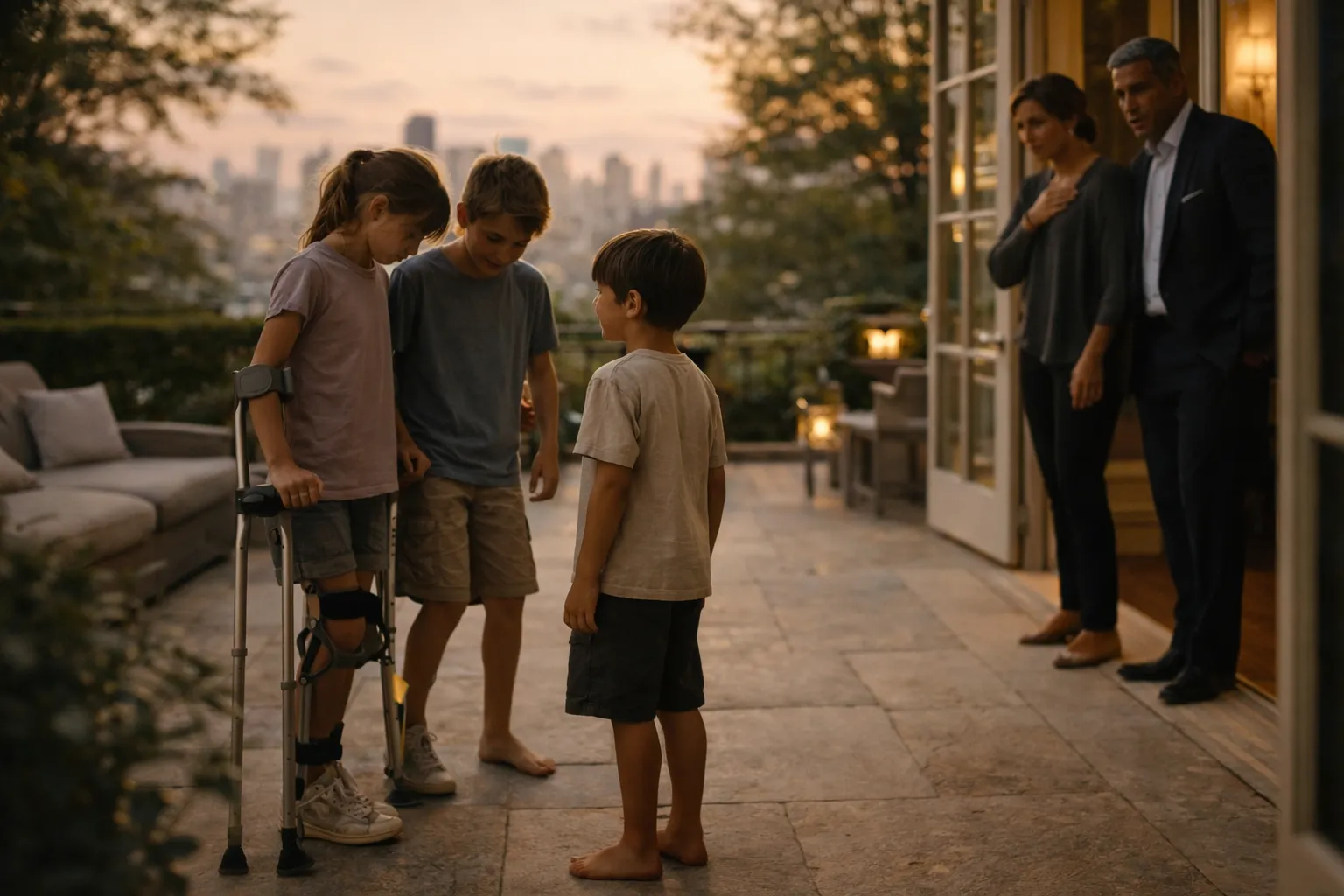
Liam and Ava had come downstairs because their mother asked them to. They leaned on their crutches and smiled when spoken to, both children far older in the eyes than they had any right to be.
William’s younger sister, Charlotte, moved through the event as if it were partly hers by birthright. She was immaculate, sharp, efficient, and practical in the way that often disguises cruelty. She believed in appearances, standards, and not letting softness interfere with order.
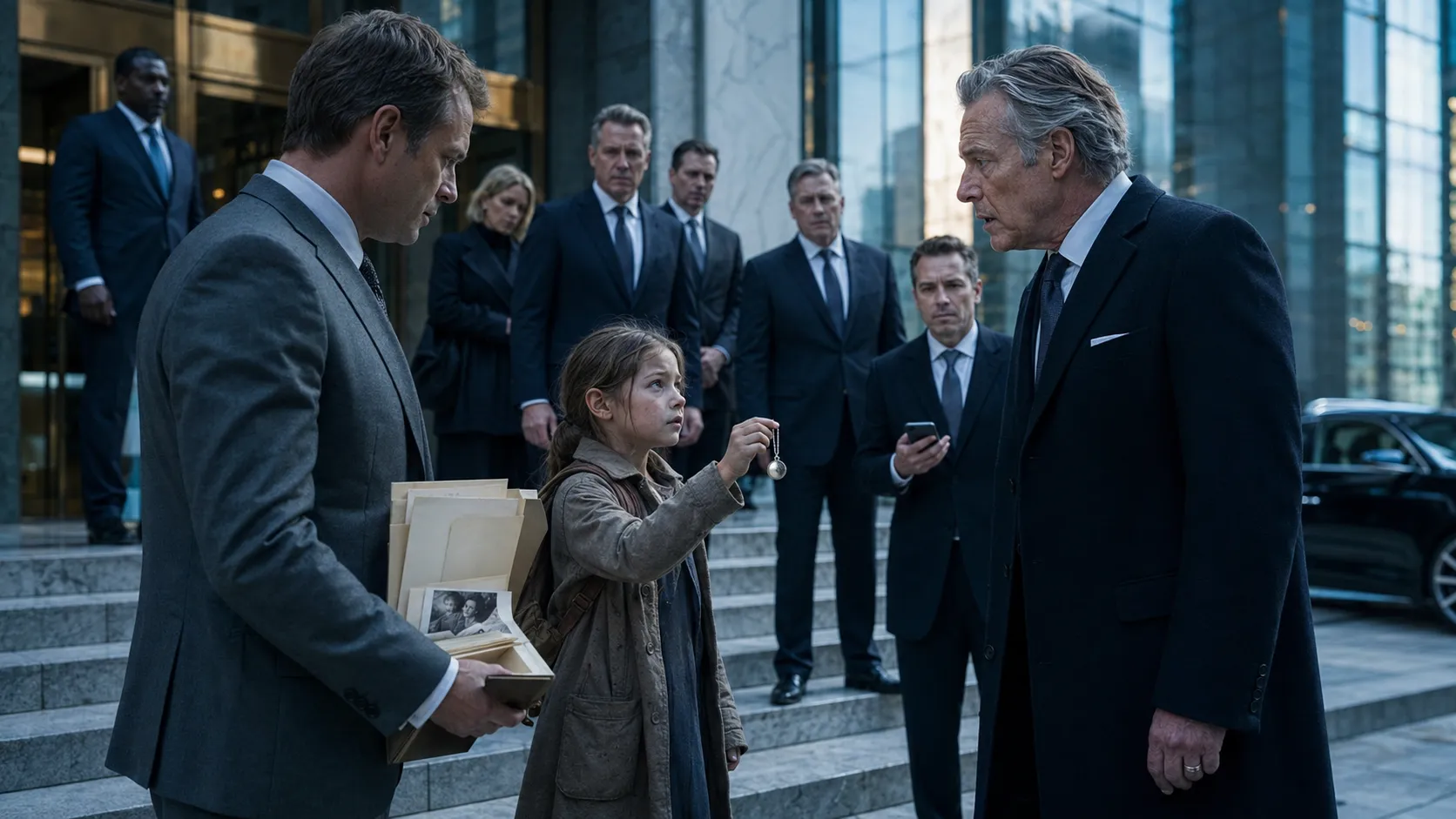
At some point, as speeches began near the piano, William looked toward the entrance and saw Thomas speaking to someone just beyond the open doors.
It was the boy.
Lucas stood just inside the iron gate, shivering a little, not begging, not shouting, simply waiting as if he had come because he meant to.
Charlotte saw him next.
Her expression hardened at once.
“Oh, no,” she muttered. “Thomas, send him away.”
But before the driver could move, Ava turned.
She stared toward the door and whispered, “That’s him.”
Liam followed her gaze.
“Who?” William asked.
“The boy from the corner,” Ava said. “The one who told you we’d be okay.”
Lucas met the twins’ eyes.
Then he smiled — not broadly, just enough to make himself look suddenly younger.
“What’s your name?” Ava asked.
“Lucas.”
Charlotte stepped forward.
“This is not a shelter.”
William should have agreed.
He should have put an end to it there.
He should have protected the room from awkwardness, the guests from discomfort, the evening from interruption.
But something raw and reckless had been building in him all day, sharpened by that strange sentence at the traffic light and by the unbearable spectacle of rich people discussing generosity under crystal lights.
Fueled by shame, exhaustion, and more wine than he should have had, he heard himself laugh too loudly.
“Well,” he said, “if the child has come to save us, perhaps we should let him try.”
The room quieted.
Charlotte’s mouth tightened.
Thomas looked away.
A few guests exchanged startled glances.
William hated himself the moment the words were out. But shame often chooses cruelty before it chooses honesty.
Lucas did not seem offended.
He only asked, very simply:
“Can I try?”
The room held still.
Before William could answer, Liam spoke for the first time that evening without being prompted.
“Dad,” he said. “Please.”
William looked at his son.
Then at Ava.
Then at Olivia, who was watching Lucas with the first real alertness he had seen in her in months.
Finally, he said, “Five minutes.”
Lucas came forward slowly.
He did not go first to the children’s faces.
He knelt by their feet.
“Can I take off your shoes?” he asked.
Ava blinked.
“Why?”
“So your feet can remember the ground.”
Charlotte made a soft scoffing sound.
But Olivia said, very quietly, “Let him.”
Lucas untied Ava’s shoes, then Liam’s, and set them aside neatly. Their feet were pale and guarded from months inside braces, orthotics, and fear. He rubbed warmth into them with both hands, the same way he rubbed life back into his own fingers on cold mornings.
Then he looked up.
“What do you miss?” he asked Ava.
She frowned.
“What?”
“In your feet,” Lucas said. “What do you miss?”
Ava swallowed.
“Grass,” she whispered. “And the kitchen tiles when they’re warm.”
He nodded, then turned to Liam.
“And you?”
Liam stared at the floor.
“The basketball court,” he said softly. “When it’s hot.”
No one in the room moved.
Lucas rose and held out one hand to Ava and one to Liam.
“Just stand,” he said. “Not for them. For yourselves.”
It was not magic.
It was not beautiful.
It was hard.
Thomas moved instinctively to one side. William to the other. The physical therapist, who happened to be at the event because Olivia had insisted on inviting the only people who still treated their children like children, stepped forward with professional caution.
Ava pushed down on her crutches.
Liam did the same.
Their arms shook.
Their breathing went ragged.
For one terrible second William thought they would fall.
Then Ava straightened.
Not fully.
Not easily.
But upright.
Liam followed half a breath later.
Ava’s crutch slipped from her hand and hit the floor.
The sound cracked through the room.
She swayed, terrified.
Lucas did not touch her.
“Look at your brother,” he said.
She did.
“Now one step.”
Ava dragged one foot forward.
Barely six inches.
But it was hers.
Liam stared at her in disbelief, then forced one stumbling step of his own toward her.
By then Olivia was crying openly.
William could not feel his hands.
No one honest could have mistaken the moment for a cure. The twins’ legs trembled violently. Thomas and the therapist were half a second away from catching them if they collapsed.
But for the first time since the crash, Liam and Ava were not standing because a machine demanded it or a specialist had set a target.
They were standing because they wanted to reach each other.
A second crutch hit the floor.
The room erupted — not in laughter, not in celebration exactly, but in the stunned, frightened noise people make when they realize they have witnessed something they do not know how to name.
Olivia dropped to her knees and gathered both children to her.
William stared at Lucas.
“What did you do?”
Lucas looked honestly confused by the question.
“I asked what they missed,” he said. “And I asked them to try.”
That should not have been enough.
But then again, in three years, almost no one had asked the children what they missed. They had been measured, treated, managed, encouraged, assessed, supported. Very few had spoken to them as if their bodies still belonged to them.
Charlotte recovered first.
“This is absurd,” she said sharply. “A coincidence. A performance.”
Lucas didn’t answer her.
He looked only at William and said, “You made a promise.”
The room went quiet again.
William looked at the boy’s thin wrists, his bare feet, the worn collar of his shirt.
Then he looked at his children, clinging to their mother and crying not from pain, but from effort and shock and something dangerously close to hope.
“I keep my word,” William said.
Lucas stayed that night in a guest room, though he was so uneasy around the mattress that Thomas later found him curled on the rug beside the bed near dawn.
The next morning, William contacted child services.
Reality moved in fast.
Lucas was not a mystical messenger dropped into the city for one perfect moment. He was a child known to the system in the way far too many invisible children are known — by file number, missed follow-ups, overburdened caseworkers, and all the gaps everyone assumes someone else is handling.
His mother had died the winter before from an untreated illness.
No stable relatives had come forward.
He had drifted between temporary placements and the street, surviving on instinct and whatever kindness happened to appear.
Charlotte objected immediately.
“This is reckless,” she told William. “You were embarrassed at your own party and now you’re overcorrecting.”
But for once, William did not answer his sister with anger.
He answered with clarity.
“No,” he said. “For once, I’m seeing clearly.”
The weeks that followed were harder than the kind version of life people prefer to tell afterward.
Lucas did not transform the Harrison house into a fairy tale.
He hid bread in his pillowcase.
He woke at every small noise.
He disliked closed doors.
He asked permission for everything, even for water.
He stood at the edges of rooms as though expecting to be moved along at any moment.
But every afternoon, after tutors and therapy sessions, he sat with Liam and Ava and turned their rehabilitation into something more human.
He asked them about surfaces.
About weather.
About texture.
About memory.
He challenged them to stand for three breaths.
Then five.
Then seven.
He made them laugh when they got angry.
Not to dismiss their frustration.
To keep it from hardening into surrender.
The physical therapist noticed the change first.
“They’re participating,” she told William. “Really participating.”
The progress was slow, stubborn, and completely real.
By winter, Ava could cross a room with forearm crutches without panic.
Liam, whose legs were stronger but whose fear ran deeper, managed short distances first between bars, then with a walker, then across the sunroom holding on to nothing but rage and determination.
There were setbacks.
There were tears.
There were days when nobody in the house believed the gains would hold.
But one thing had undeniably changed:
the children were no longer living only in the shadow of the crash.
Olivia changed too.
She started coming downstairs before noon.
She began making soup again instead of asking staff to do it.
One evening William found her sitting at the kitchen table while Lucas buttered toast with grave concentration, and the laugh that escaped her at something he said was so small and so startled that it stopped William in the doorway.
As for William, he learned humiliation of a different kind.
Home studies.
Interviews.
Parenting evaluations.
Legal scrutiny that did not care how many buildings had his name on them.
Money could buy specialists.
It could not prove fitness.
It could not prove tenderness.
It could not prove that love would remain when the miracle faded and real life began again.
At the hearing months later, Charlotte testified that her brother was acting from guilt rather than judgment.
She was not entirely wrong.
But she was incomplete.
When it was William’s turn to speak, he did not defend his reputation. He did not mention philanthropy, connections, resources, or legacy.
He simply said, “This child did not manipulate me. He reminded me how to be human. My children stood that night because he gave them something I had failed to give them for three years — hope without pressure. If the court believes I am fit to raise him, I will spend the rest of my life trying to deserve that trust.”
The adoption was not approved that day.
It was approved eleven months later.
By then Lucas had lived with them long enough that the house no longer felt like a place he was visiting. His shoes — new ones, though he still preferred going barefoot on the terrace — sat beside Liam’s and Ava’s by the back door. He had a school desk with sharpened pencils, a winter coat that fit, and drawings taped inside a closet he no longer feared closing.
When the judge signed the final order, Olivia cried openly.
Ava clapped.
Liam grinned with the careless joy of an actual child.
Lucas only smiled and slid his hand into William’s.
Life did not become perfect.
It became alive.
The Harrison house grew louder.
There were arguments over homework, wet towels left on floors, cereal bowls abandoned in sinks, braces clicking through hallways, and later — after years of work — the astonishing sound of running.
Two years after the gala, Liam could cross the garden alone on good days.
Ava still used a cane when tired, but she danced in the kitchen anyway.
William cut back his work, sold one of his most excessive projects, and funded a rehabilitation program for children whose families could never have afforded the kind of care his money once bought for his own.
Olivia joined the board and insisted the waiting rooms have windows and comfortable chairs, because grief should not have to sit under fluorescent misery any longer than necessary.
One summer night, after the children were asleep, William found Lucas sitting on the back steps looking up at the stars above the city haze.
“You should be asleep,” William said.
Lucas shrugged.
“I used to say thank you every morning.”
William sat beside him.
“For what?”
“For not being alone,” Lucas said. Then he glanced up. “Even when I was.”
William looked at him for a long time.
The stone steps still held a little warmth from the day. Inside the house, laughter drifted faintly down the hallway from a room where Ava had probably said something ridiculous in her sleep.
At last William understood.
Lucas had not arrived to perform a miracle.
He had arrived to interrupt despair.
And sometimes, William thought, that is the greater thing.
He put an arm around the child’s thin shoulders and looked up at the sky Lucas had trusted long before he had any reason to.
For the first time since the crash, William trusted it too.