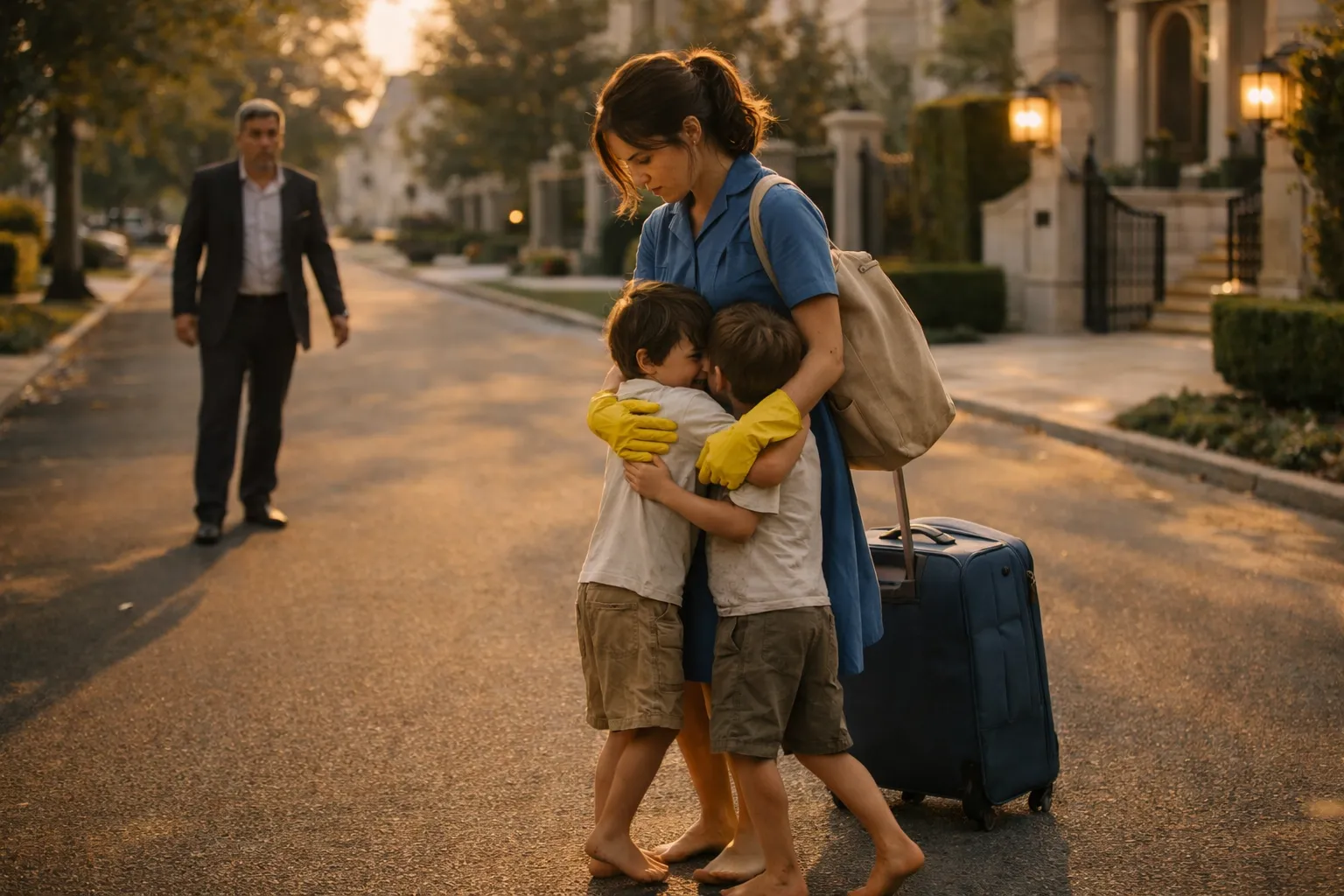
Sophia thought the worst part was being thrown out with wet cleaning gloves still clinging to her hands. Then the five-year-old twins she had practically raised came crashing after her through broken glass and hot pavement — and in one brutal minute, a billionaire father realized he had trusted the wrong woman and betrayed the right one.
The sound was unbearable.
Clack. Clack. Clack.
The cheap plastic wheels of Sophia’s old blue suitcase rattled against the polished cobblestones of the most expensive street in the city, each jolt echoing between iron gates and manicured hedges like a countdown to humiliation. She kept walking, chin up, shoulders tight, yellow cleaning gloves still damp against her wrists because no one had even given her time to take them off.
That was the part that burned the most.
Not the worn suitcase.
Not the cloth bag slung over her shoulder with the little things she had gathered over twelve years of service.
Not even the tears that kept slipping onto the collar of her blue uniform.
It was the gloves.
The fact that they had thrown her out while she still looked like someone in the middle of scrubbing other people’s messes.
The order had been absolute.
“Get out of my house. Now.”
And Sophia, with the last piece of dignity she had left, had obeyed.
She did not look back.
Because if she did, she knew what would happen: she would see the nursery windows, the boys’ room, the curved balcony where Lucas had once waved a spoon at pigeons, the kitchen door Ethan always used because he hated “fancy entrances,” and her heart would finally split open in the street.
What hurt most was not losing the job.
It was leaving the children.
Lucas and Ethan were only five. Their mother had been dead for less than two years, and grief still lived in the house like a draft that appeared whenever the rooms fell quiet. Sophia had been the one who learned which twin needed a night-light and which one only wanted the hallway door cracked open. She knew which stories calmed them, which songs their mother used to sing, which birthday cups they still refused to throw away because their mother had bought them.
And now she was leaving them alone with Vanessa.
Vanessa, Daniel Brooks’s fiancée.
Vanessa, with her perfect hair, careful smile, and voice that could turn ice to shame.
Vanessa, who had just stood in the library, pointed at Sophia’s bag, and announced in cool disbelief that Daniel’s gold Rolex had been found inside it.
Sophia had been too stunned to defend herself quickly.
Daniel had been too angry to wait for truth.
He had looked at the watch, then at her, and something in his face had hardened into judgment.
“You stole from me,” he had said.
She still felt that sentence in her ribs.
Not because it was true.
Because he had needed so little to believe it.
She had tried to speak.
Tried to tell him that Vanessa had whispered something strange earlier that afternoon. Tried to say the watch could not have come from her because she had not even been upstairs since morning. Tried to tell him that Vanessa had been looking at the boys not like a future stepmother, but like someone studying obstacles.
But Daniel, already wounded by too much stress and too used to letting Vanessa explain people to him, had thrown cash onto the carpet as if he were paying her to disappear.
“I won’t let a criminal influence my sons,” he had snapped.
Criminal.
That had been the word.
Not thief.
Not liar.
Criminal.
As if twelve years of loyalty could be erased in one accusation because it came from the right mouth and landed in the right room.
Sophia had not picked up the money.
Her pride was worth more than whatever amount he had tossed on the floor.
Still, what haunted her most as she walked down that shining street was not Daniel’s anger.
It was Vanessa’s whisper.
She had leaned close while Daniel turned away and said, with soft satisfaction, “Tomorrow those boys are leaving for boarding school in Switzerland. They’re a nuisance, and you’re the last thing standing in my way.”
Sophia had tried one last time to warn him.
He had shut the heavy front door in her face.
Now she reached the corner, the bus stop only a few steps away, when a scream split the afternoon open.
“Mom Sophia!”
She froze.
No one in the world called her that except two little boys whose voices she knew better than her own breathing.
Slowly, fear already rising like fire in her stomach, she turned around.
Lucas and Ethan were running toward her.
Their arms were stretched out.
Their faces were wet with tears.
Their mouths were open in desperate cries.
But what made Sophia drop her suitcase was not their crying.
They were barefoot.
And there was blood on their clothes.
Behind them, running hard and no longer looking like a composed billionaire but a terrified father, came Daniel Brooks.
“Lucas! Ethan! Stop!” he shouted.
The boys ignored him.
To them, the only danger in the world was losing the woman who had held them together after their mother died.
Sophia dropped to her knees just as they crashed into her.
They hit her with full force, small bodies shaking, hot with panic. Lucas wrapped himself around her neck. Ethan buried his face against her shoulder and sobbed so hard he could barely breathe.
“Don’t leave us!” Ethan cried.
Sophia held them both, then felt something warm and sticky against her wrist.
She pulled back just enough to see.
Blood.
Real blood.
“Oh, my God,” she whispered. “You’re hurt.”
Lucas had a deep cut down one forearm. Ethan’s palms were scattered with tiny slices, bright with fresh blood.
“We broke the window,” Lucas choked out. “Dad locked us in. We had to come get you.”
The world seemed to tilt.
They had broken glass just to reach her.
At that moment Daniel caught up, breathless, furious, frightened, and not yet fully understanding what he was seeing.
“Let them go!” he shouted, grabbing for Ethan. “Take your hands off my sons!”
Sophia recoiled.
“No, sir — careful. There’s glass in his hands.”
Daniel froze.
He looked down.
Really looked.
Not at Sophia first.
At the boys.
At the blood on Lucas’s arm.
At the cuts in Ethan’s hands.
At the burns on the soles of their bare feet from the hot pavement.
His face changed.
“What did you do?” he whispered, but even before the words were fully out, he knew she had not hurt them.
“She didn’t do anything!” Lucas shouted, twisting away from him. He planted himself in front of Sophia with a fierceness no five-year-old should have needed. “You’re the one who’s wrong! You and the witch Vanessa!”
Daniel stared.
“What?”
“We saw her!” Lucas yelled. “We were under your bed!”
Ethan nodded through tears.
“She took the watch out of your drawer,” Lucas said, voice breaking with urgency. “She put it in Sophia’s bag. We saw her do it. She said Sophia had to go because she was in the way.”
Daniel’s face drained.
“You must have seen wrong,” he said automatically, but the protest had no weight behind it.
“No!” Lucas shouted. “And she said tomorrow we’re going away. To Switzerland. She said we’re parasites.”
Ethan clung harder to Sophia and whispered, in the kind of broken, honest voice only small children have, “Sophia smells like Mom. Vanessa smells like cold and fear.”
That sentence struck Daniel more cleanly than any accusation could have.
For one suspended second he saw everything at once.
His dead wife in a hospital bed, making him promise that the boys would grow up safe.
Sophia sitting beside them during fevers and nightmares.
Vanessa sighing every time the twins laughed too loudly.
The way she always called them “chaos” when she thought he wasn’t listening.
The way Sophia had stood in the library, not defensive, only hurt.
Then he looked up toward the house.
There, in the second-floor window, stood Vanessa.
She was holding a glass of white wine.
She was not coming down.
Not rushing out to the injured children.
Not calling for help.
She was simply watching.
And then, with cool annoyance, she drew the curtain shut.
That was the moment denial died.
Daniel bent, scooped Ethan into one arm, then reached for Lucas with the other. But Sophia was already tearing strips from her apron and wrapping them around Lucas’s arm with steady hands, her own tears falling but her movements calm.
Daniel stared at those hands.
Rough hands.
Tired hands.
Hands Vanessa had called common.
Hands he had just called criminal.
And they were the only hands in that moment acting like home.
“Forgive me,” he said hoarsely.
Sophia did not answer.
Not because she had not heard him.
Because there are apologies too late to enter cleanly.
Daniel picked up her suitcase from the cobblestones and extended his free hand.
“Come back,” he said. “The boys need treatment. And I need to throw the real trash out of my house.”
Back inside the mansion, the marble hall looked different to Sophia than it had an hour earlier.
Less grand.
Less secure.
More like a stage where expensive lies had finally missed their cue.
Daniel ordered the housekeeper to bring the first-aid kit. Then he did something he had not done enough of in months: he knelt on the floor and cleaned his sons’ wounds himself.
Lucas hissed when the antiseptic touched his arm.
Ethan tried to act brave and failed halfway through.
Sophia held the boys steady, murmuring the same words she had used a hundred times before after skinned knees, broken toy trains, and bad dreams.
“It stings because it’s working.”
“Breathe for me.”
“That’s it.”
“You’re okay.”
At one point she pulled her hands back.
“Sir, my gloves are still dirty.”
Daniel looked up at her.
“Your hands are the cleanest in this house,” he said.
Before she could respond, footsteps sounded on the staircase.
Vanessa descended slowly, as if she still believed the strength of her posture might save her.
She stopped halfway down and took in the scene: Daniel on the floor with the boys, Sophia beside him, the open first-aid kit, the suitcase she had wanted gone now standing upright in the center of the hall like a witness.
“How touching,” she said. “I see you brought the maid back. Throw her out before she steals something else.”
Daniel rose.
He walked to Sophia’s bag, reached inside, and pulled out the gold Rolex.
Vanessa smiled instantly, triumph blazing across her face.
“I knew it,” she said. “Thief.”
Daniel held the watch in one hand and looked at her with a calm so controlled it was more frightening than rage.
“My sons saw you put it there.”
Her smile vanished.
“They’re children,” she snapped. “They lie.”
“You called them parasites.”
Vanessa’s face hardened.
For the first time, all softness dropped away.
“Yes,” she hissed. “Because they are. They ruin everything. You could have had a clean life with me, but no — every room in this house still smells like grief and crayons and nanny perfume.”
The boys went still.
Sophia felt Ethan’s hand find hers again.
Daniel did not move.
Vanessa kept going, because some people only understand they’ve lost after they’ve said the truest thing in themselves out loud.
“You don’t need those boys controlling your life forever,” she said. “And you don’t need her. You need someone who knows how to live at your level.”
Daniel let out one short laugh.
Not amused.
Finished.
“You never wanted a future with me,” he said. “You wanted my money without the parts of my life that required a heart.”
Vanessa opened her mouth to answer.
He threw the watch.
It hit the stone wall and shattered, pieces skittering across the marble like bright little lies.
“That,” Daniel said, “is the value of what you call love.”
Vanessa stared at the broken Rolex as if she could not understand how a thing so expensive could be reduced to fragments so quickly.
“Get out of my house.”
She tried threats next.
Lawyers.
Scandal.
Embarrassment.
Regret.
Daniel held out his hand.
“The ring.”
She stared at him.
“You can’t be serious.”
“The ring, Vanessa.”
His voice was quiet.
That frightened her more than shouting would have.
At last she yanked the diamond from her finger and slapped it into his palm.
Then she left, rage cracking through her elegance at last, dragging two expensive suitcases across the same threshold she had once believed would belong to her forever.
When the door shut behind her, the house changed.
Not magically.
Not completely.
But noticeably.
The air felt cleaner.
The rooms less staged.
The silence no longer heavy with the effort of pretending.
Later, when the boys were finally bathed, bandaged, and asleep in a tangle of exhaustion, Daniel found Sophia in the kitchen.
She was standing at the sink, washing blood from the last strip of torn apron as if the motion gave her somewhere to place the shaking in her hands.
He stood in the doorway for a long moment before speaking.
“I don’t know how to ask this in a way that doesn’t sound too small.”
Sophia kept her back to him.
“Then don’t make it small.”
He took a breath.
“I failed you.”
That made her turn.
Not because the sentence repaired anything.
Because it was the first honest one he had spoken all day.
“I should have known you better than that,” he said. “I should have known the woman I was inviting into this house better than that. I let my sons be frightened under my roof, and I let you be humiliated in the one place where you should have been safe.”
Sophia looked at him for a long time.
“You did,” she said quietly.
He nodded.
“I know.”
Silence stretched between them.
Then he took another step.
“No more uniforms. No more gloves unless you want them. No more pretending you are just someone who works here. I’ll triple your salary if that’s what it takes to show you I’m serious, but I’m not asking you to stay because of the job.”
Sophia’s eyes filled again, though she kept her voice steady.
“Then why are you asking?”
“Because my sons need you,” he said. “And because I need to learn how to be the father they deserve. I can’t do that by surrounding them with strangers who tolerate them and sending away the one person who has loved them well.”
He stopped.
Then, more quietly:
“I’m asking you to stay as family, if you still can.”
Sophia’s face broke then — not in a smile, not yet, but in the fragile shock of a person who has been treated as replaceable for too long and suddenly hears something almost too human to believe.
“I’ll stay,” she said.
Daniel exhaled.
“But on one condition.”
He almost laughed from the relief of hearing negotiation in her tone.
“What is it?”
She wiped her cheek with the back of her hand.
“We’re having pancakes for dinner.”
That night the billionaire learned how to make terrible pancakes.
The first batch burned.
The second batch came out raw in the middle.
By the third, Lucas was laughing so hard he nearly reopened his bandage, and Ethan kept insisting the lopsided ones tasted best because “they look like pirate maps.”
Sophia stood by the stove in borrowed clothes, no apron, no gloves, and smiled in a way Daniel realized he had almost never seen under his own roof.
A year later, the family car rolled toward the coast.
Daniel was driving.
Lucas and Ethan were in the back, louder, bigger, and healing in the ordinary noisy way children heal when they are no longer afraid every day.
Sophia sat beside him in a coral dress, sunlight on her hands, a simple ring on her finger.
It had not happened quickly.
Nothing worth trusting ever does.
There had been apologies.
Lawyers.
Therapy for the boys.
Long talks after bedtime.
Silence that had to be survived honestly instead of decorated.
And slowly, painstakingly, a house had turned into a home again.
Daniel glanced at her as the ocean came into view.
“Ready to see the water for the first time?” he asked.
Sophia looked at the twins in the back seat, then out toward the widening blue.
“Ready,” she said.
And for the first time in a very long while, every person in the car believed it.