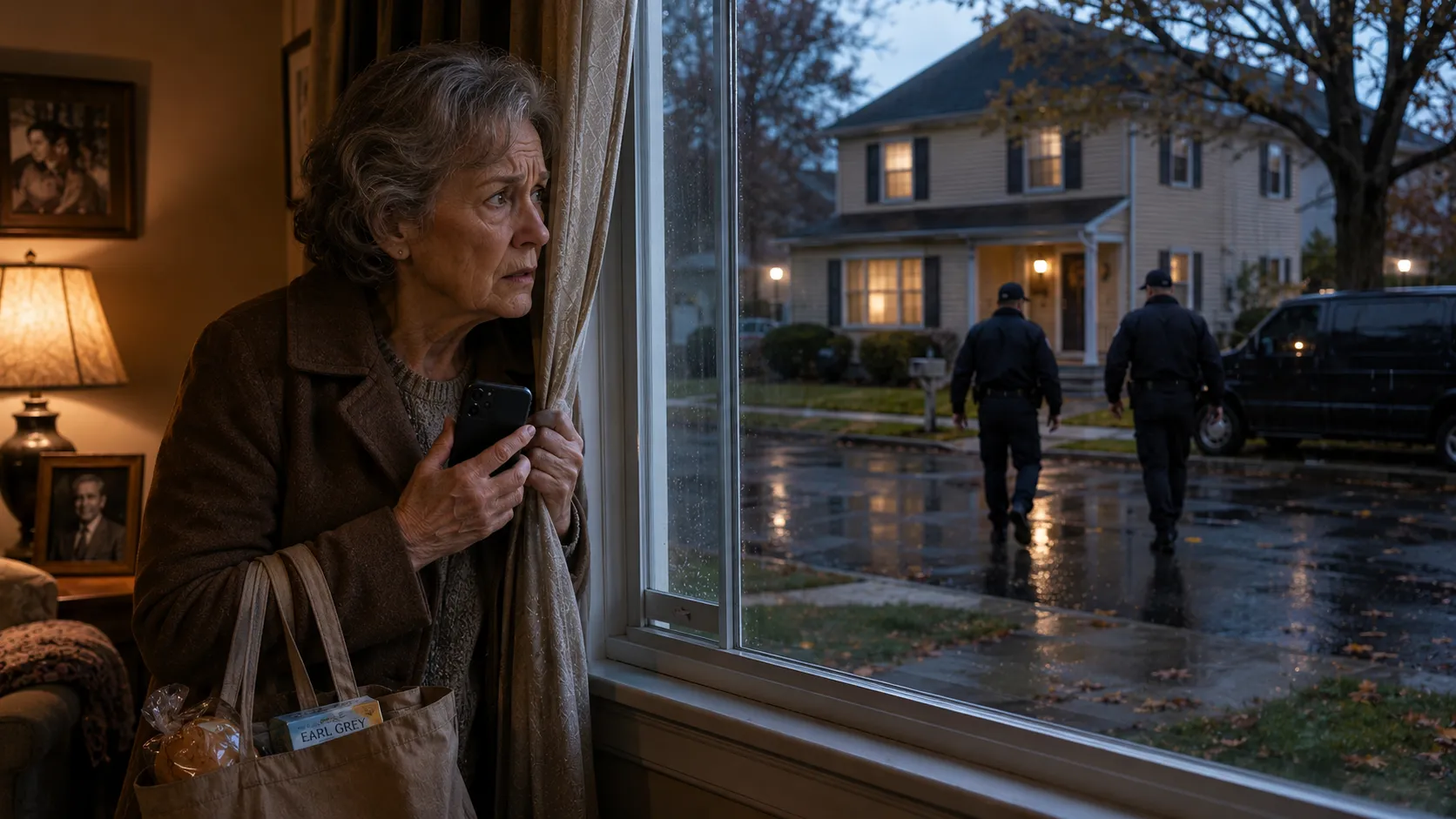
Ethan Brooks came home early expecting nothing more dramatic than cold water and a few hours of sleep. Instead, he found Grace — his housekeeper of twelve years — eating in silence on the kitchen floor, and before the night was over, he learned that cruelty had been living in his house wearing perfume, good manners, and the face of a woman he had almost married.
When Ethan Brooks pushed open the kitchen door that night, he expected nothing more dramatic than a glass of water and five hours of sleep.
He had come home early without warning, too exhausted for the investor dinner his assistant had spent three days arranging and too hollow to pretend otherwise. The house was quiet in the way large houses often are — expensive, polished, and faintly lifeless. Most of the lights were off. The marble floors still held the day’s coolness. Somewhere, a clock ticked with the smug precision of something that had never once doubted its own place in the world.
Then he saw her.
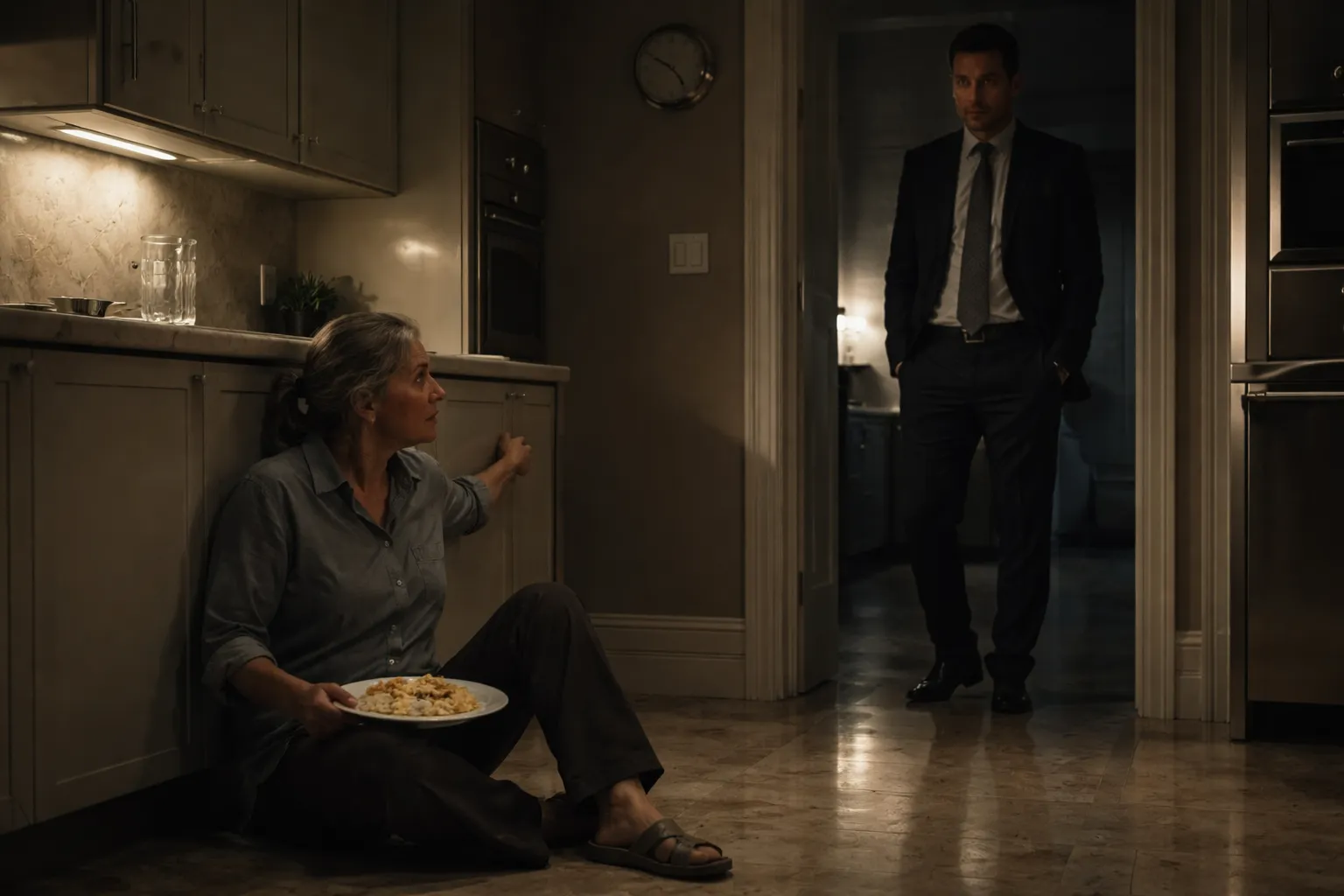
Grace Miller, his housekeeper of nearly twelve years, was sitting on the kitchen floor with her back against the cabinets.
She had a plate balanced on her lap and was eating cold rice and eggs quickly, like someone trying to finish before being discovered. She was still in her work clothes: a faded gray shirt, dark slacks, old slippers flattened at the heel. Her hair had loosened at the temples. Her eyes were swollen.
Not tired.
Swollen.
From crying.
Grace looked up and startled so violently that Ethan felt ashamed before either of them had spoken.
She tried to stand immediately, one hand clutching the plate, the other reaching for the counter.
“No,” Ethan said, too fast. “Please. Don’t get up.”
She froze.
“I’m sorry, sir. I didn’t mean to—”
“Grace.”
He hated the word sir in that moment. It built a wall between them, and the sight of her on the floor had already shown him one wall too many.
“You don’t have to apologize.”
He pulled out a chair at the kitchen table and sat down across from her, though the distance between chair and floor suddenly felt cruel and absurd.
Grace lowered her eyes.
“It was a long day,” she said quietly. “I didn’t get to eat earlier.”
It was the kind of answer she always gave: efficient, polite, impossible to argue with.
But Ethan had known her too long not to hear what sat underneath the words.
Her fingers were gripping the edge of the plate hard enough to whiten the knuckles.
“You know you don’t have to eat on the floor,” he said gently.
Something passed across her face then.
Not anger.
Not even sadness.
Habit.
The habit of making yourself smaller before someone else can do it for you.
“It’s all right,” she said. “I’m nearly done.”
She finished in silence, washed the plate, dried it, and put it away. All the while she kept her back to him, as if that were easier than letting him see her face.
Ethan lingered in the doorway, uneasy in a way no board meeting had ever made him uneasy.
“If someone said something to you,” he began carefully, “if someone has been bothering you in this house, I need you to tell me.”
Grace’s shoulders tightened just a fraction.
Then she turned with that practiced smile of hers — the one that never reached her tired eyes.
“Nothing’s wrong, Ethan. I’m fine.”
But the distance had already returned. The “sir” was gone from her mouth, yet somehow still present in her voice.
And he knew, with a cold certainty, that she was lying.
That night he lay awake staring at the ceiling while the image replayed itself in his mind: Grace on the floor, eating as if she had no right to a chair.
One name kept surfacing.
Vanessa.
Vanessa had spent the afternoon at the house while Ethan was out. She had drifted in the way she always did — perfume first, then shopping bags, then complaints, then that polished certainty that everyone in the room existed to make her life run more smoothly. Ethan had called her intense to friends, high-maintenance to himself, and complicated when he wanted to excuse things he should have named more honestly.
He had never called her cruel.
By morning, he feared he had simply refused to look.
Grace was already awake when he came downstairs. The breakfast tray was set. The coffee was poured. The house smelled faintly of lemon polish and toast. Everything was immaculate.
Grace moved through the kitchen the way she always had — quietly, efficiently, almost invisibly.
But now Ethan noticed what he had failed to notice before.
She stayed on the far side of the room.
She answered from doorways.
She never turned her back fully if someone was standing behind her.
When Vanessa swept into the house just after noon, carrying shopping bags and talking loudly into her phone, Ethan stayed in the upstairs hallway long enough to watch without being seen.
She walked straight into the kitchen, opened the refrigerator, drank from a glass bottle of imported juice, and called out without looking around:
“Grace! Come here and put my things away.”
Grace appeared almost immediately, drying her hands on a dish towel.
“Yes, ma’am.”
Ethan flinched at the ma’am.
Vanessa dropped the bags onto the counter.
“All of that goes into the guest closet. My closet is full, and I don’t want the boxes visible when people come tonight.”
Grace lifted the bags. Ethan saw, with a sick jolt, that her hands were trembling.
Not from age.
Not from fatigue.
From dread.
Vanessa never thanked her. She barely even looked at her.
Ethan stayed where he was, one hand gripping the banister, shame moving through him in slow, hot waves.
It would have been easier if the problem had been one ugly outburst.
Easier if he could have called it stress, impatience, or bad manners.
But this was not impatience.
This was degradation.
And it had been happening under his roof.
That evening he heard enough to stop lying to himself forever.
The kitchen door was slightly ajar. Ethan had come in through the side entrance after a late meeting, loosened his tie, and paused when he heard Vanessa’s voice — low, deliberate, almost playful.
“Do you really think you’re entitled to sit at the table?”
Grace said nothing.
Ethan stood still in the hallway.
Vanessa continued, savoring every word.
“You work here. You clean. You cook. You scrub things other people use. That is the arrangement. You are not family, and you are certainly not my equal.”
There was a small sound then — cloth slipping from someone’s hand.
Ethan’s stomach turned.
“And if you’re tired,” Vanessa said, her voice turning softer in the ugliest way, “the floor is perfectly fine for people like you.”
Silence.
Then a laugh.
Not loud.
Not wild.
Worse.
Amused.
Ethan stepped into the doorway.
Vanessa turned and froze.
Grace had bent to retrieve the dish towel, but now she straightened slowly. Her face had gone pale.
Ethan looked at Vanessa first.
He had imagined confrontation many times in his life — in boardrooms, lawsuits, negotiations. In those scenes he usually knew exactly what to say.
Now he only knew what he had heard.
“How long?” he asked.
Vanessa recovered first, the way people like her often do.
“Oh, Ethan, please,” she said lightly. “Don’t look at me like that. I was joking.”
He didn’t answer.
He turned to Grace.
“How long?”
Grace lowered her eyes.
“It’s not worth—”
“Grace.”
Something in his voice made her stop protecting him from the truth.
“For a while,” she said quietly. “Only when she was angry. I tried to stay out of the way.”
I tried to stay out of the way.
He felt those words like a blade.
As though the best she believed she could hope for in his home was to avoid being noticed.
Vanessa let out a sharp little laugh.
“You cannot be serious. She’s making you dramatic.”
Ethan turned back to her then, really looked at her.
At the perfect hair.
The expensive silk blouse.
The carefully painted mouth.
The coldness underneath all of it.
And all at once the last year arranged itself in brutal clarity: the sharpened comments disguised as wit, the contempt for waiters and drivers and assistants, the way Vanessa always needed someone smaller to stand on.
“No,” he said. “What’s making me serious is finally hearing you clearly.”
Something changed in her face.
“Ethan—”
“You’re leaving.”
For a moment she looked genuinely confused, as though the possibility had never once crossed her mind.
“Leaving?”
“Tonight.”
Her voice rose.
“You’re ending things because of the housekeeper?”
He took one step closer, not angry now, only finished.
“I’m ending things because of what you enjoy.”
The kitchen went still.
Even the refrigerator hum seemed louder.
Vanessa tried everything in the next ten minutes.
Tears.
Indignation.
Insults.
That old polished trick of turning herself into the wounded one.
Ethan let the storm pass without stepping into it.
Finally he said, “No one who humiliates another person for pleasure will live in this house with my permission. Pack what’s yours. The driver will take you wherever you want to go.”
When she realized he would not bend, her face hardened into something almost unrecognizable.
“This is a mistake,” she said.
“Yes,” Ethan answered. “It was.”
She left an hour later dragging two expensive suitcases over the front steps.
The house fell quiet again after the door closed.
But for the first time in months, it did not feel suffocating.
It felt like the first breath after smoke.
Ethan found Grace in the pantry stacking jars that did not need stacking.
“It’s done,” he said.
She nodded once.
Not relieved.
Not yet.
Just careful.
“I’m sorry,” he said.
Grace’s hands stopped moving.
“For what?”
The question hurt him more than anger would have.
“For hearing it too late,” he said. “For calling this home while allowing you to be treated as though you were less than human inside it.”
Grace swallowed.
“I didn’t want trouble.”
“That,” Ethan said quietly, “is exactly the problem.”
The next few days were strange in the way houses are strange after conflict. The furniture stayed where it was. The rooms were the same. But the air had changed.
Grace moved through the house more slowly now, as if some part of her expected the old cruelty to return in a new shape.
And Ethan began noticing even more.
How often she stood instead of sitting.
How she ate only after everyone else.
How she still asked permission for things she had long since earned.
It unsettled him more each day.
One Saturday afternoon, while sorting through a box of papers sent over by an old family friend after his late mother’s belongings had finally been cleared, Ethan found an envelope with his name written across the front in her unmistakable hand.
He sat down before he finished the first paragraph.
His mother wrote about many things — her illness, practical instructions, little confessions mothers force themselves to make when time has narrowed.
But one part of the letter was underlined.
If there is one thing I hope you understand when you are old enough to see people clearly, it is this: Grace did not work for us in the ordinary sense. She steadied this house when it was breaking. She came to us after burying her own little boy, and still found tenderness enough to help raise mine. I have never forgotten that debt, though she never called it one. One day, when I am gone, do not let her become invisible in the very place she helped hold together.
Ethan read those lines three times.
Grace had lost a son.
A small boy.
And still she had spent years quietly bringing tea to his mother, soup to his room, medicine when he panicked, patience when he was too wrapped in his own grief to thank her properly.
Not because it was in a contract.
Not because anyone had ordered it.
Because grief had recognized grief, and she had answered it with care.
He found her in the laundry room folding towels.
The late light came through the small window over the sink and rested on her bent head, making the silver in her hair more visible than he had ever let himself notice.
“Grace.”
She looked up.
He held the letter carefully in one hand.
“I read something my mother left for me.”
Grace’s face changed at once. Not fear. Recognition.
“She wrote about your son,” Ethan said quietly.
For a long moment Grace did not answer.
Then she sat down on the little stool by the ironing board as if her legs no longer fully trusted her.
“He was six,” she said at last. “A fever that turned too quickly. This was before hospitals took people like me seriously unless there was money in the room.”
Ethan sat across from her.
“I didn’t know.”
“There was no reason you should have.” A faint smile touched her mouth. “You were a child. And later… later there was always something else that needed tending.”
She looked down at the towels in her lap.
“When your mother got sick, I knew that look in her eyes. The one people have when they’re trying not to be afraid in front of the people they love. And when you started having those night spells after she died…” She paused. “I suppose I knew something about what it means to survive a house after someone is gone from it.”
Ethan felt his throat tighten.
“All these years,” he said, “I thanked you as if you were simply doing your job.”
Grace lifted one shoulder.
“Sometimes work is the word people use when they don’t know how to describe love that asks for nothing.”
That sentence stayed between them a long time.
Then Ethan said, “I want to change things.”
Grace gave him a tired, almost amused look.
“You already threw out the problem.”
“No,” he said. “I removed one problem. I’m talking about the rest.”
He placed the letter on the folded towels between them.
“My mother saw what I failed to see. I can’t correct the years already gone. But I can correct what happens now.”
The next week, Ethan did something wealthy men too often avoid: he made remorse practical.
He rewrote Grace’s contract with the help of a lawyer she chose, not one he assigned.
He doubled her salary.
Created a retirement fund in her name.
Added paid leave she had never taken because no one had ever sincerely told her the house could survive without her for a while.
He converted the small downstairs office into a proper sitting room for staff breaks, with real chairs, good light, and a table no one would ever be asked to earn the right to use.
He did something simpler too.
On Sunday morning, before anyone else arrived, he made coffee himself and set two plates at the kitchen table.
When Grace came in and saw them, she stopped in the doorway.
“Ethan—”
“Sit,” he said.
She almost smiled.
“You don’t have to prove anything.”
“I know,” he said. “That’s why I mean it.”
She came to the table slowly, like someone approaching something fragile.
When she sat, it was not graceful.
Not symbolic.
Not cinematic.
It was hesitant, careful, deeply real.
Ethan poured the coffee.
Sunlight fell across the table. Somewhere outside, a gardener’s radio murmured through an open window. The house felt different in a way Ethan could not have explained to anyone who had never lived in a place where silence had been doing the work of cruelty.
At last Grace looked up.
“You don’t owe me all of this.”
He thought of his mother’s letter.
Of the underlined sentence.
Of the cold kitchen floor.
“Yes,” he said quietly. “I do.”
She held his gaze a moment longer, then nodded once.
Not because the debt was settled.
Because, for the first time, it had been named.
Months later, visitors to the Brooks house sometimes noticed small changes without fully understanding them. The staff no longer disappeared when guests arrived. Meals were timed so no one ate alone after midnight beside a sink. Grace, now officially the household manager, moved through the rooms with the same quiet competence as before but with something new in her posture — less apology, more rest.
On certain evenings Ethan still came home tired.
The city had not softened.
Work had not become easier.
Loss had not been redeemed into something neat.
But the house no longer felt like a museum to success.
It felt inhabited.
One winter night he found Grace at the kitchen table reading with her glasses low on her nose and a bowl of soup steaming gently in front of her.
Not on the floor.
At the table.
She looked up when he came in.
“You’re late,” she said.
He loosened his tie.
“I know.”
“There’s soup.”
He smiled then, tired and grateful in equal measure.
And as he sat down across from the woman he had once mistaken for part of the background of his life, Ethan understood something that should have been obvious years earlier:
some people do not save you by arriving dramatically after everything falls apart.
Some people save you quietly, every day, by refusing to let your life fall apart in the first place.
All that changes, in the end, is the day you finally learn to see them.