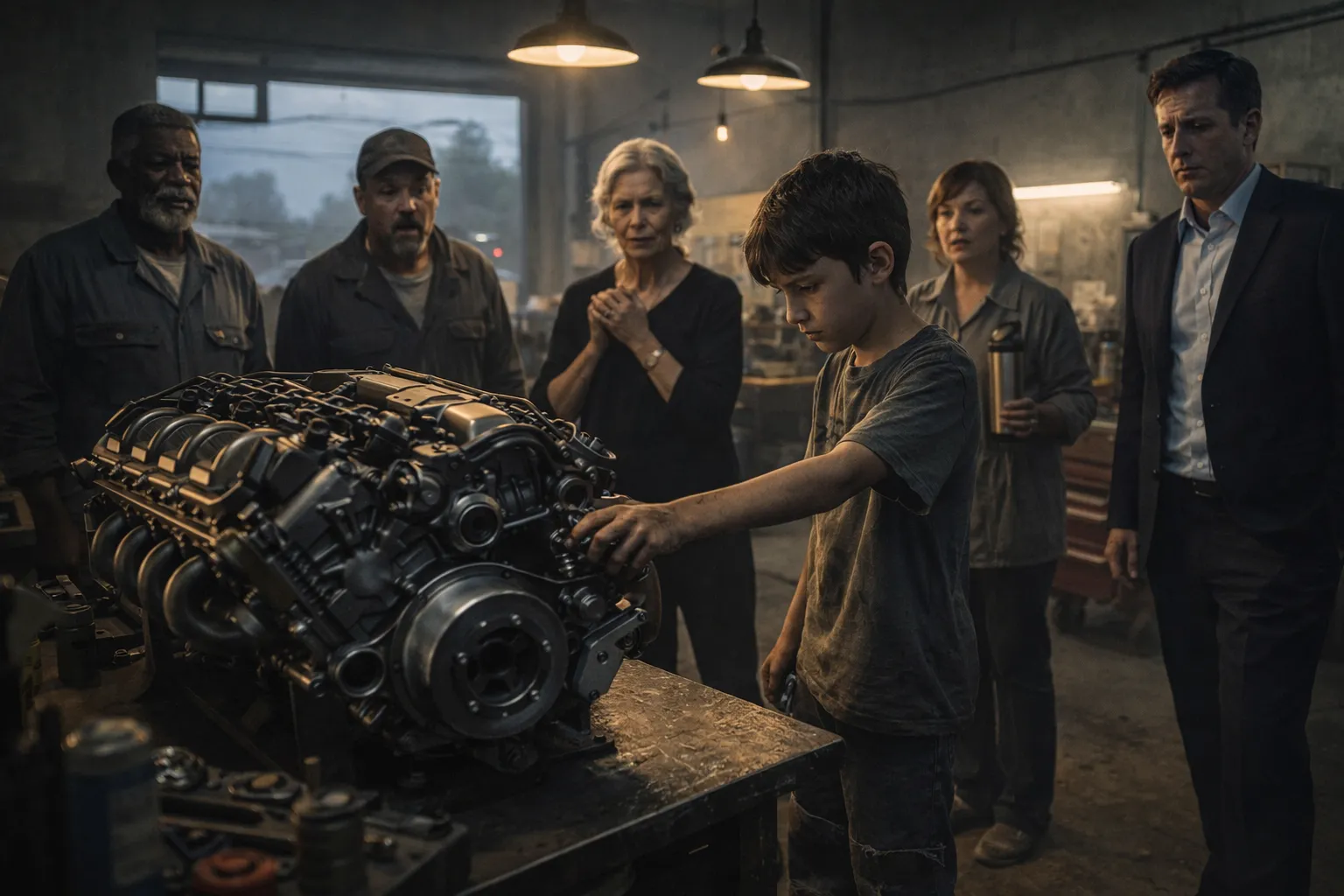
For weeks, Miguel had been treated like a stray boy with dirty shoes and empty pockets. Then the workshop’s “dead” engine landed on the bench — and with it came a buried family secret that would change every life in the room.
At fourteen, Miguel knew exactly what contempt sounded like.
It sounded like Esteban Salazar laughing in a concrete workshop full of men too afraid to disagree with him. It sounded like a gold ring striking the metal edge of a workbench while the manager pointed to a silent imported engine and said, loud enough for everyone to hear:
“If you can make that thing run, I’ll hand you my job right now, kid.”
A few mechanics laughed because they knew they were expected to. The others lowered their eyes and kept pretending to work. In places like that, survival often looked a lot like silence.
Miguel stood near the end of the workbench, thin as a rail, in a faded T-shirt darkened by old grease. His sneakers were split at the sides and held together with gray duct tape. He had spent the last month coming to the dealership every morning before school and every afternoon after it, offering to sweep the floor, organize tools, haul scrap metal, anything that might let him stay close to machines.
He did not come for charity.
He came for a chance.
But Esteban had never given him one. Every time Miguel asked to help, the answer was the same.
“This is a workshop, not a daycare.”
That day, though, something was different.
The engine on the table was not an ordinary engine. It had come out of a high-end European sedan — the kind of car people in Miguel’s neighborhood only saw in magazines or when one sped past and left the smell of money behind it. The dealership’s best mechanic had spent three days trying to revive it before finally walking out that morning in defeat.
“Mechanical brain death,” he had muttered on his way out.
No one had touched the engine since.
No one except Esteban, who now saw in it the perfect opportunity to humiliate a poor boy in public.
Miguel looked at the engine. Then at Esteban.
“Are you serious?” he asked.
The workshop quieted.
Esteban straightened his tie and smiled the way weak men smile when they are certain they hold all the power.
“I’m completely serious,” he said. “One week. If you fix it, my office is yours. My salary is yours. My position is yours. But if you fail — and you will — I don’t want to see you here again. Not in this workshop. Not outside the gate. Not even on the sidewalk.”
The men around them exchanged uneasy glances.
Miguel’s stomach was empty. He had eaten only bread that morning. But hunger had taught him something useful: if you were going to be looked down on either way, you might as well stand up straight.
He lifted his chin.
“Deal,” he said.
Esteban laughed again and walked off, already enjoying a victory that existed only in his imagination.
What he did not know was that the engine on the table was not simply broken.
It was misunderstood.
And hidden inside it — buried beneath soot, metal, and years of neglect — was a truth that would link a dead man, an orphaned boy, and a promise that had been waiting far too long to be fulfilled.
Miguel did not touch a wrench the first night.
He only watched.
When the workshop emptied and the security lights hummed overhead, he circled the engine slowly, studying it from every angle. He crouched. He leaned in. He traced the housing with careful fingers, the way other boys might trace the shape of a map leading somewhere better.
Doña Patricia, the woman who had raised him since he had been left on her doorstep as a baby, always said Miguel had “hands that could see.”
And she was right.
The men before him had tried to force the engine back into the shape the manual described. Miguel could see that immediately. A bracket had been moved where it should never have been moved. A sensor had been replaced with the wrong type. Two systems were arguing with each other inside the same machine because someone had assumed the design was conventional.
It was not.
The engine was not dying.
It was resisting.
By the second night, Miguel understood something the trained mechanics had missed: this machine had been built with an idea too advanced for the people trying to repair it. They were not fixing it. They were undoing it.
By the third day, his hands were shaking from exhaustion, and not just from the work. He had stayed too long again. He knew Doña Patricia would worry. He also knew she would hand him the last of her rice and beans before she ever admitted there was not enough food in the cupboard.
That was when Guadalupe found him.
Guadalupe was the dealership secretary, a woman in her fifties who wore practical shoes and carried herself with the tired dignity of someone who had spent years watching mediocre men be promoted over better ones. She had seen managers come and go. She had seen boys like Miguel dismissed before they ever had the chance to fail honestly.
Without a word, she placed a sandwich wrapped in napkins beside him.
“Eat,” she said. “Brains need fuel too.”
Miguel looked up, startled.
She lowered her voice.
“And don’t let Esteban frighten you. He knows how to wear a tie and talk loudly. That’s not the same thing as knowing anything. You, on the other hand…” She nodded toward the engine. “You’re listening.”
Miguel smiled for the first time that day.
After he ate, he returned to the engine and began cleaning one of the intake assemblies with a care that bordered on reverence. Beneath the soot, something caught the light.
He leaned closer.
There, almost invisible, was a hand-stamped engraving.
R.M. — Future Project 2009
Miguel stared at it.
He knew those initials.
For years, he had scavenged old technical manuals, engineering magazines, and discarded textbooks from dumpsters behind schools and repair shops. He kept them in a stack under his bed like other boys kept treasure. Again and again, one name appeared in articles about experimental efficiency systems and environmentally advanced engines:
Ricardo Morales.
A brilliant engineer.
A visionary.
Dead for years.
Miguel felt a chill run through him.
What was Ricardo Morales’s signature doing inside a modern car engine no one seemed to understand?
Word spread quickly through the dealership that the “garage boy” had found something no one else had seen. And word, in places where pride is fragile, can be more dangerous than fire.
By then, Esteban had stopped laughing so easily.
He had begun watching from a distance.
The possibility that Miguel might succeed had turned his confidence sour.
Then, on the fourth afternoon, someone unexpected walked into the workshop.
She was an elegant woman in her sixties with silver hair, a straight back, and eyes that looked as if they had learned long ago how to carry grief without letting it spill in public. Her name was Beatriz Morales, a minority shareholder in the dealership — and the widow of Ricardo Morales.
She had not come to inspect the books or review a contract. She had simply heard, through the quiet channels older employees trust more than management memos, that a boy was trying to revive a machine no one could understand.
When Beatriz saw Miguel leaning over the engine, her breath caught.
Not because she recognized his face.
Because she recognized the way he worked.
The posture. The stillness. The total refusal to rush what had not yet explained itself.
“My husband used to look exactly like that,” she said softly.
Miguel straightened at once, embarrassed by the grease on his hands and the state of his clothes.
Beatriz stepped closer.
“May I see?”
Miguel nodded and showed her the engraving.
The moment her eyes fell on the letters, they filled with tears.
“Ricardo marked his prototype work by hand,” she whispered. “He never trusted labels. He said real ideas deserved to be signed by the person willing to stand behind them.”
She looked at Miguel for a long moment — longer than was comfortable, but not unkindly.
Then she asked him questions. What had he noticed first? Why had the previous repairs failed? What did he think the engine needed?
Miguel answered carefully, unsure whether he was being tested or invited.
By the time he finished, Beatriz no longer looked at him the way adults usually looked at poor boys — with pity, or doubt, or polite distance.
She looked at him with respect.
The next day she returned carrying a polished wooden case.
Inside, nestled in dark velvet, lay a set of precision tools so fine Miguel hesitated to touch them.
“They were Ricardo’s,” Beatriz said. “He always told me a tool remembers the hand that uses it honestly. I kept these for years because I could not bear to part with them.” She lifted one of the calibrated wrenches and placed it gently in Miguel’s palm. “Today, I think I understand why I kept them.”
Miguel swallowed hard.
“I can’t take these.”
“You can borrow them,” she replied with a faint smile. “But only if you promise to do what my husband always did.”
“What’s that?”
“Respect the machine more than your ego.”
For the first time since the bet began, Miguel felt something stronger than determination.
He felt accompanied.
With the correct tools in hand, the engine began to reveal itself. It was not a conventional system at all, but an early hybrid design — ahead of its time, elegant in concept, delicate in execution. Someone, years earlier, had built a prototype that combined performance with efficiency in ways most mechanics at the dealership had never even been trained to recognize.
The previous attempts to repair it had nearly destroyed the very thing that made it special.
Miguel now understood his task clearly.
He was not repairing a dead engine.
He was restoring an unfinished idea.
The night before the deadline, fear finally made Esteban dangerous.
Long after everyone else had gone home, he slipped back into the workshop and shut down power to the main floor, assuming darkness would do what humiliation had failed to do.
When Miguel arrived later that evening, carrying a notebook full of diagrams and the last roll of bread Doña Patricia had tucked into his backpack, he found the workshop black and silent.
For a moment, he just stood there.
A lesser disappointment might have broken him. But hunger, embarrassment, and loneliness had been his teachers far longer than engines had. He did not know how to quit simply because the room had gone dark.
He called Beatriz.
An hour later, she arrived with candles, battery lamps, and Guadalupe carrying a thermos of coffee and sweet bread.
Together they lit the workshop.
Warm gold flames flickered across chrome, glass, and old steel. Shadows leaned and shifted over the workbench. Outside, the city carried on, indifferent. Inside, a boy worked through the night under the watch of a widow, a secretary, and the memory of a man he had never met.
It did not feel like a workshop anymore.
It felt like a vigil.
By dawn, Miguel’s fingers were raw, his eyes red, and his shirt clung to his back with sweat. But when he finally tightened the last fitting and stepped away, he knew.
Not that it might work.
That it should.
The test drew a crowd before the sun was fully up.
Mechanics came first, then salesmen, then detailers, cleaners, and drivers. Even those who had laughed at the beginning now stood shoulder to shoulder around the workbench, speaking in low voices. Nobody wanted to miss the moment when the boy failed.
Or the moment he didn’t.
Alejandro Morales, owner of the dealership and Ricardo’s older brother, arrived just before eight. Unlike Esteban, he carried wealth the way older men sometimes do — with less noise and more fatigue. He had come out of curiosity.
He would leave with far more than that.
Esteban stood near the office entrance with his arms crossed and his expression fixed into something between contempt and worry.
Miguel stepped forward.
“It’s ready,” he said.
His voice was rough from exhaustion.
A hush fell over the room.
Miguel reached into the driver’s side, adjusted the sequence, and turned the ignition.
For two seconds, nothing happened.
Then the engine woke.
Not with a violent roar, but with a deep, controlled, almost beautiful hum — smooth, balanced, and startlingly clean. The diagnostics lit up across the screen. Sensor response stabilized. Emission readings dropped. Fuel mapping aligned. The machine did not merely run.
It sang.
No one moved.
No one breathed.
Then a mechanic at the back whispered, “Madre de Dios.”
Esteban took a step backward.
“That’s impossible.”
Miguel looked up at him, not triumphantly, not cruelly — simply clearly.
“No,” he said. “It was never impossible. It was just misunderstood.”
Alejandro moved to the engine as if pulled by something stronger than curiosity. He studied the assembly, then the altered fuel system, then the precision of the restoration. His hand trembled when he found the engraving.
R.M. — Future Project 2009
Beatriz stood beside him, tears already running freely now.
“He built this after the doctors told him his heart was failing,” she said quietly. “He said if he could not leave behind more years, he would leave behind better ideas.”
Alejandro’s face changed.
Slowly, he turned toward Miguel.
There was something in the boy’s eyes. Something in the shape of his hands, the line of his jaw, the concentration that remained on his face even now, after the room had begun staring at him like a miracle.
Not proof.
But recognition.
Years earlier, Ricardo had confessed to his brother that before his marriage, before his public life, there had been a young woman he had loved and a child he feared he might never know. The relationship had collapsed under pressure, pride, and distance. By the time Ricardo tried to make things right, the woman had disappeared. For the rest of his life, he searched quietly. He never found them.
Or so everyone believed.
Days later, after questions were asked, papers were traced, and the small pieces of an old private tragedy were gathered together, the truth came out at last.
A DNA test confirmed it.
Miguel was Ricardo Morales’s son.
The orphan boy everyone had dismissed as a nuisance was the child Ricardo had spent years hoping to find.
When the result was read aloud in Alejandro’s office, Beatriz wept openly. Guadalupe crossed herself. Doña Patricia, who had arrived in her cleanest dress and stood clutching her worn handbag with both hands, sat down and cried the way only mothers cry — not because they are shocked, but because life has finally chosen, for once, to be kinder than cruel.
Esteban tried to speak.
He muttered something about misunderstandings, about not knowing, about how nobody could have guessed.
Alejandro raised a hand and silenced him.
“The wager was the least important thing that happened here,” he said coldly. “I’m not dismissing you because you lost a bet. I’m dismissing you because you humiliated a child, sabotaged honest work, and nearly destroyed the spirit of this workshop. You have no place managing people.”
Esteban’s face went gray.
“Leave your keys. Clean out your office.”
For the first time in his life, he had no clever reply.
When he was gone, Alejandro turned to Miguel.
“What happened here today belongs to you as much as it belongs to this family,” he said. “You can come live with us if you want. I’ll pay for the best schools. The best tutors. The best future money can build.”
Beatriz stepped forward and took Miguel’s hand.
“You will never have to struggle alone again,” she said.
It was the kind of offer most people would have accepted before the sentence had finished.
Miguel did not answer immediately.
He looked first at Doña Patricia — the woman who had raised him without wealth, without certainty, and without ever letting him feel unwanted.
Then at Guadalupe, who had fed him when she did not have to.
Then at Beatriz, who had trusted him with a dead man’s tools.
Then through the workshop doors, where several boys from the neighborhood had gathered outside the gate, peering in with wide eyes. Their clothes were patched. Their faces were thin. Their hope was painful to look at because it resembled his own from a week earlier.
When Miguel finally spoke, the room listened.
“I don’t want an office,” he said.
Alejandro blinked. “What do you want?”
Miguel took a breath.
“I want this place to become something bigger than a dealership workshop. I want kids like me to come here and learn. Real training. Real tools. Real chances. My father left behind knowledge. If I keep it only for myself, then we lose him twice.”
The room fell silent again, but this time it was not from shock.
It was from shame.
Because a fourteen-year-old boy who had every reason to ask life for comfort had chosen purpose instead.
Alejandro looked at Beatriz.
Beatriz looked at Doña Patricia.
And for perhaps the first time in years, all three adults in that room understood that the boy standing before them did not need rescuing nearly as much as the world needed making room for him.
So that is what they did.
Within the year, the old dealership workshop was expanded and reopened as the Ricardo Morales Technical Training Center.
Scholarships were offered to children who had talent but no money. Retired mechanics came in to teach. Engineers volunteered guest lectures. Doña Patricia became the unofficial mother of the place, making sure no student sat in a classroom or stood at a workbench on an empty stomach. Guadalupe ran the front office with the firm kindness of someone who knew exactly how much dignity a young person can lose in one careless sentence — and how much can be restored by one generous one.
Miguel studied, worked, and grew into the kind of engineer companies fought to recruit. He turned down offers most people would have considered impossible to refuse. Not because he lacked ambition, but because he had already found the one form of success that mattered to him.
He stayed.
Years later, when a frightened new student in secondhand clothes stood frozen before an engine everyone else said was beyond saving, Miguel would walk over, place a wrench gently in the child’s hand, and say the words that had once rescued him from humiliation:
“It’s not impossible. It’s just waiting for someone to understand it.”
As for Esteban, life taught him what arrogance never could.
Months after losing his position, after rejections piled up and his reputation closed more doors than his résumé could open, he returned to the training center a smaller man than the one who had thrown his laughter around so carelessly.
He did not ask for a management position.
He asked for work.
Miguel looked at him for a long time.
Then he handed him a broom.
“Start there,” he said.
And Esteban did.
Because in a real workshop, as in life, every repair begins with admitting what is broken.
Miguel’s greatest gift, in the end, was not the engine he revived or the legacy he inherited.
It was the choice he made after both.
He proved that success is not measured by how high you climb while others remain beneath you.
It is measured by whether, once you have climbed, you remember to reach back down.
And every time an engine started inside that workshop — smooth, steady, alive — the sound seemed to carry more than combustion and steel.
It carried memory.
It carried mercy.
And somewhere in that beautiful mechanical hum, you could almost imagine Ricardo Morales smiling at the son he had waited too long to know — not because the boy had restored a machine, but because he had restored something far more precious:
Hope.