To everyone in the bank, Evan Cross looked like a poor child who had wandered in by mistake. But the moment he unzipped the bag in his hands, the laughter died—and a six-year cover-up began to crack wide open.
The laughter started the moment the boy walked into Hawthorne & Pike Bank.
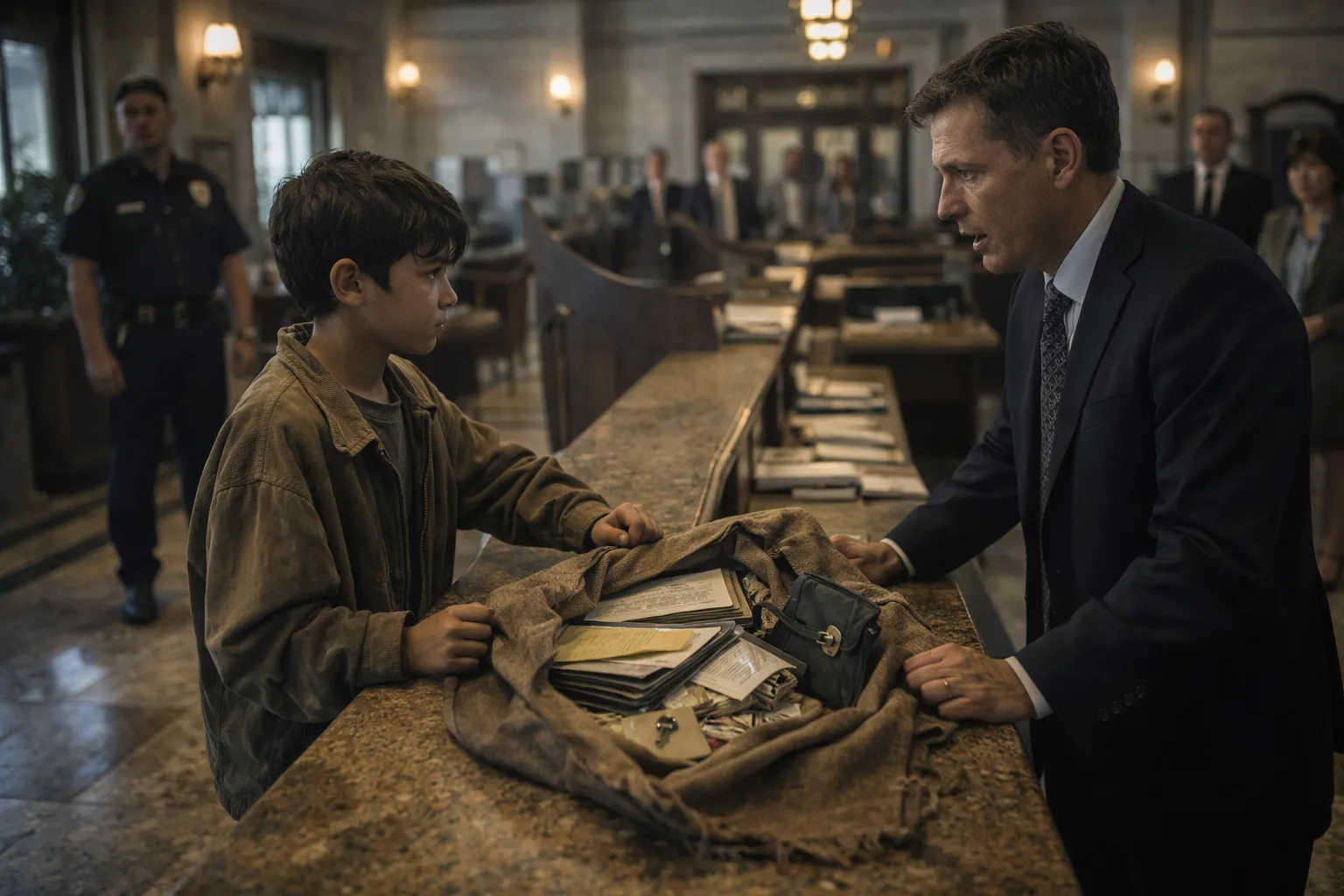
He could not have been more than twelve. Thin almost to the point of frailty, he wore a faded jacket with one sleeve slightly longer than the other, as though it had belonged to someone older before it ever reached him. His shoes were worn at the toes. In one hand he held a cloth bag so old and frayed it looked as if it had been mended more than once with different colors of thread.
At first, no one paid him much attention. It was the sort of bank where people spoke softly about mortgages, inheritances, retirement accounts, and safe places for money that had already spent years growing. Marble floors. polished counters. quiet confidence.
A boy like that did not belong there.
The security guard noticed him first.
“Hey,” he said, stepping forward. “This isn’t a shelter.”
A few of the tellers glanced up. One young employee smirked. A customer near the investment desk looked at the child, then quickly away, embarrassed for him and relieved not to be him.
But the boy did not beg, protest, or explain himself.
He only tightened his grip on the cloth bag and kept walking toward the central counter, where a silver nameplate gleamed beneath the lights:
MARTIN CALDWELL — BRANCH MANAGER
Martin Caldwell emerged from his office with the restrained irritation of a man who disliked disorder in any form. He was in his late forties, sharply dressed, well-groomed, and practiced in the art of sounding courteous without ever surrendering authority.
“What seems to be the problem?” he asked.
The guard gave a dismissive shrug. “Kid walked in off the street. Probably wants cash or food.”
Caldwell’s eyes moved to the boy. “Son, if you need assistance, there are public services—”
The boy stepped forward and gently placed the bag on the counter.
Then, with slow and careful hands, he unzipped it.
At first, the contents looked like junk.
Loose papers. Old envelopes. A cracked leather pouch. Two rubber-banded bundles of identical black key fobs. A smaller locked cash-transfer bag with the Hawthorne & Pike logo faded across one side. Plastic sleeves protecting documents that had been folded and unfolded too many times.
Then Caldwell saw the top page.
The color drained from his face so quickly that even the head teller, Emily Warren, noticed it from three stations away.
Stamped across the document in red were words no customer should ever see:
FRAUD INVESTIGATION — CASE 17-113
The guard leaned in, puzzled. The laughter in the room vanished. Someone at the far desk stopped typing mid-sentence.
The boy looked directly at Caldwell and spoke in a voice so calm it was almost unsettling.
“I was told to bring this to you.”
For one suspended second, the branch felt as though all the air had been pulled out of it.
Caldwell stared at the document, then at the boy.
His lips parted.
“You’re…?”
The boy slid the plastic sleeve forward across the polished counter.
“My name is Evan Cross,” he said.
The surname hit Caldwell harder than the document itself.
Six years earlier, Daniel Cross had been the name whispered through internal audit meetings, legal briefings, and late-night conference calls. Daniel had been an outside vault contractor, a man with access to old safe-deposit systems and internal transfer procedures. When assets began disappearing from dormant accounts and certain deposit boxes were found mysteriously empty, blame settled on him with convenient speed.
Then Daniel Cross died in what police called a hit-and-run before the case ever reached open court.
The bank declared the matter closed.
Caldwell had signed the final paperwork himself.
He had told himself, many times, that he had simply followed protocol.
Now Daniel Cross’s son was standing in front of him holding evidence that should never have existed.
“Come with me,” Caldwell said quietly.
He did not wait for a reply. He took the bag himself and led Evan into the glass-walled office, then shut the door and lowered the blinds with a hand that was no longer steady.
Outside, the bank floor fell into a hush of anxious curiosity.
Inside, Caldwell set the bag on his desk and looked at the boy more carefully.
Evan Cross had the exhausted composure of a child who had learned too early that adults were unreliable. His face was narrow, his hair roughly trimmed, and there was an old seriousness in his eyes that no twelve-year-old should have carried.
“Who told you to bring this here?” Caldwell asked.
Evan reached into his pocket and placed a cracked prepaid phone on the desk.
“A man called this number last night,” he said. “He said if I wanted the truth about my father, I should bring the bag only to Martin Caldwell at Hawthorne & Pike. He said you’d understand what was inside.”
Caldwell looked at the phone as if it were alive.
“Where did you get the bag?”
“It was hidden in a storage locker my father rented before he died. My mother found the key in one of his old coats last week. She didn’t want to open anything. She was scared. But I went with her. The bag was inside a metal toolbox.”
“Your mother knows you’re here?”
Evan hesitated, then nodded once. “She knows I came to the bank. She doesn’t know if you can be trusted.”
The honesty of it cut deeper than accusation would have.
Caldwell opened the bag fully and spread its contents across the desk.
The identical key fobs were tagged with handwritten codes. The document sleeves contained transaction logs, maintenance requests, internal emails, audit summaries, and deposit box access histories. Beneath them sat a packet of photographs, including one of Caldwell himself leaving a private parking garage years earlier with a folder under his arm and fear plainly written on his face.
On top of the second stack lay an internal memo signed by regional oversight executive Marcus Hale.
Close case. Reputational risk outweighs unresolved variance.
Caldwell’s mouth went dry.
He had not seen that memo in years, but he remembered the meeting. Hale had spoken in calm, polished tones about stability, investor confidence, and the danger of allowing a contractor’s allegations to snowball into scandal. Daniel Cross had insisted the missing assets were not random theft. Someone inside the system was using dormant accounts, safe-deposit access codes, and old transfer procedures to siphon money so quietly that ordinary clients would not notice for months—sometimes years.
Daniel had asked Caldwell for time.
Instead, Caldwell had given Marcus Hale his signature.
“What do you know?” Evan asked.
Caldwell sat down slowly.
“Enough to know your father may have died trying to expose the wrong people.”
Evan’s eyes did not widen. He looked as if some part of him had expected exactly that.
“He said my father wasn’t a thief,” the boy said. “The man on the phone. He said my father found the thief.”
Caldwell closed his eyes for a moment.
Not the thief, he thought. Not one thief.
A system.
The office phone rang, sudden and sharp enough to make both of them look up.
Caldwell glanced at the screen and felt his stomach twist.
MARCUS HALE — REGIONAL OFFICE
He answered on the second ring, forcing his voice into something flat and normal.
“Marcus.”
Hale’s voice came through warm, smooth, and dangerously relaxed. “Martin. I’m in the area. Thought I’d stop by. Ten minutes.”
Caldwell kept his expression blank.
“That’s unexpected.”
A faint chuckle. “I prefer not to announce every visit. Keeps people honest.”
The line went dead.
Caldwell lowered the receiver slowly.
Evan spoke first. “Is he coming for the bag?”
Caldwell did not answer immediately. Instead, he stood, went to the door, and checked the floor through the blinds. Emily Warren was pretending to sort forms, but she kept looking toward the office. The guard had drifted back to the entrance. No one knew yet what they were standing inside.
A bank.
A crime scene.
A confession waiting to happen.
Caldwell turned back to Evan.
“Listen to me very carefully,” he said. “From this moment on, you do exactly what I say. No improvising. No arguing. Understand?”
Evan nodded.
Caldwell took a clean folder and slid several key documents inside: the fraud report, Hale’s memo, the box access logs, the photo, and one email chain Daniel had printed before he died. Then he took out his personal phone and sent a message to Emily.
Lock the rear hallway. Call 911. Ask for financial crimes. Say there is live evidence connected to Case 17-113. Keep the boy where staff can see him. Do not let anyone be alone with him.
He hit send.
Then he reached into his desk drawer and took out the silent panic remote every branch manager was issued and almost none ever used.
Evan watched him.
“You’re scared,” the boy said quietly.
Caldwell looked at him.
“Yes,” he said. “I should have been scared six years ago.”
Heavy footsteps sounded on the marble floor outside.
Marcus Hale arrived with the ease of a man accustomed to entering rooms he already believed belonged to him. He wore a dark tailored suit, a silver watch, and the polite half-smile of someone who had built a career out of sounding reasonable while other people took the fall.
Emily intercepted him near the customer service desk.
“Mr. Hale,” she said, too brightly. “Mr. Caldwell is just finishing up with a matter—”
Hale’s eyes moved past her and landed on the office blinds.
He smiled.
“I’m sure he is.”
Caldwell opened the office door before Hale could knock.
“Marcus,” he said.
“Martin.”
Hale stepped closer and lowered his voice. “I’m told there was an irregular access ping connected to one of our legacy systems. That wouldn’t happen to involve a bag or a child, would it?”
So he already knew.
Caldwell felt something inside him settle—not into peace, but into certainty. For six years he had told himself that silence was prudence, that obedience was professionalism, that preserving the institution was somehow the same as protecting the truth.
Standing a few feet from Marcus Hale, he understood what it really had been.
Cowardice.
“There is a child here,” Caldwell said.
Hale’s smile thinned. “Then I suggest you send him away before he becomes part of something unfortunate.”
The threat was soft, almost elegant.
That made it worse.
Caldwell stepped out of the office and deliberately left the door open behind him.
The customers nearest the counter looked up. Emily froze. Even the guard straightened, sensing a change in the air he could not yet name.
Hale lowered his voice further. “Shut the door, Martin.”
“No.”
“Be sensible.”
Caldwell shook his head.
“I was sensible when Daniel Cross begged for time. I was sensible when your office buried the investigation. I was sensible when the bank called a dead man a criminal because the truth was inconvenient.”
Hale’s expression hardened.
“You are speaking far too loudly.”
For the first time in years, Caldwell did not care.
He turned slightly so the room could hear him.
“Marcus Hale has just asked me about unauthorized access to safe-deposit systems connected to a closed fraud case. I have reported it. The evidence is in my office.”
Silence crashed across the lobby.
Hale’s smile vanished.
“Martin,” he said, very softly, “think carefully.”
“I am,” Caldwell replied. “That’s why I’m done protecting you.”
The first police officer came through the glass doors less than thirty seconds later, followed by two more and a woman in plain clothes from financial crimes. Someone in the waiting area had already started recording on a phone. The same employees who had laughed when Evan walked in now stood pale and motionless, as if ashamed to even breathe.
The detective approached the counter.
“Who made the call?”
“I did,” Emily said, her voice shaking. Then she pointed toward Caldwell. “But he has the evidence.”
Caldwell stepped aside and gestured toward the office.
“And the boy’s name is Evan Cross.”
Evan emerged from behind Emily’s station with the ragged bag in both hands.
When Hale saw him, something cold and murderous flickered across his face before training covered it again. But too many people saw it. Too many eyes. Too many witnesses. Too many phones held low and steady.
It was over.
Not cleanly. Not quietly. But over.
In the weeks that followed, investigators uncovered what Daniel Cross had tried to expose.
The fraud had been running for years through a quiet internal network that targeted dormant accounts, old deposit box records, and transfer procedures few younger employees even understood. Access codes were recycled. Records were altered. Small amounts disappeared so discreetly that many victims never realized they had been robbed until estates were settled, inheritances reviewed, or boxes reopened after long absences.
Daniel had discovered irregular patterns while servicing the older vault systems. When he pressed too hard, evidence was steered toward him. By the time he understood how isolated he had become, his name had already been prepared as the sacrifice.
The bank issued statements. Lawyers circled. Executives denied knowledge until records contradicted them. Marcus Hale was arrested pending a broader investigation. Others followed.
Martin Caldwell was suspended, questioned, and eventually cleared of direct theft.
But not of silence.
He accepted that without protest.
Months later, after the worst of the headlines had passed, Caldwell asked permission to visit Evan and his mother.
They met in a quiet legal office downtown. Evan looked healthier than he had in the bank that day. Not carefree—children like him did not become carefree overnight—but steadier. Less haunted.
Caldwell did not bring gifts.
Only a folder.
Inside was the official statement clearing Daniel Cross of wrongdoing, a letter confirming recovered funds, and a formal apology issued in the bank’s name.
Evan did not reach for the papers at once.
He looked at Caldwell and asked the one question that mattered.
“Will it change anything?”
Caldwell answered honestly.
“It won’t give you back what was taken,” he said. “It won’t give your mother those years. And it won’t bring your father home. But people will say his name differently now. The truth will follow it.”
For the first time since entering the bank, Evan’s expression changed.
Not into a smile exactly.
Into relief.
Caldwell placed the folder on the table.
“I should have listened to your father when he still had a voice,” he said. “Instead, I listened when powerful men told me to be careful.”
Evan lowered his gaze to the documents, then back to Caldwell.
“They laughed at me when I walked in,” he said.
Caldwell nodded once.
“I know.”
Evan’s fingers tightened on the folder.
“I almost turned around.”
Caldwell felt that sentence land with the full weight of everything it meant—a frightened boy, standing in a polished bank, mocked before he had spoken a word, carrying the truth in a bag everyone thought was trash.
“But you didn’t,” Caldwell said.
Outside, afternoon light stretched across the office window in long pale bands. Somewhere beyond the glass, the city went on doing what cities always did—hurrying, buying, dismissing, forgetting.
But not this time.
Not for Evan Cross.
Not for Daniel Cross.
Because one poor boy had walked into a bank full of people who judged him in a single glance, and by the time he walked out, he had done what grown men in tailored suits had failed to do for six years:
He told the truth and stayed standing.