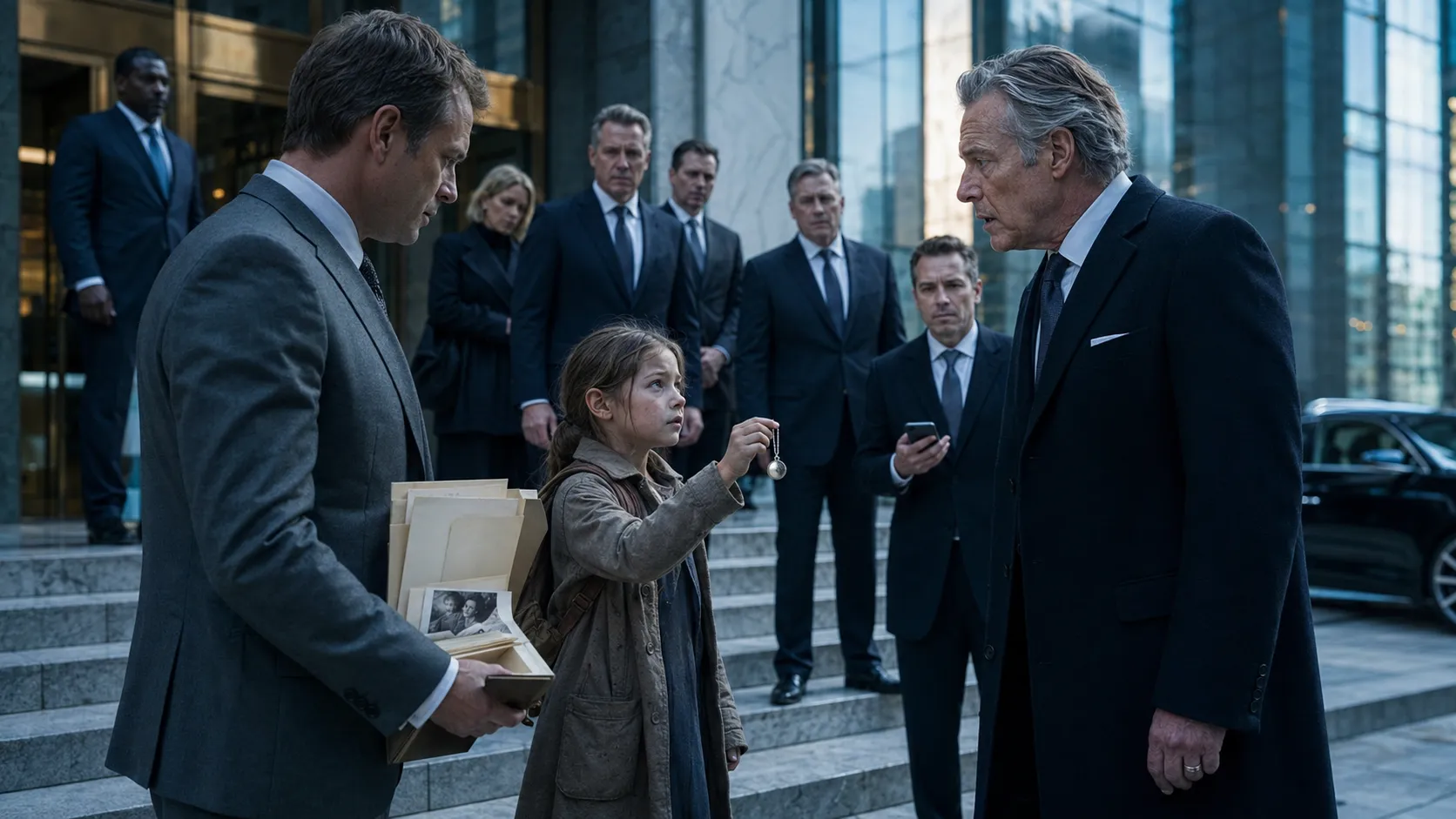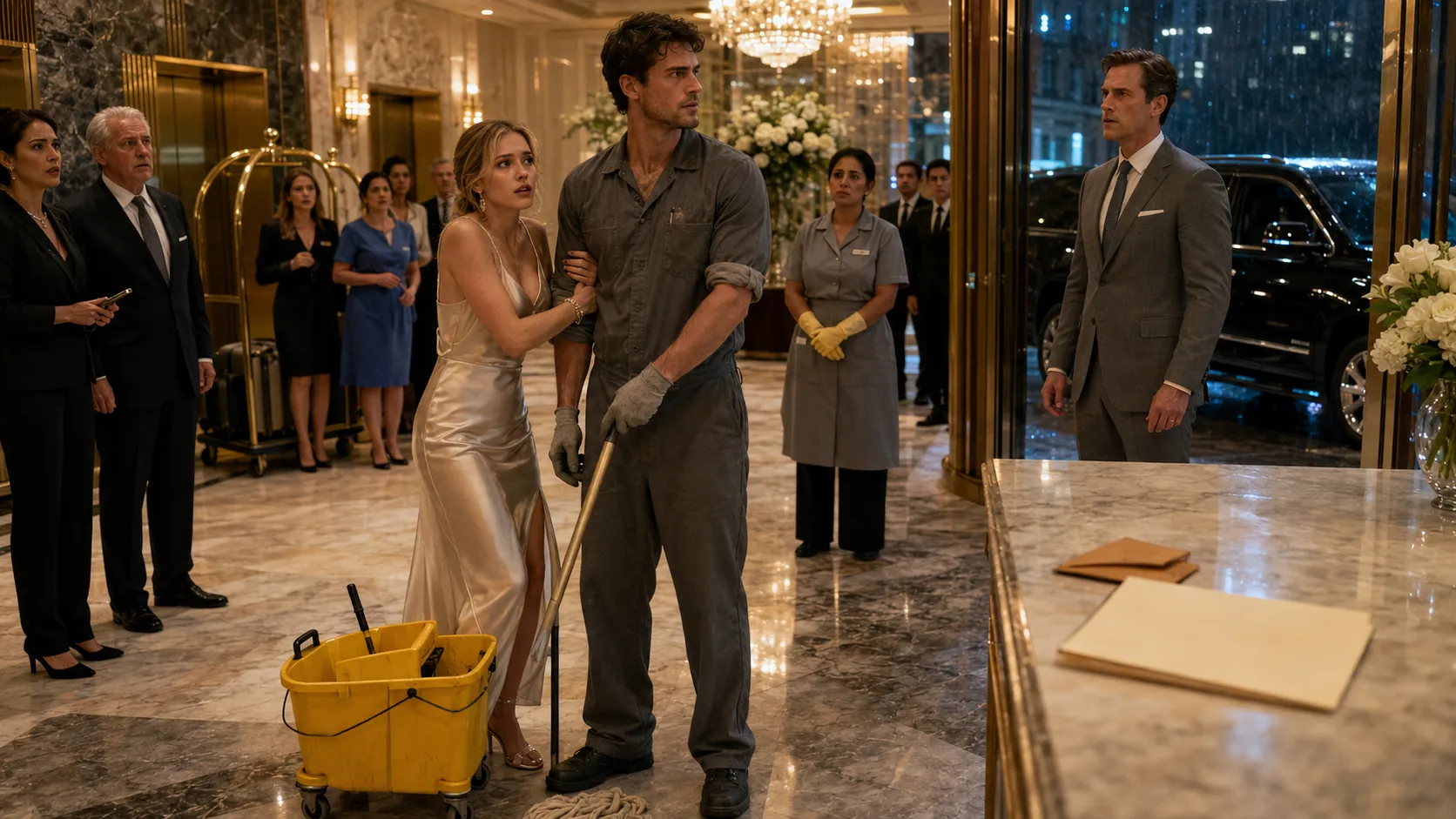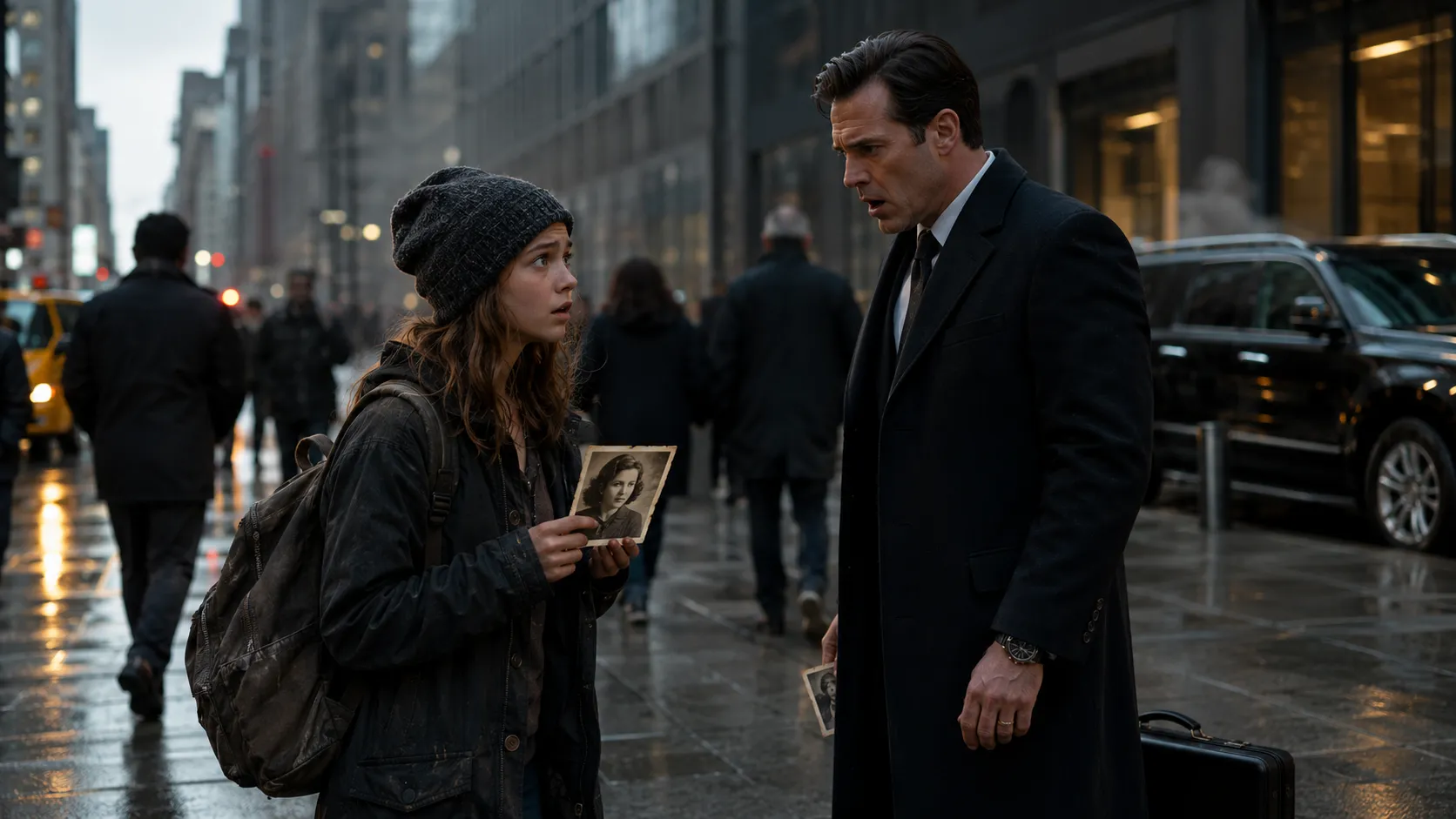

Ethan had only gone to the Grand Meridian to wait for his mother after her shift. Then he saw the silver watch on a wealthy stranger’s wrist, spoke his father’s name, and watched the man’s entire world stop.
The lobby of the Grand Meridian Hotel glowed with the kind of elegance meant to make ordinary people feel small.
Crystal chandeliers spilled warm light over marble floors polished to a mirror shine. A pianist in the lounge played softly enough to be mistaken for memory. Men in tailored suits crossed the room with the easy confidence of those accustomed to expensive places, while women in silk and cashmere spoke in quiet voices near arrangements of white lilies.
By the revolving doors, a boy stood trying not to look lost.
He was nine years old, thin for his age, with dark hair that needed cutting and a winter coat that had belonged to someone bigger. He held a worn backpack in both hands as if it were the one thing in the world that still obeyed him. Now and then he glanced toward the reception desk, then toward the elevators, then back at the front entrance, careful not to stray too far from the chair where his mother had told him to wait.
His name was Ethan.
He did not belong in places like the Grand Meridian, and he knew it.
But his mother had picked up a late housekeeping shift after another employee called in sick, and there had been no one to leave him with. So Ethan had come with her after school, carrying his homework, a half-finished sandwich, and the quiet seriousness children wear when life has made them older than they should be.
For nearly an hour he had sat still, watching the hotel move around him in gleaming silence.
Then he saw the watch.
At first it was only a brief flash of silver near the concierge desk. A man in a navy overcoat had just stepped out of a private meeting room and was speaking to the concierge with polite impatience, the way important people do when they are trying not to look rushed. He was perhaps in his late thirties or early forties, clean-shaven, broad-shouldered, wearing wealth as naturally as other men wear fatigue.
But it was not the man’s face Ethan noticed.
It was the watch on his wrist.
A silver watch with a simple round face. Elegant. Old-fashioned. Not flashy. And along the rim, near the edge of the glass, a faint scratch.
Ethan’s breath caught.
He had seen that scratch before.
Not in real life.
In a photograph.
At home, inside the bottom drawer of the old tool chest that had once belonged to his father, there was a small tin box filled with things his mother could never bring herself to throw away: loose screws, shop receipts, a bent key ring, two faded snapshots, and one photograph his father had kept separate from the rest.
In that photograph stood a younger version of his father, Scott—grease on his hands, smiling in front of the garage that had once been his whole life. Beside him stood a thin teenage boy Ethan had never met, all elbows and sharp angles, trying not to smile but failing. On the teenager’s wrist was a silver watch with a scratch on the rim.
Ethan’s father had shown him that photo many times.
“Who’s that?” Ethan had once asked.
“A boy who needed someone to believe in him,” Scott had replied.
Then, after a long silence, he had added, “And the best investment I ever made.”
Scott never said much more. Not because he didn’t want to. Because by the last years of his life, speaking for too long tired him.
But sometimes, especially on the harder nights, when the bills sat unopened and the garage was quiet, he would take that picture from the drawer and look at it with an expression Ethan had never forgotten.
“If you ever meet him,” Scott had once said softly, tapping the watch in the picture, “you tell him I never regretted it. Not for one day.”
Ethan had been too young then to understand.
Now, standing in the polished lobby of a hotel so grand it hardly seemed real, he stared at the watch and felt something stir inside him—something stronger than shyness, stronger even than common sense.
He left the chair.
Each step across the marble made him feel smaller and more visible at the same time. A woman in pearls glanced down at him, then away. A bellman slowed as if unsure whether to stop him. But Ethan kept walking until he stood only a few feet from the man in the overcoat.
For a second, courage failed him.
Then he reached out and gently touched the edge of the man’s sleeve.
The man turned.
Mild irritation crossed his face first—the automatic impatience of a man interrupted too often. But then he saw the child standing there, serious-eyed and trembling only slightly.
“Yes?” the man said.
Ethan swallowed.
“Excuse me, sir,” he said quietly. “Did… did a man named Scott ever give you that watch?”
The question was soft.
But it hit like a gunshot.
The man went completely still.
His gaze dropped at once to the silver watch on his wrist. His fingers closed around it instinctively, almost protectively. Then his eyes returned to Ethan’s face, searching it with sudden intensity.
“What did you say?”
Ethan’s heart began to pound.
“My dad had a photograph,” he said. “You were younger in it. But I know that watch. My dad’s name was Scott.”
For a moment the hotel seemed to fall away.
The piano still played. The concierge still spoke in the background. Somewhere a glass clinked against a tray. But to the man in the overcoat, none of it remained.
Only one word did.
Scott.
He had not heard that name spoken aloud in years.
His name was Daniel Mercer.
Fifteen years earlier, Daniel had owned nothing but a torn backpack, a temper he could not control, and the stubborn belief that the world had already decided what he was worth.
At seventeen, he had slept behind warehouses, beneath highway overpasses, in abandoned cars when luck allowed. He had learned how quickly hunger turns into anger and how easily anger becomes identity. He had been chased off from loading docks, laughed out of shops, and turned away from more doors than he could count. Every grown man who looked at him seemed to see the same thing: trouble.
Then came the rain.
Daniel remembered that night with painful clarity. Cold rain. Oil-slick pavement. The yellow light spilling from a small auto repair shop that should have been closed by then. He had been shivering so badly his teeth hurt. He had crouched beside the building not because he expected help, but because the overhang gave him six inches of shelter.
The shop door had opened.
A man with rough hands, tired shoulders, and grease still on his forearms stepped out carrying a metal trash bin.
He looked down at the soaked teenage boy and said the words that changed Daniel’s life.
“You hungry?”
That was Scott.
Scott had not been rich. He had not been polished. He had not been one of those men whose generosity makes them look noble from a distance. He was a mechanic with bad knees, a stubborn conscience, and the kind of practical kindness that rarely makes itself known in speeches.
He did not ask Daniel for his story that first night.
He gave him coffee so hot he could hardly hold the cup, half a meatloaf sandwich wrapped in wax paper, and a place to sit in the back of the garage until the storm passed.
The next morning, when Daniel was still there—too proud to beg, too exhausted to run—Scott handed him a broom.
“If you’re going to look miserable in my shop,” he said, “you might as well sweep.”
That was how it began.
Sweep the floor. Stack the filters. Put the sockets back where they belong. Watch. Learn. Be on time. No lies. No stealing. No vanishing for three days and expecting the world to wait.
Scott did not coddle him. He did something harder.
He treated him as if he were salvageable.
Weeks turned into months. The broom led to tools, the tools led to repairs, and the repairs led to something Daniel had never possessed before: a future he could picture without flinching.
Scott taught him engines, balance sheets, customer service, self-respect. He taught him that keeping your word matters even when no one is watching, and that resentment is a poor substitute for discipline.
When Daniel broke something, Scott made him fix it.
When Daniel lost his temper, Scott made him apologize.
When Daniel doubted himself, Scott said the same sentence every time.
“You are not what life did to you. You are what you decide to become.”
Years later, when Daniel left town to chase opportunities larger than that little garage could offer, Scott stood with him outside the bus station and slipped the silver watch off his own wrist.
Daniel had protested.
Scott ignored him.
“You’re always late,” he said with a crooked smile. “Maybe this’ll improve your odds.”
When Daniel turned the watch over, he saw the engraving on the back:
To Scott. For always being on time. — Dad
Scott’s voice had softened then.
“My old man gave me that before he died. I’m not handing it to you because it’s expensive. I’m handing it to you because time is the one thing a man can spend only once. Don’t waste yours.”
Daniel had carried those words like scripture.
He wore the watch through every stage of the life that followed: the first cheap suit, the first investors’ meeting, the first office with secondhand furniture, the first sleepless year when everything nearly collapsed, the first success, then the next, and the next after that. Startups. Real estate. Technology. One sharp decision after another. Daniel Mercer became the kind of man whose name appeared in financial magazines and whose hotel suites cost more per night than Scott had once made in a week.
And all through those years, he told himself he would go back.
He would return to the garage. He would show Scott what became of the wild, half-starved boy he had refused to give up on. He would say thank you properly, like a man instead of a frightened kid pretending he didn’t need anyone.
But life accelerated. Meetings multiplied. Success became its own machinery.
By the time Daniel returned to the old neighborhood, the garage door was shut for good.
Scott was gone.
A sudden illness, the neighbors had said. Fast. Too fast.
Daniel had stood outside the closed shop with the watch on his wrist and guilt in his throat like a stone. That day, without saying the words aloud, he made himself a promise:
If he ever found Scott’s family, he would not turn away from them.
And now Scott’s son was standing in front of him in a borrowed winter coat, in the lobby of the Grand Meridian Hotel.
Daniel lowered himself slowly until he was at eye level with the boy.
“What’s your name?” he asked, though his voice had already changed.
“Ethan.”
“Where is your mother?”
“She’s working upstairs,” Ethan said, glancing toward the elevators. “Cleaning rooms. She said to wait here and not bother anyone.”
Daniel felt something twist sharply in his chest.
“And your father?”
The boy’s eyes shifted.
“He died two years ago,” he said. “After he got sick. Mom says it happened too fast.”
Daniel closed his eyes for a second.
When he opened them, he asked the question he was already afraid to hear the answer to.
“What happened to the garage?”
“We lost it,” Ethan said. “Then we lost the house too.”
He said it simply, the way children do when life has forced them to learn adult language before adult understanding.
“Mom works a lot now,” he added. “She says we’ll be okay. But I hear her crying sometimes when she thinks I’m asleep.”
Every word struck Daniel harder than any business loss ever had.
He looked at the boy again—at Scott’s eyes in a smaller face, at the quiet dignity that seemed almost unbearable in someone so young—and something inside him stopped being memory and became obligation.
“Did your dad ever tell you about me?” Daniel asked.
Ethan nodded. “He said you were the boy in the picture.”
Daniel gave a faint, broken laugh.
“I was.”
“He said helping you was one of the best things he ever did.”
Daniel turned his face away for a moment.
Not because he was ashamed of crying.
Because in a place like that, among marble and crystal and polished men who mistook control for strength, he had forgotten how exposed gratitude can make a person feel.
When he faced Ethan again, his eyes were bright.
“I should have found your family sooner,” he said quietly. “I am sorry I didn’t.”
Ethan didn’t know what to say.
So he said the only true thing he had.
“You came now.”
That nearly undid Daniel completely.
That night he waited until Ethan’s mother finished her shift.
Her name was Claire.
She came down from the service elevator after midnight wearing a housekeeping uniform and the exhausted look of someone who had spent too many years enduring one emergency after another without time to collapse properly from any of them. When she saw Ethan standing beside an elegantly dressed stranger in the lobby, every muscle in her body tightened.
She crossed the floor at once.
“What happened?”
“It’s all right,” Daniel said quickly, rising. “I’m sorry. I should explain.”
Claire looked from Ethan to Daniel and back again. Life had trained her to distrust well-dressed men who used gentle voices.
But then Daniel said Scott’s name.
Not vaguely.
Precisely.
He spoke of the old garage on Mercer Street. Of the radio that only played classic country because Scott refused to modernize. Of the way Scott used to hum while loosening rusted bolts. Of the coffee he drank too strong, with more sugar than any doctor would approve. Of the sentence he repeated whenever Daniel wanted to quit.
Claire’s hand rose slowly to her mouth.
By the time Daniel mentioned the dent in the red toolbox that Ethan still had in his room, tears were already running down her face.
“This isn’t pity,” Daniel said. “Your husband saved my life. I have lived for years with the knowledge that I never thanked him the way I should have. Please let me do for you what he once did for me.”
Claire cried harder then.
Not loudly.
Like a woman who had been holding herself together by habit for so long that relief felt dangerous.
Within a week, Daniel had paid their overdue rent and the debts that had been hanging over Claire since Scott’s illness. He moved them into a safer apartment close to Ethan’s school. He set up an education fund in Ethan’s name that would not disappear with market shifts or changing moods. He put a lawyer and financial adviser at Claire’s disposal, not to impress her, but to protect her.
Yet the most important thing he did was not financial.
He drove Claire and Ethan one Saturday morning to the old garage.
The building stood empty, tired, and half-forgotten.
Daniel got out of the car and looked at the faded sign above the door for a long time before speaking.
“I don’t want Scott to survive only as a story about the past,” he said. “I want what he built to keep doing what it did for me.”
A few months later, after renovations, the doors reopened.
Not as a luxury business.
As Scott’s Garage & Training Shop—a working garage with an apprenticeship program for teenagers aging out of foster care, school dropouts, and kids one bad winter away from becoming the boy Daniel had once been.
Claire handled the books. Daniel funded the program but kept his name off the sign. Retired mechanics volunteered time. A local technical college partnered with them. And Ethan, still small enough that his feet didn’t reach the stool properly, spent his Saturdays there listening to old men argue about engines and learning that legacy is something built with hands, not slogans.
Years passed.
Not perfectly.
But honestly.
Claire laughed more. Ethan grew taller. Daniel did not become a replacement father—that was never his role, and he knew it. But he showed up. Consistently. School meetings. Birthday dinners. Bad report cards. Hard talks. Summer work at the garage. Lessons about money, character, failure, and the difference between success that flatters the ego and success that honors the people who carried you there.
Whenever Ethan thanked him, Daniel gave the same answer.
“This is not charity. This is gratitude.”
And because Ethan was Scott’s son, he understood the difference.
On Ethan’s eighteenth birthday, after the shop had closed for the evening and the last mechanic had gone home, Daniel asked him to stay behind.
The garage was quiet except for the ticking of the wall clock and the settling creak of old metal cooling after a long day. Daniel reached into his coat pocket and took out a small velvet box.
He placed it on the workbench between them.
Ethan opened it slowly.
Inside rested the silver watch.
For a long moment he could not speak.
He lifted it carefully, turning it in the light until he found the faint scratch on the rim. Then he turned it over and read the engraving, tracing the letters with his thumb as if he were touching not steel, but time itself.
To Scott. For always being on time. — Dad
“It was never really mine,” Daniel said. “I was only carrying it until I knew what to do with it.”
Ethan looked up, eyes full.
“My father gave this to you.”
“Yes.”
“Why give it back now?”
Daniel leaned against the bench, his voice quieter than usual.
“Because your father invested in me when I had nothing to offer him. He believed in a future no one else could see. That watch reminded me every day that my life stopped belonging only to me the moment he chose to help me. It belongs with his family now.”
Ethan closed his hand around the watch.
For a while neither of them spoke.
Then Ethan asked the question only a son of Scott’s could have asked.
“Would he be proud of you?”
Daniel smiled, but it was the smile of a man answering before the highest court he knew.
“I hope,” he said, “that I spent what he gave me wisely.”
Ethan nodded once.
“He would.”
Outside, dusk gathered over the street. Inside, among oil stains, ledgers, tools, and memory, something old and unfinished finally settled into peace.
People who later heard the story often focused on the money.
They spoke about the wealthy businessman, the hotel lobby, the debts paid, the scholarship fund, the generosity of the ending.
But the real heart of the story was never the money.
Money solved urgent problems, yes. It gave Claire and Ethan safety. It reopened a building. It funded second chances.
But money was not the true inheritance Scott left behind.
He left conviction.
He left example.
He left a way of seeing another human being at their lowest and refusing to measure them by that moment.
That was what Daniel inherited first.
The rest came later.
And when Ethan eventually took his place in the world—not as a replica of Daniel, not even as a replica of Scott, but as his own man—he carried that inheritance with him more faithfully than the watch itself.
Because real wealth is not what you keep.
It is what continues to bear fruit after you are gone.
Sometimes destiny does not arrive with thunder.
Sometimes it crosses a marble hotel lobby in worn shoes, looks up at a stranger, and speaks one familiar name.
And in that instant, time does not simply pass.
It circles back.
It remembers.
It keeps a promise that gratitude had been carrying for years.
Not in the silver watch.
But in the life that refused to let kindness end with one man.