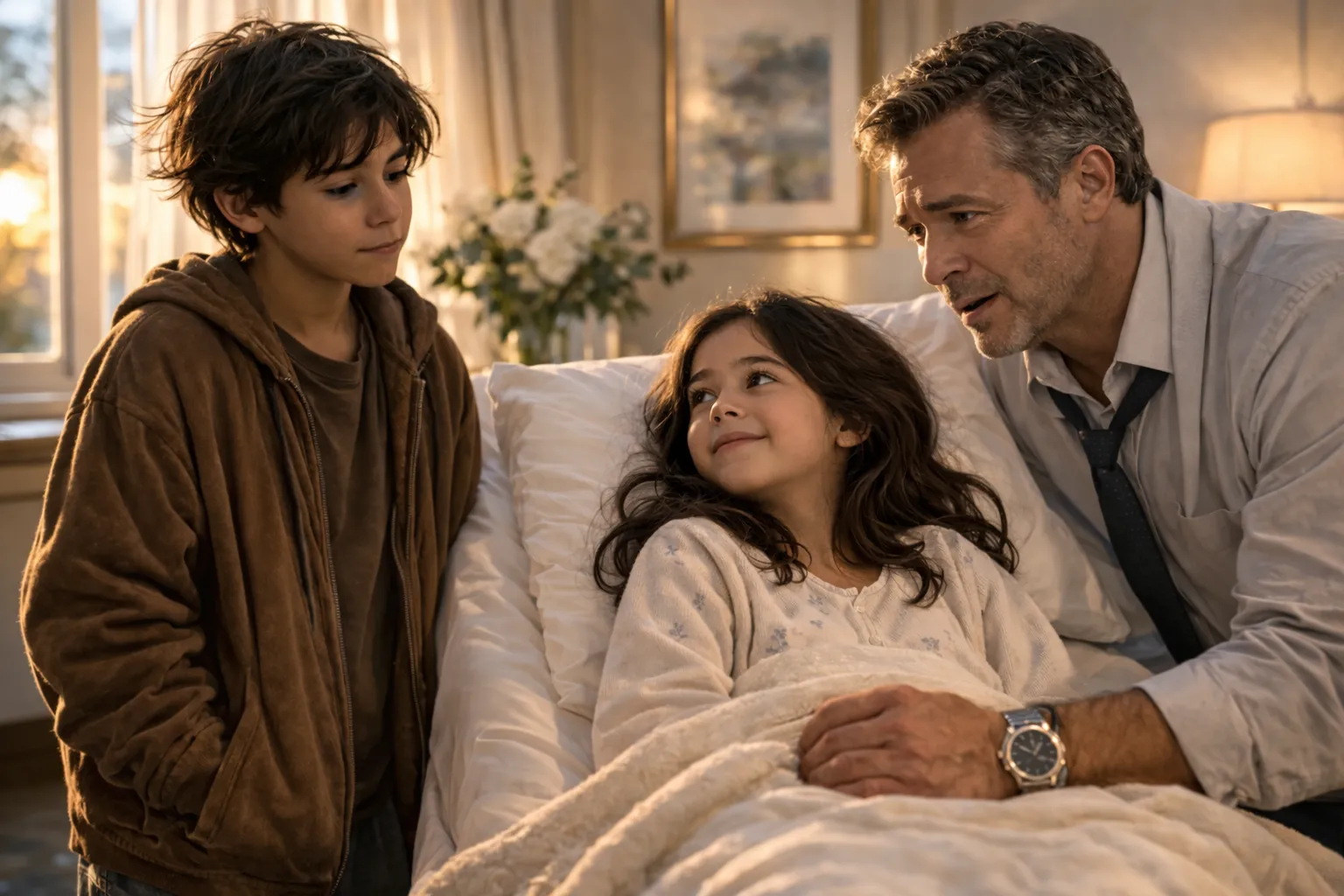
After three years beside a hospital bed, Ethan Walker had finally agreed to say goodbye to his daughter. Then a thin, dusty boy appeared outside her room and said the one thing no grieving father should have dared believe: “She isn’t gone. She’s only lost.”
For three years, the sound of the heart monitor had ruled Ethan Walker’s life.
Beep.
Beep.
Beep.
It was steady, mechanical, indifferent — the kind of sound a machine makes when it has no idea it is measuring the ruins of a man.
In every other part of his life, Ethan understood power. At fifty-six, he was one of the most feared men in American finance, a billionaire investor whose name could move stock prices before the opening bell. He knew how to evaluate risk, how to bend negotiations, how to outlast panic, and how to make even bad news sound temporary in the right room.
But none of that knowledge had helped him inside Room 512.
No spreadsheet could explain why a child’s small hand stayed warm while the rest of her life stood still. No legal strategy could negotiate with silence. No amount of money could buy back the one thing that had been taken from him on a rain-soaked highway outside Seattle three years earlier.
His daughter, Olivia.
She had been six when the accident happened.
Now she was nine.
And yet in that hospital bed she still looked heartbreakingly close to the child she had been the night everything shattered — pale lashes against still cheeks, dark hair combed gently back by nurses who had come to care for her as if she were their own, fingers so thin Ethan still found himself warming them between his palms whenever the room felt too cold.
The crash lived inside him with a clarity that time had never dimmed.
The slick road.
The sudden hydroplane.
The violent spin of headlights in black rain.
The blast of metal folding into metal.
The screaming that stopped too fast.
Ethan had survived with bruises, stitches, and a cracked rib.
Olivia had not woken up.
At first there had been hope. Hope from specialists. Hope from second opinions. Hope from cutting-edge therapies flown in from other states and countries. Hope from neurologists who spoke in careful percentages and from private consultants who used words like promising, minimal response, emerging activity, experimental pathway.
Ethan had paid for everything.
He had chartered flights, funded treatments, brought in the best names money could reach. He had spent more on his daughter’s recovery than some hospitals spent in a year, and he would have spent ten times more if anyone had said the right figure out loud.
But hope, he had learned, can become its own form of cruelty when it stops being medicine and starts becoming delay.
That morning, just after ten, the lead neurologist had asked him to step into the corridor.
The woman had known Olivia since the beginning. She had once believed there might be a path back. Ethan trusted her because she had never lied to him, even when he desperately needed her to.
Her face told him the answer before she spoke.
“Mr. Walker,” she said gently, “her vital functions are declining. We are no longer talking about recovery. We are talking about prolonging a body that has already given everything it can give.”
Ethan stared at her.
“No.”
The word came out before he meant to say it. Flat. Automatic. Childish in its refusal.
She did not argue with him.
“We’ve repeated the scans,” she continued. “We’ve consulted every specialty available. There has been no meaningful neurological improvement in years, and now her system is beginning to fail. If we continue, it will not be because medicine still offers her a path back. It will be because you cannot bear to let go.”
The sentence cut him because it was true.
He hated her for speaking it.
He hated himself more for recognizing it.
The paperwork was placed before him an hour later. He did not sign immediately. He walked to the window. Sat down. Stood again. Read nothing. Remembered everything. In the end, his signature looked older than his hand.
By late afternoon, the hospital lights had taken on that bleak, colorless glow reserved for the hour when visiting ends and fear grows louder.
Ethan stood outside Olivia’s room with one hand on the door handle.
He had promised himself he would not collapse before he reached her bedside.
He had promised himself he would speak clearly.
He had promised himself that if this was the final thing he ever did for his daughter, he would do it with dignity.
Then a voice behind him said, very softly:
“Don’t go in there to say goodbye.”
Ethan turned.
A boy stood at the far end of the corridor.
He looked about ten years old, maybe a little older, though there was something strangely ageless in his face. He wore a faded brown hoodie, jeans gone white at the knees, and sneakers so worn the toes had begun to separate from the rubber. His hair looked wind-tangled, as if he had been outdoors for too long. There was nothing remarkable about him except his eyes.
They were calm.
Not bold, not frightened, not pleading — simply calm, in a way children almost never are around grief unless they understand something the adults do not.
Ethan’s first thought was that security had failed again.
His second was that he no longer had the strength to care.
“This is a private floor,” he said wearily. “You shouldn’t be here.”
“I know,” the boy replied.
His voice was gentle, almost apologetic.
“But you shouldn’t be saying goodbye. Not yet.”
Something in Ethan’s chest tightened.
Under any other circumstances, he would have asked for a nurse, called security, demanded to know where the child’s parents were. But grief hollows a man out in strange ways. It leaves behind pockets of desperation where impossible things can survive a little longer than they should.
Ethan looked at him more closely.
“Who are you?”
“My name is Gabriel.”
The boy took a step nearer.
“She isn’t gone,” he said. “She’s only lost. I can help her hear the way back.”
Ethan did not speak.
He should have laughed. Or walked away. Or told the child he was cruel to play with a father’s mind at a moment like this.
Instead, he heard himself ask, in a voice already breaking:
“Can you?”
Gabriel held his gaze.
“That depends,” he said quietly. “Do you still believe she wants to come back?”
The question undid him.
Ethan pressed a hand to his mouth and looked toward the hospital room where his daughter lay sleeping her endless sleep. For three years he had been speaking to her as if she could hear him, reading stories to her long after she had outgrown them, bringing in music she used to love, telling her about birthdays, weather, school friends, and the dog she had begged for but never got.
Maybe none of it had mattered.
Or maybe all of it had.
“Yes,” he whispered. “God help me, yes.”
Gabriel nodded once.
“Then let me see her.”
Ethan opened the door.
The room was dim except for the soft amber light over the bed. Olivia lay as she always did — small, still, beautiful in a way that made the whole world feel unbearably unfair.
Gabriel walked to the bedside without hesitation.
He did not behave like a curious child or a frightened one. He did not stare at the machines or ask awkward questions. He only stood beside Olivia for a moment as if listening to something no one else could hear.
Then he placed one hand lightly against her forehead.
“Talk to her,” he said to Ethan. “Not like a man making a speech. Like her father.”
Ethan came to the bed at once.
He took Olivia’s hand in both of his. The skin was warm. Fragile. Familiar.
“Liv,” he said, and his voice broke on her name. “It’s Daddy. If you can hear me… if there’s any part of you still listening… you don’t have to stay lost for me. But if you want to come home, I’m here. I’m here.”
The room changed.
Not dramatically. Not with thunder or blinding light. Just a subtle shift, as if the air itself had grown warmer by a single degree, enough to notice only because grief had made Ethan sensitive to the smallest impossible thing.
The heart monitor quickened.
One number climbed.
Then another.
Olivia’s fingers moved.
Not much.
Not enough for certainty.
But enough to make Ethan stumble backward and stare.
Gabriel swayed slightly, as though some effort had drained him.
“That’s all for today,” he murmured.
Ethan looked from the monitor to Olivia and back to the boy.
“What do you mean, all for today?”
Gabriel lowered his hand.
“She heard you,” he said. “Tomorrow will be easier.”
Then, before Ethan could stop him, he turned and walked out of the room.
That night, Ethan did not leave.
He did not take a single business call. He did not answer the messages piling up from New York, London, and Singapore. He sat beside Olivia’s bed with his coat draped over the back of the chair and watched every movement of the monitor as if the green line itself had become scripture.
The nurses noted small changes. Increased responsiveness in vital patterns. Subtle muscle activity. Unexplained but measurable shifts.
No one offered conclusions.
Ethan didn’t ask for them.
He was afraid to name hope too soon, afraid that language might scare it away.
At dawn, pale gold light slipped across the windows.
At 6:13 a.m., Gabriel returned.
He looked even thinner in the morning light, almost translucent with tiredness, but his eyes were the same — steady, kind, impossibly certain.
“You came back,” Ethan said.
“I told you I would.”
Gabriel moved to the bedside again, but this time he looked at Ethan first.
“When she wakes,” he said, “don’t ask where she’s been. Just let her know she’s safe.”
The sentence was so strange, so specific, that Ethan could only nod.
Gabriel placed his hand over Olivia’s once more.
“Call her,” he whispered.
Ethan leaned close, tears already threatening.
“Olivia,” he said. “Sweetheart, come back to me.”
For one suspended second, nothing happened.
Then Olivia inhaled sharply.
The monitor leaped.
Her lashes fluttered.
And her eyes opened.
They were unfocused at first, frightened by light, but they were open.
Alive.
Searching.
Then she found him.
“Daddy?”
The word was dry and ragged and weak, but it struck Ethan with the force of a miracle.
He fell to his knees beside the bed and began to sob — not the dignified tears of a man touched by relief, but the broken, helpless sobbing of someone whose soul has just been handed back to him after years of mourning it.
Nurses rushed in. Then doctors. Then more nurses. Monitors sounded alarms simply because the body that had been silent for so long was suddenly waking to itself.
Questions flew through the room. Orders. Tests. Instructions.
Through it all, Olivia kept her eyes on her father.
And through it all, Gabriel quietly stepped toward the door.
Ethan saw him only at the last second.
“Wait.”
He rose unsteadily and crossed to the boy, his entire body shaking.
“You saved her.”
Gabriel shook his head once.
“She chose to come.”
Ethan reached for him, though not quite touching, as if afraid the child might vanish if held too firmly.
“I can give you anything,” he said. “A place to live. School. Clothes. A home. Whatever you need — just tell me.”
Gabriel smiled, and there was something heartbreakingly gentle in that smile.
“I don’t need anything from you,” he said. “Just make sure she’s happy.”
Then he turned and walked away.
Ethan hurried into the hall after him.
It was empty.
He looked left. Right. Toward the elevators. Toward the stairwell.
Nothing.
He asked the nurses if they had seen a boy in a brown hoodie. None had. Security was called. Footage was reviewed.
The camera showed Ethan standing alone outside Room 512 the evening before, speaking into empty air. It showed him opening Olivia’s door and entering without anyone beside him. It showed him stepping into the corridor the following morning and pausing as though listening to someone the camera could not record.
No child ever appeared.
The hospital had no record of a Gabriel on that floor.
Ethan watched the footage twice.
Then a third time.
He did not tell the doctors what he believed. He did not tell the nurses. He scarcely trusted language to hold the event without cheapening it.
But later that afternoon, when the room had finally quieted and Olivia had drifted in and out of medicated sleep, she looked at him with a strange softness in her eyes and asked:
“The boy came, didn’t he?”
Ethan felt the back of his neck go cold.
“What boy, sweetheart?”
“The one from the dark road.”
Her voice was weak, dreamy, but clear.
“The one who told me not to be scared.”
Ethan sat down very slowly.
“What was his name?”
Olivia closed her eyes as if listening inward.
“Gabriel Hayes,” she whispered. “He said you were calling me, and that it was time to go where love still knew my name.”
Ethan had never spoken the surname aloud.
In fact, no one had.
That night, long after Olivia fell asleep, he sat alone in the hospital family lounge with his laptop open and his hands trembling over the keyboard.
He typed:
Gabriel Hayes Seattle accident
Search results appeared.
Then an old local news article.
He clicked.
The headline made the room tilt around him.
10-Year-Old Boy Killed in Multi-Car Collision on I-90 During Severe Storm
Three years earlier.
The same date.
The same storm.
The same highway.
Ethan read every line twice and still could not breathe.
According to the report, his own vehicle had lost control in heavy rain, spinning across two lanes and triggering the chain-reaction crash that followed. Ethan had been shielded from the worst legal consequences by weather reports, insurance findings, and teams of attorneys who reduced tragedy to language. The case had been settled quietly. Efficiently. Professionally.
As if sorrow could be processed.
As if paperwork could carry moral weight.
But one family in a smaller vehicle had paid a price no settlement could erase.
Two parents survived.
Their youngest son did not.
Gabriel Hayes. Age ten.
Below the article was a school photo.
A thin face. Gentle smile. Calm eyes.
The same eyes.
Ethan pushed back from the table so suddenly his chair scraped the floor. Then he bent forward, elbows on knees, and buried his face in his hands.
For three years he had lived with guilt.
Now guilt had been given a name.
And somehow — impossibly, unbearably — that name had returned not to accuse him, not to terrify him, not to claim justice in the cruel way the world often balances itself.
It had returned to save his daughter.
The next morning, Ethan did something he had avoided for years.
He searched for Gabriel’s parents.
It took only a few calls. Money opens doors, but shame makes a man walk through them differently.
By late afternoon he was standing outside a modest white house north of Seattle, carrying no lawyers, no assistants, no prepared statement. Just flowers. And a grief he had postponed too long.
A woman in her fifties opened the door.
She had tired eyes, work-roughened hands, and the kind of composure that suggested sorrow had lived in the house so long it no longer needed announcing.
“Mrs. Hayes?” Ethan asked.
She nodded.
When he gave his name, she went very still.
For a moment he thought she might shut the door in his face, and he would not have blamed her if she had.
Instead, she stepped aside.
Gabriel’s father sat in the living room by the window, older than his years, one hand wrapped around a mug that had long since gone cold. Family photographs lined the mantel. In the middle sat Gabriel’s school portrait in a simple wooden frame.
Ethan did not sit.
He apologized standing up.
Not the polished apology of public relations. Not the careful language of men trained never to admit too much. A real apology — clumsy, broken, inadequate, and therefore finally honest.
He told them there was no excuse. That he had hidden behind reports, settlements, and distance because facing them would have required him to accept that one terrible night had not only injured his daughter but stolen their son.
Mrs. Hayes listened without interrupting.
When he finished, she looked at him for a long time.
Then she asked the question that mattered most.
“Why now?”
Ethan’s eyes filled.
“Because yesterday,” he said, “my daughter woke up.”
Something changed in her face.
Not suspicion. Not belief exactly. Just attention.
He told them everything after that. The hallway. The boy. The name Olivia spoke in her sleep. The photograph.
By the time he finished, the room had gone completely still.
Gabriel’s father set down the mug with shaking hands.
Mrs. Hayes wiped a tear from her cheek and gave a small, broken laugh that sounded almost like pain.
“When he was little,” she said softly, “Gabriel used to bring home hurt things. Birds with broken wings. stray kittens. once even a squirrel he swore was only ‘temporarily discouraged.’ He couldn’t bear the thought of anything staying lost if it could still be brought home.”
Ethan bowed his head.
“I don’t deserve your kindness.”
“No,” she said gently. “Maybe not. But forgiveness isn’t always about deserving.”
She looked toward the framed photograph on the mantel.
“He was like that. Even before he died.”
When Ethan left the Hayes home, he did not feel absolved.
Some griefs do not vanish because you have finally spoken them aloud.
But he did feel something else.
Humbled.
And responsible in a way he had never been before.
Olivia’s recovery moved faster than any physician could explain. There was weakness, yes. Confusion. Months of therapy ahead. But no catastrophic neurological loss. No medical theory sturdy enough to satisfy the facts. Even the doctors stopped trying to use the word impossible and began replacing it with phrases like extraordinary response and unexplained reversal.
Ethan no longer needed a better phrase.
He knew what had happened.
And knowing it changed the shape of his life.
He stepped down from two boards within the month. He moved meetings, canceled travel, and for the first time in decades allowed deals to proceed without him. Colleagues called it a personal recalibration. Financial journalists called it a surprising softening.
They were all wrong.
It was not softness.
It was clarity.
He had spent years believing that provision was the same thing as love if the numbers were large enough.
Now he learned better.
Love was breakfast at home.
Love was physical therapy on tired afternoons.
Love was reading to Olivia even after she could read to herself.
Love was keeping promises small enough to keep and sacred enough not to break.
Six months later, Ethan created the Gabriel Hayes Foundation, not as a monument to guilt, but as a living act of gratitude. It funded long-term family lodging for parents with critically ill children, trauma counseling after catastrophic accidents, and emergency support for families who would otherwise face medical decisions alone in hallways that smelled of bleach and fear.
He visited the hospital wing often.
Not as a benefactor seeking praise.
As a father who remembered what despair sounded like after midnight.
In Olivia’s room at home — now bright with books, drawings, soft blankets, and the terrible uneven singing of the old music box she insisted on keeping by her bed — there was one framed photograph on the shelf with no caption.
Just a school portrait printed from an old news article and placed in a silver frame.
Visitors sometimes asked who the boy was.
Olivia always answered the same way.
“He’s the one who helped me find the door.”
Ethan never corrected her.
One clear autumn evening, a year after she woke, he carried Olivia out to the back garden because she wanted to see the first stars appear. She leaned against his shoulder, still smaller than she should have been for her age, but warm and alive and full of questions again — glorious, ordinary questions about school and clouds and whether heaven had dogs.
When the first star appeared, she pointed.
“Do you think Gabriel can see us?”
Ethan kissed the top of her head.
“Yes,” he said. “I think he can.”
She was quiet for a moment.
Then she asked, “Why did he help us?”
Ethan looked up into the deepening sky and felt the old ache move through him, changed now by wonder.
“Maybe,” he said slowly, “because some souls are too gentle to leave people lost.”
Olivia seemed satisfied with that.
She rested her head against him, and together they watched the night gather itself softly around the house.
For a long time Ethan said nothing.
Then, so quietly his daughter almost could not have heard it, he whispered into the dark:
“Thank you.”
The miracle, he understood now, was not only that a little girl had awakened from the edge of death.
The deeper miracle was that mercy had found a man who did not deserve it, placed his daughter back in his arms, and then demanded that he live differently in return.
And this time, Ethan Walker intended to be worthy of the gift.