Aaliyah Brooks had hidden her alopecia for months beneath the braids that made her feel safe. But when a teacher turned that private pain into public humiliation, her military mother came home ready to expose not just cruelty—but the system that protected it.
The sound Aaliyah Brooks remembered most was not the clippers.
It was the laughter in the hallway.
Twelve years old and already far too practiced at making herself small, Aaliyah had spent months learning how to move through Cedar Grove Middle School without drawing attention. She kept her hood low when the weather allowed it, walked with her notebook hugged to her chest, and learned which hallways to avoid when the louder kids crowded the lockers between classes.
Her braids were part of that protection.
To anyone else, they might have looked like style—neat, long, carefully done. But for Aaliyah, they were cover. Beneath them, alopecia had left uneven patches across her scalp, the kind that made strangers stare too long and children ask questions with all the bluntness of the very young. Some mornings she could bear it. Other mornings she could not.
Her mother, Captain Renee Brooks, had been deployed overseas for nearly four months. Aaliyah was staying with her grandmother until Renee returned. They spoke whenever schedules allowed, but military time, distance, and unstable connections often turned even simple calls into brief, hurried moments. Her grandmother did everything she could, but there are some comforts only a mother can give a child—especially a child who is beginning to understand how easily the world can turn visible differences into targets.
That Thursday morning had begun badly.
Aaliyah had woken before dawn after another restless night. She stood in front of the bathroom mirror for almost twenty minutes, adjusting her braids, checking the front edges, making sure the thinner spots near her crown stayed covered. By the time she reached school, she was already tense.
Then Ms. Marlene DeWitt stopped her in the eighth-grade hallway.
Ms. DeWitt taught language arts and had a reputation for strictness that some parents admired and many students feared. She liked order, instant compliance, and the kind of discipline that left no room for explanation. Children who cried annoyed her. Children who hesitated angered her.
That morning, her eyes settled on Aaliyah’s hair.
“Remove those extensions,” she said sharply.
Aaliyah froze.
A few students slowed down nearby, sensing trouble the way children always do.
“They’re not a style issue,” Aaliyah said quietly. “I have a medical—”
“I am not interested in excuses,” Ms. DeWitt cut in. “You know the rules.”
Aaliyah’s hands instinctively went to the ends of her braids.
“They help cover—”
“They come out now.”
The hallway had grown quieter. Aaliyah could feel eyes turning toward her. The hot, prickling humiliation began at the back of her neck and spread upward.
“My grandmother told the school,” she said, barely above a whisper. “There’s a note.”
But Ms. DeWitt had already made up her mind.
“Come with me.”
It wasn’t a request.
Aaliyah glanced once toward the classroom door, once toward the office, as though help might appear if she looked hard enough. Instead, she found her best friend Kiara near the lockers, staring with alarm. Aaliyah’s lips parted, but no sound came. Kiara stepped forward instinctively, phone already in hand, though she did not yet know why.
Ms. DeWitt led Aaliyah down the hall and into the nurse’s office.
The nurse looked up from her desk, confused. “What’s going on?”
“Dress code violation,” Ms. DeWitt said. “We’re correcting it now.”
Something in the nurse’s face changed as she took in Aaliyah’s trembling hands and red-rimmed eyes. “Shouldn’t we call the office first?”
“We are the adults,” Ms. DeWitt replied. “This has already gone on long enough.”
She reached for the braids.
Aaliyah flinched backward so sharply that the chair scraped the floor.
“Please don’t,” she whispered. “Please. My mom—”
“That’s enough.”
Kiara had stopped at the doorway by then. She did not enter. She only lifted her phone a little higher, her own heartbeat suddenly hammering in her ears. Something about the room felt wrong—too forceful, too fast, too cruel for something being described as policy.
The first braid fell to the floor.
Aaliyah made a sound then—not speech, not quite—but the kind of broken breath that leaves the body when a child understands they are losing control in front of witnesses.
The nurse took a step forward. “Ms. DeWitt, maybe we should—”
“Finish it,” DeWitt said.
Another braid fell. Then another.
By the time the clippers began to hum, the hallway outside had gone still. Students gathered near the office window. Some looked horrified. Some looked embarrassed. A few, because children can be both unkind and frightened at once, laughed quietly behind their hands.
Every pass of the clippers exposed more of what Aaliyah had tried so hard to hide.
The uneven patches.
The vulnerable skin.
The truth she had only trusted to family.
She stared down at her lap, tears falling soundlessly. Shame moved through her so completely that, for several seconds, she could not even feel her own hands.
When it was over, hair and braids lay scattered on the nurse’s tile floor like evidence of something no one in that room yet wanted to name.
Abuse.
By afternoon, the school had already begun protecting itself.
Aaliyah was sent home with a one-day suspension and language that framed the event as a routine disciplinary issue. A short statement followed from administration: dress code had been enforced, no discrimination had occurred, and the matter was considered closed.
It might have ended there, as so many things do, if not for Kiara.
She sent the video to her older sister, who sent it to a cousin, who sent it to a local parent group. By evening, it had spread far beyond Cedar Grove. The footage did not show the full story, but it showed enough: a child crying, a teacher in control, adults standing by, and humiliation turned public.
The comments came quickly.
Then the questions.
Then the outrage.
Three days later, Captain Renee Brooks came home.
She arrived still carrying the stiffness of deployment—shoulders square, jaw set, exhaustion hidden beneath discipline. She did not go home first. She did not change clothes. She drove straight from the airport to Cedar Grove Middle School in uniform, her boots striking the hallway floor with a sound that caused conversations to break apart one after another as she passed.
It was not her rank that made the building fall silent.
It was her purpose.
She entered the front office, asked where her daughter had been taken, and walked to the nurse’s office with a manila folder in one hand and several printed pages in the other. Staff moved aside without fully knowing why. The principal stepped out from his office too late to intercept her.
When Renee reached the nurse’s door, she stopped.
Inside, Aaliyah sat on the exam table with her hood up, shoulders curved inward, looking older and smaller at the same time. A child who had not yet recovered from being seen against her will.
Renee took one look at her daughter and felt the air leave her lungs.
Ms. DeWitt turned from the counter.
For one instant, teacher and mother simply stared at each other.
Then DeWitt straightened. “Captain Brooks, I understand you’re upset, but—”
Renee lifted her hand.
“Not another word until I’ve seen my child.”
Her voice never rose. It did not need to.
She crossed the room and stood in front of Aaliyah. Gently, carefully, she lowered herself until they were eye level.
“Baby,” she said.
Aaliyah looked up, and whatever composure she had left gave way. Her mouth trembled. Tears rushed into her eyes. Renee opened her arms and her daughter folded into them, all the fear and shame of the past three days breaking loose at once.
Renee held her until the sobbing eased.
Then she stood.
When she turned back toward Ms. DeWitt, the room seemed to shrink around them.
“You cut my daughter’s hair.”
“It was a dress code issue,” DeWitt said. “She refused to comply.”
Renee set the folder on the counter and opened it with deliberate precision.
Inside were copies of medical letters, email correspondence, accommodation requests, and the district’s own policy handbook. On top was a formal diagnosis from Aaliyah’s physician confirming alopecia and recommending protective styling to reduce emotional distress and physical exposure.
Renee slid the papers across the counter one at a time.
“This diagnosis was sent to the school counselor two months ago,” she said.
Another page.
“My mother followed up by email.”
Another.
“This district’s own policy requires accommodation for medical conditions affecting hair and scalp.”
Then she placed down the final document—a printed screenshot from a staff group chat.
At the top was Ms. DeWitt’s name.
Below it, time-stamped the morning of the incident, were words no teacher should ever write about a child:
She’s hiding something under those braids. Watch her squirm when it comes out.
The color drained from DeWitt’s face.
“That’s out of context,” she said too quickly.
Renee looked at her with a steadiness that was somehow more devastating than anger.
“There is no context,” she replied, “that makes cruelty professional.”
By then, the principal had appeared in the doorway, followed by the school counselor and the nurse, each carrying a different expression of dread.
“Captain Brooks,” the principal began, “let’s move this conversation somewhere private.”
Renee turned to him.
“We will,” she said. “But first, I want my daughter’s complete file. Every disciplinary note. Every nurse log. Every internal report connected to what happened here. And I want written confirmation that no one in this building is to question her hair, hood, or head covering again.”
The principal hesitated just long enough to reveal the instinct beneath his polished tone.
“We’ll have to review what the district can release.”
Renee’s gaze never wavered.
“My attorney will review what the district withholds.”
That changed the room.
She took off her uniform jacket and draped it over Aaliyah’s shoulders. It was too big for her, but that seemed to be the point. A shield. A statement. Protection made visible.
“Look at me,” Renee said softly.
Aaliyah did.
“You did nothing wrong.”
“They laughed,” Aaliyah whispered.
Renee’s face changed then—not into fury, but into something deeper and more dangerous: resolve.
“That ends now.”
The meeting in the principal’s office lasted less than twenty minutes, but by the time Renee walked out, three things had happened. Ms. DeWitt had been ordered off campus pending review. The district had been formally notified. And Cedar Grove’s administration understood that the woman in uniform had not come for reassurance.
She had come with evidence.
That afternoon, Renee met civil rights attorney Monica Hale in a quiet downtown office. Monica watched Kiara’s full video, reviewed the medical documents, and read the screenshot without interrupting.
When she finished, she removed her glasses and said only, “This is worse than they think.”
She explained it plainly. Forced removal of protective styling. Public humiliation connected not only to a medical condition but to a racialized hair policy. Retaliatory discipline afterward. A misleading public statement implying misconduct by the child rather than misconduct by the adults.
“This is not just about one bad decision,” Monica said. “This is about authority being used to degrade a student—and then protect itself.”
Renee sat very still.
“I’m not looking for revenge,” she said.
Monica nodded. “Good. Then we’ll ask for what matters: accountability, protection, and reform.”
The complaint was filed the next morning.
It demanded immediate preservation of all evidence—emails, security footage, internal messages, nurse logs, and disciplinary records. It required that Aaliyah be shielded from retaliation, reassigned away from Ms. DeWitt, and permitted to wear protective head coverings without question. It also challenged the school’s public statement and requested a formal correction.
At first, the district answered the way institutions usually do when they hope language can outrun truth.
They said they took the matter seriously. They said a review was underway. They said they could not comment fully while facts were being gathered.
Then Monica requested a board review and notified two local education reporters known for investigating policy failures instead of chasing sensational headlines.
That changed the district’s tone almost overnight.
By the end of the week, Ms. DeWitt had been placed on administrative leave.
But the deeper wound was only beginning to show.
As word spread, other families came forward.
A mother described her daughter being repeatedly pulled from class because school staff said her natural hair looked “distracting.” Another family shared records showing their son, who had a scalp condition, had been subjected to humiliating “inspection checks” after physical education. A former aide quietly told Monica that administrators had long treated grooming complaints as discipline issues rather than accommodation issues because it was “simpler” and created less paperwork.
A pattern was emerging.
Not isolated cruelty.
A habit.
A system that confused compliance with dignity and silence with order.
The school board meeting took place on a Thursday evening.
Renee chose civilian clothes, not her uniform. She did not want the room distracted by rank. She wanted them to hear her as a mother.
The board chamber was full—parents, teachers, reporters, community members, district staff, and a few students whose families believed they should witness what accountability looked like when someone was brave enough to insist on it.
Aaliyah did not attend. Her therapist had recommended against it, and Renee agreed. Some children should not be asked to watch adults debate the legitimacy of their pain.
When Renee spoke, she did not dramatize anything.
She laid out the facts in order.
“My daughter had a documented medical condition,” she said. “The school was informed. A teacher ignored that documentation, removed her protective hairstyle without consent, exposed her medical vulnerability in front of peers, and then the administration disciplined my child as though she had done something wrong.”
Monica then displayed the evidence: the diagnosis letter, the accommodation email chain, the district policy, the suspension notice, and the staff message from Ms. DeWitt.
Audible reactions rippled through the room at the sight of the screenshot.
The superintendent shifted in his seat.
One board member removed her glasses.
Another lowered his head.
When the superintendent began with the usual phrase—“We take this very seriously”—Renee interrupted with a calmness that silenced the room more effectively than shouting ever could.
“Then show it,” she said.
That night, the board approved an independent third-party investigation, mandatory staff training on medical accommodations and hair discrimination, an immediate review of all grooming-related discipline cases from the previous two years, and a formal policy stating that under no circumstances could any employee cut, shave, alter, or forcibly remove a student’s hair or protective style.
It should never have needed to be written.
But some rules exist because too many people once assumed decency was automatic.
Within days, Ms. DeWitt resigned.
The district prevented her from quietly transferring to another nearby school while the investigation remained open. The principal, under pressure from both the board and the public record, issued a revised statement acknowledging that the school had failed to follow accommodation procedures and had caused serious harm to a student.
It was not enough to undo what had happened.
But it mattered.
Especially to Aaliyah.
The apology came in writing first. Renee sat beside her at the kitchen table while Aaliyah read it slowly, one line at a time. Her hands trembled halfway through.
“Does this mean they know it was wrong?” she asked.
Renee took a breath before answering.
“Yes,” she said. “And it means they can’t pretend anymore.”
Healing did not arrive all at once.
For a while, Aaliyah avoided mirrors. She startled when adults moved too quickly behind her. She asked before taking off her hood even at home. Some mornings she cried without wanting to explain why. Some afternoons she came home from school and went straight to her room without touching her backpack.
So they did the slow work.
Therapy.
Routine.
Honesty.
Renee rearranged her leave and then her assignments. Her grandmother remained a constant presence. Kiara kept showing up the way true friends do—without making bravery look easy, but making loneliness feel smaller.
The district assigned Aaliyah a new homeroom teacher, Ms. Elena Park, who greeted her on the first morning back with no false pity and no nervous overcompensation—just warmth, calm, and respect.
“I’m glad you’re here,” Ms. Park said. “If anything feels wrong, you tell me. We will handle it together.”
It was the word together that softened something in Aaliyah’s face.
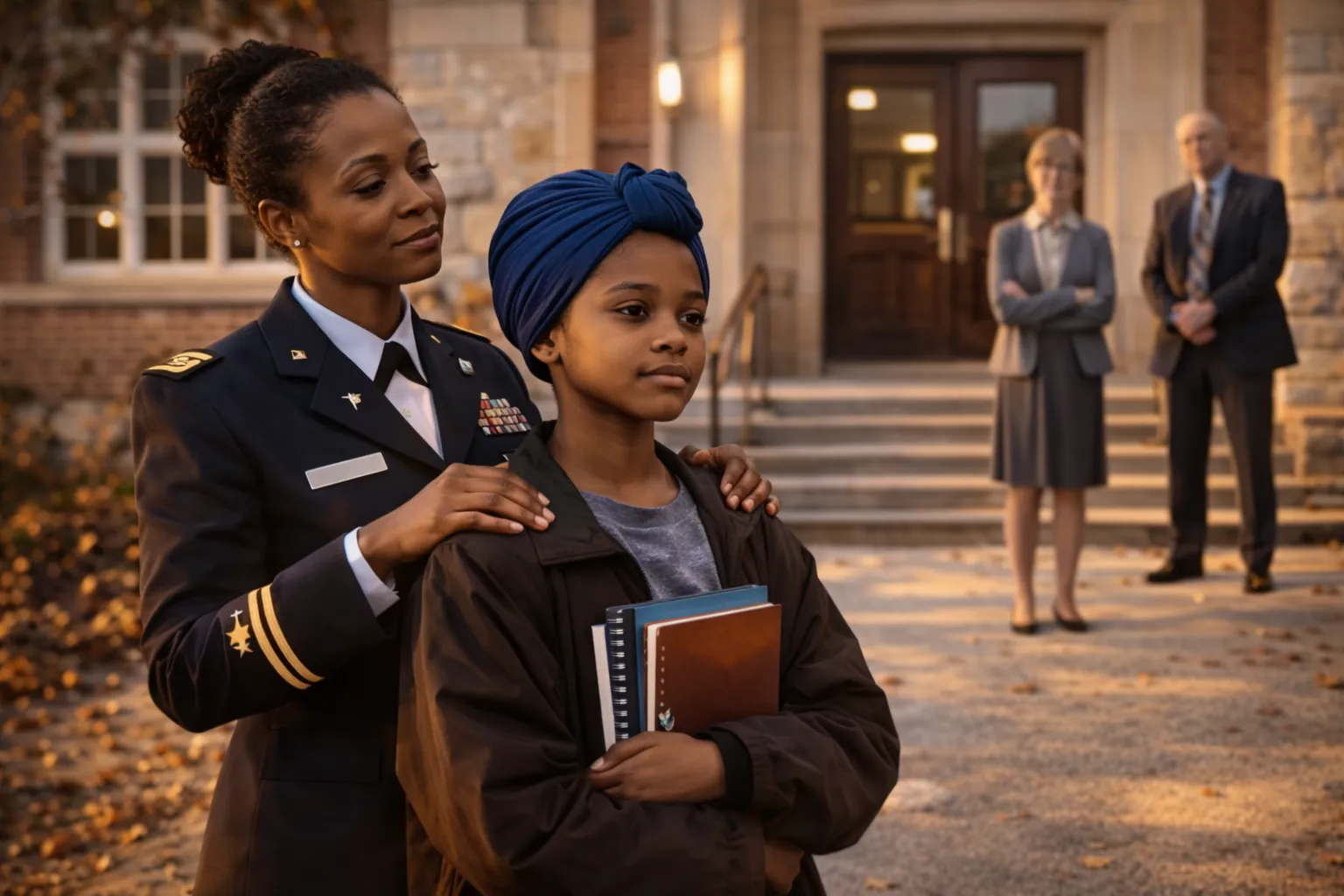
Weeks later, she wore a headwrap to school in deep cobalt blue. No one questioned it.
A month after that, she chose a patterned scarf.
Then, one Saturday while shopping with her mother, she picked up a bright yellow wrap and smiled for the first time in what felt like forever.
“It’s loud,” she said.
Renee smiled back. “Then it’s perfect.”
Over time, Aaliyah began reclaiming what had been taken from her—not just confidence, but authorship over her own story.
With Kiara’s help, she joined a student-led awareness group about invisible conditions and dignity in schools. Later, quietly and on her own terms, she spoke to a smaller support circle about alopecia—not because she owed anyone an explanation, but because fear no longer deserved to be the loudest voice in the room.
One afternoon, many months after the incident, she stood in front of the mirror at home and slowly removed her headwrap.
Her scalp still showed patches.
Her hair was still growing back unevenly.
Her face was still the same face that had once crumpled under fluorescent lights in the nurse’s office.
But something in her eyes was different.
She looked at herself longer than she had in months.
Then she turned to her mother and asked, “Do you think I was brave?”
Renee had answered many questions in her life—questions from commanding officers, from lawyers, from school officials, from reporters who wanted quotes and clean endings. But none of those answers mattered as much as this one.
She crossed the room, placed both hands gently on her daughter’s shoulders, and said, “Yes. Braver than many adults.”
Aaliyah considered that for a moment.
Then she nodded.
Outside, the world had already begun moving on, as it always does. There would be new stories, new headlines, new outrages. But inside that house, something more important had taken root.
Not just justice.
Not even accountability.
Restoration.
Because Aaliyah’s hair had never been the truest thing about her.
Not her braids.
Not her patches.
Not what had been cut away.
Her courage was.
And once a child learns that truth, it becomes much harder for the world to shame her into silence again.