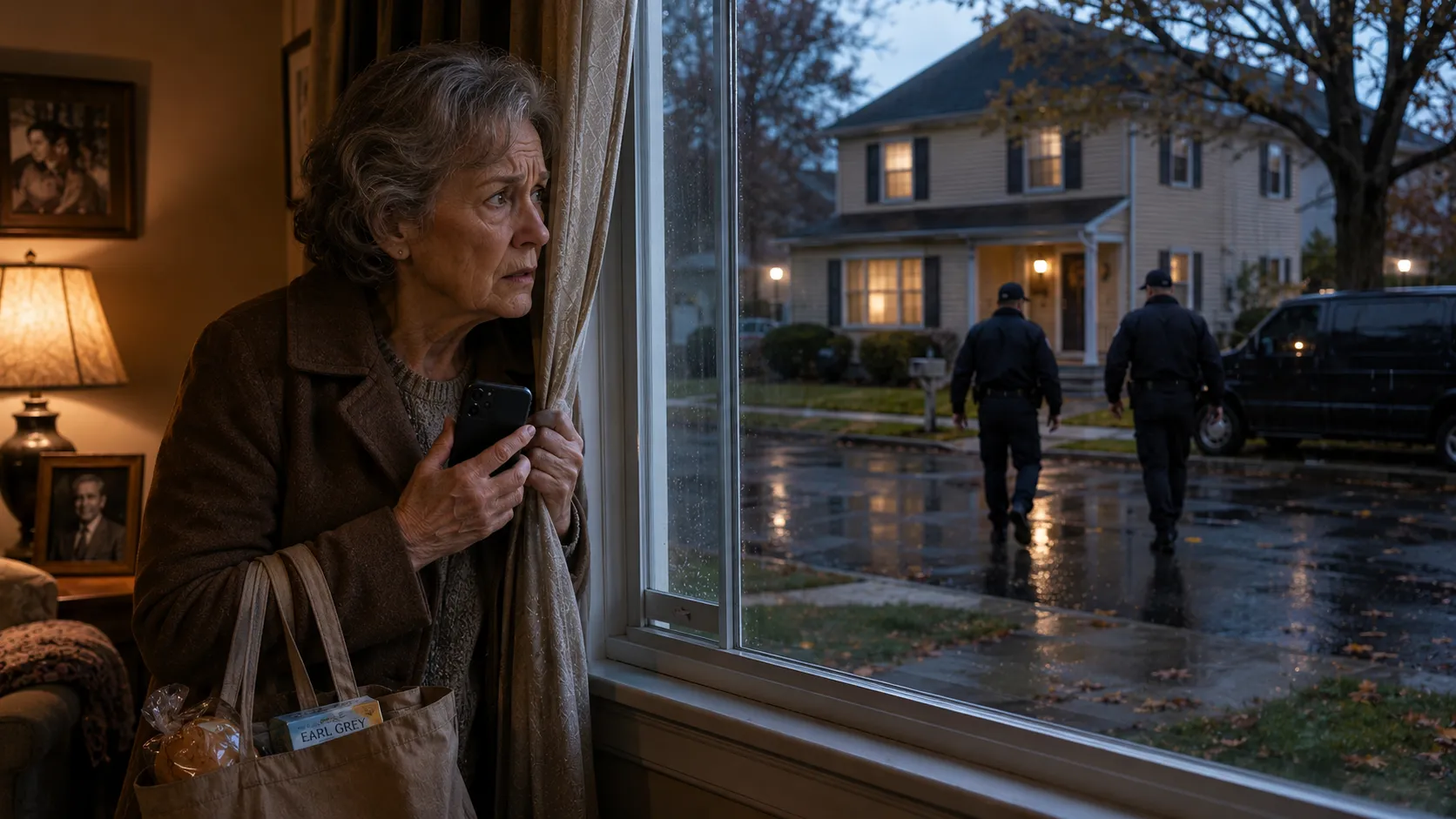
We believed every transfer bought our mother food, medicine, and peace. Instead, someone we trusted took it all—and forced her to pretend she was fine while she slowly disappeared.
For five years, my brother, my sister, and I told ourselves the same comforting lie:
As long as we sent money home on time, our mother would be safe.
Every month, without fail, one of us wired something. Sometimes it was a few hundred dollars, sometimes a few thousand. When one of us earned more, we sent more. When one of us struggled, the others covered the difference. Holidays, medical scares, birthdays, repairs, unexpected bills—there was always another transfer, another receipt, another reason to believe we were doing right by her.
We called it responsibility.
We called it love.
Now I know it was also guilt.
My name is Ryan Sutton. I was thirty-five then, an engineer working in Dubai, where everything around me had taught me to think in measurements—efficiency, output, profit, results. I lived among towers of steel and glass, among people who believed enough money could solve almost any problem if it was sent to the right place in time.
Without meaning to, I started believing the same thing about family.
My older sister, Melissa, worked long nursing shifts in Houston. My younger brother, Miles, had taken warehouse jobs and odd repair work in Arizona. None of us were rich in the way people imagine when they hear “working abroad,” but together we sent enough that our mother should have been living in comfort.
More than enough.
Over five years, it added up to well over one hundred and fifty thousand dollars.
In my mind, that money meant a solid roof, three meals a day, medicine in the cupboard, and a bed soft enough for an aging woman to sleep without pain. I pictured my mother, Florence Sutton, in a clean little home somewhere on the outskirts of Mexico City, watered plants near the window, groceries in the kitchen, maybe even a television humming in the background while she folded laundry.
She had earned at least that much peace.
She raised the three of us alone after our father died. She took sewing jobs until her eyesight worsened, cleaned other people’s houses when her knees were already failing, and somehow still found the strength to make us feel protected. She never demanded. Never complained. Never asked for more than she absolutely needed.
That was part of the reason we trusted Rudy.
Rudy was our cousin—the son of our mother’s late sister—and the only relative who still lived nearby. When we first left Mexico for work, he had stepped forward with reassuring ease.
“Don’t worry,” he told us. “I’ll check on Aunt Florence. I’ll pay her bills, buy her groceries, take her to the clinic if she needs it. Just send the money to me. I’ll handle everything.”
It seemed practical at the time.
Our mother didn’t like banks, barely understood transfers, and had never wanted the burden of paperwork. Rudy sent us photos every now and then: a bag of groceries on the counter, medicine beside a cup of tea, our mother smiling weakly on video calls and telling us not to worry.
So we didn’t.
At least not enough.
The three of us decided to surprise her.
I flew in first. Melissa arrived the next morning. Miles met us at the airport with eyes red from lack of sleep and a hopeful grin that made him look like a boy again instead of a worn-out man in his late twenties. We hugged, laughed too loudly, and carried too many bags—gifts for Mom, warm slippers, vitamins, chocolates, a new shawl Melissa picked because it was the exact shade of blue our mother used to wear on Sundays.
For a few hours, we allowed ourselves to be children coming home.
“She’s going to cry the second she sees us,” Melissa said in the taxi.
Miles smiled out the window. “Good. I want her to.”
I tried to smile too.
But something inside me had already begun to tighten.
Maybe it was the fact that Rudy had sounded nervous on the phone the week before. Maybe it was how often our mother’s video calls had grown shorter over the past year. Maybe it was the small pauses before she answered simple questions. At the time, I blamed age, fatigue, bad signal, the thousand excuses distance is always willing to hand you.
But as the taxi moved deeper into the city, then beyond the streets I remembered, unease hardened into dread.
The neighborhoods changed.
The wide roads narrowed. Storefronts gave way to patched walls, rusted sheet metal, and open drains. The heat pressed down with suffocating force. Puddles sat in broken pavement beside heaps of trash. Children in torn sandals ran barefoot through mud as if it were ordinary. Laundry hung from sagging wires. The smell of sewage drifted through the open taxi window.
Miles leaned forward. “This can’t be right.”
The driver looked at us in the mirror. “It’s the address.”
Melissa said nothing.
She just gripped her bag tighter.
When the taxi finally stopped, I stared at the row of makeshift dwellings in front of us and felt something cold move through my chest.
This was not poverty hidden behind dignity.
This was abandonment.
I got out first and approached an elderly woman sitting on a plastic chair near a doorway made from hanging fabric and old plywood. Her face was lined deeply by sun and hardship. She looked from my clothes to my sister’s suitcase to Miles’ stunned expression, and whatever she saw there made her eyes fill with tears.
“Excuse me,” I said. “Does Florence Sutton live here?”
The woman stood up slowly.
“Who are you?” she asked.
“We’re her children.”
She covered her mouth.
For a moment, I thought she might collapse.
Then she whispered the sentence I will hear for the rest of my life.
“Why did you take so long?”
We didn’t wait for her to explain.
We ran.
Calling it a house would have been generous.
It was a shack made of patched wood, scraps of tin, warped boards, and old tarps nailed down against weather that had still found its way in. There was no proper door—only a stained curtain hanging crooked in the frame.
Melissa pulled it aside.
“Mama!”
The room was dim and smelled of dust, damp cloth, and hunger.
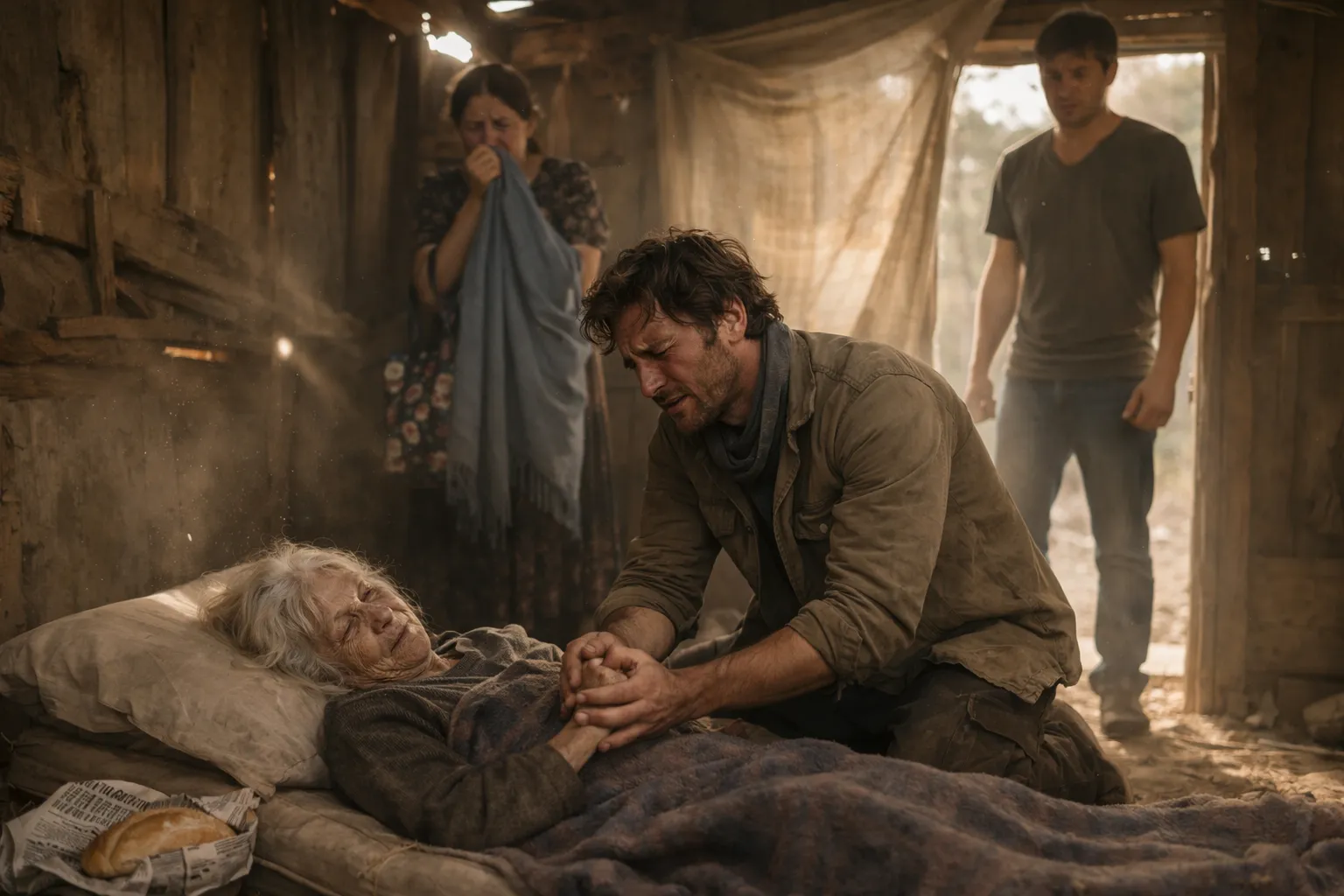
Our mother lay on a thin mat on the floor, covered with a blanket too light for comfort and too worn to keep out anything. For one terrible second I did not recognize her.
She had always been a small woman, but this was different. Her cheeks were hollow. Her wrists looked like sticks beneath the blanket. Her gray hair had thinned so badly at the temples that it barely framed her face. Even her eyes seemed smaller, as though pain and fear had been slowly closing them from the inside.
Then she saw us.
And smiled.
Not a full smile. Barely even that.
Just enough to break what little remained intact inside me.
“Ryan,” she whispered.
I dropped to my knees beside her. Melissa was already crying. Miles stood frozen, fists clenched so tightly I thought his hands might split open.
There was almost nothing in the room.
No refrigerator.
No medicine.
No table.
No fan against the brutal heat.
In one corner sat an empty sardine tin and half a stale loaf of bread wrapped in newspaper.
I asked her when she had last eaten.
She lowered her eyes, embarrassed in a way no mother should ever have to be in front of her children.
“Yesterday,” she said. “A little bread.”
It was after two in the afternoon.
Melissa turned away and covered her face.
Miles slammed his fist into the wall so hard the thin board shook.
I sat there with my mother’s hand in mine and felt every transfer receipt, every delayed visit, every “next year for sure,” every convenient excuse come crashing down on me at once.
All those years, I had believed money was doing the work that love was supposed to do in person.
All those years, I had been wrong.
The elderly neighbor stepped into the doorway behind us. Her name, we later learned, was Elena. She had been checking on our mother when she could, bringing tortillas, soup, or tea from her own meager kitchen, though she herself had almost nothing to spare.
She looked at us with the tired sorrow of someone who had carried another family’s secret for too long.
“I’m going to tell you the truth,” she said. “Your money never reached her.”
I turned so fast I nearly lost my balance.
“What do you mean?”
Elena looked down.
“For five years,” she said quietly, “Rudy took everything.”
The name landed like a blow.
Rudy.
The one who always answered quickly.
The one who sent cheerful messages.
The one who told us Mom was getting stronger, eating better, resting more.
The one who thanked us for being such devoted children.
Elena told us the rest in pieces, as though each part still shamed her even though none of it was her fault.
Rudy came before every scheduled video call and brought a small bag of groceries—just enough to place in the background or hand to our mother while we watched. Sometimes he gave her clean clothes for the call and took them back afterward. He coached her on what to say.
“I’m fine.”
“Don’t worry.”
“I have everything I need.”
If she looked too weak, he told her to sit closer to the light.
If she tried to say more, he cut the call short.
He told her that if she complained, we would stop sending money. He told her we were busy, successful now, and already burdened enough. He told her that if she caused trouble, he would disappear and leave her with nothing.
Over time, fear did what hunger could not.
It silenced her.
When he took money from us, he spent it on drink, gambling, and a life far above anything he had earned. He rented a better apartment, wore new watches, drove a used SUV, and told people abroad had made him lucky. People suspected things, Elena said, but no one had proof. And our mother, raised in an older generation that believed family shame should be carried privately, never went to the police.
By then, my mother was crying—not loudly, not dramatically, but with that exhausted, defeated grief that looks more like surrender than pain.
“Forgive me,” she kept whispering. “I didn’t want you to worry. I thought maybe he would change. I thought if I was patient, it would get better.”
That was the moment I understood the worst part of it.
It wasn’t only that she had been hungry.
It was that she had been afraid.
Afraid to speak.
Afraid to lose even the illusion of help.
Afraid that the children she had sacrificed everything for might believe she was ungrateful.
We got her to the hospital within the hour.
I remember carrying her because she felt so light it terrified me. I remember the heat outside, the smell of traffic, Miles shouting at the driver to move faster, Melissa holding a damp cloth to Mom’s forehead in the back seat while trying not to break apart.
At the hospital, a doctor took one look at her and called for immediate admission.
Severe malnutrition.
Dehydration.
Untreated infection.
Dangerously low blood pressure.
The doctor did not dramatize any of it. He simply told the truth.
“You brought her in just in time.”
Just in time.
Not early.
Not when she first began losing weight.
Not when the medicine ran out.
Not when the fear began.
Just in time.
While the doctors worked, the three of us sat in the hallway under harsh fluorescent lights and pieced together the last five years of our lives with a horror I can barely describe.
Melissa pulled up every transfer.
Miles found screenshots of messages.
I called my bank and requested records stretching back to the first payment. Rudy had used the same explanations over and over: clinic bills, repairs, food, rent, utilities, medicine. The amounts varied just enough to look plausible. Looking back, the lies were almost lazy.
That somehow made it worse.
We filed a report that same week.
This time, we did not rely on family pressure, private apologies, or the hope that guilt might make him confess. We gave authorities everything—transfers, chats, account details, old voicemails, the fake receipts he had once forwarded, and witness statements from neighbors who knew our mother had often gone days without proper food.
The investigation took months, not days.
That is the truth no dramatic story likes to tell.
But evidence is patient.
Money trails are patient.
And eventually, the lies ran out of places to hide.
Rudy was charged with fraud, financial exploitation of a vulnerable adult, and intimidation. Some of his property was seized. A court ordered restitution, though everyone in that room knew money returned late is not the same as years restored.
Justice, I learned, is often incomplete.
Necessary.
But incomplete.
When our mother was finally discharged from the hospital, she did not return to the shack.
Melissa found a small rental home with two real bedrooms, clean water, and windows that opened to light instead of rot. Miles bought a proper bed before he bought himself anything. I arranged for home nursing visits, medication, and follow-up appointments. For the first time in years, there was food in the kitchen and medicine in a drawer labeled clearly enough that none of us would ever miss a dose.
But even then, the real decision was still ahead of us.
What came next mattered more than any transfer we had ever sent.
We stayed.
Not forever all at once, not in some dramatic gesture that solved everything overnight, but truly stayed.
Melissa turned down a promotion in Texas.
Miles stopped talking about going back to Arizona.
I shifted to remote contract work and gave up the career path I once thought defined me.
Some people called us foolish.
They said we were throwing away opportunities.
They said our mother would never want that kind of sacrifice.
They said money would have been enough if we had only managed it better.
Those people did not know what our mother looked like on that floor.
They did not know what it does to a grown man to hear his mother say she ate bread yesterday and still try to smile so he won’t feel guilty.
So we stayed.
Recovery was slow.
It did not happen in one triumphant montage.
It happened in teaspoons.
A little more soup.
A little more strength.
A few more steps to the bathroom without help.
A morning when she asked for coffee and actually finished it.
An afternoon when she sat outside in the sun with a blanket over her knees and watched the street without fear in her eyes.
Melissa took charge of the medical side with the competence only a tired eldest daughter and a nurse can have. Miles repaired everything he could get his hands on, as though fixing shelves, faucets, and broken hinges might somehow redeem the years none of us could repair. I learned the quiet work of presence—shopping lists, pharmacy runs, sitting beside her during long silences, listening when she wanted to remember our father, and listening even harder when she didn’t.
One evening, months later, after dinner, our mother spoke a truth that silenced all three of us.
“What hurt the most,” she said, staring down at her hands, “wasn’t the hunger.”
No one interrupted.
Her voice shook.
“It was believing you had forgotten me.”
Melissa began crying before she could stop herself.
Miles bowed his head.
I moved my chair closer and took my mother’s hands in mine, those same hands that had once stitched school uniforms late into the night and rubbed our backs when we were sick and fed us first even when there was not enough for everyone.
“We didn’t forget you,” I said.
But even as I said it, I knew the sentence was not entirely true.
We had not forgotten her in our hearts.
But in practice, in the daily reality of what a lonely aging mother actually needs, we had allowed ourselves to be replaced by bank receipts, phone calls, and the word soon.
So I told her the fuller truth.
“We didn’t mean to abandon you,” I whispered. “But we trusted distance for too long.”
She squeezed my hand, thin fingers still fragile from everything they had endured.
Then she did what mothers too often do even after being wronged.
She forgave us before we had finished forgiving ourselves.
Today, when people ask why I walked away from the life I built abroad, I no longer answer the way I once would have. I do not talk about burnout or priorities or market changes or family obligations.
I tell them this:
There are things money can buy.
Medicine.
Food.
Rent.
A safer roof.
And then there are things it can only imitate.
Presence.
Protection.
A voice in the next room.
A hand that notices when another hand has become too light.
For years, I confused support with love performed at a distance. I believed a transfer sent on time could stand in for sitting beside my mother, looking directly at her, and asking one more question when her smile seemed too careful.
It cannot.
No amount of money can replace the dignity of being seen.
No receipt can hold a frightened woman through the night.
No bank confirmation can tell you whether the person you love has eaten.
The day we came home, I thought we were bringing gifts.
In truth, we arrived carrying the weight of our absence.
And what we found waiting for us was not only betrayal, hunger, and a collapsing home.
It was a final warning.
Come home before love has to survive on memory alone.
Because sometimes the cruelest lie is not the one told by a thief.
It is the one good people tell themselves—that sending enough money means they are still truly there.