The courtroom was seconds away from a corrupt acquittal when a barefoot child walked down the aisle and touched Judge Hector Valverde’s forehead. What she revealed did more than destroy his empire—it forced a ruined man to become, at last, the servant of the justice he had betrayed.
The courtroom looked less like a room of law and more like a place built to magnify power.
Its ceilings rose high enough to swallow ordinary voices. Dark wooden beams crossed overhead like the ribs of an ancient cathedral. Sunlight pressed weakly through tall windows, falling in pale bands across polished marble. Even the fluorescent lights seemed to buzz more softly there, as though noise itself were afraid to overstep its bounds.
At the center of that silence, elevated above every plea, every defense, every trembling witness and grieving family, sat Judge Hector Valverde.
People called him the Iron Judge.
Not because he was brilliant—though he was. Not because he was disciplined—though no one doubted that either. They called him that because Hector had made severity into a kind of religion. For two decades, his gavel had fallen with cold, decisive force, and every strike seemed to say the same thing: mercy has no place here.
He rarely looked the accused in the eye. He claimed emotion clouded judgment. He said compassion was how weakness entered the law. In private, he told himself he was protecting order. In truth, he had long ago stopped distinguishing between justice and control.
That morning, the city was watching.
In the defendant’s chair sat Ricardo La Fuente, a wealthy industrial magnate whose name had become synonymous with corruption. The charges against him were grave: embezzlement, bribery, the laundering of public funds, and the disappearance of a key witness. The prosecution had come armed with offshore account records, taped conversations, and testimony from former associates who had finally broken their silence.
Everyone in the courtroom knew what the evidence meant.
Everyone, that is, except the man who had already decided what truth would be permitted to survive.
For three hours Hector dismantled the case piece by piece.
“Inadmissible due to procedural irregularities.”
“Insufficient chain of custody.”
“Speculative inference.”
He spoke in a calm, almost bored voice, as if he were correcting paperwork rather than clearing a path for injustice.
Every ruling cut another support beam from the prosecution’s case. Every objection sustained, every document excluded, every witness weakened seemed to draw one man’s smile a little wider.
Ricardo La Fuente sat back in his tailored suit and adjusted the gold cufflink at his wrist with unhurried confidence. He knew exactly what was happening. He knew that the bench had become an instrument bought long before the hearing ever began.
Hector saw the expression and felt, not shame, but satisfaction.
By evening, he told himself, public criticism would roar for a few hours, television commentators would perform their outrage, and then the storm would pass—as it always did. By the next morning, a larger transfer would appear in an offshore account whose existence no honest auditor would ever discover.
He placed his hand on the gavel.
The prosecutor, a woman with exhausted eyes and a spine kept straight by anger alone, lowered her gaze for a moment as if praying not for victory, but merely for endurance. In the front row, the mother of the missing witness clutched a handkerchief in both hands so tightly her knuckles had gone white.
The room held its breath.
Hector lifted the gavel.
And then, just before it fell, a sound slipped into the silence.
Not a shout.
Not a door slammed open.
Just the soft, rhythmic tap of bare feet against marble.
Hector stopped mid-motion.
The entire courtroom turned at once.
A little girl was walking down the center aisle.
She could not have been more than ten years old. Her dress was worn thin at the hem, her dark hair loose and uneven as if cut at home with kitchen scissors. Her feet were bare, leaving faint dusty prints across the polished floor. She did not hurry. She did not seem frightened. She walked with the strange calm of someone who had already decided where she was going and knew no one in the room had the power to stop her.
For a second, no one moved.
Then Hector’s irritation flared.
“Security,” he barked. “Remove her immediately.”
Two guards stepped forward. Both were large men accustomed to restoring order by force of presence alone. Yet when the first reached toward the girl, he slowed. His hand hovered uncertainly in the air and then dropped to his side. The second guard came up beside him, but he too stopped—not paralyzed, not entranced, simply overcome by an inexplicable reluctance, as though every instinct in him was whispering that this child was not to be touched.
The girl kept walking.
The flashes from journalists’ cameras reflected in her dark eyes, but she never looked toward them. She looked only at Hector.
And for the first time in many years, the Iron Judge felt something like fear.
Not fear of scandal.
Not fear of exposure.
Something older. Something more primal. The fear a man feels when he senses, before any proof is offered, that the walls around his hidden life have already begun to crack.
The girl reached the steps to the bench and climbed them slowly, one after another. She stopped before his desk. Up close, she looked impossibly small against the carved wood, the leather chair, the authority of the robe and the seal of the court.
Hector tightened his grip on the gavel.
“Who are you?” he demanded.
The girl did not answer immediately.
Instead, she raised her hand and gently touched the center of his forehead with two fingers.
The contact was light.
But it struck Hector like a door thrown open inside a house he had spent years keeping locked.
A rush of memory flooded through him—not one image, but many. Smoke in a café. An envelope passed under a table. A woman led away in handcuffs. A child crying behind a courtroom door. Signatures. Accounts. Dismissed motions. Men he had saved and men he had buried.
“May I read your mind?” the girl asked softly.
Her voice was quiet, but in that silence it sounded like a bell.
A nervous laugh broke somewhere in the gallery, then died at once.
Hector tried to pull back, but his body no longer obeyed him with its usual authority.
“You have hidden many things,” the girl said. “But truth remembers where men bury it.”
The courtroom seemed to lean toward her.
“September 12, 2013,” she said. “Café La Viña. Back table near the service door. Mauro Ortega handed you a manila envelope. Fifty thousand dollars. In exchange, you dismissed the river contamination case and called the evidence speculative.”
Hector’s face lost all color.
No one in the room could have known that.
There had been no cameras. No witnesses who survived long enough to speak. Hector had chosen that café precisely because it sat on a side street no one respectable used at midday.
Yet the girl spoke as if she had been standing beside the sugar jars, watching.
Murmurs erupted across the gallery. Journalists looked from Hector to one another in open disbelief, fingers flying across their phones.
“You are lying,” Hector snapped, but the force was gone from his voice. It came out thin, almost pleading. “This is absurd. Bailiffs—”
No one moved.
The girl continued.
“Camila Espinoza,” she said. “You sentenced her to thirty years because she exposed your friend, the commissioner. Her son was three years old. He cried in the waiting room until you ordered the door closed because his voice disturbed you.”
The mother of the missing witness pressed her hand to her mouth.
The prosecutor stood.
Hector felt his throat tighten.
He remembered that cry.
God help him, he remembered it exactly: small, panicked, exhausting in its innocence. He had told the clerk to shut the door because he wanted silence, because he wanted order, because in that moment a crying child had mattered less to him than the neatness of his own control.
“Enough,” he whispered.
But the girl was not finished.
She turned then—not toward Hector, but toward the cameras.
“This man is not justice,” she said, pointing at him with that same impossibly steady hand. “He is a merchant who sold pain as law. And today his shop closes.”
Hector’s fingers opened.
The gavel fell from his hand, struck the desk, and rolled once before hitting the floor.
In that sound, something larger than a verdict collapsed.
It did not happen all at once, of course. Empires rarely fall in a single instant, no matter how dramatic the story later becomes. But that moment was the fracture line. Everything after it was merely consequence.
The hearing dissolved into chaos. Journalists ran from the room to break the story live. The prosecutor ordered an emergency hold on all final rulings. Investigators, spurred by public outrage and the impossible precision of the girl’s accusations, began reopening files Hector had long considered safely buried.
And one by one, the things she named were found.
A receipt hidden inside an old law book in Hector’s private chambers.
An account linked through shell companies to offshore transfers.
Property records that did not match declared income.
Handwritten notes that tied dismissed cases to private meetings he had sworn never took place.
The evidence was not magical.
That was what made it devastating.
The girl had not created his ruin. She had merely spoken the truth aloud and pointed others toward the places where he had hidden it.
Within weeks, Hector Valverde was stripped of his position. His licenses were suspended. His assets were frozen. Criminal charges followed. Public fury spread like fire through a dry season.
The press stopped calling him the Iron Judge.
They called him what he was.
Corrupt.
He was convicted.
And in a final humiliation no screenwriter could have improved, Hector was sent to serve his sentence in the same prison system over which he had once ruled from a polished bench.
Prison did not merely reduce him. It revealed him.
The first months passed in a kind of living collapse. The stench of damp concrete, disinfectant, sweat, and old despair seeped into everything. Metal doors clanged shut with a brutality no courtroom gavel had ever matched. The narrow cot in his cell creaked each time he turned, though he slept little. Most nights he sat upright in the darkness staring at a stain on the ceiling and replaying the exact moment those small fingers had touched his brow.
He had lost everything that had once allowed him to pretend he was untouchable.
His title.
His income.
His tailored suits.
His private dining room.
His reputation.
His wife had not visited. His son sent one letter through an attorney, formal and devastatingly brief, asking for no contact until further notice. The television pundits who once quoted him now used his name as shorthand for institutional rot.
Hector did not yet think of this as justice.
He thought of it as ruin.
Then one afternoon, three months into his sentence, his cell door opened.
He assumed it was a guard.
He did not raise his head.
“You still have time.”
The voice lifted his eyes before his body understood why.
She stood in the doorway.
The girl.
Not barefoot now, but dressed simply, plainly, with the same composure that made the prison corridor itself seem quieter around her. She was older than she had looked in the courtroom, or perhaps suffering had given her a gravity that childhood normally did not possess. Either way, she seemed less like an apparition than a person—and that unsettled Hector even more.
“What have you come for?” he asked, his voice rough from underuse. “To look at what’s left?”
She stepped inside and sat on the concrete bench opposite him as though visiting fallen judges in prison cells were the most natural thing in the world.
“There is very little left,” Hector said bitterly.
“There is enough,” she replied.
He laughed once, without humor.
“Enough for what?”
“For truth,” she said. “For work. For repentance, if you still want it.”
He looked away.
“I am past repentance.”
“No,” she said quietly. “You are merely past denial.”
The words struck deeper than accusation would have.
For a while neither spoke. Then she took a folded paper from the pocket of her dress and laid it on the blanket beside him.
“These are names,” she said.
Hector did not touch it.
“People whose lives you helped bury. Men you convicted too quickly. Cases you bent because it suited you. Read them.”
He stared at the page. There were at least a dozen names.
“What do you expect me to do?” he asked. “I have no power.”
The girl’s expression did not change.
“You have knowledge. That is more dangerous than power when it finally serves the truth.”
She stood.
At the door, Hector’s voice stopped her.
“Why?” he asked.
She turned.
“Why are you doing this?”
For the first time, something like sadness entered her face.
“Because punishment without redemption only multiplies the damage,” she said. “And because you know where the traps are. You built many of them yourself.”
Then, after a brief pause, she added, “It is time you started tearing them down.”
That night Hector did not sleep.
He unfolded the paper.
The first name was Julio Serrano.
He remembered the case vaguely. Armed robbery. Weak eyewitness identification. Inconsistent timeline. He had rushed the conviction because a golf reservation and a campaign dinner had mattered more to him than caution. At the time he told himself the man was probably guilty anyway.
Probably.
The word sickened him now.
By morning, Hector had asked a guard for legal forms, paper, and a pen. The guard laughed in his face—but by the end of the day the materials arrived. Whether out of mockery, curiosity, or some bureaucratic accident, Hector never knew.
He began to write.
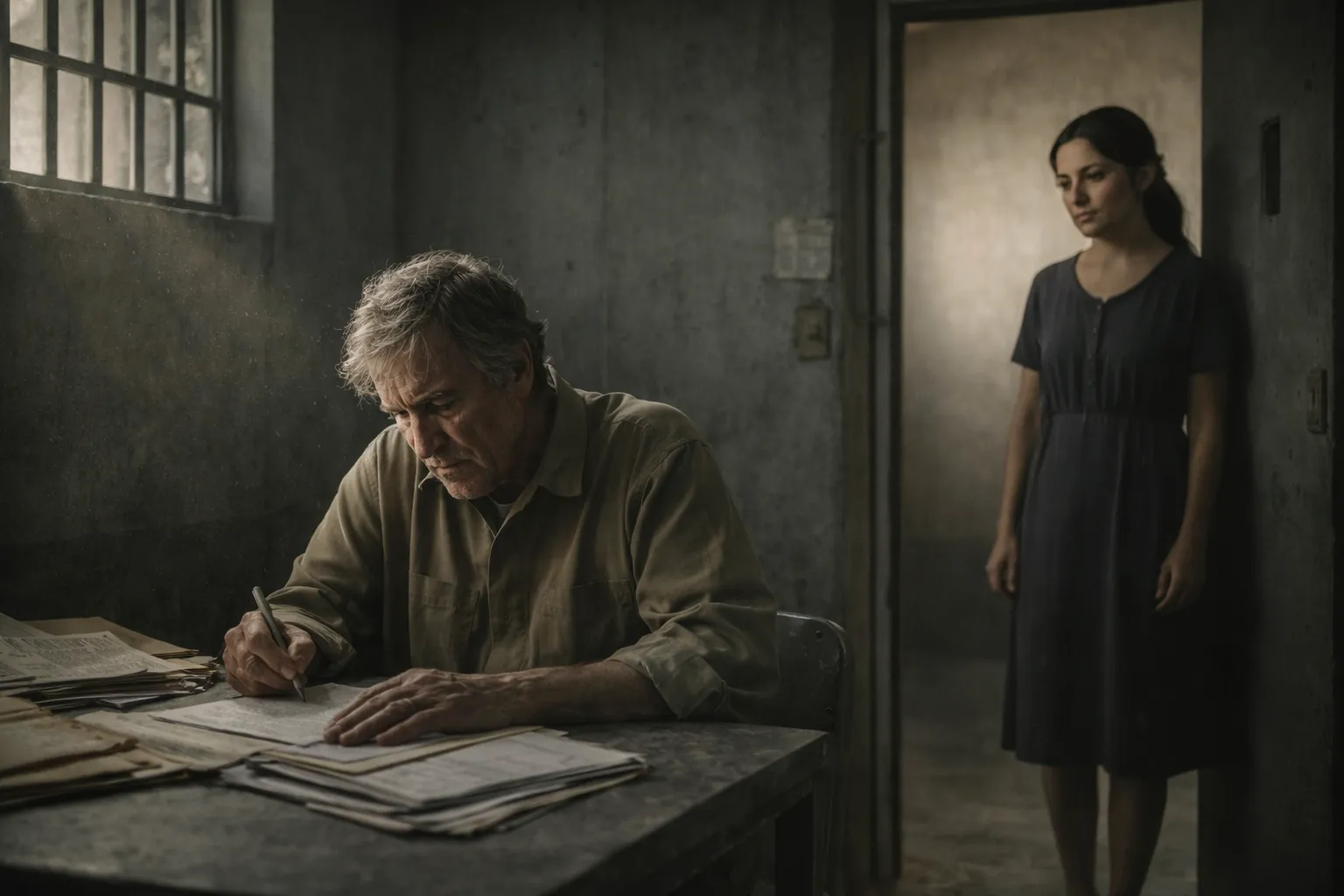
At first, he wrote like a man trying to breathe after being buried alive. Fast. Furious. Precise. He drafted motions for review, petitions for sentence relief, requests for evidentiary hearings, affidavits challenging procedural errors that he himself had once exploited because he knew ordinary public defenders were too overworked to catch them.
Soon he became a permanent figure in the prison library, bent over books beneath flickering lights.
The inmates watched him warily.
Some hated him on sight. Others spat near his shoes when passing in the yard. A few made crude jokes about the “honorable judge” now living among the people he once condemned.
Hector accepted it all.
He did not ask to be forgiven.
He did not deserve comfort.
But slowly, as word spread that he was filing real motions—good ones, dangerous ones, carefully built ones—men began approaching him.
At first they came in whispers.
“You know appeals, right?”
“My lawyer never showed up for sentencing.”
“They planted the knife.”
“The witness changed his story twice.”
Hector listened.
That was new for him.
Perhaps the most important change of all, though he did not yet know it. The man who once never listened to pain unless it came packaged as admissible evidence now sat for hours hearing the broken, disorganized, contradictory language of the incarcerated. He learned to ask different questions. To listen beneath rage. To separate excuses from injustice. To recognize where the system had failed, and where he had helped it fail.
Months passed.
Then one morning, Julio Serrano walked out free.
It was not redemption. Nothing so neat. A single release cannot repay a life carelessly damaged. But when Hector heard the news, something in his chest shifted. Not pride. Never that again. Something quieter.
Purpose.
Two more reviews followed. Then another. Outside the prison, honest judges and overworked clerks began receiving filings from Cell 104 so meticulous and devastating that they could not simply be tossed aside. Reporters noticed. Legal aid groups noticed. A retired appellate judge wrote an op-ed calling the documents “embarrassingly better than much of what our system provides to the poor.”
Hector asked no payment.
He requested only paper.
And then he reached the final name on the list.
Miguel Herrera.
The file arrived on a rainy Thursday. Hector almost did not open it.
Something about the name had unsettled him from the moment he first read it. Some buried memory knocking from behind a locked door.
He sat on the edge of his cot, folder in hand, and began reading.
Homicide. Eight years earlier. Political pressure. A public demand for swift closure. Contradictory evidence. An ignored alibi. A coerced witness statement. A conviction delivered with unusual haste.
Then his eyes fell to the family information section.
Daughter: Alma Herrera.
The folder slipped from his hands.
For a moment he thought he might be ill.
Alma.
The girl from the courtroom.
The girl from the cell.
Not a phantom. Not an angel. Not some wandering prophet sent by storybook justice to expose him for the sake of spectacle.
A daughter.
A child whose father he had helped bury inside a prison cell.
Everything about her came into focus at once—her composure, her grief, her precision, the old pain in her gaze, and the unbearable mercy of what she had chosen to do.
She could have let him rot.
She could have watched him collapse under the weight of his own disgrace and called it balance.
Instead, she had placed in his hands the very means to free the man he had wrongfully condemned.
Hector bent forward and wept with a depth of shame that left him shaking.
It was not the shame of being caught. That had come earlier.
This was worse.
This was the shame of seeing mercy offered where vengeance would have been easier.
From that day, Miguel Herrera’s case ceased to be simply another file.
It became Hector’s confession.
He worked on it with relentless discipline. He traced timelines. Rebuilt witness sequences. Mapped contradictions. Dug through old rulings and procedural shortcuts. He exposed the hidden pressure placed on investigators, the suppressed testimony, the false certainty with which a frightened public had been handed the wrong man in exchange for speed.
The appeal he wrote was the finest legal document of his life.
Not because it was clever.
Because it was honest.
It did not disguise his own role. It named what had happened. It named what had been ignored. It named the pressure, the shortcuts, the vanity, the damage. It did not ask for mercy. It demanded correction.
When the review hearing finally took place, Hector was not present. He listened from a prison guard’s radio set on a metal table in the corridor, every muscle in his body drawn tight.
The update came in fragments.
Appellate panel reconvened.
New forensic review admitted.
Witness credibility compromised.
Conviction unsafe.
Then the sentence that made Hector sit down hard on the cot behind him:
“Conviction vacated. Immediate release ordered.”
He closed his eyes.
For the first time in years, he prayed.
Two weeks later, a guard escorted him to the visiting room.
His hands shook all the way there.
He expected hatred. He expected condemnation. Perhaps he hoped for it. Hatred would have been simpler. Easier to bear than grace.
Miguel Herrera was waiting on the other side of the glass.
He looked older than the file photo, of course. Prison had carved lines into his face and stolen a softness that might once have lived there. But there was still steadiness in him. A grave, durable steadiness. Beside him sat Alma, her hand wrapped around his.
Not a ghost.
Not a mystery.
Only a daughter who had fought longer than most adults could bear.
Hector sat.
For several seconds, no one spoke.
Then Miguel said, “Look at me.”
Hector obeyed.
“You took eight years from me,” Miguel said. His voice was calm, which made the words hit harder. “Eight years I should have spent with my daughter. Eight birthdays. Eight Christmas mornings. Eight years of hearing her voice through prison glass instead of across a kitchen table.”
Hector swallowed.
“I know.”
“No,” Miguel said. “You do not know. You are only beginning to understand.”
Hector lowered his head.
“I do not deserve forgiveness.”
Miguel regarded him for a long moment.
Then he said, “Probably not.”
Hector blinked, startled by the bluntness.
Miguel’s hand tightened around Alma’s.
“But my daughter told me what you did. She told me about the nights you worked on my case. The others you helped free. The men who are home because you finally chose to use your mind for something other than ambition.”
Alma leaned slightly toward the glass.
“Justice isn’t a robe,” she said quietly. “It isn’t a bench or a title or a perfect speech. Justice is what a person does after he finally understands the harm he caused.”
Hector looked at her.
“Why didn’t you hate me?” he asked.
A shadow moved through her eyes.
“I did,” she said. “For a long time.”
The honesty of it struck him cleanly.
“But hatred would have made me your prisoner too,” she continued. “I wanted my father free. And I wanted the men still buried in there to have someone who knew how the machine worked. You built part of it. So I decided you should spend the rest of your life helping dismantle it.”
Miguel raised his palm to the glass.
“I will never bless what you did to me,” he said. “But I respect what you are doing now. Don’t stop.”
Slowly, almost fearfully, Hector lifted his own hand and pressed it opposite Miguel’s.
The glass between them remained.
As it should.
Some things are not repaired by sentiment.
But in that moment Hector felt something he had never truly felt when he wore the robe and raised the gavel.
Not authority.
Not superiority.
Not distance.
Responsibility.
When the visit ended, he watched father and daughter walk away together, framed in late afternoon light. Their shoulders nearly touched. Alma said something that made Miguel smile, and for one fleeting second Hector saw not what he had taken from them, but what had somehow survived him.
He returned to his cell.
On the metal desk waited a fresh stack of paper.
He sat down.
Outside, somewhere in the prison yard, men shouted over a basketball game. A radio played too loudly in another cell. Pipes knocked in the wall. It was an ugly place. Harsh. Claustrophobic. Full of damage that no single man could undo.
But Hector no longer mistook difficulty for futility.
He uncapped his pen and wrote the next name.
Then the next.
Then the next.
Years later, people would tell the story in different ways.
Some spoke of a miracle—that a barefoot girl had read a judge’s mind and brought an empire crashing down in a single afternoon.
Some called it divine justice.
Some said it was folklore disguised as scandal.
Perhaps all of them were partly right.
But the deepest truth was simpler and harder.
The miracle was not that Hector Valverde was exposed.
Exposure is only the beginning.
The miracle was that a man who had spent his life selling punishment was finally forced to understand suffering—and, instead of dying inside that knowledge, chose to serve those he had once ignored.
His sentence remained long.
His losses remained real.
Redemption did not restore his title, return the stolen years, or erase the names of the innocent he had harmed.
Redemption never does.
What it does—when it is real—is make a person useful to the truth at last.
And so the Iron Judge, who once believed himself untouchable, spent the rest of his days touching nothing lightly again. Not evidence. Not testimony. Not another human life. Each case he took from his prison desk became a small act of reparation in a world where full repair was impossible.
As for Alma, she never explained how she knew the secrets she spoke in that courtroom.
She did not need to.
Some truths are discovered through documents.
Some through grief.
And some through the unbearable clarity of a child who has spent years watching injustice from the wrong side of a prison gate.
By the time Hector Valverde understood that, he no longer needed to know how she had seen into him.
It was enough that she had turned on the light.
The rest—the shame, the work, the long road toward a more honest soul—had been waiting there all along.
And that, at last, was the true judgment.