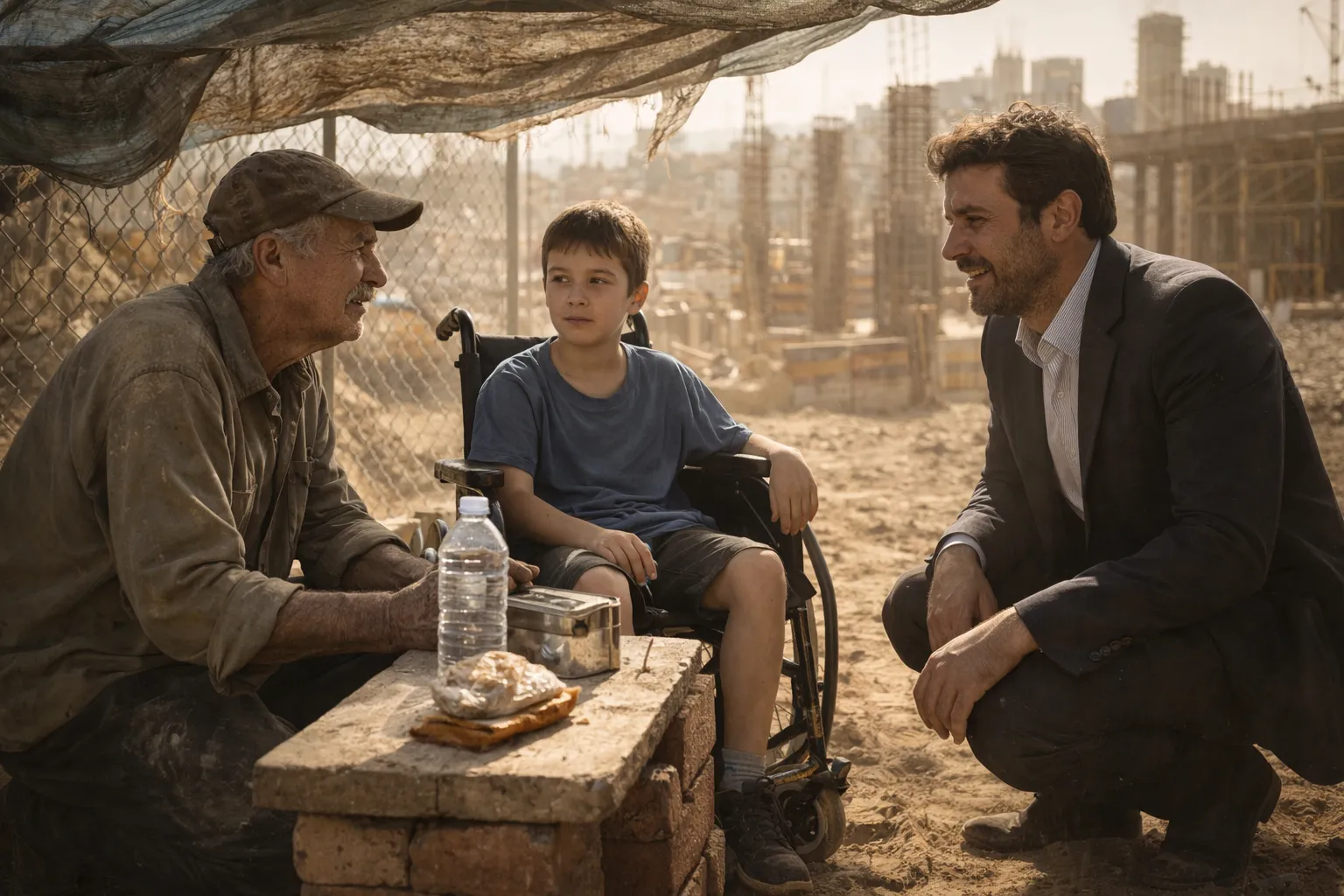
Every day, old bricklayer Cicero slipped food and water through a construction fence to a child nobody seemed to claim. When the company owner finally arrived in panic, the entire site learned how poor men can be even when they are surrounded by money.
By the time the city began to sweat, Cicero had already been at work for an hour.
He was the kind of man younger laborers no longer noticed until they needed him. Sixty-three, shoulders bent just slightly from decades of lifting brick and mortar, he moved with the quiet economy of someone who had spent a lifetime letting labor speak louder than pride. His hands were white at the knuckles from lime, rough as unfinished stone, and careful with tools in a way some men were only careful with money.
He still carried his lunch in the same battered aluminum box he had used for years.
Rice. Beans. Sometimes a boiled egg. On better days, a piece of chicken wrapped in wax paper and tucked in by his wife, Maria, before dawn. He never complained. A man who has eaten through hard seasons does not insult food by asking it to be prettier than it is.
The construction site itself was a world of heat, noise, and impatience. Cement mixers groaned. Rebar clanged. Foremen barked instructions over the dust. Trucks reversed with shrill beeps that grated against the nerves. Younger workers cursed the weather, the hours, the pay, and one another with equal enthusiasm.
At lunch, most of them drifted to the bar on the corner or collapsed in the shade to argue about soccer and politics.
Cicero always went to the fence.
There, where the site backed onto a cracked stretch of sidewalk, he would sit on an overturned paint bucket, open his lunchbox, and eat slowly while watching the city move through the metal gaps: delivery drivers in a hurry, mothers dragging children who never seemed to want the same thing at the same time, office clerks with phones pressed to their ears, old men shuffling past with newspapers under their arms.
It was on a Tuesday thick with dust and heat that he first noticed the boy.
A wheelchair sat just beyond the fence where the sidewalk widened near a utility pole. In it was a child no older than ten or eleven, wearing a blue T-shirt too large for his narrow frame. His dark hair had been combed at some point that morning but was already lifting in the hot wind. His hands rested in his lap. His face was turned toward the site with such deep, still attention that for a moment Cicero forgot his food.
The boy was not begging.
He was not playing.
He was not calling for anyone.
He was simply watching.
Watching the crane swing through the air.
Watching pallets rise and descend.
Watching the measured choreography of men, concrete, steel, and noise.
Cicero looked up and down the street for a parent, a nurse, a driver, anybody who might belong to him.
No one.
The old mason frowned, wiped his mouth with the back of his hand, and kept one eye on the child until lunch ended.
The next day the boy returned.
Same place.
Same chair.
Same fixed, fascinated gaze on the movement inside the site.
This time Cicero noticed more. The boy’s skin was pale beneath the sun. His lower body remained almost motionless, but his eyes followed everything — especially the crane, whose sweeping arc seemed to calm him in a way Cicero did not understand.
At last the old man stood, took his dented water bottle, and walked to the fence.
“Are you thirsty, son?” he asked.
The boy turned slowly toward him.
His eyes were large, serious, and older than a child’s eyes ought to be.
For a moment Cicero thought he might not answer at all.
Then the boy gave the smallest nod.
Cicero unscrewed the cap and passed the bottle through the bars.
The child drank in small, careful pulls, then returned it with both hands.
“You come here alone?” Cicero asked gently.
No answer.
Not rudeness. Not fear. Just silence.
Cicero knew enough about the world not to force speech where there might be pain behind it.
“That’s alright,” he said. “You don’t have to talk to me. We can still be civilized.”
Something flickered in the boy’s expression — not quite a smile, but the beginning of one.
When the lunch whistle sounded, Cicero rose.
“I’ll bring more water tomorrow,” he said. “And something to eat. This sun doesn’t forgive anybody.”
That evening, when Maria noticed him scraping the bottom of the rice pot into a second container, she asked, “Who’s the extra portion for?”
Cicero washed his hands at the sink before answering.
“There’s a boy near the fence,” he said. “Always alone. Thin as a reed. Watches the site like he’s studying it.”
Maria did not ask whether the child could pay him back or whether someone else should be responsible. Women who have built families out of little learn quickly that compassion is often the only thing in a house that multiplies when shared.
She wrapped an extra piece of bread in cloth and handed it to him.
“Then tomorrow,” she said, “you take enough for two.”
And so a routine began.
Every lunch hour, Cicero walked to the fence.
Every lunch hour, the boy was there.
At first the meals were small — rice and beans, half a sandwich, cool water, sometimes a wedge of melon if Maria had managed one from the market. Cicero found a weathered plank and balanced it between two loose bricks on the sidewalk side of the fence so the boy could rest his food more easily. On the third day he brought an old pillow from home because the chair looked too hard for the long hours the child seemed to spend in it.
“Can’t have a prince sitting on metal all afternoon,” he muttered while adjusting it.
The boy watched him with solemn concentration.
Cicero began talking as he ate, not expecting answers.
He explained how a wall is only as honest as the line of its first course. He talked about foundations, why one badly placed brick can eventually crack an entire structure, and why people who rush small things usually end up paying for it later.
The boy listened as if none of it were boring.
That alone made Cicero warmer toward him than almost anyone on the site.
On the fourth day, the child spoke.
It was barely a whisper, so quiet Cicero nearly missed it under the clatter of steel.
“Again.”
Cicero paused.
“You want me to explain the crane again?”
The boy nodded.
So Cicero did.
He used his spoon to draw shapes in the dust: balance points, counterweights, leverage.
The child’s eyes brightened.
“Well, look at that,” Cicero said softly. “You’ve got a mind for machines.”
By the end of the week, he had started calling him champion.
Not because the boy looked strong. Because he did not.
Not because he talked much. Because he didn’t.
But because there was something quietly determined in the way he showed up day after day, facing heat, dust, noise, and the stares of strangers without complaint.
Unfortunately, kindness is rarely left alone for long.
The younger workers noticed.
Not the way Cicero hoped. The other way.
Roberto noticed first — broad-chested, loud, and too pleased with himself for a man whose greatest gift was laughing when managers were watching.
“Well, look at old Saint Cicero,” Roberto called out one afternoon as the men were washing up. “Feeding strays now, are we?”
A few of the others laughed.
“What next?” Roberto went on. “You opening a nursery between the cement mixers and the scaffolding?”
One of the welders snorted. Another muttered something cruel about “the mute kid by the fence.” Someone else laughed at the wheelchair.
Cicero rose slowly from his bucket.
He was not a man who shouted often. That was precisely why people noticed when he spoke.
“A man’s worth,” he said, looking directly at Roberto, “is measured by how he treats those who can do nothing for him.”
The laughter thinned.
Roberto rolled his eyes, but not as confidently as before.
“Suit yourself, old man.”
Cicero sat back down.
The boy had heard everything. His hands had gone very still.
Cicero tore the bread in half and passed him the larger piece.
“Don’t pay fools with your attention,” he said. “It encourages them.”
The child looked at him, and this time the smile came fully — brief, fragile, and beautiful enough to make the whole lunch break feel worth defending.
As the days passed, Cicero began to notice a pattern he could not explain.
The boy did not come every morning.
He appeared only around midday or early afternoon, often from the direction of the rehabilitation clinic two streets away. Sometimes a van would stop nearby and then move on again. Once or twice Cicero saw a uniformed aide in the distance, distracted by a phone call or paperwork. The old man concluded what nobody had bothered telling him: the child must be slipping away from some program or supervised outing, drawn by the order of the construction site and by the one place where no one treated him like an inconvenience.
Cicero did not approve of children wandering off.
He approved even less of adults who noticed a child’s need and dismissed it because paperwork said someone else was responsible.
So he kept sharing his lunch.
Friday came hot and brutal.
The kind of heat that does not sit on the skin but presses down on the lungs. The kind that makes concrete glare white and steals patience from everyone by noon.
When Cicero reached the fence, the boy was already there.
But something was wrong.
His face looked pale beneath the tan. Sweat dampened his temples. His breathing came faster than usual, and the blue T-shirt clung to him in dark patches.
Without thinking, Cicero dropped his lunchbox and climbed down from the stack of blocks he had been working on.
“Champion?”
The boy looked at him, unfocused for a second, then blinked.
Cicero swore under his breath, went to the material pile, and returned dragging a length of tarp and two spare rods. Within minutes he had tied together a rough awning from the fence posts, angling it just enough to throw a rectangle of shade across the sidewalk.
The men on the site laughed again.
“Look at this!” Roberto shouted. “He’s building a penthouse for beggars now!”
Cicero ignored him.
He wedged the old pillow behind the boy’s back, passed him cool water, and folded a cloth from his lunchbox to place at the back of his neck.
“There,” he said, adjusting the shade until the sun no longer touched the boy’s face. “Let the rich people build towers. We’ll settle for a little decency.”
The child lifted one hand and caught Cicero’s wrist with surprising urgency.
His grip was weak, but grateful.
For a moment the old mason had to look away.
He thought of his grandchildren. Of Maria. Of how easy it is for a life to go unnoticed when it does not move quickly enough for the people around it.
Then the construction gate exploded into commotion.
A black luxury sedan swung so sharply to the curb that gravel sprayed across the pavement. Behind it came an SUV with tinted windows. The site fell quiet almost instantly.
Only one kind of man arrived at a working job site like that.
A tall figure stepped out of the sedan before the driver had fully opened the rear door. He wore a suit that did not belong anywhere near brick dust, and panic had stripped him of whatever elegance money usually bought him. His hair was disordered. His face was wet with sweat. His eyes were wild.
“Miguel!”
The cry cracked through the site like a shot.
The boy in the wheelchair startled and turned, his whole body straining toward the voice.
The suited man broke into a run, crossed the dirt without seeing any of it, and dropped to his knees beside the chair.
“Miguel, my God…”
He touched the child’s hair, his cheeks, his shoulders, as if checking whether he was real.
The boy made a sound then — not loud, but unmistakably joyful.
“Papa.”
The entire site went silent.
Even Roberto stopped breathing for a second.
The man gathered the child into his arms as carefully as if he were lifting glass.
“We’ve been searching for you for hours,” he whispered, voice breaking. “The clinic called. The driver lost sight of you. Do you understand what you did to us?”
But he was not angry. Only terrified, relieved, and ashamed all at once.
One of the supervisors rushed forward, suddenly recognizing the man.
“Mr. Valadares—”
Daniel Valadares, owner of the development company, head of a construction empire with projects across the region, turned with such intensity in his face that the supervisor stopped speaking.
Then Daniel saw the shade.
He saw the pillow.
The plank table.
The lunchbox standing open on the ground.
He saw the water bottle, the cloth at the back of Miguel’s neck, the old man in the faded cap standing a few feet away with mortar dust on his trousers and concern still written plainly across his face.
Daniel rose slowly.
“Was it you?” he asked.
Cicero removed his cap.
“He looked overheated,” he said simply. “And hungry.”
Daniel stared at him for a long moment.
Then he looked back at his son, who had already reached one hand toward Cicero again.
“Did he do this for you?” Daniel asked softly.
Miguel nodded.
The billionaire’s face changed.
Somewhere behind him, the executives and site managers who had rushed from their air-conditioned offices were beginning to understand that whatever was about to happen had very little to do with schedules or budgets now.
Daniel turned back to Cicero.
“My son lives with autism and partial paralysis,” he said, his voice steadier, though still raw. “The rehabilitation clinic is two streets over. He slips away sometimes when the world becomes too loud for him. We’ve had therapists, specialists, aides, doctors, tutors… and somehow he keeps ending up here.”
Daniel swallowed.
“Now I think I know why.”
Cicero said nothing.
He did not know what to do with a rich man’s gratitude. Men like him were too far outside his daily life.
Daniel glanced at the open lunchbox again.
“You fed him?”
Cicero nodded.
“Water too.”
“And you didn’t know who he was.”
“No, sir.”
“Then why?”
It was not a challenge. It was a genuine question, and perhaps Daniel Valadares had gone too long without hearing an answer that wasn’t polished for advantage.
Cicero looked at Miguel first before answering.
“Because he was a child,” he said. “And because nobody should have to sit alone in this heat feeling like the whole world is on the other side of the fence.”
Daniel lowered his eyes.
For one startled second, it seemed he might break right there in front of laborers and managers and the son whose expensive care had still somehow failed to give him what he needed most.
He reached into his suit jacket and pulled out an envelope, thick with cash.
Cicero stepped back at once.
“No.”
Daniel frowned, almost confused.
“Please. Let me thank you.”
Cicero shook his head.
“If I take money for feeding a hungry boy,” he said quietly, “then Maria’s cooking turns into business. I won’t do that to her.”
Something passed through the crowd — embarrassment first, then something heavier.
Because the truth had become impossible to ignore.
The poorest man on the site had acted with the most dignity.
Daniel slipped the envelope away.
Then, to the astonishment of everyone watching, he extended his hand.
Cicero hesitated only a second before taking it.
The billionaire clasped the old bricklayer’s rough, dust-whitened hand in both of his.
“Then I will thank you properly another way,” Daniel said.
Miguel tugged weakly at his father’s sleeve.
Daniel bent closer.
The child looked past him and, with visible effort, raised his hand toward Cicero.
The old mason stepped nearer.
Miguel’s voice came out hoarse and small.
“Thank… you.”
Cicero felt his throat close.
He smiled beneath his weathered mustache and touched two fingers to the brim of his cap.
“You’re welcome, champion.”
That would have been enough for him.
Enough to carry home to Maria. Enough to remember when the days grew long again.
But Daniel Valadares was a man used to acting once he had been shown the truth, and what he had witnessed that afternoon would not let him go.
By Monday, the site leadership had been ordered into an internal review.
Daniel had asked only a few questions, but they were the kind powerful men ask when they already suspect the answers:
Who knew the child had been sitting there?
Who mocked him?
Who allowed it?
Who thought a worksite could call itself respectable while men laughed at a boy in a wheelchair on the other side of the fence?
Roberto and two others were dismissed within the week — officially for conduct violations and repeated safety complaints that no one had bothered taking seriously until a richer reason appeared to force the matter. The foreman received a final warning and mandatory training. The entire site staff was required to attend disability and dignity training led not by lawyers, but by people who had actually lived what men like Roberto preferred to joke about.
Some grumbled.
No one did it loudly.
Meanwhile Daniel kept thinking about the shade structure.
About the lunchbox.
About the sentence Cicero had spoken without performance: Nobody should have to sit alone in this heat feeling like the whole world is on the other side of the fence.
It lodged in him like a nail.
He had spent years building impressive structures — office towers, shopping centers, residential blocks with glass facades and rooftop gardens marketed to people who liked the idea of community more than the inconvenience of it. He had funded therapies, bought wheelchairs, hired specialists, flown in consultants. Yet somewhere along the way he had mistaken expensive care for human connection.
Cicero, with one old pillow and half a lunch, had accomplished what expertise alone had not.
He had made Miguel feel seen.
Three weeks later, a letter arrived at Cicero’s home.
It was thick cream paper with the company seal at the top, so formal that Maria dried her hands on her apron before touching it. Cicero opened it at the kitchen table while the afternoon light fell across the worn wood.
Inside was not a gift card, nor a token bonus, nor an invitation to pose for a photograph with smiling executives.
It was an offer.
Daniel Valadares had suspended one wing of the office project and ordered a redesign. Half the lower complex would become a comprehensive care center for children with neurological and physical disabilities — therapy rooms, sensory spaces, family counseling offices, an adaptive garden, and a workshop where children could learn through touch, building, and movement instead of being treated like broken things waiting to be corrected.
At the bottom of the letter, in Daniel’s own hand, was a final paragraph:
I need someone in that building who understands that structures are only as worthy as the people they shelter. I am asking you to become head of maintenance and community liaison for the center. My son has already asked whether “the man with the lunchbox” will be there. I hope your answer will be yes.
Maria read the paragraph twice.
Then she looked at her husband.
“Well?” she asked.
Cicero stared at the page.
“I’ve laid brick my whole life.”
Maria shrugged gently.
“And now perhaps you’ll help hold up something even bigger.”
He accepted.
Not because the salary was better, though it was.
Not because the title sounded fine on paper, though Daniel had made sure it did.
He accepted because the first time he visited the unfinished center and saw Miguel in the new adaptive garden, the boy’s face lit in the same quiet way it had at the fence, only now there was no heat beating down on him and no crowd of men laughing nearby.
Just space.
Shade.
Safety.
And recognition.
In the months that followed, Cicero learned an entirely different kind of building.
He still inspected beams, checked doors, fixed leaking pipes, adjusted broken rails, and made sure every ramp, lift, and handhold worked the way it should. But he also learned the names of families who arrived tired, frightened, and already half defeated by medical systems that spoke in codes instead of comfort.
He became the man who knew where the best bench in the garden was after four in the afternoon. The man who kept extra biscuits in a tin for siblings forced to wait through therapy sessions. The man who never spoke to children in that careful, false voice adults use when they are more afraid of disability than of cruelty.
Miguel changed too.
Not overnight. Healing never does its honest work that way.
But with the right therapists, the right routines, and — perhaps most importantly — adults who saw him as a person before they saw a diagnosis, he began to speak more often. Not much. Not in long speeches. But enough.
He said Cicero’s name.
He asked questions about cranes.
He wanted to know why brick dust smelled different after rain.
Sometimes, in the late afternoon, the two of them sat in the garden with a piece of bread between them while Cicero explained again how foundations work and why the strongest things in life are often the least visible once a structure is finished.
Miguel listened with the same solemn wonder as before.
No fence stood between them now.
Daniel watched those moments from a distance more than once.
He had once believed that fatherhood meant solving every problem with the highest quality money could afford. Now he was learning a harder lesson: that love without humility can still leave a child lonely.
One evening, as Cicero was locking the workshop at the back of the center, Daniel approached him without an assistant, without a driver, and without the polished armor wealthy men often wear around those who know too much of ordinary life.
“I used to think I was giving my son everything,” Daniel admitted.
Cicero closed the toolbox and leaned against the bench.
“And now?”
Daniel looked toward the garden, where Miguel was tracing the edge of a raised flower bed with one finger while a therapist waited nearby.
“Now I know I was giving him resources,” he said. “You gave him welcome. They are not the same.”
Cicero nodded slowly.
“No, sir,” he said. “They aren’t.”
Daniel let the silence sit.
Then he asked, “How did you know what he needed?”
The old mason smiled faintly.
“I didn’t know,” he said. “I just paid attention.”
That answer stayed with Daniel longer than any consultant’s report ever had.
Years later, people in the city would talk about the Valadares Center as if it had begun with philanthropy, vision, strategy, or corporate conscience. They would point to the architecture, the equipment, the funding partnerships, and the newspaper profiles that praised Daniel’s transformation.
But those who really knew the story told it differently.
They said it began with an old bricklayer sitting on a paint bucket by a fence.
With a lunchbox opened in the heat.
With water passed through metal bars.
With a plank balanced on two bricks so a child in a wheelchair could eat like a guest instead of an afterthought.
And they were right.
Because great changes rarely begin where important people expect them to.
They begin in the small places.
In the human places.
In the moment one person looks at another and decides not to measure their worth by what they can repay.
As for Cicero, he never stopped calling Miguel champion.
And every now and then, when a new family arrived exhausted, frightened, and ashamed of needing help, they would see the old man with lime-scarred hands kneeling beside a child at eye level and speaking with complete seriousness about bread, cranes, or the stubborn honesty of bricks.
The children trusted him quickly.
Adults did too.
Perhaps because they could sense what Daniel Valadares had sensed beneath that torn awning on the hottest day of the year:
that some men build walls,
and some men build shelter,
and the difference between them is not skill.
It is heart.