At first, everyone thought the dog was causing trouble around Daniel’s car for no reason. But when the officers lifted the trunk and heard a faint cry from inside a sealed box, the whole crowd realized the animal had been trying to save lives.
There are ordinary days that vanish the moment they end, and then there are days that stay with people for years.
For Daniel, it happened on a warm Thursday afternoon in a parking lot so ordinary that no one there would have remembered it a week later if not for the dog.
He had pulled up outside a low office building just after lunch, left his car for a few minutes to collect some documents, and returned expecting nothing more dramatic than traffic, deadlines, and another long stretch behind the wheel. Daniel was the kind of man who moved through life efficiently. He noticed details, yes—but mostly the ones that kept schedules on time and work from going wrong.
That afternoon, something went wrong anyway.
A large stray dog was standing behind his car, scratching at the trunk.
At first Daniel assumed it was the usual thing—a hungry animal drawn by the smell of food wrappers or shade beneath the bumper. He clapped his hands once and said, “Hey, go on now.”
The dog jumped back, but it did not leave.
Instead, it circled the rear of the car and came back to the trunk, whining low in its throat, then pawing at the metal again. Not wildly. Not viciously. Desperately.
A woman carrying grocery bags stopped to watch.
“Maybe he smells food,” she said.
“Maybe,” Daniel answered, though even as he said it, something about the animal’s behavior unsettled him. The dog was not sniffing around the doors or tires. It was focused on one place and one place only.
The trunk.
The dog scratched harder. Then it stopped, pressed its ear toward the seam as if listening, and let out a sharp bark that made two people turn from the sidewalk.
By then, a small knot of strangers had formed in the lot—an elderly man from the pharmacy next door, a teenage clerk on break, a young mother buckling a child into a stroller. The kind of crowd that gathers not because anyone understands what is happening, but because something in the air has shifted and no one wants to be the first to walk away.
Daniel frowned and reached for his keys.
The dog saw the motion and stepped back at once, but it did not run. It stood tense and still, eyes fixed on the trunk with such urgency that Daniel felt the first real flicker of unease move through him.
One of the bystanders had already called over a nearby patrol officer who had been directing traffic at the intersection.
The officer approached cautiously. “What seems to be the problem?”
Daniel glanced at the dog, then at the trunk. “I’m not sure. This dog won’t leave my car alone.”
The officer looked down at the animal. It was dusty, rib-thin, and scarred in the quiet way street animals often are. But there was nothing aggressive in it. No bared teeth. No growling. Just raw insistence.
The dog barked once more and touched the trunk with one paw.
The officer’s expression changed slightly.
“Have you got anything in there?” he asked.
Daniel shook his head. “Not that I know of. I was only inside a few minutes.”
“Was the car locked?”
Daniel hesitated.
“For part of it,” he said. “I think. I left in a hurry.”
The officer nodded once, then stepped closer to the rear of the vehicle. “All right. Open it.”
Daniel did.
As the trunk lifted, the parking lot seemed to fall still.
Conversations stopped. Footsteps halted. Even the dog went silent.
At the bottom of the trunk sat a neatly taped cardboard box.
At first glance it looked harmless—ordinary, even. The kind of box a person might carry home with office supplies or old files. But the dog moved toward it at once, and when the officer leaned in, he held up a hand for everyone to stay back.
“I don’t understand,” Daniel murmured. “I didn’t put that there.”
The officer carefully lifted the box from the trunk and set it down on the pavement.
The dog came close, but no longer scratched or barked. Its earlier panic had changed into something else now—tense watchfulness, almost reverence. It stood beside the box with its ears forward and its head slightly tilted, as though waiting for the rest of them to finally catch up.
Then someone heard it.
A tiny sound.
So faint it might have been mistaken for wind if the whole lot had not gone so quiet.
A whimper.
The young mother put a hand over her mouth. “There’s something inside.”
The officer crouched down, slipped a finger beneath the tape, and opened the flaps.
And in that instant, the mood of the entire street changed.
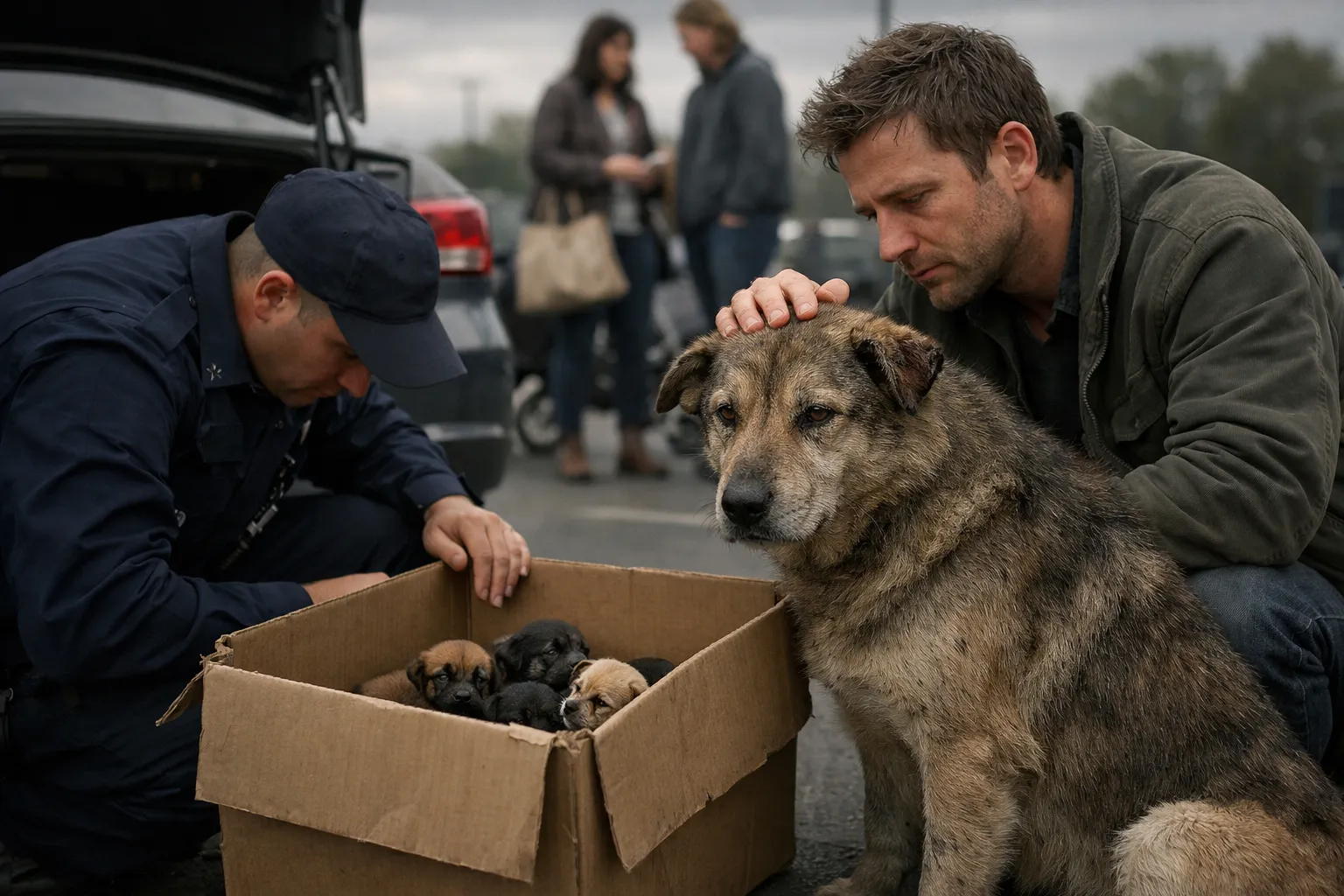
Inside were puppies.
Several of them, tiny and fragile, huddled together for warmth in the bottom of the box. Their eyes were barely open. Their bodies trembled with that unsteady helplessness only very young animals have. One shifted and let out another soft cry.
No one spoke for a second or two.
Then the woman with the grocery bags whispered, “Oh, Lord.”
The stray dog stepped closer and gently nudged the edge of the box with its nose.
There was such tenderness in that small movement that it undid people more than any speech could have. A teenage clerk who had been half-smiling at the drama a moment earlier suddenly looked ashamed. The elderly man from the pharmacy removed his cap and held it in both hands.
“He was trying to tell us,” the young mother said softly.
The officer nodded. “Yes,” he replied. “He heard them.”
Daniel stood motionless, staring first at the puppies, then at the dog, then back at the open trunk as though some missing piece of the last hour might still reveal itself if he looked hard enough.
“This morning,” he said slowly, “I stopped here to pick up documents. I was gone maybe two or three minutes. The trunk must not have been fully secured.”
He swallowed.
“Someone could’ve put the box there without me noticing.”
No one needed the rest explained.
If the dog had not insisted, Daniel would have driven away with the puppies sealed in the dark metal trunk on a warm afternoon. By the time anyone noticed, it might have been too late.
A young woman hurried to her car and came back with a bottle of water. Another woman found a clean baby blanket in her back seat and carefully tucked it around the puppies to make a softer nest. The officer radioed animal control and then, seeing how small the pups were, called for a local rescue volunteer as well.
Through all of it, the dog stayed right there beside the box.
Whenever one of the puppies stirred, the dog’s tail moved—not wildly, just once or twice, in quiet relief. No one knew whether the animal had seen whoever abandoned them, whether he was their father, whether he had simply heard distress and could not leave it unanswered. In the end, those details seemed to matter less than the one truth everyone could see plainly:
He had refused to walk away.
Daniel crouched beside the box.
One of the puppies lifted its head weakly, searching for warmth. The dog leaned closer but remained remarkably gentle, as if he understood that his job now was not to panic, but to guard.
For reasons Daniel could not fully explain, the sight of that did something to him.
Maybe it was the vulnerability of the puppies. Maybe it was the fierce, almost human determination in the dog’s behavior. Maybe it was the shame of realizing how close he had come to driving off without a clue that life was trembling in his trunk.
He reached out slowly and touched the dog’s head.
The animal did not flinch.
Instead, it seemed to exhale.
A woman standing nearby smiled through tears. “I think he trusts you.”
Daniel looked down at the dog, at the dusty coat and scarred ears and intelligent, exhausted eyes.
“Well,” he said quietly, “I don’t think he should be left alone today.”
That was the beginning.
Animal rescue arrived within twenty minutes. The puppies were taken to a vet for immediate evaluation—dehydrated, frightened, but alive. A volunteer promised Daniel they had been found in time. The officer took statements from the witnesses. Someone suggested checking nearby security cameras. Someone else brought dog food. The teenage clerk who had first laughed asked if he could help carry the supplies.
By late afternoon, the tension that had first drawn everyone together had turned into something gentler.
Not spectacle.
Solidarity.
People who had been strangers an hour earlier stood around comparing numbers for local rescues, asking after the puppies, discussing whether the dog had eaten, whether he belonged to anyone, whether the police would find whoever had left the box behind.
Daniel stayed until the last of it was sorted.
The dog stayed too.
When the rescue volunteer tried to lead him toward another vehicle, he resisted—not aggressively, but with a quiet refusal that made everyone laugh softly through the emotion of the day.
“He’s chosen,” the elderly man from the pharmacy said, nodding toward Daniel.
Daniel looked down at the animal and, for the first time all day, smiled without strain.
“All right,” he said. “Then he comes with me.”
The dog climbed into Daniel’s car as if the decision had already been made long before the humans caught up.
In the days that followed, the story spread farther than anyone expected.
Not because it was scandalous.
Because it was the sort of story people wanted to believe still happened—that instinct still mattered, that strangers still stopped, that police officers could kneel beside a cardboard box and respond with gentleness, that a small life could be saved because one stubborn creature refused to stop asking for help.
Daniel helped arrange care for the puppies and checked on them constantly. Several of the same people who had witnessed the moment returned to visit. The young mother came back with her children carrying donated towels and formula. The woman from the grocery store asked whether one of the puppies would eventually need a home. The pharmacy man brought old newspapers and a soft laundry basket lined with blankets.
Little by little, the puppies grew stronger.
Their eyes opened fully. Their legs steadied. Their cries turned into clumsy squeaks and playful wrestling. As soon as they were strong enough, they tumbled over one another in the rescue yard with all the determination of creatures who had no idea how narrowly they had escaped disappearing unnoticed.
And always, nearby, was the dog.
He watched over them with the same calm intensity he had shown in the parking lot, though now the panic was gone. He no longer paced or barked. He simply stayed close, as though making sure the promise had held: they were safe now.
Several puppies eventually found homes.
One went to the young mother who had stood by the box with tears in her eyes. Another was adopted by the grocery-store woman and named Lucky. A third went to a retired couple who had seen the story in the local paper and said their house had felt too quiet since their old dog passed.
Each goodbye carried a little ache, but it also carried relief.
As for the dog, he never went anywhere except home with Daniel.
At first, Daniel told himself it was temporary. A few days of shelter. A little food. A warm place to sleep while things settled.
But some forms of loyalty announce themselves quickly.
Within a week, the dog had claimed a corner rug in Daniel’s living room and a place in his daily rhythm. Within two weeks, Daniel found himself buying a better leash, a proper collar, and a bed he pretended was unnecessary. Within three weeks, he was speaking to the dog the way lonely people speak when they realize silence has become too familiar.
Every morning, when Daniel picked up his car keys, a tail began to thump against the floor.
Every evening, when he came home, there was someone waiting at the door who greeted him as though the return itself mattered.
The neighbors started asking for updates on “the trunk puppies.” Children pointed when they saw Daniel walking the dog. Strangers occasionally recognized them from the local news piece and asked, “Is that him? The one who found them?”
Daniel always corrected them.
“No,” he would say. “He found them. I just listened.”
A few weeks later, Daniel parked in almost the same spot outside the office building where it had all begun. The dog sat calmly in the passenger seat, no longer frantic, no longer dirty, no longer alone.
Daniel looked over at him and thought of how strange life can be—how an ordinary afternoon can crack open without warning, and how mercy can arrive in the form of a creature most people would have dismissed in a glance.
He had gone to the building expecting to pick up paperwork.
Instead, he had driven away with a different kind of responsibility.
And, unexpectedly, with company.
Sometimes he still thought about that first moment: the dog scratching at the trunk, the crowd assuming nuisance, the officer lifting the lid, the tiny whimper inside the box, the shock moving through strangers all at once.
But the memory he carried most often was smaller than that.
It was the moment after the trunk opened, when the dog stopped barking and simply stood beside the puppies in silence—as if all he had wanted, all along, was for somebody to finally see what he had seen.
And perhaps that is why the story stayed with people.
Not because it was dramatic.
Because it was true in the deepest sense.
A helpless thing cried out in the dark.
A faithful heart heard it.
And refused to leave until the rest of the world did something about it.