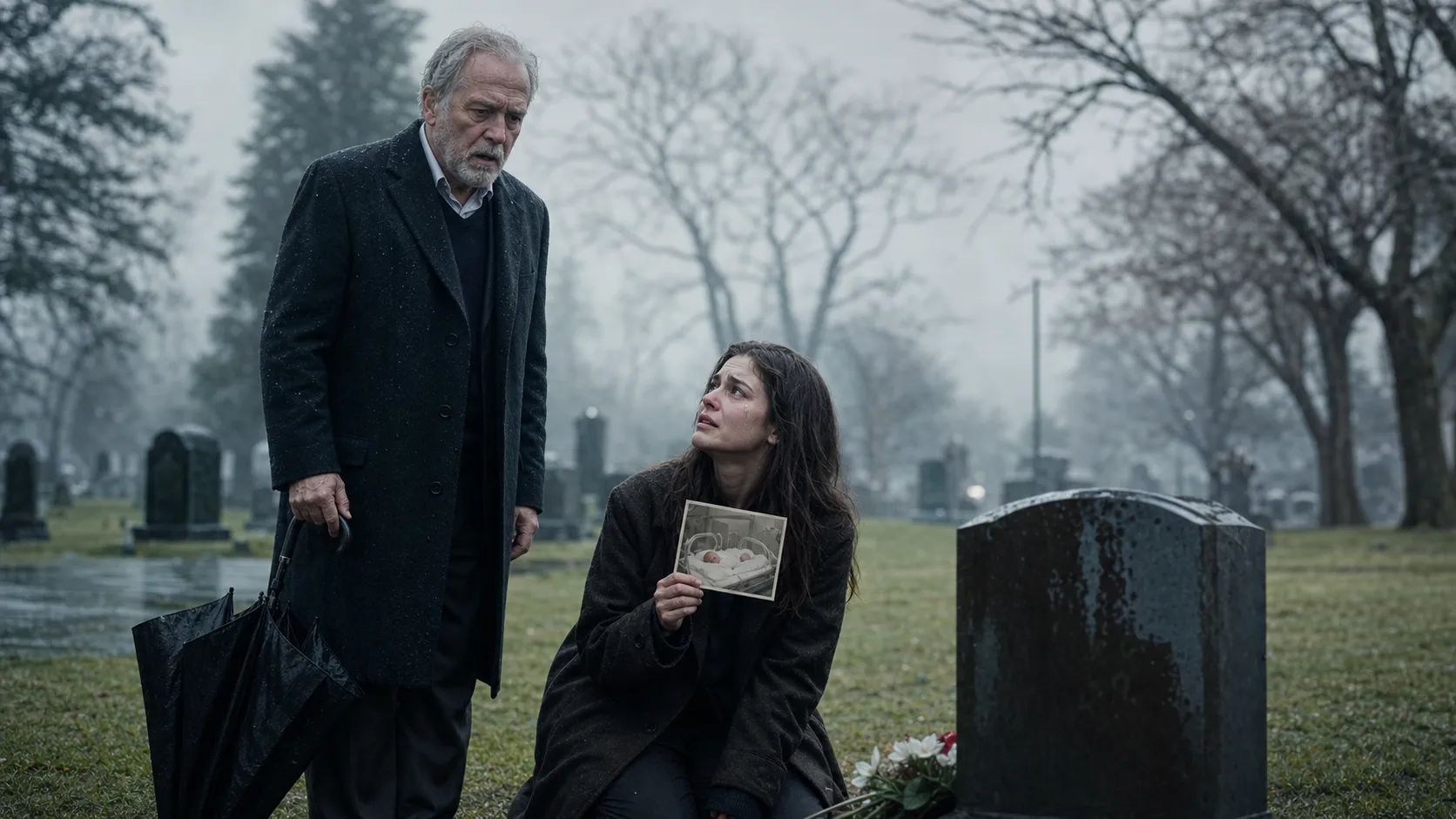
For five years, he visited his son’s grave the same way: same path, same silence, same private ritual of grief. Then one cold morning in Seattle, he found a young woman kneeling at the headstone — and when she looked up with his late wife’s eyes and whispered, “He’s my brother,” mourning turned into something even harder to survive: the discovery that he had buried one child while another was still out there, waiting to be found.
For five years, I had gone to Oakwood Cemetery the same way.
Same route.
Same umbrella.
Same silence.
Same effort to keep my hands steady until I reached the stone.
Grief had changed shape over time, but it had never left. It no longer tore through me every hour. It no longer made strangers stare when I forgot how to breathe in grocery stores or parking lots or church. It had learned to behave better than that. To sit beside me quietly. To wait. To let me function.
But every time I visited my son’s grave, it stood up again.
That morning in Seattle was cold and wet, the kind of rain that never quite commits to falling hard but never stops either. I parked farther away than usual. I told myself I wanted the walk.
Really, I think I just wanted more time before the pain became precise.
When I turned onto the path that led to my son’s headstone, I saw someone already there.
At first, I thought I was mistaken.
Oakwood was quiet, private, the kind of place where strangers didn’t wander without reason. But there she was — a young woman kneeling in the wet grass, arms wrapped around the stone as if she were holding on to something living. Her coat was too large for her, her hair damp and falling loose around her face, her shoulders bent with the exhausted collapse of someone crying long after the tears had stopped helping.
Anger reached me first.
That surprised me, but grief makes selfish creatures of us all.
This was my place.
My son.
My loss.
I moved toward her faster than I should have, my voice sharper than it had any right to be.
“Excuse me,” I said. “You can’t be here.”
She lifted her head slowly.
And my breath left me.
Her eyes were unmistakable.
Green, fractured with gold, the exact strange shade my wife Eleanor’s had been. I had looked into those eyes across hospital rooms, breakfast tables, funerals, decades of marriage, and one unbearable casket. I knew them so well that seeing them in a stranger’s face felt like being struck.
For a second, I told myself grief was distorting everything.
That I was old.
That rain does things to memory.
That pain creates ghosts where it cannot bear ordinary emptiness.
But the resemblance held.
The young woman looked exhausted, thin, no older than twenty. There was caution in her face, but not guilt. She didn’t seem like someone trespassing for thrill or cruelty. She seemed like someone who belonged there in a way I had not yet understood.
“I’m sorry,” she whispered. “I didn’t mean any harm.”
I asked her who she was.
She hesitated so long I thought she might run.
Then she said, barely above the rain:
“He’s my brother.”
The world tilted.
My son had been an only child.
That was what I had been told.
What I had believed.
What I had buried myself inside for more than twenty years.
I stared at her and heard my own voice turn hard with disbelief.
“What did you say?”
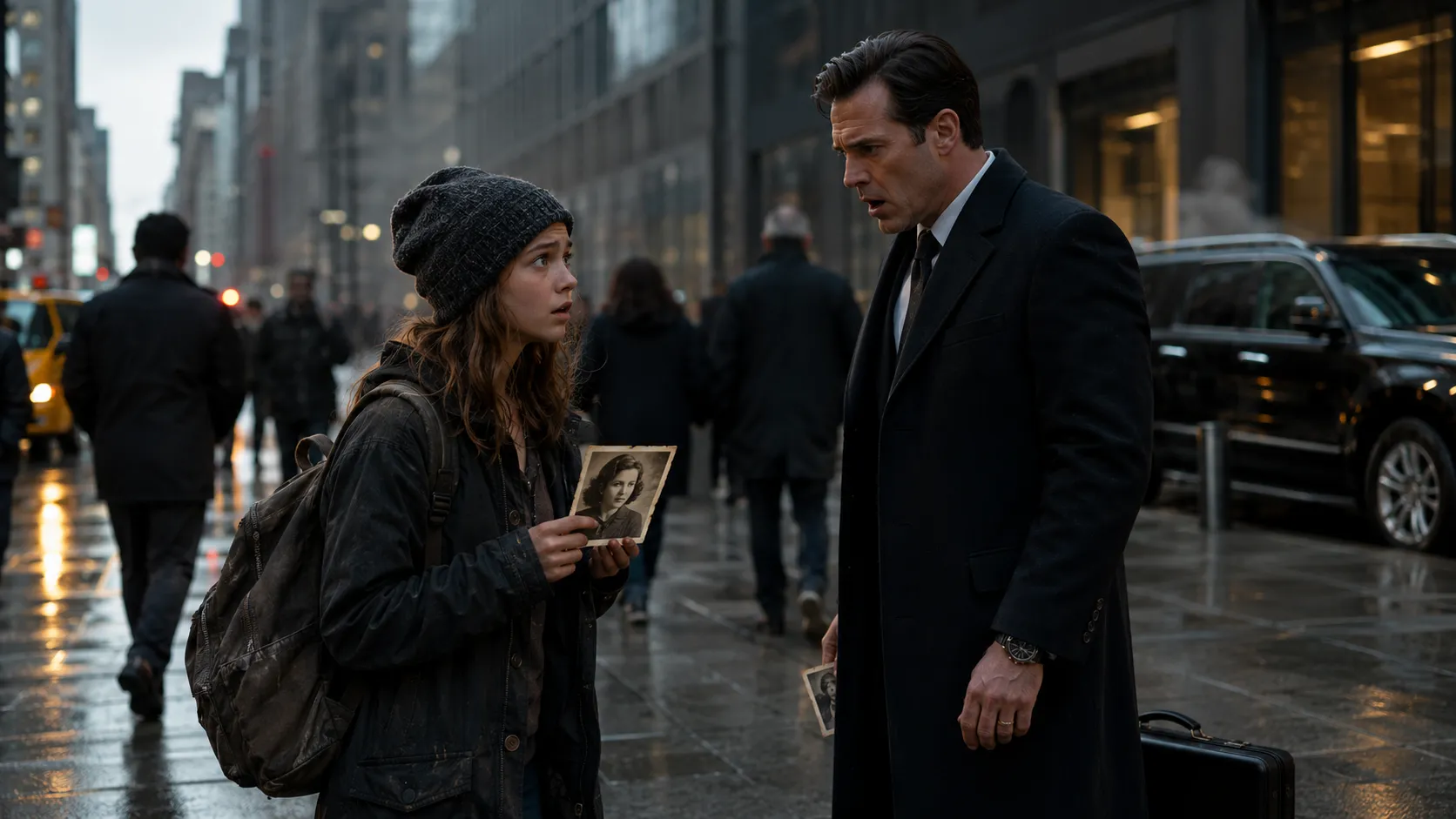
Instead of answering, she reached into her coat and pulled out an old photograph. It was bent at the corners, water-worn, carried too long in too many bad places. She handed it to me with both hands, as if it mattered enough to deserve care even now.
It was a hospital room.
A nurse stood near the bed, holding two newborns.
One wrapped in blue.
One wrapped in pink.
My knees nearly gave out.
On the back, in Eleanor’s handwriting — Eleanor’s, there could be no mistake — were words I read three times before they made sense:
My twins. Please keep them safe.
Twins.
Not one baby.
Two.
I looked up so fast it hurt.
The girl was crying again now, but quietly, like someone used to not being comforted.
“My name is Emma,” she said. “I didn’t come for money. I didn’t come to ruin anything. I just… I only wanted to say happy birthday to him.”
It was my son’s birthday.
That undid me more than the photograph had.
Because this young woman — this possible stranger, this possible daughter, this impossible answer — had come to mourn a brother she had never even met.
I asked her everything at once.
Who gave you this?
Where did you get it?
Why now?
Where have you been?
Her story came in fragments.
Foster homes.
Shelters.
Short-term placements.
A life made of moving bags and temporary beds and adults who spoke about her in rooms they assumed she could not hear. She had grown up with almost no history, only the photograph and the feeling — impossible to name but impossible to ignore — that she belonged to someone who had been erased.
She had not come to demand anything.
She had come because the photograph had led her there, and because grief, even inherited grief, sometimes pulls people toward graves before it leads them anywhere else.
I should tell you that I handled the moment well.
That I stayed calm.
That I asked intelligent questions in a measured voice and protected both of us with care.
I did none of that.
I sat down in the wet grass beside my son’s grave and cried like a man whose entire life had just been split open with one sentence.
Because grief layered itself in me all at once.
The grief for the son I had buried.
The grief for the daughter I had never known.
The grief for my wife, suddenly transformed from the woman I thought I had fully mourned into the keeper of a secret I did not yet understand.
And beneath it all, the sickening suspicion that somewhere in the collapse between birth and loss, people had made decisions about my children without ever letting me speak.
I brought Emma home that afternoon.
Not because trust was already there.
Because leaving her alone after that felt unbearable.
The first days were made of records.
Old hospital requests.
Archived files.
Birth dates.
Transfer notes.
Administrative fragments that had once meant nothing and now looked like the edges of a crime. Dates didn’t align as neatly as they should have. Signatures were missing in places where signatures should have lived. Questions that had once been dismissed during my wife’s difficult labor and the chaos that followed no longer looked harmless.
And then came the DNA test.
I already knew before it arrived.
But some truths need paper before the body can survive them.
Emma was my daughter.
The system had failed her.
People had failed her.
Silence had failed all of us.
There was no dramatic villain standing in a doorway waiting to confess. No car chase. No hidden prison. Nothing tidy enough for revenge. Just the slow, devastating realization that convenience, bureaucracy, fear, and other people’s decisions had stolen twenty years from a child and handed the rest of us a version of reality that was easier to file, easier to explain, and easier to live inside — until it wasn’t. :contentReference[oaicite:2]{index=2}
Healing did not happen because the test came back.
That part is important.
Truth is not the same thing as comfort.
Emma flinched at kindness.
Questioned every offer.
Waited for warmth to become conditional because in her life, it usually had.
I had spent years imagining what it would mean to regain something lost. I learned quickly that finding a daughter is not the same thing as knowing how to father her.
So I learned slowly.
How to ask instead of assume.
How to sit in a room without filling it with explanations.
How to hear hard things without rushing to make them easier.
How to talk about my son without turning him into a saint polished by grief.
How to talk about Eleanor without pretending I understood everything she had carried.
Emma and I spent long evenings at the kitchen table with tea growing cold between us while she told me about the life she had survived and I told her about the family she had been denied.
I told her how my son laughed.
How he hated wool socks.
How he once cried because a bird hit the window and he thought it was his fault.
How Eleanor painted in silence and sang while cooking and used to stand at the hallway mirror brushing her hair with the same distracted expression Emma wore when she was reading.
Emma listened as if every detail were food.
Sometimes she cried.
Sometimes I did.
Sometimes we only sat there because words had limits and grief was bigger than both of us.
In time, the house changed.
It did not become lighter all at once. That would be a lie.
But it became fuller.
Less museum.
Less shrine.
Less mausoleum built by one careful widower around one polished absence.
There were sketches on the kitchen table now because Emma drew when she could not speak.
There were wet boots by the back door.
There were questions in the morning and music in the late afternoon and two sets of grief moving around one another until they learned not to apologize so much for taking up space.
Months later, we went back to Oakwood together.
The rain had stopped. Sunlight moved through the trees in narrow beams, touching the wet headstones so they looked almost newly made. Emma knelt where I had first found her, but this time she was not alone.
She placed flowers beside the grave.
Then, in a voice barely stronger than breath, she whispered:
“Hi. I found Dad.”
I stood a little way back and let the moment belong to her.
That is the thing people misunderstand about closure.
They think it means finishing.
Forgetting.
Sealing pain neatly enough to place it somewhere out of sight.
It doesn’t.
Closure, if it exists at all, is smaller and stranger than that.
It is understanding.
It is context.
It is the difference between a wound that only hurts and a wound whose shape you can finally see.
I did not lose one child.
I lost two lives’ worth of time.
But I gained something too.
A daughter who survived.
A truth that surfaced at last.
A second chance I did not deserve but was given anyway.
And every time I think back to that wet Seattle morning — to the anger, the rain, the girl at the grave, the eyes that were my wife’s and not my wife’s, the two words that turned my life inside out — I know this much for certain:
love does not disappear just because it was denied a name for too long.
Sometimes it waits.
Sometimes it kneels in the rain beside a headstone.
And sometimes, when you least expect it, it looks up and says:
He’s my brother.