When I pulled into the driveway and saw my four-year-old daughter standing outside in the dark with a suitcase, swollen eyes, and the kind of grim resolve no child should ever wear, I thought something terrible had happened inside my house. I was wrong — but the mistake I made that night taught me something far more unsettling than fear: how quickly love can turn panic into a story before truth gets a chance to speak.
The sun had just slipped below the rooftops when I turned into our driveway, and everything about the evening felt wrong before I even shut off the truck.
Our house is usually messy in the ordinary way happy houses are messy. A tricycle tipped over near the garage. Chalk drawings fading into the concrete. One sock on the porch, its match nowhere in sight. Some sign that life has been happening inside whether or not anyone took the time to straighten it.
That night, everything looked too still.
Too neat.
And right in the middle of it all stood my daughter.
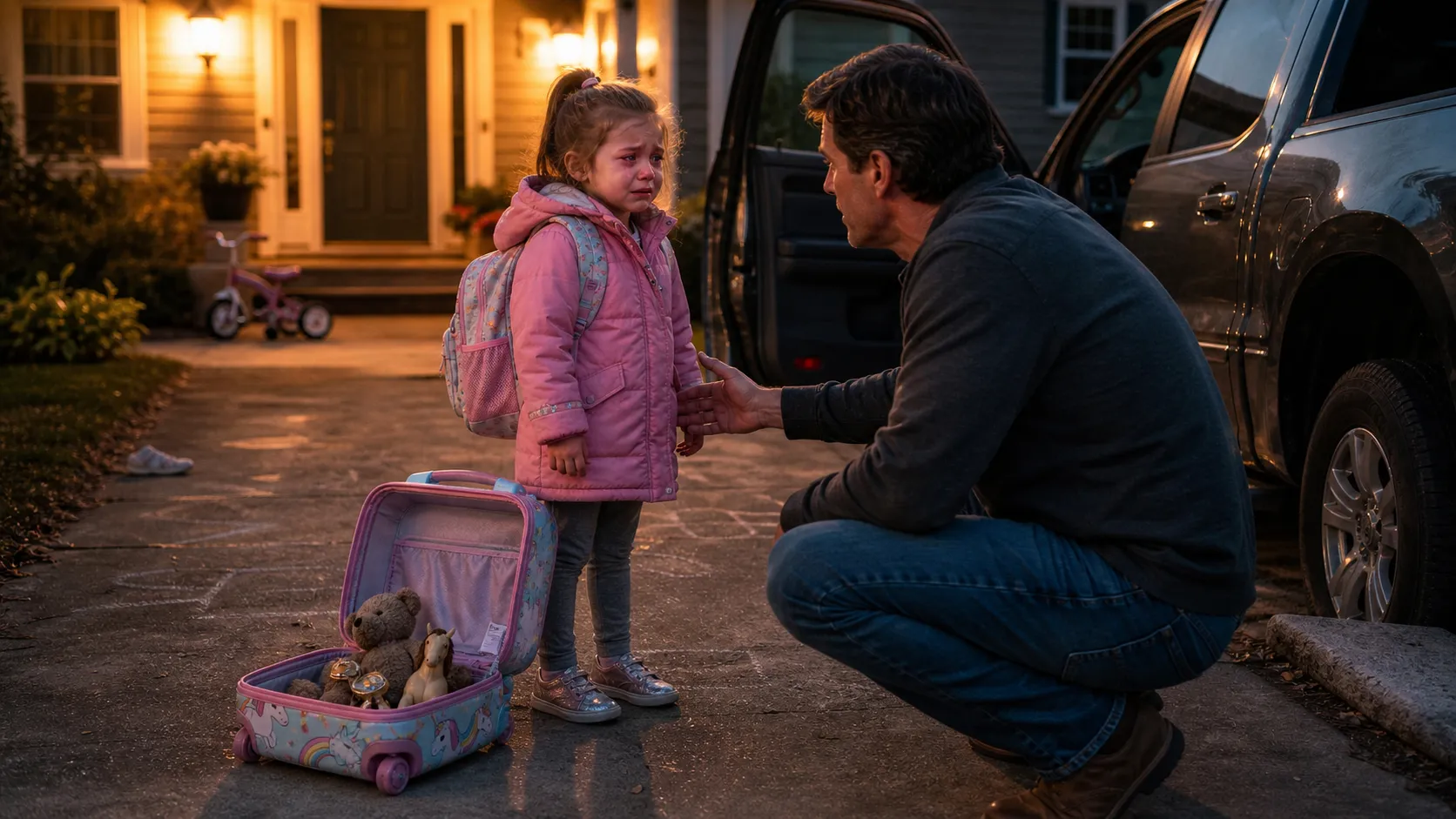
Lily was four years old, small enough that the suitcase beside her looked almost as big as she was. She wore her favorite pink coat zipped all the way to her chin, though the air wasn’t cold enough to need it. Her little backpack was stuffed so full it bulged against her shoulders. One hand gripped the handle of her unicorn rolling suitcase with the fierce determination of someone preparing for exile.
She wasn’t playing.
She was waiting.
My stomach dropped so fast it felt like missing a stair in the dark.
I climbed out of the truck without even closing the door.
“Lily?” I called, hurrying toward her. “Sweetheart, what are you doing out here?”
The porch light flicked on as I got closer, and that was when I saw her face clearly.
Her eyes were swollen.
Her cheeks were streaked with tears.
She had been crying hard — not the quick hot tears of frustration, but the long, exhausted kind that leave a child looking older than she should.
She looked at me with trembling lips and said, in a voice so small it almost disappeared into the evening:
“Daddy… I’m leaving.”
For a second, I stopped understanding language.
“What?” I asked, crouching down in front of her. “What do you mean you’re leaving? Where are you going?”
She swallowed hard and tightened her grip on the suitcase.
“I can’t do it anymore,” she whispered. “I packed my things. I have my teddy. I have to go.”
Panic shot through me so suddenly it made my hands cold.
A child doesn’t stand outside alone at dusk with a suitcase unless something is wrong. Really wrong. My mind started racing ahead of me at once — stranger danger, someone in the house, some terrible thing she didn’t know how to name, some nightmare that had already happened while I was at work and unreachable.
“Honey, you’re scaring me,” I said, fighting to keep my voice soft. “Tell Daddy what happened.”
She glanced over her shoulder at the house, and the fear in her face hit me like a punch.
Then she leaned closer and whispered, as if the walls might hear her:
“I can’t live with your wife anymore.”
My blood ran cold.
Not Mommy.
Not Mom.
Your wife.
It sounded like something much older than four. Something severed. Something final.
“You mean… Mom?” I asked.
Her little face twisted with hurt and outrage.
“Yes,” she said. “I don’t love her anymore. And I’m never going back inside.”
My chest tightened so badly it hurt.
My wife, Sarah, was the gentlest person I knew. At least I thought she was. Had I missed something? Had stress turned into cruelty while I kept telling myself everything at home was fine because I was too tired to look closely? Was this one of those moments fathers remember forever because they failed to act quickly enough?
“What did she do?” I asked, my voice barely steady.
Lily threw up both hands and let go of the suitcase. It fell sideways with a clatter against the concrete.
“She’s a monster!” she cried. “A real monster, Daddy! She’s ruining my life!”
The front door behind her suddenly looked darker than it had any right to.
I stood up instinctively and moved half in front of her.
“A monster?” I repeated. “Did she hurt you?”
“Yes!” Lily sobbed. “She hurt my heart! She won’t let me live!”
At that point I was fully inside the nightmare.
Not because her words made perfect sense, but because fear doesn’t wait for clarity. It builds its own bridge out of whatever pieces it can grab and forces you across before reason catches up. I wasn’t hearing a tired child anymore. I was hearing accusation, danger, emergency.
I looked at the house.
Then back at Lily.
Then toward the truck.
I had one thought in my head: get her out first, ask questions later.
“Okay,” I said, trying to sound calm. “Get in the truck, baby.”
Her eyes widened.
“Really?”
“Yes,” I said. “We’re going to figure this out. But first, I need you to tell me exactly what happened.”
She nodded solemnly, wiped her face with the back of her hand, and climbed into the passenger seat still wearing her backpack. I loaded the suitcase into the truck bed like it contained evidence from a crime scene.
I didn’t drive far. Just around the block, then into the empty parking lot by the closed hardware store where the streetlights buzzed and the world felt far enough away from the house for both of us to breathe.
I turned in my seat and looked at her.
“All right,” I said gently. “Start from the beginning.”
Lily took a big breath, the kind kids take when they’re trying to tell a story exactly right.
“She made me clean.”
I stared at her.
“What?”
“She made me clean,” she repeated, offended that I hadn’t understood the seriousness of this. “And she said I had to put my things away, and I said no, and then she said I couldn’t have candy if I didn’t help, and then she moved my chair, and then she said I had to take the wrapper to the trash, and then…” Her voice began to wobble again. “Then she said I had to do chores because I live there.”
I kept looking at her, my mind slowly trying to climb back down from the ceiling.
“That’s why you packed your suitcase?”
She nodded hard.
“She doesn’t love me anymore,” Lily said miserably. “She wants me to work.”
I closed my eyes.
For one second, relief hit so hard it almost felt like dizziness.
Nothing violent had happened.
Nothing monstrous.
No hidden cruelty.
No bruises.
No secrets.
No horror waiting behind the front door.
Just a four-year-old in full emotional collapse because her mother had asked her to pick up after herself and throw away a candy wrapper.
When I opened my eyes again, Lily was still watching me with tragic seriousness, completely convinced she was telling the story of her escape from a tyrant.
That was the moment my panic began turning into shame.
Because the truth was not that my daughter had lied.
The truth was that I had let my fear turn her feelings into facts before I slowed down enough to understand the difference.
I took a slow breath.
“Can I see what you packed?” I asked.
She hesitated, then dragged the suitcase toward her and unzipped it.
Inside were:
Her teddy bear.
Three rocks she liked because one looked like a heart.
A half-eaten bag of candy.
The TV remote.
A plastic horse with one wheel missing from its little wagon.
And one sock.
Not clothes.
Not food.
Not the belongings of someone planning to survive.
Treasures.
Comfort objects.
Evidence of what mattered in the emotional logic of a child.
I almost laughed then, but stopped myself. To her, this was not silly. It was enormous. To her, a chore wasn’t a chore. It was oppression. A wrapper in the trash was loss. A cleaned room was forced labor. A denied candy was proof of emotional collapse.
“Daddy,” she said quietly, “am I in trouble?”
That question broke my heart more cleanly than the suitcase had.
Because fear had done to her what it had done to me: built a world that felt real because the feeling inside it was real.
“No, baby,” I said. “You are not in trouble.”
I reached over and pulled her into my lap. She came easily, still warm from crying, still smelling faintly of crayons and strawberry shampoo.
“You know what I think happened?” I said.
She sniffled.
“What?”
“I think your feelings got really, really big. Bigger than the real problem.”
She thought about that.
Then asked, “Like a balloon?”
“Yes,” I said. “Exactly like a balloon.”
She rested her head against my chest.
“I thought I had to leave forever.”
“I know.”
“I was going to go somewhere safe.”
“Where?”
She looked up at me as if the answer were obvious.
“To Grandma’s. Or the moon. I didn’t decide.”
That nearly finished me.
I laughed then, quietly, and kissed the top of her head.
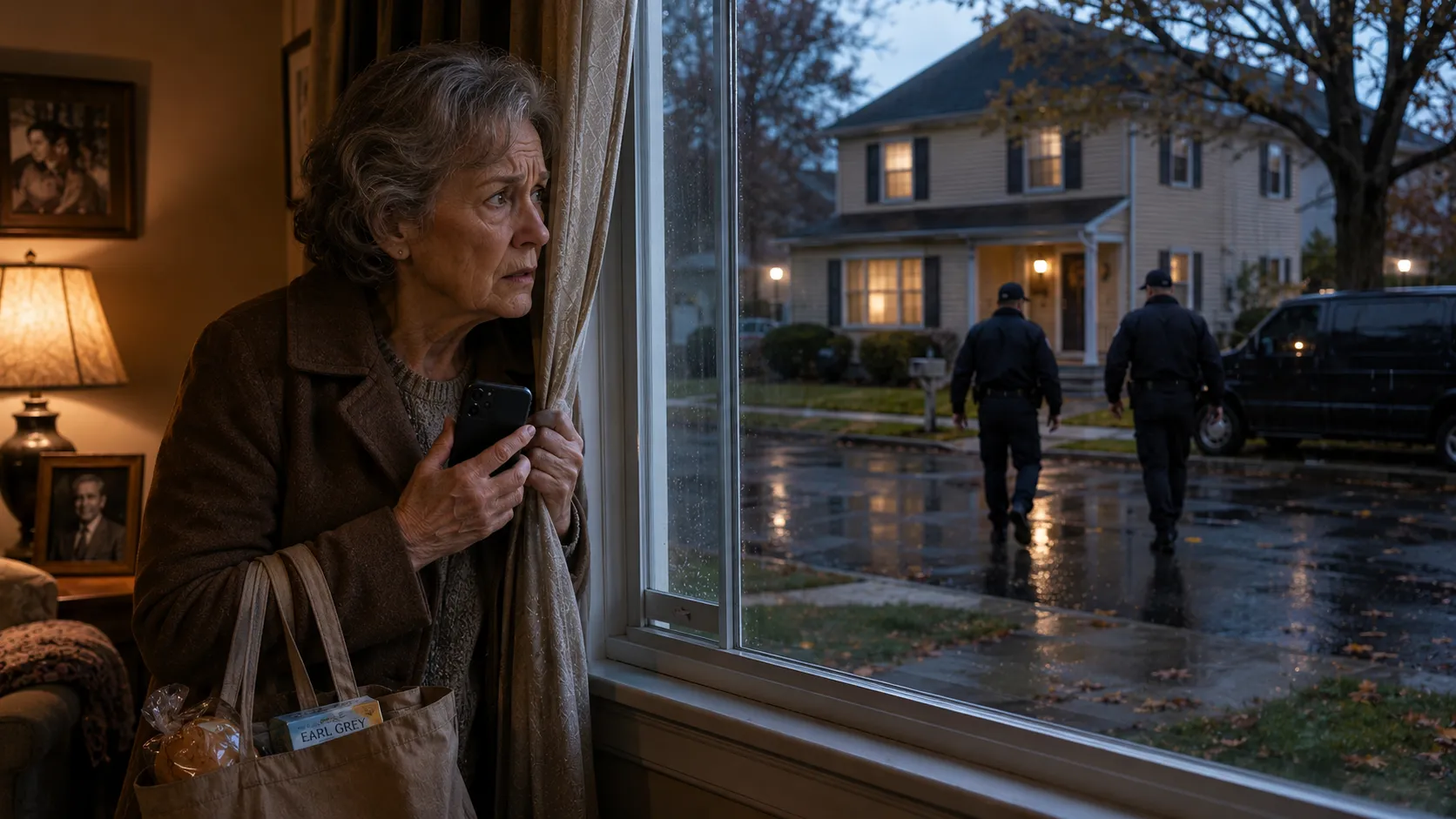
When we got back to the house, Sarah was standing in the doorway barefoot, pale with panic, one hand still holding her phone. She had been seconds from calling the police.
The moment Lily saw her, she stiffened.
I carried her to the porch and said, “Nobody’s in trouble. We just need to reset.”
Sarah looked at me, then at the suitcase, then at Lily’s blotchy little face, and understanding began arriving in painful pieces.
“She thought I was sending her away,” Sarah said softly.
Lily crossed her arms.
“You were making me clean.”
Sarah knelt down in front of us and, to her credit, did not laugh.
“Yes,” she said. “I was.”
“That’s mean.”
“A little,” Sarah admitted. “But not monster mean.”
Lily studied her.
Then, in the solemn tone of a child negotiating peace after war, asked:
“If I live here again, can I keep the rocks?”
Sarah nodded immediately.
“You can keep the rocks.”
“And have one candy?”
“After dinner.”
Lily considered this like a diplomat reviewing treaty terms.
Then she slid out of my arms and walked into the house carrying her teddy while I followed with the suitcase and a head full of humility.
That night ended quietly.
No villains.
No police.
No broken family.
Just two exhausted parents sitting at the kitchen table after their daughter finally fell asleep, both of us laughing shakily because the alternative was admitting how fast fear had taken the wheel.
I learned something that night I’ve never forgotten.
Children don’t explain the world the way adults do.
They explain it the way it feels.
And if you’re tired enough, scared enough, or guilty enough, you’ll start translating their feelings into disasters before you ever stop to ask what actually happened.
My daughter did not run from abuse.
She ran from overwhelm.
From frustration.
From the unbearable injustice of being four and asked to throw away a wrapper when your heart is still learning the difference between inconvenience and catastrophe.
And I — loving her as hard as I did — nearly turned a child’s emotional storm into a real one.
The suitcase stayed in her room after that.
For months, it became a family joke.
Whenever Lily felt wronged, she’d drag it halfway out of the closet and announce that she was “considering options.”
But beneath the humor, the lesson remained.
Love can make you reckless.
Protective.
Immediate.
Blind.
It can make you assume the worst because part of you believes that being wrong is better than being too late.
Sometimes that instinct saves lives.
And sometimes it just means you need to sit in a hardware store parking lot with a tiny girl, a suitcase full of rocks, and enough patience to let the truth become smaller than the fear.