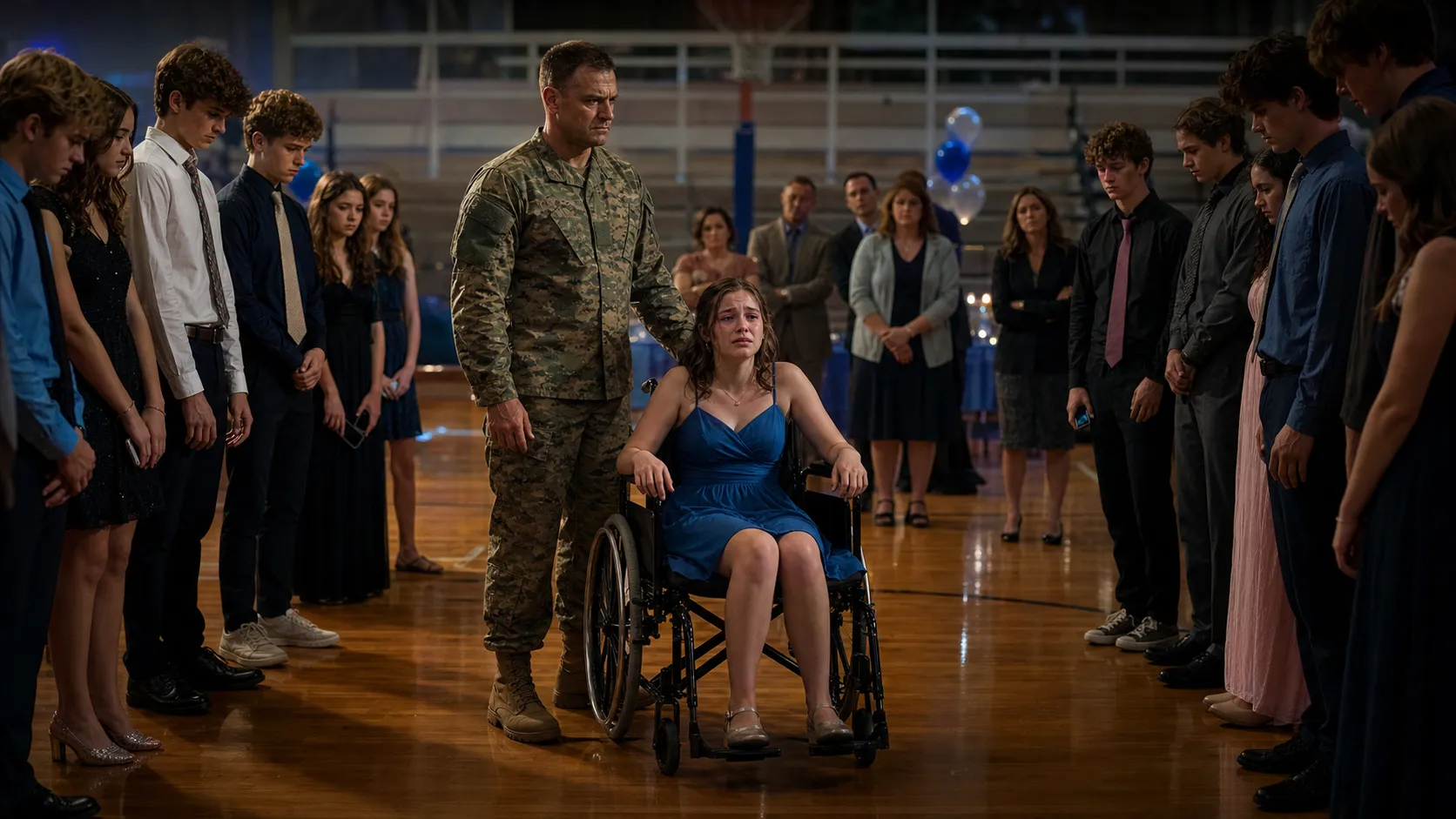
I came home from war hoping to surprise my daughter for one ordinary high-school night. Instead, from the shadows of the bleachers, I watched a pack of smiling cowards turn her wheelchair into a joke while teachers looked away and phones lit up around her like a ring of witnesses. They thought she was alone. They thought no one important had noticed. They were wrong.
I hadn’t slept in thirty-six hours when I walked into that gym.
The flight from Germany to Dallas had blurred into airport coffee, fluorescent lights, and the stale ache that settles into your bones when adrenaline has been carrying you farther than your body was built to go. By the time I reached the little Texas town where my daughter lived, my uniform was wrinkled, my boots were still carrying dust that didn’t belong to this country, and my eyes felt lined with sand.
But I didn’t care.
I had one thing in my head the whole way home:
Lily.
I hadn’t told anyone I was coming. Not my ex-wife. Not the principal. Definitely not my daughter. I wanted to see her face when she realized I was back. I wanted one clean moment before life started asking questions again — before deployment stories, doctor’s updates, custody schedules, and all the wreckage of ordinary life started pressing in.
It was homecoming night.
The parking lot outside the school was packed. Music was already pounding through the gym walls hard enough to make the air vibrate. I crossed the lot carrying all the exhaustion of eighteen months overseas and all the hope of a father who still believed he might get one good surprise before the world complicated itself again.
A volunteer mom at the ticket table looked up when she saw me.
“Sir?”
I didn’t stop walking. I only gave her the truth.
“My daughter is in there.”
Something in my voice — or maybe the uniform — told her not to ask another question.
So I slipped through the double doors and climbed into the shadows of the bleachers.
I wanted to find Lily before she found me.
That was the plan.
The gym was chaos in the ordinary American way — cheap lights, pulsing music, perfume, sweat, teenagers pretending they were too grown for nerves while still glancing around to see who was watching them. It took me a moment to spot her.
Then I did.
And the whole room changed.
She was near the edge of the floor, close to the punch table, sitting in her wheelchair in a blue dress that matched her eyes so perfectly it hurt to look at. My little girl had always had those eyes — the kind that made people think she was fine even when she was swallowing pain hard enough to split her in half.
She looked beautiful.
And she looked terrified.
At first, I didn’t understand what I was seeing.
There were five of them around her. Three girls, two boys. The type exists in every country, every school, every unit, every corner of the world where cruelty learns to dress itself as confidence. They weren’t attacking her loudly. Not yet. They were doing something uglier.
Closing in.
One joke too close.
One laugh held too long.
One circle drawn tighter with every second until she had no room left to leave with dignity.
Then one of the boys — varsity jacket, smug mouth, shoulders built more by praise than by struggle — stepped behind her wheelchair and grabbed the handles.
My hands locked around the metal railing in front of me.
“Don’t,” I whispered.
He shoved her forward.
Not toward the door.
Not out of the way.
Toward the center of the dance floor.
The others followed, laughing.
Lily tried to stop the chair, but the floor was slick and the push had too much force behind it. She spun once, almost lost control, then caught herself hard on the wheels. The crowd around them began to part, not because anyone was coming to help, but because humiliation makes room for itself.
The music kept blasting.
The lights kept flashing.
And one by one, the phones came out.
That was the moment something cold and lethal moved through me.
Not the battlefield kind.
Not panic.
Something cleaner.
Recognition.
I knew exactly what I was looking at.
A kill zone of another sort.
A public one.
The kind where the body might survive, but something inside a person gets dragged out and made to bleed in front of witnesses.
“Dance, Wheels!” one of the girls shouted.
Laughter rippled.
Lily covered her face with both hands.
Her shoulders shook.
And no one moved.
Not the teachers leaning near the far wall.
Not the parents chaperoning by the snack table.
Not the students recording it like the moment belonged to them because they had captured it.
I let go of the railing.
And I started walking.
I didn’t run.
People think rage always explodes. It doesn’t. The worst kind goes quiet. It narrows. It becomes exact.
My boots hit the bleacher steps one at a time.
Then the gym floor.
Heavy.
Slow.
Unmistakable.
The first few students noticed me from the edge of the circle. Their laughter died before their faces fully understood why. Heads began turning. Someone nudged someone else. The sound of the room changed in little fractures.
The DJ cut the music.
Now the only sound left was Lily crying softly into her hands and the measured thud of my boots crossing the floor.
The boy with the varsity jacket finally turned around.
The expression on his face changed so fast it almost looked painful.
I stopped in front of him.
Three feet away.
I could see the phone still in his hand, camera open, my daughter caught in the frame like a joke he thought he had earned.
“You think that’s funny?” I asked.
My voice wasn’t loud.
It didn’t need to be.
The whole room heard it anyway.
He tried to speak.
Nothing useful came out.
“We were just—”
“Just what?”
I took one step closer.
“Documenting your cruelty? Making sure you could replay it later? Showing the world exactly what kind of coward it takes to hunt a girl who can’t walk away?”
He stepped back.
Around him, every phone lowered.
I turned my head slowly and looked at the whole crowd.
Every student.
Every teacher.
Every adult who had watched long enough for damage to become the main event.
“Put them down,” I said.
That was all.
Phones disappeared.
Then I turned my back on the boy because he no longer mattered.
I knelt in front of Lily.
She was still trembling. Her fingers were pressed so tightly over her face that the knuckles had gone white. When I said her name, she flinched.
Then she looked up.
Saw the uniform.
Saw the name tape on my chest.
Saw me.
“Daddy?”
It came out in a whisper so broken it nearly ended me right there.
“I’m here, baby,” I said. “I’ve got you.”
She started crying harder then, not because she was more frightened, but because fear had finally found somewhere to go.
“Take me home,” she said. “Please just take me home.”
I wanted to.
God, I wanted to.
I wanted to wheel her straight out of that room, carry her to the truck, lock the doors, and take her somewhere the world couldn’t reach. But some instincts are not only about escape. Some are about witness. About refusing to let shame become private when the cruelty was public.
“I will,” I said. “But first, look at me.”
She did.
I wiped one tear from her cheek with the back of my hand.
“You did nothing wrong.”
Her mouth trembled.
“I know.”
“Hold your head up anyway.”
Then I stood.
I turned back to the room.
The principal was hurrying over now, face pale, tie crooked, too late in exactly the way institutions often are. A teacher hovered nearby with the expression of someone already preparing language about misunderstandings, escalation, and student behavior.
I didn’t let any of them start.
“My daughter,” I said, loud enough for the rafters to hear, “has spent the last six months fighting a war in a hospital bed while I was fighting one overseas. She has survived pain that would fold most of you in half. And tonight, instead of meeting that courage with respect, you turned her into entertainment.”
No one made a sound.
I looked directly at the teachers.
“You saw this.”
Then at the principal.
“You let it happen.”
Then back at the students.
“And every one of you who laughed, filmed, or stayed silent needs to understand something right now: weakness is not in that chair.”
I let that sit.
Then I stepped behind Lily and took the handles of the wheelchair.
“Move,” I said.
I wasn’t speaking to Lily.
The boy in the varsity jacket scrambled out of the way so fast he almost stumbled over his own shoes. The others split apart with him.
As I pushed her toward the exit, the gym stayed silent behind us.
Not awkward.
Not uncertain.
Ashamed.
Then, somewhere near the back wall, one pair of hands began to clap.
Softly.
Tentatively.
Then another.
And another.
It spread in uneven waves, not for me, and not out of sudden heroism, but because even a room full of frightened teenagers sometimes recognizes dignity when it sees it walking away from them.
Outside, the air was cooler.
Lily drew one long shaking breath.
“I thought nobody was going to stop them,” she said.
I crouched beside her in the parking lot, my hand still on the wheel of her chair.
“I know.”
She looked toward the gym doors, where music had not started again.
“Were you mad?”
“Yes,” I said. “But not at you.”
That mattered to her. I could see it.
Then she asked the question that broke my heart for the second time that night.
“Did I look weak in there?”
I shook my head immediately.
“No.”
She searched my face, making sure I meant it.
“You looked surrounded,” I said. “There’s a difference.”
She nodded slowly.
Then leaned toward me, exhausted now that the adrenaline was gone, and rested her forehead against my shoulder.
Later, the school called.
Then emailed.
Then called again.
Meetings were held.
Policies reviewed.
Parents apologized in voices tight with embarrassment.
Students were suspended.
Videos were deleted, or at least that was the official line.
The principal used words like accountability, failure, responsibility, safe environment.
I heard all of them.
What stayed with me wasn’t the school response.
It was Lily’s face in the center of that gym under bright lights, trying to disappear while the room watched.
And what changed me wasn’t the rage.
It was what came after.
The next week, Lily went back.
Not because she had to.
Because she wanted to.
When I asked if she was sure, she looked at me with those same blue eyes and said, “If I don’t go back, then they keep the whole story.”
That was when I understood that whatever I had brought home from war, my daughter had brought something home from that hospital too.
Steel.
Not loud.
Not theatrical.
Real.
And when she rolled back into that school, head high, shoulders straight, not hiding one inch of herself from anyone, I realized the room that night had gotten one thing wrong above all else.
They thought they were dragging a broken girl into the spotlight.
What they actually did was reveal the bravest person in the building.