My daughter had already fought harder battles than anyone in that courtyard could imagine. She showed up anyway, carrying her body carefully and her pride even more carefully, only to be met with laughter, phones, and the kind of casual cruelty people excuse because it isn’t loud. What changed everything was not rage, revenge, or a public scene — it was the moment someone finally chose not to look away.
Some days stay in your bones long after the details should have faded.
Not because of what was shouted.
Not even because of the cruelty itself.
But because of the moment you realize how much damage silence can do when it stands beside humiliation and calls itself neutrality.
My daughter Lily was fourteen the year it happened.
Before everything changed, she had been one of those girls who moved through the world as if movement itself were a language she had been born fluent in. She ran when walking would have done. She danced in the kitchen while waiting for toast. She leapt over puddles, twirled in store aisles, and treated the length of a sidewalk like it had been built for joy.
Then illness entered our life and rewrote the rules.
It did not take her mind.
It did not take her humor.
It did not take the sharp, thoughtful kindness that had always made her more observant than most adults.
But it changed the way she moved. Permanently enough that every hallway, every staircase, every crowded space became something she had to think through instead of simply entering. At fourteen, when everyone else is trying to disappear into sameness just long enough to survive adolescence, Lily had to learn how to be seen in ways she never wanted.
The hardest part wasn’t the physical pain.
It was the attention.
The glances that lingered too long.
The fake sympathy.
The way people either looked away too fast or stared as if they were entitled to a front-row seat to someone else’s adjustment.
Going back to school after months away took more courage than most people will ever understand.
The morning she returned, she stood in front of the mirror adjusting her backpack strap with steady fingers and said, almost to herself, “I’m not hiding. I want my life back.”
I nodded.
What else was I supposed to do?
Encourage her?
Protect her?
Warn her?
Promise the world would be kinder than I knew it often was?
So I did the only honest thing I could. I kissed the top of her head and told her I was proud of her.
All day I carried the unease anyway.
At work, I kept checking my phone more often than a reasonable person should.
I replayed her face at breakfast.
The brave voice.
The careful way she had walked out the front door.
The fact that courage in children never looks as strong to them as it does to the adults who love them.
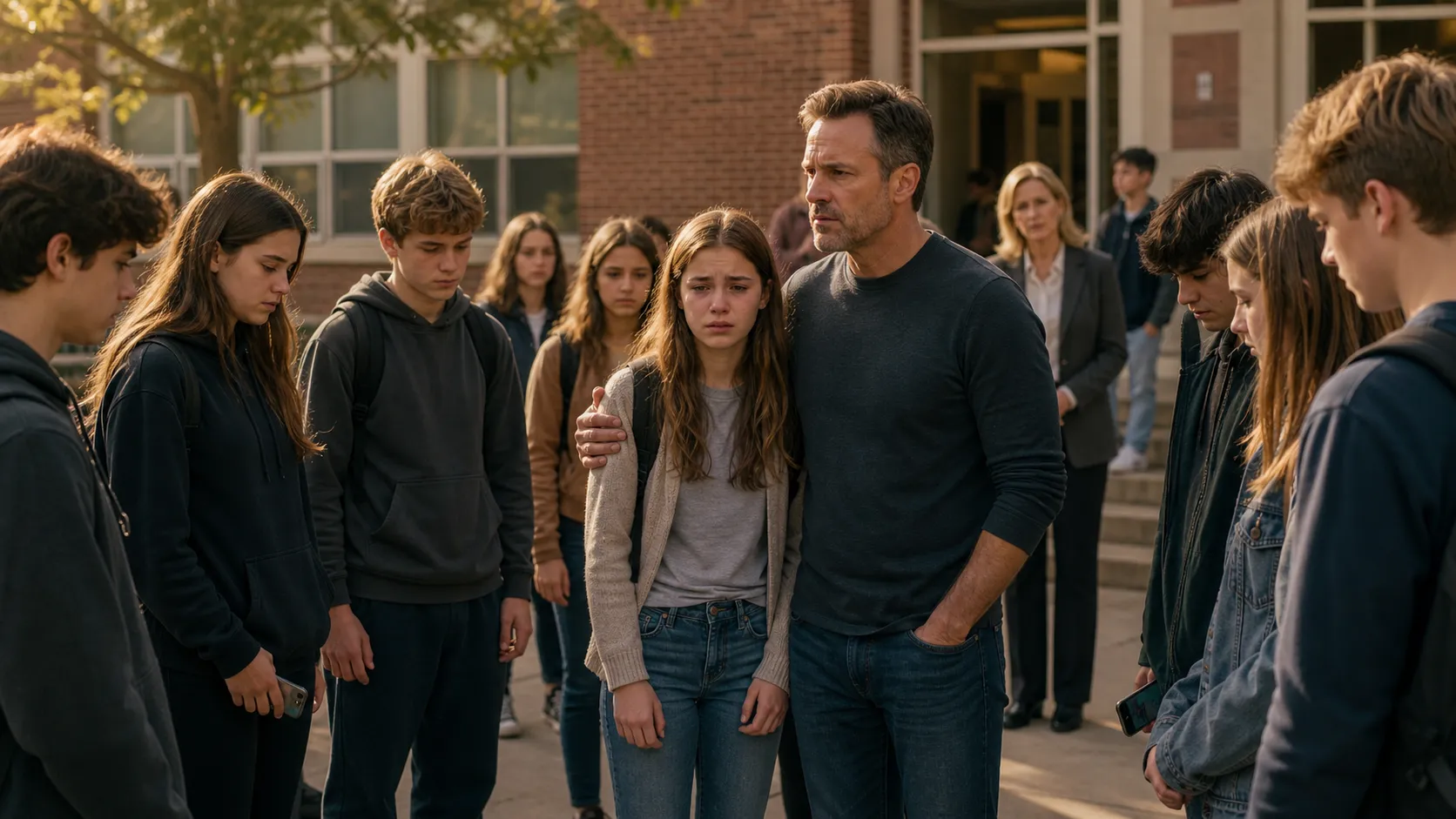
That afternoon, when I reached the school, the courtyard was full.
Clusters of students.
Backpacks on shoulders.
Phones in hands.
Laughter, sunlight, restless after-class energy.
At first glance it looked ordinary.
Then I saw Lily.
She was standing near the center path, completely still.
Not resting.
Not waiting.
Not scrolling through her phone or talking to a friend.
Frozen.
That kind of stillness has its own shape when you know your child well enough. It is the stillness of someone trying not to let the moment get bigger than they can survive.
There were four students around her — not close enough to look openly aggressive, not far enough to be innocent. Two girls. Two boys. All of them wearing the careless expressions of people who believe the room will protect them because what they are doing is not dramatic enough to count as violence.
One of them said something.
I was too far away to hear the words.
But I saw the reaction.
A couple of nearby students laughed.
Another lifted a phone slightly higher.
Someone pretended not to notice while clearly noticing everything.
Lily didn’t answer.
That hurt more than if she had cried immediately. Because I knew what that silence cost her. It meant she was trying to endure it. Trying to make herself smaller. Trying to wait for it to pass without feeding it.
Another comment came.
Then another.
Not shouted.
Not cinematic.
Just dismissive enough to be deniable later.
That is how a lot of cruelty survives in public. It hides inside tone. Inside half-smiles. Inside the ugly confidence of people who know adults are nearby and no one wants to make things “bigger than they are.”
What hurt most was not them.
It was everyone else.
The watchers.
The ones recording.
The ones glancing over, understanding perfectly well what was happening, then choosing comfort over interruption.
Lily lowered her eyes.
I saw her press her lips together.
Saw her shoulders tighten.
Saw the terrible effort it took for her not to give them what they wanted.
I did not run.
That matters to me now.
Not because running would have been wrong, but because by the time I reached her, I understood something clearly: this moment did not need more chaos. It needed one adult willing to enter it without fear.
So I walked straight through the courtyard.
The students around her noticed me first, then the others did, then the energy changed in small visible cracks. One phone lowered. One laugh died unfinished. One of the boys shifted backward. The oldest teacher on duty, who had somehow missed the obvious until then, finally looked up sharply from his conversation near the steps.
I went directly to Lily.
I didn’t glare first.
I didn’t shout.
I didn’t ask anyone what was going on before checking the only person in that courtyard who actually mattered.
I knelt in front of her so we were eye level.
“Are you okay?” I asked.
She nodded, but only barely.
Her face was composed in the way children’s faces sometimes are right before they break — too still, too careful, all the feeling jammed behind the eyes where pride is making a last stand.
That was enough.
I stood up and turned toward the group.
“This ends now,” I said.
I didn’t raise my voice.
I didn’t have to.
The kind of authority that matters in moments like that does not come from volume. It comes from moral clarity so clean that nobody can mistake what side of the line you are standing on.
The space changed immediately.
One of the girls crossed her arms, pretending boredom.
One of the boys looked at the ground.
The teacher began moving toward us at last, too late and knowing it.
A phone disappeared into a pocket.
I looked at all of them — the students involved, the ones who watched, the adults who should have reached the moment before I did.
Then I said the thing I most needed the room to hear.
“She should not have had to stand here alone.”
No lecture.
No performance.
Just the truth.
And because it was the truth, no one argued.
The teacher finally stepped in and separated the students.
An administrator was called.
Names were taken.
Phones were lowered for good this time.
The crowd began to dissolve, not because they suddenly understood courage, but because accountability had entered the space and made spectatorship less comfortable.
Lily was still trembling when I turned back to her.
“Come on,” I said softly.
She looked at me, searching my face for pity. Children hate pity almost as much as humiliation.
So I gave her none.
I offered her my arm the same way I would have before any of this — normal, steady, available. She took it.
And together we walked out of the courtyard.
Not fast.
Not hiding.
Not as if we were fleeing a defeat.
We walked like people who belonged there.
The next few days were full of meetings.
The school called.
Policies were reviewed.
Teachers apologized in language polished enough to sound institutional and sincere at the same time.
Conversations were had about student conduct, supervision, responsibility, social climate, restorative process, safe reentry, support.
Some of it mattered.
Some of it was paperwork wearing empathy as a tie.
But one thing did happen that was real:
the school was forced to stop pretending that meanness only counts when it is loud.
Lily was offered support.
The students involved faced consequences.
Adults became more visibly present.
Not because systems suddenly developed hearts, but because embarrassment had finally forced them to acknowledge what should have been obvious from the start.
That evening at home, I found Lily sitting at the kitchen table tracing circles in a ring of spilled sugar with one fingertip.
I asked if she wanted to stay home the next day.
She looked up at me for a long moment.
Then she said, “If I don’t go back, then they get to keep the whole story.”
I stared at her.
And in that instant, I understood that my daughter had traveled somewhere in those months of pain that I, as her parent, would never fully be able to follow. She had learned something fierce and lonely and mature about dignity. Something I wished life had never needed to teach her so soon.
The next morning, she went back.
I drove her to school and parked longer than necessary, pretending to check a message just to watch her cross the sidewalk.
She moved more slowly than she used to. She probably always would.
But she moved without apology.
When she entered the same courtyard, people looked up.
Of course they did.
That part doesn’t change quickly. People always look.
But this time nobody laughed.
One girl near the bench gave a small nod and said, “Hey, Lily.”
A boy she barely knew held the door open without making it weird.
Someone smiled.
Someone moved aside.
Someone, somewhere, had learned something.
Not enough.
Maybe never enough.
But something.
That afternoon she got in the car and said, “It was quieter today.”
And I knew exactly what she meant.
Not silent.
Different.
Safer.
Years from now, I probably won’t remember every face from that courtyard. I won’t remember which student said what, or which teacher looked away first, or which administrator chose what phrasing in which meeting.
But I will remember this:
kindness is not proven when everyone is comfortable.
It is proven in the exact second discomfort begins and someone decides whether to step closer or stay back.
My daughter taught a whole community that lesson by simply showing up.
And what happened next changed more than one school day.
It changed the way people in our town understood what looking away really costs.