It should have been an ordinary Tuesday lunch: pancakes, burnt coffee, and the familiar routine of helping an aging father keep a little dignity in public. Then one trembling hand, one splash of syrup, and one cruel slap turned the whole diner into a courtroom — and for once, the room chose not to look away.
The hardest part of watching your father age is not the gray hair.
It is not the slower walk, or the careful way he lowers himself into a booth, or even the long pauses between movements that used to come naturally.
It is the betrayal.
The moment his body stops cooperating with the man he still is inside.
My father, Arthur, was eighty-one the day it happened.
He had worked most of his life on factory floors, raised a family, paid his bills, and carried himself with the quiet pride of a man who never needed applause to know his worth. He was not loud. He was not showy. But he was solid — the kind of man who fixed things, showed up, and never asked much from the world except the right to stand on his own feet.
Parkinson’s had been taking that from him inch by inch.
Every Tuesday, we ate lunch at the same diner.
Same booth.
Same waitress.
Same tired coffee.
Same little routine we both pretended was ordinary, even though every week required more patience than the one before.
That afternoon, his hand was shaking harder than usual.
He reached for the syrup bottle, jaw set, eyes narrowed in concentration. I could tell before he even touched it that this was one of those moments where helping would feel like an insult and not helping would feel like cruelty.
“I’ve got it,” he muttered.
“I know, Dad,” I said softly.
The bottle slipped.
Not far.
Not dramatically.
Just enough.
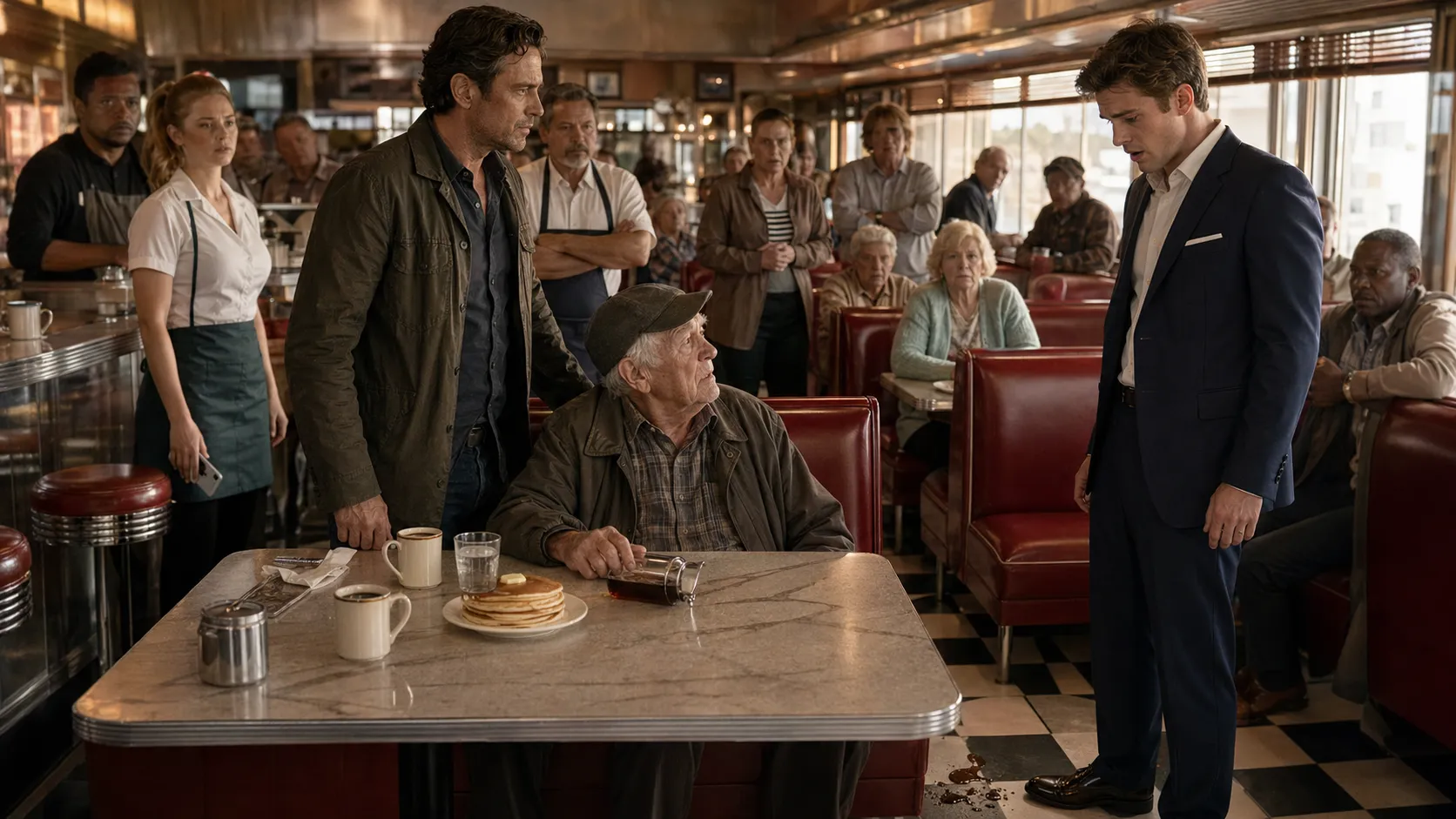
The syrup didn’t land on his pancakes. It tipped sideways, splashed across the edge of the table, hit the floor — and caught the polished shoe of a young man standing nearby.
The diner went silent.
My father froze with the bottle still half in his hand, eyes wide with the awful, immediate shame of a man whose illness had just exposed him in public.
“Oh no,” he said quickly, already reaching for napkins. “I’m so sorry. My hand…”
The young man looked down at his shoe.
Then at my father.
And something ugly lit up in his face.
“Are you serious?” he snapped.
He was young, sharply dressed, expensive in every visible way. Crisp shirt. Costly watch. The kind of polished anger that comes from a life where inconvenience is treated like personal insult. He looked at the syrup on his shoe as if my father had attacked him.
“Do you know how much these cost?” he demanded.
My father stood halfway up, bent and unsteady, trying to wipe at the mess with a napkin that was already dissolving in his shaking hand.
“I’ll pay,” he said quickly. “I can pay for the cleaning.”
The young man stepped closer.
Too close.
“You shouldn’t even be out in public like this,” he said. “You’re a mess.”
I stood then, but not fast enough.
Because before I could say a word, before my father could even fully straighten, the young man lifted his hand and struck him across the face.
The sound cracked through the diner.
Sharp.
Clean.
Final.
My father’s cap fell to the floor. He collapsed back into the booth with one hand pressed to his cheek, stunned not by pain so much as by humiliation.
No one moved at first.
No one spoke.
The whole room seemed to freeze around the fact of what had just happened.
And that, maybe, was the worst part — not the slap itself, but the half second afterward when shame tries to settle in like law.
Then I stood fully.
Not shouting.
Not rushing.
Not throwing a punch.
Just standing.
“That was assault,” I said.
The young man scoffed, still riding the last of his own outrage.
“Mind your business.”
But the room had already begun to change.
The waitress had a phone in her hand.
The manager was coming around the counter.
A couple at the far booth stood up.
Two men by the window stepped closer, not aggressive, just present — witnesses choosing not to disappear.
The young man felt it.
That shift.
The one that happens when cruelty stops being entertainment and starts becoming evidence.
The manager pointed toward the door.
“You need to leave,” she said. “Now.”
He laughed at first.
Then he saw no one was laughing with him.
Not the waitress.
Not the customers.
Not me.
Not even the girl he had walked in with, who now looked at him as if she had just seen something she could never unsee.
Phones were out.
People were watching.
And outside, faint but growing louder, came the sound of approaching sirens.
The confidence began draining from him.
Police arrived within minutes.
They listened.
They asked questions.
They looked at the footage.
And the story, once it had witnesses, became very simple.
A sick old man spilled syrup.
A cruel young man chose violence.
A room full of strangers refused to let him rewrite what happened.
They led him out quietly, without drama, without spectacle, without the dignity he had denied my father.
Paramedics checked Arthur.
He waved them off, embarrassed still, his hands shaking harder than ever.
Not from Parkinson’s that time.
From the pain of having his weakness turned against him in public.
We sat there for a long while after the room slowly began breathing again.
Coffee poured.
Plates clinked.
People returned to their booths, though nobody quite returned to normal.
My father stared at the tabletop and finally said, “I hate that you saw that.”
I looked at him for a long moment.
“I’m glad I did,” I said. “Because it stops now.”
He nodded once.
And for the first time since the syrup spilled, his eyes were steady.
The diner eventually went back to being a diner.
The coffee stayed bad.
The pancakes stayed too big.
The Tuesday crowd kept coming.
But something had changed in that room.
Not because a rich young man got dragged out by police.
Because everyone there saw what happens when arrogance collides with accountability.
And my father?
He still shakes.
But after that day, no one ever touched his dignity again.