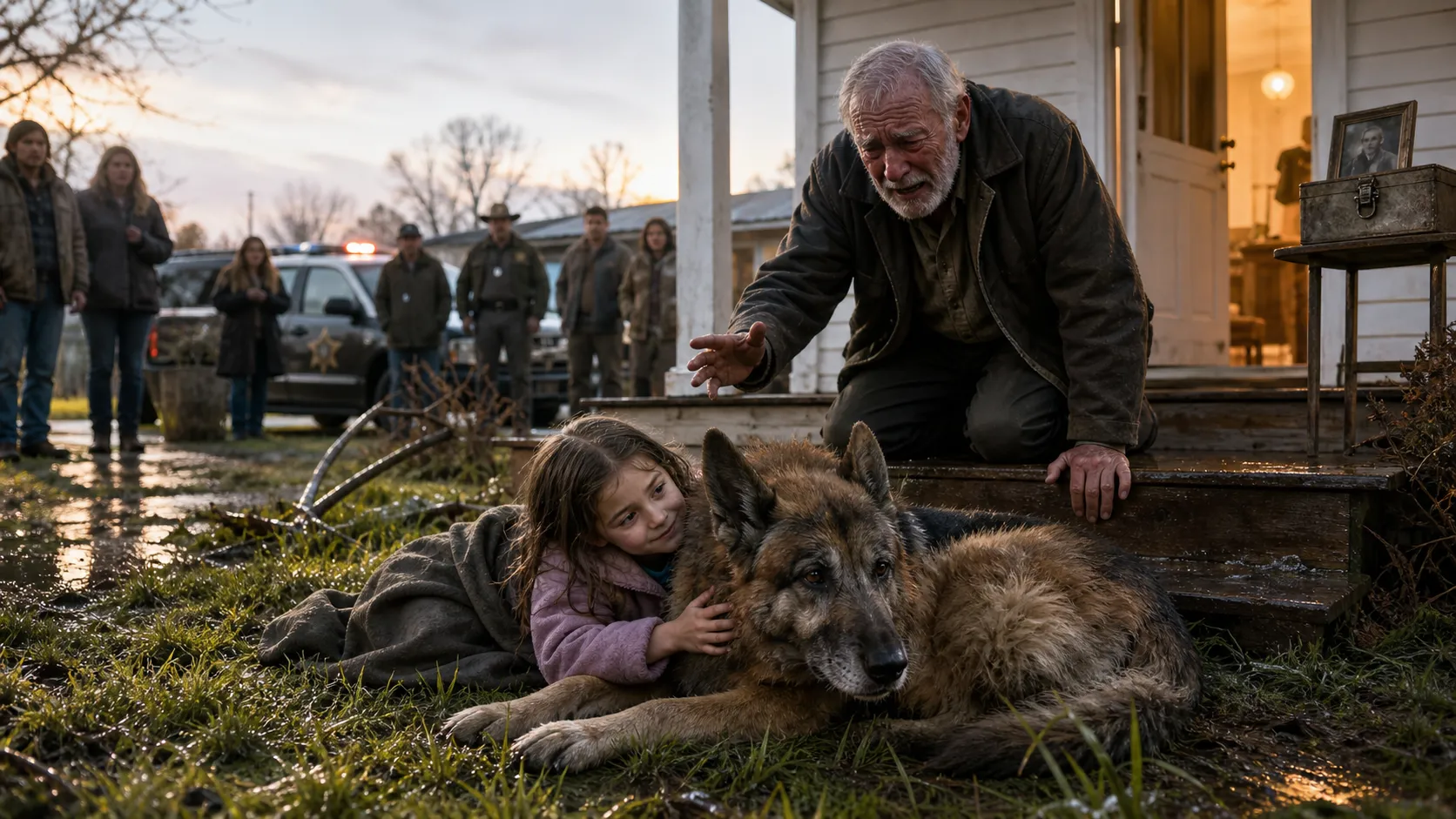
Henry thought he was taking home an old dog no one else wanted. He never imagined the dog would dig up a buried piece of his past in the middle of a storm — and before dawn, save a life that changed the entire town forever.
Henry Calloway was seventy-eight years old when he brought the dog home.
He had not gone to the shelter looking for a miracle.
He had gone there because the house had become too quiet, and quiet, after a certain age, can begin to sound like surrender.
His wife Margaret had been gone for three years. The little white farmhouse at the edge of town still held her shape in a hundred painful ways — the apron hanging behind the pantry door, the teacup with the faded blue roses, the half-finished crossword folded beside her armchair. Henry had stopped moving those things. It was easier to let grief settle into the furniture than to admit he did not know how to live around the empty spaces.
The county shelter sat just beyond the feed store, a low brick building with peeling paint and a hand-lettered sign about adoption hours. Henry had only meant to drop off two old blankets and a bag of unopened dog food Margaret had bought years before “just in case they ever got one.”
He never meant to leave with a dog.
But then he saw him.
In the last kennel, lying on a threadbare blanket, was an old German Shepherd with a gray muzzle, cloudy eyes, and ribs that showed too clearly through thinning fur. One ear stood up, the other folded halfway down. His body looked tired, but his gaze did not. Even from across the room, the dog watched Henry with the strange, patient attention of a soul that had already made up its mind about something.
A volunteer came up beside him.
“His name’s Shadow,” she said softly. “He was picked up on the highway. Nearly blind. Arthritis in both hips. Heart murmur. Nobody wants a dog that old.”
Henry looked down at the paper clipped to the kennel.
SENIOR.
MEDICAL NEEDS.
LOW ADOPTION PROBABILITY.
Below that, in smaller writing:
FINAL REVIEW: TOMORROW.
Henry didn’t need anyone to explain what that meant.
The dog pushed himself up slowly. Painfully. Then he walked to the front of the kennel and stood there, quiet, steady, waiting.
“How much?” Henry asked.
The volunteer hesitated. “Sir… the adoption fee is usually—”
Henry reached into his wallet and counted what he had.
A five-dollar bill.
Two singles.
Some change.
He looked embarrassed before he even finished pulling it out.
“This is all I’ve got on me,” he admitted. “Five dollars and some coins.”
The volunteer smiled sadly. “He’ll need medicine. Special food. He may not have much time.”
Henry looked at Shadow again.
Neither of them were what they used to be.
Neither of them had much time guaranteed.
Neither of them had anyone waiting at home.
“That’s all right,” Henry said. “I don’t need much time. I just don’t think he should spend whatever’s left alone.”
The volunteer said nothing for a moment.
Then she unlatched the kennel door.
“Five dollars is enough.”
That was how Shadow came home.
At first, the dog did not do much.
He slept near the wood stove.
Drank slowly.
Ate like someone who had learned not to expect seconds.
When Henry spoke to him, Shadow listened with one tilted ear, as if filing every word somewhere important.
And Henry, without meaning to, began speaking more than he had in months.
He told Shadow about Margaret.
About the arthritis in his own hands.
About how the tomatoes had not grown right since she died.
About the little town they had lived in for forty-two years.
About the oak tree in the backyard that Margaret had loved because it turned gold in the fall and made the whole yard look blessed.
Shadow followed him everywhere.
Slowly.
Stiffly.
Faithfully.
When Henry sat on the porch, Shadow sat beside him.
When Henry boiled soup, Shadow lay in the kitchen doorway.
When Henry woke in the night and could not bear the silence, he would look down and see the old dog sleeping near his bed, and somehow the dark felt less endless.
For the first time since Margaret’s funeral, Henry started leaving the radio on during the day.
He even laughed once, quietly, when Shadow stole half a slice of toast and looked proud of it.
Weeks passed.
Then came the storm.
It rolled in just after dusk, low and mean, dragging black clouds over the fields and making the windows rattle in their frames. Rain smacked hard against the porch roof. Wind moved through the trees with a sound like something searching.
Henry had just latched the back door when Shadow began barking.
Not the bored bark of a dog wanting out.
Not the anxious bark he gave at thunder.
This was different.
Insistent.
Focused.
“Settle down,” Henry muttered. “Ain’t nobody out there but rain.”
But Shadow wouldn’t stop.
The old dog paced, then shoved his nose against the back door, whining low in his throat. When Henry opened it a crack, Shadow slipped past him and disappeared into the yard.
“Shadow!” Henry shouted. “Come back inside!”
Lightning flashed.
For a second, the whole backyard turned white.
Henry saw the dog beneath the oak tree, digging.
Not clumsy scratching. Not play.
Digging with purpose.
Dirt flew behind him in wet clumps. His old paws tore into the earth as if something under those roots mattered more than the storm crashing around them.
Henry grabbed his coat and hurried outside, rain soaking him before he was halfway across the yard.
“Shadow, what on earth are you doing?”
Another flash of lightning split the dark.
This time Henry saw it.
A small rusted metal box, half-buried among the roots.
Shadow stepped back, panting.
Henry knelt in the mud with trembling hands and pulled the box free.
It was heavier than it looked. The lid fought him at first, then gave with a rusty snap.
Inside, wrapped in faded cloth, was an old photograph.
Henry stared at it and forgot the storm.
It was him.
And Margaret.
Forty years younger, standing beneath that same oak tree. Margaret was laughing with her head turned toward him, one hand pressed against his chest. He remembered the day instantly — their fortieth anniversary picnic, the summer before her heart started failing, when she insisted on taking photographs even though Henry had complained they already had plenty.
Under the picture was a folded note in Margaret’s handwriting.
Henry unfolded it carefully, afraid the paper would disintegrate in the rain.
It said:
If you ever find this again, it means life has gone on farther than we imagined.
And if I’m not there with you, don’t spend your days waiting for the world to end.
Love is not only what we lose.
Sometimes it comes back wearing another face.
Let it in.
Henry’s vision blurred.
For a long moment, he couldn’t move.
Then Shadow came closer, pressed his wet head gently against Henry’s knee, and stood there in the storm as if he understood every word on the page.
Henry laid a shaking hand on the dog’s head.
“Where did you find this?” he whispered.
Shadow wagged his tail once.
And there, under the oak tree, with thunder rolling over the fields and Margaret’s handwriting trembling in his hands, Henry understood something that broke his heart open in the gentlest possible way.
This dog hadn’t come to be saved.
He had come to save him.
That night, Henry dried the photograph, set the box on the mantel, and fed Shadow an extra piece of chicken from his own supper. The dog ate it slowly, then curled up by the stove as if nothing extraordinary had happened.
Henry slept more peacefully than he had in years.
At dawn, he woke to silence.
No soft dog-breathing by the stove.
No scrape of claws on old wood.
No Shadow.
Henry sat upright.
The back door stood slightly open.
Panic hit him fast and hard.
“Shadow?”
He pulled on his boots with fumbling hands and hurried through the house.
“Shadow!”
No answer.
The yard was wet and silver under the early morning sky. The storm had moved on, leaving branches down and puddles shining in the road. Somewhere in town, sirens wailed.
Henry stepped onto the porch—and froze.
At the bottom of the steps, curled against the railing in a patch of muddy grass, lay Shadow.
And tucked against his side, wrapped in the dog’s body like a blanket, was a little girl.
She could not have been older than six.
Her hair was wet. Her pink pajama sleeve was torn. One sneaker was missing. But she was breathing.
Shadow lifted his head weakly when he saw Henry.
The old dog’s coat was soaked through, spattered with mud and burrs, and one paw was bleeding.
“Lord above,” Henry whispered.
He rushed down the steps and dropped to his knees.
The little girl opened her eyes first.
They were huge and frightened.
“It’s okay,” Henry said at once. “You’re safe now, sweetheart. You’re safe.”
She clutched at Shadow’s fur.
“The dog found me,” she whispered. “I got lost in the storm.”
By then the sirens were closer.
A sheriff’s SUV turned onto Henry’s lane, followed by two pickup trucks and half the town behind them. Everyone had been looking for little Emma Burke since midnight. She had wandered from her grandmother’s house during the blackout, and the search had gone on all night through rain and wind and rising panic.
When Emma’s mother jumped from the truck and saw her daughter alive on Henry’s lawn, she made a sound no one there would forget.
She fell to her knees in the mud, gathered Emma into her arms, and cried so hard she could barely speak.
People crowded the yard.
The sheriff.
Neighbors.
Volunteers from the church.
A reporter who had been following the search.
And then they all saw Shadow.
The nearly blind old shelter dog.
The one everyone would have called unadoptable.
The one Henry had taken home for five dollars.
Emma, still trembling, pointed at him and said, “He stayed with me when I was scared. He laid on me when it got cold. Then when the rain stopped, he kept pushing me to walk. He brought me here.”
The yard went silent.
Even the sheriff took off his hat.
“What kind of dog is that?” someone whispered.
Henry looked at Shadow, who was trying to lift his head again despite obvious pain, and felt his throat tighten.
“The best kind,” he said.
The vet came next.
Shadow had a strained leg, a cut paw, and pure exhaustion, but he was alive.
By noon, the whole town knew the story.
By evening, the local diner had put up a handwritten sign:
COFFEE FUND FOR SHADOW THE HERO DOG.
By the next day, the story had spread beyond town limits.
The shelter volunteer came to Henry’s house with tears in her eyes and a bag full of prescription food, medicine samples, and envelopes stuffed with donations.
“I guess five dollars turned out to be the bargain of the century,” she said, smiling through tears.
Henry laughed then.
A real laugh.
The kind that reaches the chest before the face.
Emma visited every Saturday after that.
She always brought Shadow something — a biscuit, a ribbon for his collar, a hand-drawn picture. Henry kept every drawing in the rusted box on the mantel, right beside the photograph of him and Margaret.
One afternoon, months later, Henry sat beneath the oak tree with Shadow sleeping against his boot and the box open in his lap.
He looked at Margaret’s note again.
Love is not only what we lose.
Sometimes it comes back wearing another face.
He smiled slowly, then added something new to the box:
a fresh photograph of himself, Shadow, and Emma standing on the porch together, all three looking a little surprised by happiness.
Then he folded a note of his own and placed it beneath the picture.
You were right, Maggie.
It came back.
When he closed the box this time, he did not bury it again.
Some things are not meant to be hidden.
And in that small town, people never forgot the lesson an old dog had taught them:
Sometimes the life everyone overlooks becomes the one that saves everything.